The Emotional Rollercoaster of Calculus: Mean vs. Nice Value Theorems
Why is this Mathematics meme funny?
Level 1: Mean vs Nice
Think about the word “mean.” It has two meanings: one is an average (like the mean of 4 and 6 is 5), and the other is not nice or unkind (like a mean person who is angry or cruel). This meme makes a joke by mixing up those meanings. In math, the Mean Value Theorem is a serious rule that uses the word “mean” to talk about an average value. But the meme pretends “mean” is describing a mood. So it draws a curved line as a face that looks mean and angry for the “Mean Value Theorem.” The curve even has angry eyebrows and eyes, making the shape look like a little frowning face! Now, if one is mean, what’s the opposite? Nice. So the meme invents a fake “Nice Value Theorem” and draws another curve as a nice, happy face. This second curve has kind-looking eyebrows and a big smile-like arc. It’s completely made-up – there’s no actual “Nice Value Theorem” in math – and that’s why it’s funny. It’s as if the first math rule was being grumpy, so the second one decided to be friendly.
Imagine a teacher talking about an “average value” and a kid in class doodles a grumpy face because they heard the word “mean.” It’s exactly that kind of silly literal misunderstanding. The humor is that we don’t normally attribute human personalities to math theorems – they’re just facts, they don’t have feelings – but here we’re joking that one theorem is mean (so it gets a mean face) and if there were a nice version, it’d get a smiley face. It’s a simple word play: mean vs nice. Even the shape of the graph helps the joke: one curve bends downward like a frown, and the other bends upward like a smile. By turning graphs into little cartoon faces, the meme makes a dry math idea feel like a funny comic. You don’t need to know the calculus details to giggle at an angry-looking graph next to a happy-looking graph. The core of the joke is that a single word (“mean”) can mean two very different things, and the meme flips from the math meaning to the everyday meaning to create a playful, nerdy little cartoon. It’s basically saying: sometimes math can look mean, but it can also be pretty nice!
Level 2: Mean Means Average
Let’s break down the math and the joke in simpler terms. The Mean Value Theorem is a well-known rule from calculus. In plain language, it says: if you have a nice smooth function (no jumps or sharp corners) between two points a and b, then somewhere between those points the function’s instantaneous slope (the derivative at some point) will equal the average slope from a to b. The “slope from a to b” is just the slope of the straight line connecting the point $(a, f(a))$ on the curve to the point $(b, f(b))$. This straight line is called a secant line. The instantaneous slope at a point – what we call the derivative $f'(x)$ – is the slope of the tangent line, the line that just touches the curve at that one point and goes in the direction the curve is heading right there. The Mean Value Theorem (often abbreviated as MVT) basically guarantees at least one point $\xi$ in between $a$ and $b$ where:
- Slope of tangent at ξ = Slope of secant from a to b.
In formula form, that is $f'(\xi) = \frac{f(b) - f(a)}{b - a}$. Think of a real-world analogy: if you drive 100 miles in 2 hours, your average speed is 50 miles/hour. The Mean Value Theorem says at some moment during your trip, your instantaneous speed on the speedometer was exactly 50 mph. It’s a cool idea – you might speed up and slow down, but at some point you hit the average exactly. That’s what’s happening with the slopes: you might have a curvy graph doing all sorts of things, but somewhere its exact steepness matched the overall average steepness between the start and end.
Now, why is it called “Mean Value Theorem”? In math, mean means average. The word “mean” here has nothing to do with being mean or nice in the personality sense – it’s purely about the average value. The theorem is about the average slope (the “mean” slope) and says the function’s derivative takes on that value. So “mean” is used like you’d use in “mean of a dataset” or “mean time between failures” – it’s the statistical mean. The function has to be nice enough (pun intended) – meaning it’s continuous on the interval and differentiable (smooth) inside – for the theorem to hold. Mathematicians often informally say a function is “nice” if it behaves well (no crazy discontinuities or cusps). So we require a “nice” function to apply the Mean Value Theorem, but officially the theorem’s name refers to a mean (average) value, not niceness or meanness.
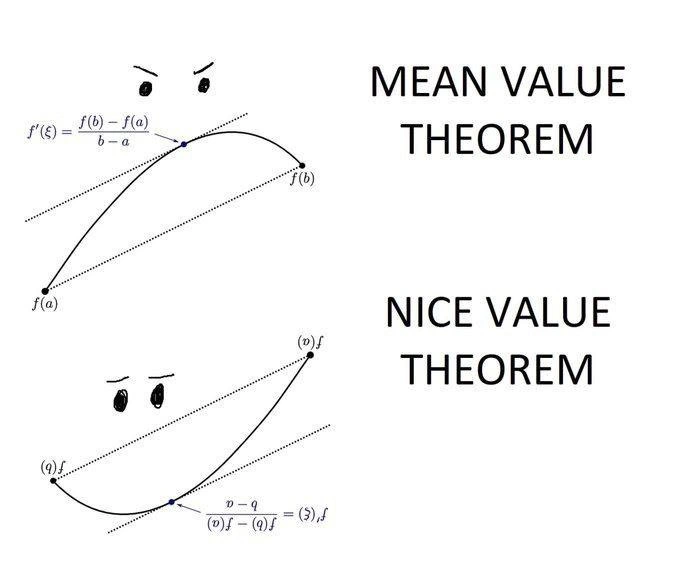
That brings us to the joke. The meme maker noticed that “mean” can also mean “not nice” in everyday English. So they took the phrase Mean Value Theorem and imagined it as a person who is mean (like a grumpy teacher or a bully). In the image, on the top-left, there’s a curve drawn from a point labeled f(a) up to another point f(b). This curve is concave down (bending downward like an upside-down bowl). They’ve drawn two angled, thick eyebrows slanting downward and two little filled circles as eyes above the curve. With those simple additions, the curve suddenly looks like a face that is scowling or frowning. It visually says “this graph is mean!” The dotted line connecting f(a) to f(b) is the secant line (the average slope), and the little blue point on the curve is where they drew a tangent line (you can see a short dotted line touching the curve there). Right next to it, in text, they’ve written the official formula $f'(\xi) = \frac{f(b) - f(a)}{b - a}$, which is exactly the Mean Value Theorem’s statement. So the top panel is a proper math diagram of the Mean Value Theorem, just with a funny angry face layered on it. They even wrote “MEAN VALUE THEOREM” in big letters to make it clear. It’s both educational and humorous: you see the actual elements of the theorem (points a and b, secant line, tangent line, formula) and also this idea that the theorem itself is “mean” (grumpy).
Now look at the bottom panel. Here the text says “NICE VALUE THEOREM.” There’s no real theorem called that – this is a made-up term for the sake of the joke, playing off the opposite of mean (mean vs nice). The graph drawn is a curve going upward from a point labeled f(q) to another point f(v). This curve is concave up (shaped like a U or a smile). If you notice, they drew softer, raised eyebrows and more open, friendly looking eyes on this curve, so the curve looks like it’s smiling. It’s a happy face graph! There’s again a blue point in the middle with a tangent line, and a dotted secant line connecting the endpoints $(q, f(q))$ and $(v, f(v))$. They wrote a slope expression near it, which is meant to be analogous to the top formula but with q and v. It seems to be a bit jumbled in text ((v – q)/(v)f – (q)f as described), but we can interpret it as the slope from q to v: $\frac{f(v) - f(q)}{v - q}$. In other words, they’re applying the same idea: there should be some point between $q$ and $v$ where $f'(\xi) = \frac{f(v) - f(q)}{v - q}$. And that point is marked by the blue dot with the tangent line. So the bottom panel is effectively the Mean Value Theorem diagram again, just with different letters and a smiling face. By calling it the “Nice Value Theorem,” the meme implies this is what happens when the function is nice instead of mean. It’s purely a playful inversion – there’s no standard thing called Nice Value Theorem, but the diagram shows the same kind of relationship between a tangent and secant slope.
So the humor comes from this contrast: Mean vs Nice, shown by an angry face graph and a happy face graph. It’s taking a dry calculus concept and personifying it. If you’re a junior developer or a student who’s taken Calculus 101, you might recall that concave down curves look like frowns and concave up curves look like smiles. In fact, teachers often say “concave down, like a frown” to help remember. This meme literally uses that idea! The top graph is concave down and has a frown-y face; the bottom is concave up with a smiley face. It’s a visual pun reinforcing the word pun. Even the terminology “Mean Value Theorem” is turned on its head: instead of meaning an average value property, it’s portrayed as a mean (angry) value property, so to balance it they imagined a nice value property. It’s a lighthearted way to review a calculus fact – by dressing it up as a cartoon. For someone who knows the basic math terms (function, secant, tangent, derivative) this is a cute and quick laugh. And if those terms were rusty, well, now you got a brief refresher that mean = average and tangent = instant slope in the middle of a joke! It’s a fun intersection of CSFundamentals knowledge and just plain old goofy HumorAndMemes.
Level 3: Differentiating Meanings
At first glance, this meme looks like a standard calculus diagram from a textbook – until you notice the little eyes and eyebrows turning the graphs into faces. That’s when an engineer or math-savvy developer will smirk: it’s AcademicHumor at its finest, playing on the double meaning of the word “mean.” The phrase Mean Value Theorem is very familiar to anyone who’s taken calculus or CS fundamentals involving math. We all learned that it’s about an average slope, but here the meme pretends “mean” is describing an attitude. It’s the classic geeky wordplay where a technical term (mean = average) is misinterpreted in the everyday sense (mean = cruel), yielding a silly contrast: mean vs nice. This contrast is explicitly spelled out by the bold labels “MEAN VALUE THEOREM” above a scowling graph and “NICE VALUE THEOREM” above a smiling graph. It’s a punny_math_meme that takes a serious concept and gives it a whimsical twist.
Why is this combo of elements so funny to developers and students in the know? Because it mixes high-brow math with low-brow cartoon doodling. Many of us remember grappling with the Mean Value Theorem in calculus class – proving it, applying it to problems, maybe even getting it wrong on a midterm. It’s a non-trivial theorem that marked a step into more rigorous math. Seeing it now as a goofy graph with an attitude is both nostalgic and absurd. It triggers that “I see what you did there” reaction. The secant_line and formula in the diagram are 100% legit – that’s exactly how textbooks illustrate MVT, with a line through $(a, f(a))$ and $(b, f(b))$ and a tangent at some $c$ showing equal slope. The meme creator essentially took that dry diagram and scribbled facial features on it, as if a bored student started drawing in the margins of their notebook. For a seasoned developer, it’s a throwback to being a student again, when you’d sometimes daydream and imagine the graphs having personalities (concave-down frown vs concave-up grin).
The humor also comes from the invented “Nice Value Theorem.” There is no actual Nice Value Theorem in math – that term is completely made-up for the joke. And that’s hilarious to anyone who remembers the precise language of math theorems, because you never hear words like “nice” in their titles. Math theorems have names that sound formal and serious (Intermediate Value Theorem, Mean Value Theorem, Fundamental Theorem of Calculus… nothing like “Nice”). The meme pokes fun at that formality by introducing an almost childishly simple adjective “nice” as if it’s an official counterpart to “mean.” It’s as if someone thought, “Well, if there’s a mean theorem, shouldn’t there be a nice one too?” It’s absurd and that’s why it works. The straight-faced diagram suggests a legitimate concept, but any math-literate person knows it’s just nonsense – and that contrast sparks laughter. It’s TechHumor intersecting with pure silliness: the kind of joke you share in the engineers’ Slack channel or on /r/ProgrammerHumor to get knowing chuckles.
Moreover, the visual anthropomorphism – giving the graphs eyes and eyebrows – is a universal comedy touch. Even without reading the text, one graph looks angry and the other looks happy. That alone is a goofy idea: imagine telling a colleague “the graph was mean to me, but now it’s nice.” It humanizes an abstract concept. For those in on the joke, there’s also a layer of wit in how the shape of the curve complements the emotion. Developers who remember their calculus might recall the mnemonic that a concave-down curve looks like a frown, and concave-up looks like a smile. The meme directly taps into that: the top curve is concave down (so it naturally arches like a frown) and they accentuated it with angry brows; the bottom is concave up (naturally like a smile) with friendly brows. It’s a visual pun stacked on a verbal pun. Basically, it’s HumorAndMemes built from the very fabric of CS_Fundamentals math knowledge.
In real-world developer culture, this kind of joke is a little bonding moment. It says “we survived calculus, and now we can laugh about it.” The Mean Value Theorem might have been something you studied for exams or used in algorithm analysis (for instance, ensuring some average case equals a specific instance). But here, instead of a serious application, you get a wholesome joke. It’s the type of joke only those who know the material will get, creating a sense of camaraderie among those with that shared background. It’s also refreshingly innocent as a joke – no sarcasm about coding fails or corporate life, just pure math nerd playfulness. After dealing with complex code or debugging, seeing a math graph literally being “mean” or “nice” is a light-hearted reminder that engineers can find fun in the strangest places, even in old calculus theorems. In summary, the meme lands so well with its audience because it differentiates between the two meanings of “mean” (pun intended, since differentiation is calculus!) and serves up a double-layered insider gag. It’s an ode to the idea that even the driest technical concept can have a humorous side when viewed through a playful lens.
Level 4: For Every Secant, a Tangent
In formal calculus, the Mean Value Theorem (MVT) guarantees that for any smooth curve between two endpoints, there’s at least one interior point where the tangent line’s slope equals the secant line’s slope between those endpoints. In mathematical terms, if a function f(x) is continuous on [a, b] and differentiable on (a, b), then there exists some point $\xi \in (a, b)$ such that:
$$ f'(\xi) ;=; \frac{f(b);-;f(a)}{,b ;-; a,},. $$
This equation is exactly what’s written on the top graph of the meme: the left-hand side $f'(\xi)$ is the derivative (instantaneous rate of change) at some magic point $\xi$, and the right-hand side $\frac{f(b)-f(a)}{b-a}$ is the average rate of change from x = a to x = b. The Mean Value Theorem tells us these two are equal at least once under the given conditions. Geometrically, the dotted line connecting $(a, f(a))$ to $(b, f(b))$ is a secant line representing the average slope, and the dotted line at the blue point $\xi$ is a tangent line representing the instantaneous slope at that point. The theorem guarantees those two lines are parallel (same slope) at some $\xi$. This isn’t just coincidence – it’s a fundamental property of differentiable functions.
Why is this theorem so important? It’s a cornerstone of real analysis and calculus. It formalizes the intuitive idea that a continuous, smooth change from one value to another must achieve all intermediate slopes. If you’ve ever heard a professor mention Rolle’s Theorem, that’s a special case: if $f(a) = f(b)$, then there’s a point in between where $f'(\xi)=0$. Mean Value Theorem (sometimes called Lagrange’s Mean Value Theorem) generalizes that – even if $f(a)$ and $f(b)$ are different, the derivative at some point equals the overall change. The proof usually involves subtracting the straight-line secant and applying Rolle’s Theorem to the difference f(x) - [secant line] function, revealing an interior point where the difference in slopes vanishes. In other words, roll(e) with it and you get MVT! This guarantee underpins many other results (for example, it’s used to prove that if a derivative is zero everywhere, the function is constant, and it’s instrumental in deriving Cauchy’s Mean Value Theorem which leads to L’Hôpital’s Rule in calculus). It’s one of those elegant truths in mathematics that ensures a “nice” well-behaved function can’t be too wild between two fixed points – the function’s derivative must take on the mean (average) value of the overall change at some stage.
Now, in the meme’s top panel, the function drawn is a smooth curve going upward (concave down) from $f(a)$ to $f(b)$. The author sketched fierce eyebrows and beady eyes above that curve, turning it into an angry-looking face. This visual doesn’t affect the math at all – the Mean Value Theorem holds for any shape as long as conditions are met (the function could be smiling or frowning or straight; the theorem doesn’t care). But here the curve is deliberately drawn concave down (like a frown) to match the angry “mean” expression. Importantly, “mean” in Mean Value Theorem is referring to the mean (average) value of the derivative, not “mean” as in “cruel” – a crucial distinction. The meme exploits this double meaning. Traditionally, mathematicians named it “mean value” because it involves an average (mean) slope. In everyday English, however, mean is more often used to describe someone or something that is not nice. There’s absolutely nothing inherently “mean” or malicious about the theorem – it’s purely about an average rate of change. The meme riffs on this by pretending the theorem is mean in the personality sense, hence the grumpy face.
The bottom panel introduces a fictional “Nice Value Theorem,” which doesn’t exist in any textbook – it’s a playful invention to pair with “Mean Value Theorem.” The graph here is a smooth curve drawn concave up (like a smile) from $(q, f(q))$ to $(v, f(v))$. Again there’s a blue interior point where a tangent line is drawn, parallel to the secant line connecting the endpoints. In other words, it’s illustrating the same concept: some point $\xi$ between $q$ and $v$ where $f'(\xi) = \frac{f(v) - f(q)}{v - q}$. The meme labels this slope in a somewhat goofy way (the text \(v – q)/(v)f – (q)f\ in the description seems to be a formatting quirk – presumably they meant $\frac{f(v) - f(q)}{v - q}$, analogous to the formula above). The specifics aren’t important; what matters is it mirrors the Mean Value Theorem setup. But this time, by dubbing it the “Nice Value Theorem,” the creator decorates the curve with gentle, raised eyebrows and kind-looking eyes, making the curve look happy. The graph annotations (dotted lines and formula) are all there to mimic a serious calculus diagram, but the anthropomorphic face turns it into punny math humor. The concave-up arc naturally resembles a smile (there’s a common calculus mnemonic: “concave up, like a cup (or a smile); concave down, like a frown.”). The meme artist has literally taken that teaching phrase and run with it — one curve frowns, the other smiles.
It’s worth noting that in rigorous math there’s no “Nice Value Theorem” counterpoint; the Mean Value Theorem applies regardless of the function’s “mood.” Mathematicians do sometimes informally say a function is “nice” if it behaves well (is smooth, satisfies conditions). In a tongue-in-cheek way, you could say the Mean Value Theorem already assumes a “nice” function (since it needs continuity and differentiability). But the meme isn’t suggesting a new theorem – it’s purely a play on words and cartooning. By understanding the actual MVT, we see why the diagram includes those secant and tangent lines and formula – it’s faithfully representing a real theorem. The humor emerges from overlaying human traits (mean or kind) onto this serious mathematical scene. It’s a clever blend of Mathematics and HumorAndMemes: taking a dry calculus concept and making it cute. To fully appreciate it, one needs to recall that mean = average, and realize the joke is twisting that into mean = not nice. Once you catch that, the “mean vs nice” faces on the graphs turn a deep principle of calculus into an adorable visual pun.
Description
A two-panel meme that humorously personifies a mathematical concept. The top panel is labeled 'MEAN VALUE THEOREM' and displays a standard calculus graph of a convex function. The curve, combined with a pair of angry, hand-drawn eyes above it, resembles a frowning or 'mean' face. The accompanying formula, f'(ξ) = (f(b) - f(a)) / (b - a), and the graphical representation correctly illustrate the theorem. The bottom panel, labeled 'NICE VALUE THEOREM', shows a concave function. With a pair of relaxed, happy eyes drawn above it, this curve resembles a smiling or 'nice' face. This meme is a wordplay pun, contrasting the mathematical term 'mean' (average) from the Mean Value Theorem with the emotional meaning of 'mean' (unkind). The 'Nice Value Theorem' is a fictitious, friendly counterpart, making the joke accessible to anyone who has studied introductory calculus
Comments
11Comment deleted
The Mean Value Theorem proves there's an instant your code's performance is exactly as average as its overall run. We just call that 'the bottleneck'
Code reviews are just the Mean Value Theorem in action: between the first nitpick and the final LGTM, there’s inevitably one tangent comment whose snark perfectly matches the average shade of the whole thread - still waiting for the Nice Value Theorem plugin
After 20 years of explaining to junior devs why their O(n²) algorithm won't scale, you realize the Mean Value Theorem perfectly captures your code review mood - there's always that one point where your patience derivative equals the average frustration over the entire PR
The Mean Value Theorem: proving that somewhere between your sprint start and deadline, there exists a point where your velocity exactly equals your average velocity - though by the time you find it, you're already behind schedule. The Nice Value Theorem, however, suggests that if you're pleasant about it, stakeholders might not notice the difference between (b)f and (a)f
MVT: Guarantees a perf optimum somewhere between commit A and prod deploy - existence proven, location forever elusive
Benchmarks obey two theorems: Mean Value - there’s a ξ where the tangent equals the average slope; Nice Value - choose the time window until the secant equals the narrative
MVT guarantees a ξ where your latency equals the average; the Nice Value Theorem would guarantee a sprint where estimate/actual = 1 - still unproven in production
sure because that's totally how life works lol Comment deleted
Finally, we have thirst bot around here Comment deleted
Damn thirst bot in here before GTA VI is crazy Comment deleted
What's thirst bot? Comment deleted