Skip to content
DevMeme
1905 of 7435
The XY Problem: Where Math Meets Programming Panic
Languages Post #2115, on Oct 1, 2020 in TG

The XY Problem: Where Math Meets Programming Panic

Why is this Languages meme funny?

Level 1: One Name vs Two Numbers

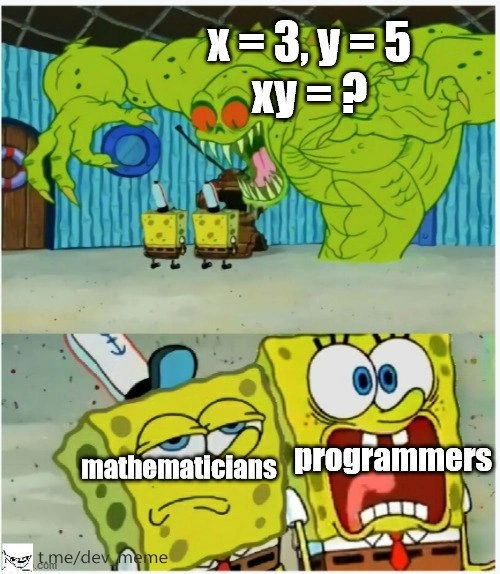
Imagine you have two toy boxes: one labeled X with 3 candies inside, and one labeled Y with 5 candies. A math friend looks at X Y written side by side and just naturally thinks, “Oh, combine the candies by multiplying 3 and 5, we get 15 candies in some magical way.” They’re using a secret shorthand where putting the boxes together means multiply their amounts. But a computer is like a very literal-minded robot. When it sees XY stuck together, it doesn’t think of two separate boxes anymore – it thinks it’s looking for one single box named "XY". The computer goes to find this big "XY" box and… it’s not there! Error! In our meme, the calm SpongeBob (the math friend) isn’t scared because to him "xy" just means a simple 15. The panicked SpongeBob (the programmer) is screaming because "xy" makes the computer super confused, like asking for a toy box that doesn’t exist. That’s why the programmer is freaking out – something that should be 15 in plain math turns into a big UH-OH in code. It’s funny because it shows how the same two letters can mean “do a easy calculation” to a person but “I have no idea what this is!” to a computer.

Level 2: Multiplication Sign Required

Let’s break this down in simpler terms. In programming, you must use an operator (like * for multiplication) to tell the computer what to do with two variables. Writing x * y clearly means multiply x by y. But writing xy without any symbol is not valid syntax in most languages – the computer smashes those letters together and thinks you’re referring to a single thing named “xy”. If you haven’t created a variable called xy, the program throws an error (often a NameError, which essentially says “I have no idea what ‘xy’ is!”). This meme compares that situation to two different perspectives:

  • Mathematician’s view: They see x = 3, y = 5 and the expression xy as a straightforward question: “what is 3 times 5?” Their answer: 15. No fuss, because in math class writing variables together means multiply.
  • Programmer’s view: They see the same xy as a mistake in code. The question becomes: “what is the value of this single variable xy?” And since no such variable was defined, the program will likely crash or refuse to run. The programmer is effectively asked about something that doesn’t exist, hence the panic.

To visualize the difference:

Notation Math Interpretation Code Interpretation
xy x × y (implicit multiply) = 15 single variable named "xy" (undefined) -> Error
x * y x × y = 15 (explicit) x multiplied by y (defined operation) -> 15

In the table above, you can see that mathematicians don’t need the * to mean multiplication, but code absolutely does. This falls under SyntaxHumor because it’s about the exact characters you have to type. A missing operator is a very common CodingMistake. New programmers often come from doing algebra and might write something like:

x = 3
y = 5
print(xy)  # ❌ ERROR: Python thinks "xy" is one variable name

And Python (or Java, C++, etc.) will complain: NameError: name 'xy' is not defined. The fix is simple – add the multiplication sign:

print(x * y)  # ✅ Prints 15, now it's clear we mean multiply

This distinction is a big part of the RelatableDeveloperExperience: nearly everyone has seen or made a silly typo where the computer took things very literally. It’s also about VariableNaming: x and y are two separate variable names. If you intend to use them separately, they need to stay separate with an operator or at least whitespace that the language understands. Writing them together unintentionally creates a brand new name. (Fun fact: Some languages allow implicit joining for string literals – e.g., in Python "hello" "world" becomes "helloworld" – but that only works for quoted strings at compile time, not for variables like x and y. In general code, you need an explicit + to concatenate strings or * to multiply numbers.) The meme’s categories Languages and Bugs come in because this is a little language rule that, when misunderstood, leads to a bug. And Mathematics is referenced because that’s where the implicit notation comes from.

So, the mathematician SpongeBob in the meme is super relaxed because he sees “3 and 5, easy multiply to 15.” The programmer SpongeBob is screaming because his brain goes “Ahh! xy is a single term and I never defined it!” It’s a perfect illustration of how something that’s totally fine on a chalkboard can be a facepalm error in code. The humor hits home for developers because we’ve all been that screaming SpongeBob at some point, facing a runtime error beast caused by something as trivial as a missing *.

Level 3: Implicit Multiplication Monster

In mathematics, writing variables side-by-side implies multiplication. For example, if a mathematician sets x = 3 and y = 5, then writing xy is understood as x × y, which equals 15. It’s an implicit multiplication convention taught in math classes: no symbol needed, just write variables adjacent and multiplication is assumed. However, programming languages don’t share this implicit rule – they have strict syntax. In code, the sequence of characters xy is parsed as a single identifier (a variable or function name). There’s no magical math context to interpret xy as x * y. Therefore, unless a variable named xy exists, the code freaks out with a NameError (in Python) or a compile error. This meme humorously personifies that discrepancy: the “xy” monster looms large for the programmer (SpongeBob screaming) because xy in code is a bug, whereas the mathematician SpongeBob stays chill seeing a simple 15.

From a senior developer’s perspective, this highlights a classic syntax vs. semantics battle. The meme tags like SyntaxErrors and NamingThings point to real developer experiences: a missing operator * is an easy mistake that leads to a scary error. The horror is real – forgetting a tiny * can crash a program at runtime, much like a monster attack on your calm coding session. Seasoned devs have encountered this: perhaps copying formulas from a math textbook into code and running headfirst into a bug because code isn’t as forgiving as pen-and-paper math. The Languages category is relevant because each programming language has grammar rules preventing implicit multiplication. Historically, languages like FORTRAN (designed for formula translation) still required explicit * for multiplication to avoid ambiguity in parsing. Indeed, the compiler’s lexer and parser treat x and y as separate tokens only if there’s an operator or delimiter; if you run them together as xy, the compiler reads it as one token. This strictness is what saves us from ambiguity but also generates this comedic frustration when math notation meets code.

The humor also touches on variable naming conventions. In code, xy could be a legitimate single variable name (like int xy = 15; in C, meaning something completely different). A nightmare scenario for a senior engineer would be if xy was declared elsewhere – then writing xy instead of x*y wouldn’t error at all, it would quietly use the wrong value! 🐛 That’s an even scarier monster: a logical bug yielding incorrect results without immediate failure. This possibility underscores why many dev teams use linters or strict compilers: to catch undefined names or enforce spaces around operators. The meme’s brilliance is in how it captures a shared PTSD of devs who have hunted down a bug only to find it was a missing * or + in an equation. It’s a gentle reminder that what’s obvious to a human (especially one wearing a mathematician’s hat) can be utterly lost on a machine. As the saying goes, “Be explicit with computers – they won’t do you any favors.” Here, leaving out the * is like leaving a key detail out of an instructions list, and the runtime’s reaction (error) is essentially the program screaming in confusion, much like our panicked SpongeBob. Meanwhile, the mathematician SpongeBob is nonchalant because in his world, xy = 15 is the tamest little bug – not a bug at all, just basic arithmetic.

Description

A two-panel meme format from the show SpongeBob SquarePants that contrasts the perspectives of mathematicians and programmers. In the top panel, a giant, scary green monster represents a problem with the text 'x = 3, y = 5' and 'xy = ?'. Two small SpongeBob characters look up in fear. The bottom panel is a close-up of the two SpongeBobs, showing their different reactions. The one labeled 'mathematicians' has a calm, unimpressed expression. The other, labeled 'programmers', is wide-eyed with panic. The humor hinges on the ambiguity of the expression 'xy'. A mathematician sees a simple multiplication problem (3 * 5 = 15). A programmer, however, sees a potential type issue: is 'xy' multiplication or string concatenation ('35')? This ambiguity, especially in weakly-typed languages, is a common source of bugs, hence the programmer's panic over a seemingly trivial problem

Comments

41
Anonymous ★ Top Pick In mathematics, the solution is 15. In JavaScript, it's '35'. In Python, it's a TypeError. In C++, it's four pages of template metaprogramming that also returns 15 but nobody understands why
  1. Anonymous ★ Top Pick

    In mathematics, the solution is 15. In JavaScript, it's '35'. In Python, it's a TypeError. In C++, it's four pages of template metaprogramming that also returns 15 but nobody understands why

  2. Anonymous

    On the whiteboard, xy = 15; in prod it’s NameError: xy not defined - yet another reminder that implicit multiplication scales about as well as implicit requirements

  3. Anonymous

    After 20 years in the industry, I've learned that 'xy' in production code is either a coordinate system about to cause an off-by-one error, or someone's attempt at 'descriptive' variable naming that will haunt code reviews for generations

  4. Anonymous

    This perfectly captures the moment when a mathematician joins your code review and asks why you're not using implicit multiplication. Meanwhile, your linter is having an existential crisis trying to figure out if 'xy' is an undeclared variable, a typo, or someone's idea of 'self-documenting code.' It's the eternal struggle: in math, juxtaposition means multiplication; in programming, it means you forgot the operator and now your CI/CD pipeline is red

  5. Anonymous

    Even after 20 YoE refactoring distributed monoliths, xy=? hits like a 3AM PagerDuty alert for an unknown prod failure

  6. Anonymous

    Math says xy=15; the platform team says it’s 15 in a typed service, “35” in JavaScript, and an outage in YAML

  7. Anonymous

    Math allows implicit multiplication; our lexer doesn’t - pay the operator tax or enjoy a midnight undefined-name incident

  8. @imikailoby 5y

    Test

  9. @Trace171 5y

    Nice test dude

  10. @alex_hol 5y

    Yeah

  11. @imikailoby 5y

    TDD

  12. @energizer91 5y

    nice discussion awesome tests

  13. @AmindaEU 5y

    Type error?

    1. @ipaal 5y

      syntax error maybe 🤔

      1. @AmindaEU 5y

        I should actually try it or practice instead of hanging around here, thanks 😸

  14. @imikailoby 5y

    Yeah:(

  15. Deleted Account 5y

    I am gay

    1. @energizer91 5y

      developer*

      1. @Sebov 5y

        Oh, nice cock

      2. @ChcikenJockey 5y

        I'm gay developer

        1. @pluresque 5y

          I’m a hentai developer btw

          1. @e18e02930b94d725daa9 5y

            log out yanderedev

          2. @ChcikenJockey 5y

            What game, my fellow dev?

    2. @Four_Velocity 5y

      Wow, the comments are so fast I didn't even notice that

  16. @BuHoGPaD 5y

    grats

  17. @APT3M 5y

    35?

    1. @alex_hol 5y

      Js devs..

      1. @APT3M 5y

        😏

  18. @alex_hol 5y

    thats nice)

  19. @n0name_user 5y

    Hello world

  20. @LucioSulla 5y

    This is a test

    1. @ipaal 5y

      No, this is a monkey

      1. @LucioSulla 5y

        MONKI POOP Hhahahahaha

  21. @Agent1378 5y

    xy=й

    1. @APT3M 5y

      1c devs in chat

  22. @ipaal 5y

    Yes

  23. @ipaal 5y

    What if in comments to meme we will discuss another meme ? Bunt blyad'

  24. Deleted Account 5y

    Продам гараж

  25. @Twentyminuteadventure 5y

    Купил гараж

  26. @ipaal 5y

    Bunt.exe crushed: unresolved reference to 'another_meme'

  27. @affirvega 5y

    wait fuck that was a 2020 year message

Use J and K for navigation