Skip to content
DevMeme
5448 of 7435
Mark Zuckerberg's 'Human Update' Triggers Terminator Infiltration Alert
DevCommunities Post #5972, on Apr 22, 2024 in TG

Mark Zuckerberg's 'Human Update' Triggers Terminator Infiltration Alert

Why is this DevCommunities meme funny?

Level 1: From Robot to Real Boy

Imagine you have a toy robot that always acted stiff and awkward, almost like it wasn’t sure how to be a person. It spoke in a monotone voice and never smiled, so you always felt, “Hmm, this doesn’t feel like a real friend.” Now picture that one day, you give this robot a special update (like when you update a game or an app on a tablet) called the “be more human” update. Suddenly, the robot starts doing little things that real people do: it smiles and laughs a bit, its hair is a bit messy like someone who just woke up, maybe it even pretends to sweat when it’s hot or says “Excuse me” after a sneeze. All of a sudden, your robot buddy seems much more alive, almost like a real person!

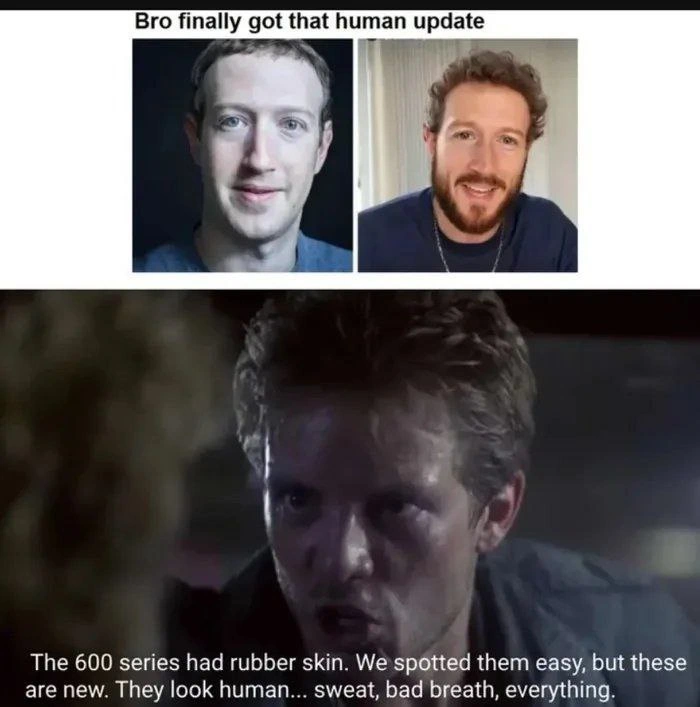
This meme is joking about exactly that kind of scenario. In the first picture, the character looks kind of like a robot disguised as a human – very neat, no emotion. In the second picture, after the “human patch,” he looks friendly and human – more like someone you’d trust or relate to. It’s like the story of Pinocchio, the wooden puppet who wanted to become a real boy, but told in a geeky tech way. Instead of a magical wish turning the puppet real, here a software update did the trick for the robot-man!

The reason it’s funny is that we don’t usually talk about people “installing updates” in their behavior – that’s what we say for phones or computers. Mixing those worlds (people and computer software) makes for a silly image. It’s a bit like saying, “Hey, our normally robotic friend finally downloaded the Latest Human Behavior Pack and now he’s acting just like us!” Everyone kind of cheers and laughs because we always knew something was a little fake about him, and now he’s doing normal stuff like messing up his hair or having smelly breath – yuck but also so human! The emotion behind the joke is a mix of relief and amusement: relief that the robot-person isn’t so spooky anymore, and amusement at the idea that being sweaty and imperfect is actually an achievement. In simple terms, the meme is telling a little story: Robot learns how to be human, and we find it both funny and endearing.

Level 2: The Human Touch Patch

Let’s break down what’s happening in this meme in simpler terms and explain the tech jokes. The image compares two versions of the same person side-by-side, joking that the person (or robot) finally installed an “act human” patch – basically an update that makes them behave more like a normal human. In software, a patch is a piece of code you apply to a program to fix bugs or add small improvements. By calling it the “human update” or "human touch patch," the meme is treating a person’s change in appearance/mannerism as if it were a software update. This is a common form of software versioning humor among developers: for example, someone might say “I got Haircut 2.0” after a dramatic new hairstyle, or joke that a friend’s improved fashion sense is them “applying the style patch.” It’s nerdy humor that compares life or people to software.

In this case, the humor targets how artificial intelligence (AI) and robots sometimes struggle to seem human. The two top photos subtly allude to a public figure (Mark Zuckerberg, the CEO of Facebook/Meta), who internet communities often tease for appearing robotic or emotionless in interviews. Whether fair or not, it’s a running joke that he’s a bit like an alien learning human customs. The left photo has him with a blank look and cool lighting, making him appear more like a lifeless android. The right photo shows him looking warmer and more relaxed – think of it like switching from a stiff robot stance to a chill human posture. The caption “Bro finally got that human update” is written in a casual, meme-y tone (calling someone “bro” in memes is like a friendly, slightly teasing address). It implies “Dude finally got an upgrade to act like a real human being!”

Now, the bottom image is a scene from the famous 1980s sci-fi movie The Terminator. In the movie’s story, there are killer robots called Terminators that are trying to blend in with humans. In earlier models, like the T-600 series, the Terminators had fake rubber skin that looked not quite real – humans could tell they were imposters (“we spotted them easy,” the quote says). But the newer models (like the one Arnold Schwarzenegger plays, the T-800) have real human flesh covering a metal endoskeleton, even producing realistic sweat and bad breath. Essentially, the new robots in that movie were much harder to distinguish from real people because they had all these tiny human details right. The text shown in the meme is a direct terminator_quote from that movie:

“The 600 series had rubber skin. We spotted them easy, but these are new. They look human... sweat, bad breath, everything.”

By including this, the meme draws a parallel between the sci-fi scenario and the real world scenario of an AI/robot (or in jest, Mark Zuckerberg) finally nailing those details. It’s saying: Previously, it was obvious he was a robot (like rubber skin obvious). But now the new update has given him realistic features (like sweat and a bit of messiness) so he truly looks human.

Let’s decode some terms and context here:

  • AI/ML (Artificial Intelligence/Machine Learning): This refers to computers or machines trying to perform tasks that normally require human intelligence, like recognizing faces, understanding language, or making decisions. One big goal in AI is to interact with humans in a natural way – think of talking to Siri/Alexa or chatbots that customer service uses. Early attempts often feel mechanical. (Sometimes the responses are too formal or the voice is monotone, which is a giveaway that “this ain’t a human.”)
  • Uncanny valley: This term might not be familiar to everyone. It’s a concept from robotics/animation describing how we react to human-like things. If something is a little human-like (like a cartoonish robot or R2-D2), we find it cute. If it’s fully human-like (actually a human or a perfect android), we’re okay with it. But in between, if it’s almost human but not quite (like a wax figure or a not-quite-right CGI human face), we feel creeped out. That creepy zone is the uncanny valley. In simpler words: almost-human robots or animations can weird us out because our brains sense something is not natural. In the meme, the left image (cool, stiff Mark) could be seen as stuck in the uncanny valley – looking human but behaving in a way that people find oddly robotic. The right image shows him climbing out of that valley by looking more naturally human (smiling, casual posture).
  • Human update / robot_to_human_transition: The meme imagines there’s a literal update file or patch that you could install into a robot to make it act human. Of course, in reality, people can’t be “patched” like software. But we do use training, practice, or PR makeovers to change behavior. The phrase “robot to human transition” sums it up: it’s like the person (or AI) is transitioning from obviously robotic behavior to convincingly human behavior. The meme uses the language of software to describe this transition for comedic effect.
  • IndustryTrends_Hype (AI hype): Lately, there’s a lot of buzz in tech about AI becoming super life-like. Every year there’s some new AI that people claim is almost like a human – whether it’s a chatbot that can write jokes, or a deepfake that looks exactly like a real person on video. This excitement (and sometimes over-excitement) is what we call hype. The meme is playing with that trend. It’s as if everyone’s been waiting for the moment the AI will act truly human, and “finally” it happened via this patch. Developers might chuckle because it’s a bit sarcastic: in reality, no single patch flips a robot from awkward to fully human-like – it’s a gradual, difficult process – but imagining it did makes for a funny, hyperbolic scenario.
  • “Bro finally got that X update” meme format: The phrasing “Bro finally got that ___ update” is a popular way on social media to joke about someone’s noticeable change. For example, if a usually quiet friend suddenly starts dancing confidently, someone might quip “Bro finally got the social skills update.” It’s a tongue-in-cheek way to credit an imaginary software patch for a real-life change. Here, “that human update” implies that being genuinely human-like was a feature that was missing and has now been added.

In sum, at this level we understand the meme is comparing a before-and-after difference in how human someone (or something) seems. The top panel directly shows the difference in a person’s vibe (from robotic to humanized). The bottom panel uses a famous movie example to reinforce why adding little human details (like sweat or a genuine smile) is such a game-changer: those details fool people into thinking the robot is real. The meme cleverly uses a mix of tech lingo (“update/patch”) and movie lore to make a joke about AI and possibly poke fun at a real tech figure’s image. Even if you didn’t catch that it’s Zuckerberg or haven’t seen Terminator, you can get the basic idea: the robot finally learned to act like a human being, hooray!

Level 3: Release Notes: Now With Sweat

For seasoned developers and tech observers, this meme lands as a witty commentary on AI hype cycles and the incremental nature of improvements. The top panel shows a familiar tech figure – widely recognized as Mark Zuckerberg – in a before-and-after style comparison. In the left “before” photo, he appears almost android-like: a neutral expression, uncanny smoothness, and cool lighting that gives a sorta lifeless vibe. This image reflects the long-running tech humor that jokes about Zuckerberg as if he were a robot trying to act human (a nod to how famously controlled or awkward his public persona can seem). The right “after” photo is dramatically different: he’s sporting a friendly beard, a casual shirt, even a slightly messy haircut and warmer lighting. He looks more relaxed and authentically human. The bold caption at the top, “Bro finally got that human update,” reads like a changelog entry from the universe of TechHumor: it humorously frames this change in appearance and demeanor as if Zuckerberg’s internal software finally installed a long-awaited “act human” patch. Developers often jokingly describe real-life changes in software terms – here it’s like we’re looking at version 2.0 of the person, with major release notes emphasizing Humanity Improved.

The bottom panel cements the joke by pulling in an iconic PopCultureReference from Terminator. In the screenshot, resistance fighter Kyle Reese grimly explains how to spot a cyborg: “The 600 series had rubber skin. We spotted them easy. But these are new. They look human... sweat, bad breath, everything.” This line is basically a 1984 sci-fi way of saying “the new version has all the realistic features turned on.” In Terminator lore, earlier robot models (like the T-600) were poor mimics – their flesh looked fake, so humans could detect them. But the newer T-800 model (think Arnold Schwarzenegger’s character) had genuine living tissue, even bodily fluids, making it indistinguishable from a real person until it was too late. By quoting this, the meme equates Zuckerberg’s apparent transformation to a model upgrade from a obvious android (easy to spot) to an almost human-like being with all the subtle giveaways present (yes, even sweating!). It’s a playful jab: the “robot” finally learned to sweat and maybe even have morning breath, so now we can’t tell it’s a robot.

Why is this so funny to devs and techies? Because it perfectly lampoons the AIHypeCycle and our collective fascination with making AI appear human. We’ve all read press releases or watched keynotes where some company claims their chatbot or robot is now more personable or lifelike thanks to an update (“Now with improved conversational tone!” – basically “now with sweat and bad breath!” in marketing speak). There’s a shared understanding that early versions of AI are usually very rigid or obviously machine-like – much like a T-600 with plastic skin or an early voice assistant that spoke in monotone. As iterations go on, the AI gets incremental tweaks: maybe a bit of humor here, a pause there, a less robotic face. These are the “patches” that gradually add those human touches. The meme has us picture a literal patch install for a robot: Update v10.6 – Added casual chuckle and bedhead hairstyle; improved small talk module; fixed bug where smile did not reach eyes. It’s poking fun at the idea that human behavior can be broken down into a list of features to be implemented – a very developer way to see the world!

Developers also catch another layer of humor in the phrasing “finally got that update.” It implies this was a long-standing item in the backlog – as if everyone knew the robot was due for a humanity upgrade but it took ages to roll out. In software_versioning_humor style, one might imagine the commit message for this patch looking like:

commit 604fde8: Activate Human Emulation Module (v42.0)
- Applied "Human Update" patch, enabling more natural social behaviors.
- HairAppearance: switched from default = 'neat' to 'slightly_messy' for realism.
- ExpressionEngine: added new subroutine for spontaneous smiles and eyebrow moves.
- ThermalControl: enable light perspiration (sweat) under warm lighting.
- BreathSubsystem: simulate halitosis at random intervals (feature flag behind badBreathEnabled).
- AudioTone: updated to include casual slang and laughter (no more monotone).
Fixes #600 (Uncanny skin bug)

*(Yes, “Fixes #600” is a cheeky nod to the T-600 series from Terminator. 😉)

This kind of faux changelog resonates with developers because we deal with actual patch notes and bug fixes daily. Seeing something as human-centric as sweat framed as a feature update is absurd and hilarious – it’s taking the mundane (sweating, messing up hair) and treating it like a deployed feature. It reflects a cynical-veteran subtext too: how sometimes tech companies focus on superficial features to make their AI seem more “human” without addressing deeper issues. For instance, an AI might use casual emoji or “uh-huh” in chat now (a surface improvement), yet it still lacks true understanding or can’t avoid obvious mistakes – analogous to how adding bad breath doesn’t give a robot consciousness, it just masks the robotic nature a bit better.

Finally, the meme touches on the culture of AI humor around figures like Zuckerberg. Within tech circles, it’s practically a meme format in itself to joke about Zuck being a lizard or robot wearing human skin. When he does something slightly more normal – say, barbecuing meats or surfing with too much sunscreen on (remember that viral photo?) – the internet jokes “he’s trying the human thing again.” So bro_finally_got_update is a punchy way to say “after many failed attempts, he’s acting like a real human now.” The meme merges that running joke with a classic Terminator reference, delighting anyone who’s into tech history and modern AI trends. It’s a fusion of IndustryTrends_Hype (the relentless push for human-like AI) and good old-fashioned geeky movie lore. In essence, the senior dev perspective here appreciates both the layered references and the grain of truth: success in AI (or even public relations for a tech CEO) often does come from nailing those human nuances that we used to overlook. And when those nuances are finally in place, it really does feel like a major version release worthy of tongue-in-cheek celebration.

Level 4: Crossing the Uncanny Valley

At the deepest technical level, this meme riffs on the uncanny valley phenomenon and the evolving realism of AI. In robotics and CGI, the uncanny valley describes how a simulacrum of a human (like an android or avatar) evokes increasingly positive responses as it becomes more lifelike – until a point where it’s almost human, but not quite. At that near-human point, people feel uneasy or creeped out instead of charmed. The "rigid demeanor" in the left image (cool blue lighting, blank expression) falls squarely into that valley – something is off, much like an older robot whose rubbery skin or stiff motion triggers our instinct that it isn’t truly human. The right image, however, shows an upgrade: warmer lighting, a casual smile, even slightly unruly hair. These subtle imperfections help bridge the uncanny valley by making the figure appear more naturally human.

From a theoretical standpoint, achieving genuine human-like presence in an AI or robot is a grand challenge that touches on cognitive science, robotics, and even philosophy. Alan Turing’s famous Turing Test (1950) proposed that if a machine’s behavior (in conversation) is indistinguishable from a human’s, we must consider it intelligent. Here the meme humorously posits a kind of visual Turing Test: the “act human” patch has apparently passed the eye test – the robot finally looks and acts convincingly alive. This calls to mind sci-fi scenarios like Terminator, where machines try to camouflage as humans. The quote shown (“They look human... sweat, bad breath, everything.”) highlights how the new Terminator models incorporated minutiae of human biology to avoid detection. In real technological terms, adding features like sweat or bad breath is akin to adding stochastic imperfections into a model – for example, a speech synthesizer injecting tiny hesitations or breaths to sound more natural.

Under the hood, advanced AI and robotics research recognizes that authenticity often comes from randomness and nuance. A perfect, flawless simulation actually feels fake because real humans have idiosyncrasies and minor flaws. So engineers might literally program a robot to blink irregularly, or a chatbot to throw in an occasional spelling mistake or slang term – a strategy similar to what the meme implies with “the human update.” This is reminiscent of GANs (Generative Adversarial Networks) in machine learning, where one network generates increasingly human-like outputs (faces, voices) and another judges them, in a competition that improves realism over time. Each generation of the model is like a new software version closing the gap. The meme’s cyborg got a version bump that fixed the glaring bugs (the obvious tells of being a machine) by adding features once considered trivial: emotional expression, casual appearance, even metabolic quirks like sweat.

Interestingly, this humor aligns with real-world robotics breakthroughs. Researchers have experimented with synthetic skin that can perspire to cool down circuits – inadvertently granting the robot a human-like sweaty handshake! Such details illustrate a core truth in AI/ML realism: the devil is in the details. Achieving a human facade requires satisfying countless subconscious expectations, from the way light scatters on skin to micro-expressions in conversation. The meme is essentially celebrating (and poking fun at) the idea that a long-awaited firmware patch finally delivered those last-mile human features. At a systems level, one could say the AI’s model was updated to incorporate previously missing parameters of human behavior. The result? The once robotic entity now falls on the far side of the uncanny valley – that coveted place where we perceive it as one of us. In short, the meme’s core joke is rooted in the advanced concept that making AI “look human” is a non-trivial, almost theoretical, pursuit. It humorously imagines that after many iterations (and presumably failed attempts stuck in uncanny valley), an update has at last made the AI indistinguishable from a real human, achieving what decades of industry hype have promised.

Description

This is a two-panel meme that humorously comments on Mark Zuckerberg's change in appearance. The top panel has the caption, "Bro finally got that human update," and displays two photos of Zuckerberg side-by-side: the left one shows his classic, somewhat stiff and clean-shaven look, while the right one shows a more recent, bearded, and seemingly more relaxed version. The bottom panel features a still image of the character Kyle Reese from the movie 'Terminator Salvation'. He has a serious, concerned expression, and the subtitle reads, "The 600 series had rubber skin. We spotted them easy, but these are new. They look human... sweat, bad breath, everything." The joke combines the long-running internet meme about Zuckerberg being a robot or alien with a direct reference to the Terminator franchise, where humanity fights against ever-more-convincing humanoid robots. The meme implies that Zuckerberg's previous appearance was like an early, easily identifiable android ('rubber skin'), and his new look is a dangerously convincing upgrade designed to better blend in with humans
Comments

14
Anonymous ★ Top Pick Zuckerberg's latest update finally passes the Turing test for 'looks like he might enjoy a barbecue.' The previous version was stuck in an uncanny valley of smoked meats
  1. Anonymous ★ Top Pick

    Zuckerberg's latest update finally passes the Turing test for 'looks like he might enjoy a barbecue.' The previous version was stuck in an uncanny valley of smoked meats

  2. Anonymous

    v600 release notes: enabled sweat() for thermal throttling, injected coffee-breath into the heartbeat loop, and swapped deterministic replies for stochastic filler words - QA finally marked it “indistinguishable from senior engineer.”

  3. Anonymous

    After years of A/B testing his personality API, Zuckerberg finally merged the 'authentic human' feature branch to production - though some users report the empathy module still throws occasional null pointer exceptions during Congressional hearings

  4. Anonymous

    Looks like someone finally merged the 'add_human_traits' branch into production after years of running the beta with that uncanny valley bug. Classic case of premature optimization - turns out users prefer authentic imperfection over perfectly rendered but soulless interfaces. The 600 series taught us that passing the Turing test isn't just about intelligence; it's about embracing the messy, unoptimized reality of human existence. Sometimes the best feature isn't another layer of abstraction - it's just shipping with a few more edge cases visible

  5. Anonymous

    Zuck finally refactored from rubber-skin prototype to mimetic polyalloy production - no more uncanny valley regressions

  6. Anonymous

    Shipped human_update 1.0: replaced rubber_skin mocks with a stochastic sweat/halitosis generator behind a feature flag - passes Turing now, but SRE’s humidity SLOs are flapping and Legal wants a retention policy for breath telemetry

  7. Anonymous

    Deployed v601 Human Update - patched UncannyValley, enabled sweat() and badBreath(); passes the Turing test, violates the SLA

  8. @NiKryukov 2y

    🤫🧏‍♂️

  9. @SamsonovAnton 2y

    C'mon, we all know MZ is from another future.

    1. @ZgGPuo8dZef58K6hxxGVj3Z2 2y

      His initial are in all .exe files

      1. @SamsonovAnton 2y

        That's yet another proof that MZ is not from Skynet future timeline (at least as we know it), as those earliest destination point was 1984, while MS-DOS EXE appeared in 1981. On the other side, Star Trek's Data travelled back in time as far as 19th century.

        1. @ZgGPuo8dZef58K6hxxGVj3Z2 2y

          Absolutely true

    2. @user638294 2y

      "brisket and ribs"

  10. Deleted Account 2y

    Mak jukebeg 😳

Use J and K for navigation