The Manager's Guide to Psychic Debugging
Why is this Management PMs meme funny?
Level 1: No Magic Powers
Imagine your toy stopped working and someone expected you to know exactly which tiny part inside it broke just by hearing the toy’s name – without you looking at or testing the toy at all. Sounds silly, right? You’d probably say, “I can’t know that until I check the toy and see what’s wrong!” That’s basically what’s happening in this meme, but with computer programs. The boss (manager) character is acting like programmers have magic powers or can read minds: he thinks they can figure out a big software problem instantly, without any investigation, just from a simple title of a bug report. The other characters react with disbelief, basically saying “that’s ridiculous!” and walking away.
It’s funny because it’s showing something impossible in a goofy way. No one can fix a broken thing without looking at clues, whether it’s a toy, a car, or a computer program. We usually need to open it up, see what’s happening, and try things out to find the real problem. The manager in the meme suggests something so unrealistic that the explorers (the programmers in the joke) just throw up their hands. It’s like if a coach told a soccer player they should score a goal without even moving – the players would think that coach has no idea how soccer works. Here, the team realizes the boss has no idea how debugging works. We laugh because we know the boss is wrong and being unreasonable. The meme uses this over-the-top scenario to make us smile about a frustration many have felt: sometimes, people in charge just don’t get how much work it takes to solve a hard problem, and the only sensible reaction is to shake your head and laugh at how crazy that expectation is. In simple terms: no, we can’t fix things by magic, and thinking that we can is pretty laughable!
Level 2: Debugging Reality Check
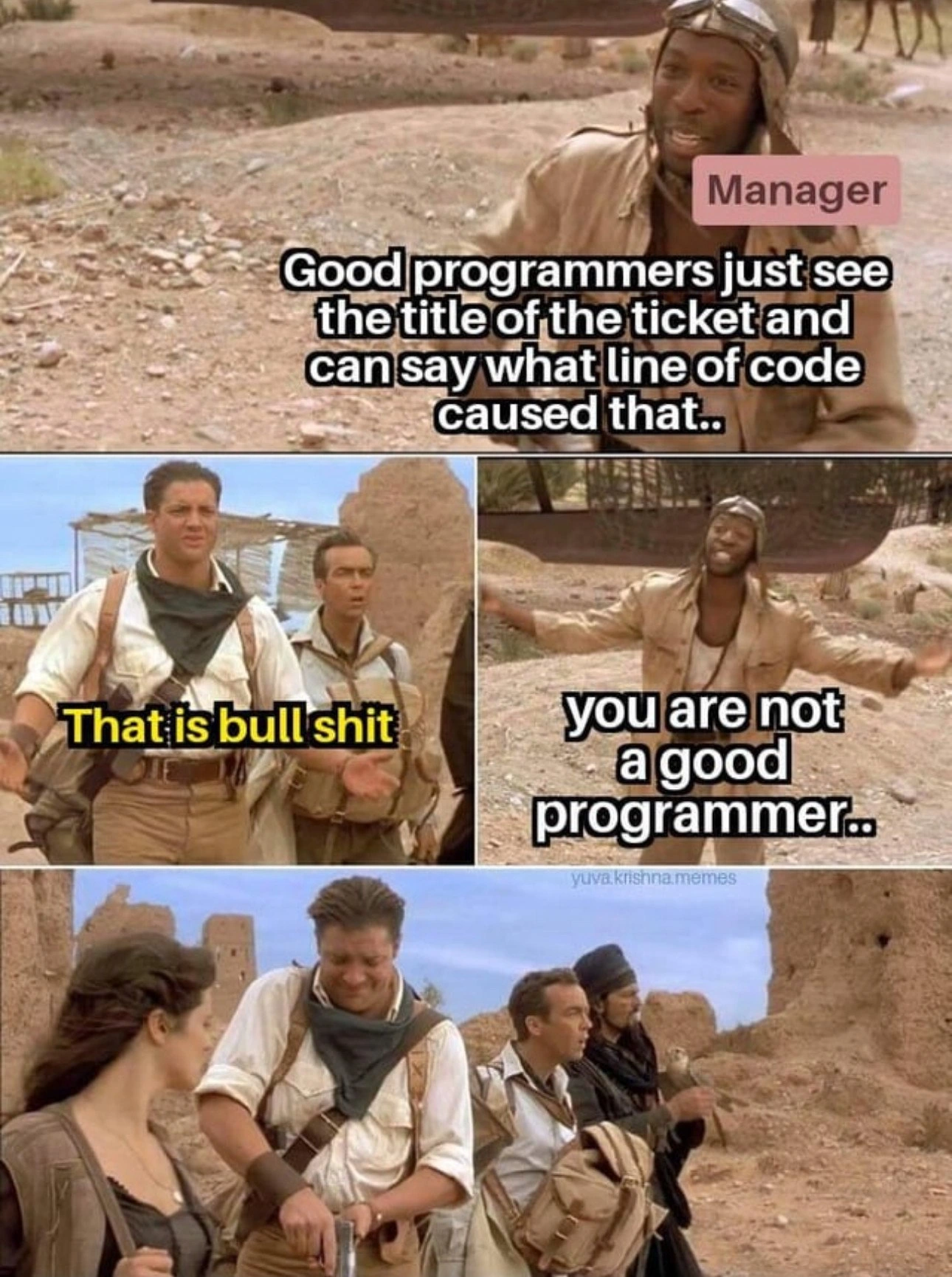
Let’s break down what’s happening in simpler terms. The meme is joking about a manager (a boss or project leader) who thinks programmers have almost magical abilities. He believes a “ticket” (which is basically a bug report or a task in a system like Jira) contains all the info needed – that a “good” programmer can read the short title of that bug report and immediately know exactly which part of the program (even down to a specific line of code) is causing the problem. This idea is ridiculous to developers, and the other characters in the meme react by basically saying, “No way, that’s nonsense!” (Hence the bold caption “That is bull shit” under the stunned explorer).
In reality, here’s how debugging works when a bug or issue comes in: a programmer needs to investigate and gather clues, almost like a detective solving a case. The title of a Jira ticket is usually a one-line summary, like “App crashes when clicking Save.” That’s just the starting hint. To actually fix the bug, the developer has to do a lot more. Some typical steps include:
- Reproduce the issue: Run the application and try to make the crash or bug happen again by doing what the bug report says (e.g. click “Save” and see it crash). If you can’t reproduce it, you can’t investigate it well.
- Gather information: Look at any error messages or logs (logs are files where the app writes down what it’s doing, especially any errors). Often, we get a stack trace – this is a list of function calls the program made right up to where it crashed, kind of like a trail leading to the problem. This can tell us which part of the code blew up.
- Isolate the cause: Using debugging tools or even just adding some
printstatements, the programmer checks where exactly things start going wrong. Maybe the bug happens when saving data to the database, so you inspect the database code path. - Identify the faulty code: Once you narrow it down, you find the section (perhaps a function or a couple of lines) that doesn’t work as expected. It might be a missing check (like not handling a null value), the wrong formula, or just a typo.
- Fix and test: After making a change to fix the issue, you run the app again (and ideally write or run tests) to make sure the crash is gone and that you didn’t break anything else.
Each of those steps takes time and thought. Even to find one line of code that’s causing a bug, a programmer might have to read through many files, try multiple things, and use various tools. It’s not instantaneous, and it’s certainly not done by mind reading the ticket title. The title helps us know where to begin (for example, “crash when clicking Save” points us to look at the saving functionality), but it’s nowhere near enough detail to just know the answer.
Now, a non-technical manager (someone in charge who doesn’t write code) might not understand all this. They might assume that since programmers wrote the software, they remember every detail and can immediately pinpoint any problem. But modern software (especially large applications or systems) is usually developed by many people over time and can have millions of lines of code. No single person memorizes all of that or instantly knows what’s wrong when something breaks. Developers use observability tools (like reading logs, monitoring dashboards, and error reports) to understand issues. It’s very much like investigating a puzzle or troubleshooting why a machine isn’t working – you look at symptoms, try things out, and gradually figure it out.
The meme highlights ManagementHumor by poking fun at this misunderstanding. The manager character basically says “if you can’t do this psychic debugging, you’re not a good programmer,” which is an unfair and ignorant statement. The other explorer yelling “bullshit” is representing the developer’s perspective: he’s calling out that statement as completely false. It’s a moment of DebuggingFrustration turned into a joke. Every developer sometimes faces pressure to solve problems super fast, but good debugging requires patience and method.
Key terms explained:
- Ticket (in Jira): A ticket is like a digital note or card that describes a task or a bug. In Jira (a popular project management tool), each bug gets a ticket with a title (short summary) and description (details, steps to reproduce, etc.). Example: Ticket title “Login page error” might have a description “Users get a red error when logging in. Error code 500.”
- Debugging: The process of finding and fixing bugs (errors) in the code. It’s like hunting down the cause of a problem in the program.
- Stack trace: When a program crashes or errors out, it often prints a stack trace, which is basically a list of function calls in the reverse order they happened, leading to the crash. It’s a very useful clue. For instance, a stack trace might say the program failed in
FunctionC, which was called byFunctionB, which was called byFunctionA. That tells the developer where to look in the code. - Logs: These are records that the application writes out while it runs, often detailing events, errors, or important checkpoints. Reading the logs can tell you what was happening right before the crash or bug.
- Observability: A buzzword meaning how well you can understand what’s happening inside a system from the outside. It includes logs, metrics (like CPU usage, request rates), and traces. Basically, all the data that helps you observe the internal workings of the software in production.
- Line of code: Just literally a line in the program’s source code. Code is typically numbered by line for reference. Saying “line of code that caused it” implies a very specific pinpoint in the program’s text where the bug lies.
For a junior developer (or a student new to coding), the takeaway is: Don’t feel “not good enough” if you can’t immediately see a bug’s cause from a one-line bug report. Nobody can do that in any complex system. Real developers, even senior ones, have to investigate methodically. The meme is exaggerating to make a point: a manager who believes in a kind of ticket_title_clairvoyance is out of touch. Good programmers aren’t those who magically know all answers; they’re the ones who know how to use tools, ask good questions, and work through the debugging process efficiently. The funniest part is that the team in the meme doesn’t even try to politely explain – they outright call it nonsense and walk away. In reality, a junior dev might feel pressure when a boss or client asks for immediate answers, but it’s okay to say “I need to look into it.” That’s the honest and professional approach. This meme uses humor to reassure us that the crazy expectation is on the manager, not on you as the developer.
Level 3: Ticket Title Telepathy
Manager: “Good programmers just see the title of the ticket and can say what line of code caused that.”
Engineer: “That is bullsh*t.”
The meme captures a hilariously misaligned expectation between non-technical management and reality. The manager in the first panel grandly claims developers should debug issues almost telepathically — as if merely reading a short Jira ticket title gives mystical insight into the exact broken line in a million-line codebase. This is the absurd magical_debugging_expectations that senior engineers immediately recognize as nonsense. In real life, software bugs don’t broadcast their location via ESP or mummy curses, no matter what some clueless boss might fantasize.
Seasoned developers have seen this scenario play out in many forms. Maybe a project manager lightly strolls over, coffee in hand, asking “So you saw the bug report title — you know what’s wrong already, right?” Meanwhile, you’re staring at a sea of microservice logs at 3 AM, groaning because real debugging involves actual detective work, not crystal-ball gazing. The humor cuts deep: anyone who’s been on-call for a production outage knows that you can’t just divine the failing line_of_code by gut feeling. You need data. You need steps to reproduce the bug, error stack traces, log files, maybe a memory dump or two. In short, you need observability and analysis, not some managerial incantation.
The manager’s fantasy here completely ignores the cognitive load of modern development. No engineer (not even the ones who wrote the code) carries a complete mental map of a large system’s every line. Codebases are often too massive and interconnected for one person to know every nook. Sure, experienced devs develop a sixth sense for common pitfalls – like suspecting a null pointer or a misconfigured database when hearing a bug description – but that’s hard-earned intuition, not omniscience. And even those hunches must be verified with actual debugging. Debugging_Troubleshooting is a systematic process of elimination, not a parlor trick. The meme bluntly calling “That is bullsht”* is a cathartic stand-in for what many of us wish we could say in sprint planning meetings when a higher-up drops unrealistic comments.
Consider the phrase “can say what line of code caused that.” The manager reduces a complex failure to a single offending line, as if bug fixing is just finger-pointing at a lone culprit in the code. In reality, bugs are often the result of several things going wrong in concert: an unseen edge case, a data format change, a configuration tweak in another service. It’s rarely as simple as “line 153 in Foo.java is wrong, case closed.” By expecting instantaneous pinpointing of a bug, the manager is implying any delay in response means you’re “not a good programmer.” That’s a toxic ManagerExpectations issue – it pressures developers to make wild guesses to appear competent. We’ve all seen panicked blame games where someone hastily guesses “it must be the login module!” just to appease a boss, only to later discover the root cause was elsewhere entirely. Good engineers resist that knee-jerk blame and instead gather clues methodically. As the meme depicts, the rest of the team literally walks away in disbelief by the final panel – a perfect dramatization of engineers mentally checking out when leadership expectations veer into fantasy land.
This meme cleverly uses a scene from The Mummy to exaggerate the absurdity. The “Manager” character waving his arms is like those out-of-touch bosses we joke about, invoking a kind of jira_ticket_mythology where bug titles are all-powerful oracles. The explorer team’s exasperated reaction (“bullsh*t!” and walking away) is the development team collectively facepalming and exiting the conversation. It’s a comedic release: we laugh because it’s so true. Every senior dev has war stories of being asked for on-the-spot answers about complex bugs with barely any info. We’ve learned the hard way that debugging is a grind of careful troubleshooting, not a flashy mind-reading act. If telepathic debugging were real, we’d all have much quieter pagers and a lot more sleep.
In summary, the humor hits home because it skewers a real workplace dynamic: ManagementHumor rooted in a MisalignedExpectations gap. The manager expects a magical level of insight – like a ticket_title_clairvoyance – that no real engineer possesses. And the engineers respond with open disbelief, which is satisfying because in real life we usually have to bite our tongues. It’s a nerdy sort of vindication seeing that DeveloperReality acknowledged: no, we can’t just sniff out bugs like bloodhounds from a one-line description. If we could, we’d all be wizard level programmers (and we’d charge a lot more per hour!). Instead, we rely on good old-fashioned debugging and troubleshooting. The meme’s punchline is basically our collective inner voice saying “Give me a break – debugging is hard work, not Hogwarts.”
Description
This is a four-panel meme using scenes from the 1999 movie 'The Mummy'. In the first panel, a character labeled 'Manager' states, 'Good programmers just see the title of the ticket and can say what line of code caused that..'. The second panel shows another character, representing a programmer, reacting with the subtitled text, 'That is bull shit'. In the third panel, the manager character retorts, 'you are not a good programmer..'. The final panel shows the group of characters looking away in awkward silence, conveying a sense of resignation. The meme humorously critiques the unrealistic and often absurd expectations that non-technical managers can have of software developers. It highlights the vast oversimplification of the complex, investigative process of debugging, contrasting the manager's belief in a magical diagnostic ability with the developer's grounded, and frustrated, reality. This scenario is highly relatable for senior engineers who have often had to manage such expectations

Comments
15Comment deleted
Some managers think reading a bug ticket is like a DNS lookup - a direct path to the faulty line's address. They don't realize it's more like BGP, where you spend hours staring at routing tables just to find out the problem is in a completely different autonomous system
Fine, boss - let me just grep the stack for vibes and deploy the psychic hotfix to prod
After 20 years in the industry, I've learned that managers who think you can debug from ticket titles alone are the same ones who believe 'it worked on my machine' is a valid deployment strategy and that adding more developers to a late project will make it ship faster
Ah yes, the mythical 'psychic debugger' skill that managers believe appears at Senior Engineer III level. In reality, even the most experienced architects need stack traces, logs, reproduction steps, and probably three cups of coffee before identifying root causes - but sure, let's pretend we can divine the exact line number from a ticket titled 'App broken pls fix urgent!!!'
Experienced devs know: 90% of debugging is translating 'urgent pls fix' into a stack trace autopsy
If titles mapped to line numbers, I’d cron a script to grep Jira subjects, run git bisect, and retire on the savings from cancelled standups
Pinpointing a line from a ticket title only works when the entire system is a 300‑line script called do_everything.py - otherwise it’s called observability, not clairvoyance
That’s actually true Comment deleted
It looks like a Bug ticket Comment deleted
All bug ticket titles are just reminders for your tech debt you left there on purpose. You always know exactly which one. Comment deleted
This meme sponsored by Jia Tan Comment deleted
Ticket: Develop a new micro-service for managing a system of services for ocr Lines of code that caused it: inside PMs schizophrenia induced dreams Comment deleted
My manager: "Good programmers just see the title of a user story, and write down acceptance criteria by themselves" Comment deleted
That’s sometimes true. But knowing the line does not mean that it is known how to fix it Comment deleted
Aaaaand knowing a way to fix it doesn't mean knowing the right way to fix it Comment deleted