Skip to content
DevMeme
2046 of 7435
When Your Classifier Promises Squirrel Detection But Outputs Nonsense Math Instead
AI ML Post #2280, on Nov 10, 2020 in TG

When Your Classifier Promises Squirrel Detection But Outputs Nonsense Math Instead

Why is this AI ML meme funny?

Level 1: Overthinking It

Imagine you ask your friend to help you spot a squirrel in your backyard. You point and say, “Hey, is that a squirrel on the fence?” Now, instead of just glancing over and saying “Yes, it’s a squirrel!” your friend pulls out a giant notebook and a calculator. They start furiously adding, multiplying, writing down numbers, their forehead even has little veins popping out because they’re trying so hard. After a while, you ask again, “So… is it a squirrel?” and your friend proudly announces, “I did all these calculations and according to my math, 5 + 6 = 9!” – which isn’t even correct… and also not the answer to your question at all! You’d probably blink in surprise and then burst out laughing, thinking, “What on earth are you doing? I just wanted a simple yes or no!”

This meme is showing exactly that kind of silly situation but with a computer program (an AI) instead of a friend. We expected the computer to do something simple – recognize a squirrel like a dog would. But instead, it overcomplicated everything, doing tons of pointless math and still getting the answer wrong. It’s funny because the computer is basically overthinking it. Just like a person who overthinks a simple problem and ends up confusing themselves, the AI here turned a straightforward task into a big, wrong mess. The dog in the top picture represents the easy, correct solution (“Squirrel!” wagging tail, done ✅), and the bottom picture represents the goofy over-thought solution (lots of work, wrong answer ❌). The humor is that sometimes fancy machines or smart-looking people can mess up something obvious by going about it the hard way. In the end, the meme is a chuckle-worthy reminder: sometimes doing too much is as bad as doing nothing at all, and a little dog’s instinct can beat a high-speed computer that’s trying to be smart but totally missing the point.

Level 2: Classifier Crash Course

Let’s break down the meme in more straightforward terms. We have two scenes:

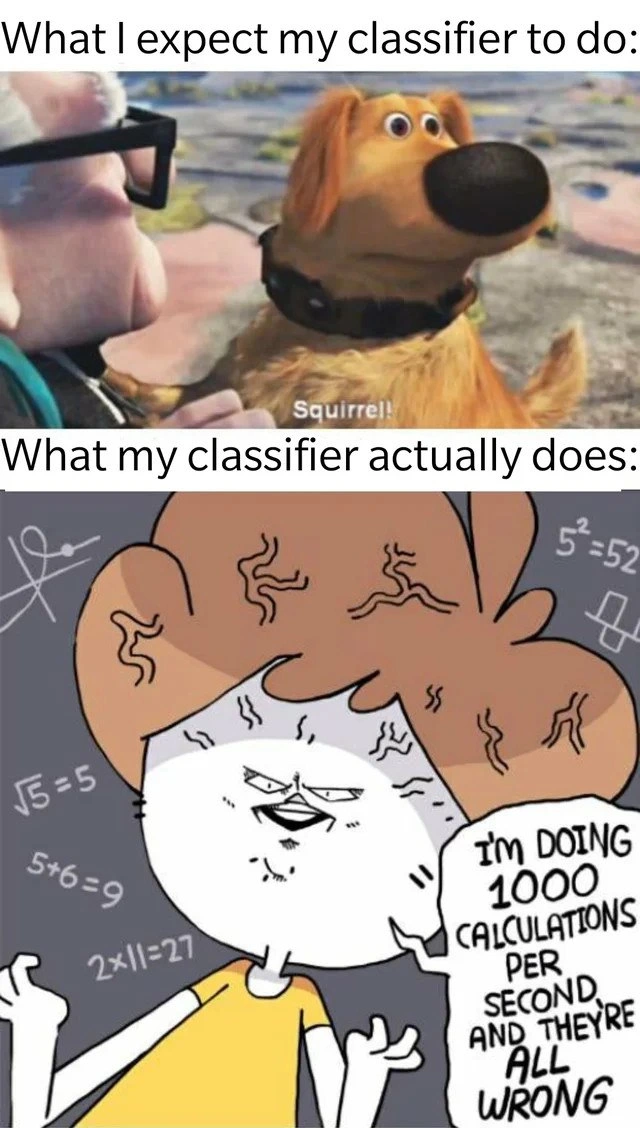
  • Top panel: Pixar’s dog Dug from Up excitedly yells “Squirrel!” This caption says “What I expect my classifier to do:”. Here, Dug represents what we want – a quick, correct identification of a squirrel. In tech terms, a classifier is a kind of AI model that looks at input data (like an image) and tries to classify it into a category (in this case, the category would be “squirrel” vs “not squirrel”). So ideally, if you show the model a picture of a squirrel, it should confidently output “Squirrel!” just like the dog does when he sees a squirrel in the movie. It’s a simple and accurate reaction. We expect our fancy AI to be as sure and straightforward as a dog recognizing a squirrel in the park.

  • Bottom panel: Instead of that simple outcome, we see a cartoon character with bulging veins, surrounded by crazy wrong math scribbles (√5 = 5, 5+6 = 9, 2×11 = 27, etc.). The caption here is “What my classifier actually does:”. And the character is saying, “I’m doing 1000 calculations per second and they’re ALL WRONG.” This represents the AI model’s actual behavior: it’s working really hard (lots of calculations) but giving a totally wrong output (nonsense math answers, which symbolize wrong classifications or predictions). In other words, our classifier isn’t calmly saying “squirrel” when it sees a squirrel. Instead, it’s as if it’s spitting out gibberish or making incorrect judgments, despite using a ton of computing power. Visually and textually, it’s a big misclassification fail – the model is not doing what it’s supposed to do.

Now, why would this happen? Let’s explain some key terms and ideas in simple words:

  • Classifier: In machine learning, a classifier is a program that answers a question like “What is this?” for a given input. For example, you feed it a photo of an animal, and it will try to answer “That’s a squirrel” or “That’s a cat” or whatever categories it knows. You can think of it as an extremely picky sorter: give it something, and it puts it in a bucket (label) based on patterns it learned. We trained this classifier expecting it to put squirrels in the “squirrel” bucket every time it sees one.

  • Expectation vs. Reality: This meme is a classic expectation vs. reality joke. We expected the AI to perform great (like the dog who immediately spots the squirrel). In reality, we got a mess – the AI’s output doesn’t make sense. It’s like when you run a new piece of code expecting a correct result, and instead you get a screen full of errors or weird outputs. Here the weird outputs are represented by wrong math equations — basically a metaphor for “completely wrong answers.” The AI was supposed to detect an animal, but it’s acting as if it’s doing complicated math (and doing it badly at that!).

  • Misclassification: This is when the AI guesses the wrong label. If the AI sees a squirrel but outputs “cat” or some random number, that’s a misclassification. It’s a bug in terms of the model’s performance. In the meme, the wrong math like “5+6=9” is analogous to a misclassification error — it’s obviously incorrect, so it’s as if the model is confidently giving the wrong answer to a simple question. (We expected “Squirrel!”, we got nonsense.)

  • Bugs in AI: In software, a bug usually means there’s a mistake in the code causing an error. In AI, bugs can be trickier: sometimes the code runs fine, but the logic or the learning is flawed, so the model gives bad results. It’s as if there’s a hidden bug in the training process or data. For example, maybe the training data was bad (perhaps most squirrel pictures it saw were blurry, so it learned something wrong), or maybe we coded the algorithm incorrectly (like we gave it the wrong objective). The result is an AI that technically runs (no error messages, it does do “1000 calculations per second”) but the outcome is wrong every time – a silent bug in the model’s understanding. That bottom panel character bragging about calculations is like a program that says “I executed successfully!” but when you check the output, it’s garbage.

  • Overfitting: This is an important concept to explain why an AI might do this. Overfitting happens when a model learns the training data too well, including all the quirks and noise, and fails to generalize to new examples. It’s like a student who memorized practice test answers word-for-word instead of actually learning the material – they do great on the practice test but flunk the real test with new questions. In our case, perhaps the classifier saw only a few squirrel images during training, and maybe those all had something in common (say, all the squirrels in training data were on green grass). The model might have unconsciously learned “anything on green grass is a squirrel.” If you then show it a brown dog on green grass, it might wrongly say “squirrel” because of that misguided rule. It’s doing a bunch of calculations based on a pattern that doesn’t truly represent “squirrel,” hence it’s overfitted to a wrong pattern. In the meme, the AI’s bizarre arithmetic is a caricature of overfitting – it’s doing some pattern internally (like consistently adding wrong) which might match its training examples but is fundamentally incorrect. The model is effectively overthinking: it’s too complex and hasn’t actually learned the general concept of a squirrel, only some accidental pattern.

  • AI limitations & hype: There’s often a gap between what people think AI will do and what it actually does, especially if you’re new to it. You might have heard the hype that “AI will solve everything! It can see and understand like humans!” But in practice, AI is just a complicated computer program crunching numbers. If anything is off – the data, the parameters, the design – it can behave in silly ways. The meme’s second panel is basically saying: “Yeah, the AI is super fast and ‘smart’ in a way, but it can also be super wrong.” It’s a humorous reminder that AI doesn’t have common sense. It won’t shout “Squirrel!” just because it should; it will do whatever its internal math tells it, even if that math has become nonsensical.

For a junior developer or someone starting in ML, this scenario is a cautionary tale. You might train your first image classifier and be excited that it runs at all. But then you test it on a new image and scratch your head when it outputs something absurd. The meme basically is that experience drawn as a comic. The dog in the first panel is like your optimistic expectation (“This will be easy, the model will just work!”), and the veiny cartoon in the second panel is reality biting back (“Oops, my model is spitting out rubbish.”). It’s funny in hindsight because we’ve been there – like writing a program that compiles without errors on the first try (yay!) but then the output is completely wrong (oh no!). In this case, the classifier_errors are obvious (like seeing 2×11=27 wrong on the “screen” of the model’s mind), so it’s easy to laugh at how off-base it is.

In simpler terms: the meme teaches that just because a computer is doing a lot of calculations doesn’t mean it’s doing the right thing. A classifier can be wrong if not set up correctly, no matter how fast or fancy it is. The expectation vs reality joke here is a lighthearted way to show newbies that building a working AI isn’t as straightforward as it seems — sometimes your AI will confidently tell you something completely incorrect. The good news is, once you know this can happen, you can learn from it (check your data, simplify the model, use validation tests) so your next attempt will be more like Dug (correct and eager) and less like the math scribble guy (busy but clueless).

Level 3: Barking Up the Wrong Tree

At a senior engineering level, this meme nails a familiar AI hype vs. reality scenario. We often expect our shiny new model to perform a simple task (like “find the squirrel in this image”) as easily as Pixar’s dog Dug shouting “Squirrel!” on cue. That’s the expectation: a straightforward, accurate classification. But the reality is captured in the bottom panel: the classifier is wildly misbehaving, doing tons of work and getting it all wrong. The humor comes from that jarring contrast. We’ve got a dog (the simplest classifier nature ever built, who just knows a squirrel when he sees one) versus a presumably advanced AI system that, instead of saying “Squirrel”, is spewing out broken math like some deranged calculator. It’s expectation_vs_reality for any machine learning project in a nutshell: We hoped for Dug, but we got a derp.

Why is this so funny (or painful) to developers? Because it’s too real. We’ve all seen a program or model that by all accounts should work, yet its output is utter nonsense. In the meme, the character with bulging forehead veins proclaiming, “I’M DOING 1000 CALCULATIONS PER SECOND AND THEY’RE ALL WRONG,” perfectly encapsulates a certain kind of bug we dread: the one where the system is hard at work, confidently wrong, and not telling you it’s wrong. This is the kind of bug where nothing crashes, no alerts fire – the algorithm runs flawlessly from a computational standpoint, yet the results are garbage. It’s doing exactly what you told it to do, but not what you wanted it to do. That phrase is a direct punchline for anyone who’s grappled with a stubborn ML model: the model brags about its throughput (maybe you even optimized it with GPU acceleration for 10x speed!), but it doesn’t have a clue what a squirrel actually looks like. The meme exaggerates it with silly arithmetic errors as a metaphor for logical errors. It’s basically the AI saying, “Look how busy I am!” while the engineer facepalms because all that busy-ness is worthless.

In practice, scenarios like this happen with mis-trained models or algorithmic bugs. Maybe the training data was flawed or too small, so the model “overfit” - it learned patterns that don’t generalize, effectively misclassifying new images. The result is an AI that might have seemed fine in lab tests but in the real world it’s identifying every rock as a squirrel or outputting some random number rather than a yes/no squirrel answer. The top panel’s simplicity (“Squirrel!”) versus the bottom panel’s over-complication (“5+6=9?!?”) is a comedic exaggeration of over-engineering: a senior dev recognizes the trope of a simple problem tackled with an overly complex, utterly wrong solution. It’s like using a quantum computer to calculate 2+2 and getting 5 – the senior folks smirk because they’ve seen teams throw massive resources and fancy algorithms at a problem without truly understanding the problem, ending up with a fast, complicated failure. All crunch, no clue.

This meme also touches on the collective PTSD of ML engineers: you spend days or weeks training a deep learning model (watching those epoch losses go down, feeling optimistic), and when you finally run it on real-world data, it’s embarrassingly off. Perhaps the model latched onto the wrong features (like background scenery or noise) instead of the actual squirrel. There’s a well-known cautionary tale: a classifier trained to distinguish wolves vs dogs got high accuracy on test data until someone realized it was simply looking for snow in the background of wolf photos. The model wasn’t truly “seeing” the animal; it was doing a dumb heuristic at lightning speed. In essence, it was doing “1000 calculations” on pixel values but basing its decision on the wrong clue — just like our meme’s brainless math savant. Misclassification errors often lurk until a human spots the obvious mistake the model is making. In our meme, anyone can see the math is wrong, analogous to any human seeing “that’s not a squirrel, why did you say it is?” But the poor AI doesn’t have that common sense; it confidently delivers wrong answers because it doesn’t know they’re wrong.

From a senior perspective, the meme is also a nod to AI_ML bugs being a different beast than typical software bugs. There’s no stack trace or exception thrown when your model is conceptually wrong. It’s a silent failure. You have to catch it with thorough testing and validation. Experienced engineers will chuckle (and cringe) because they’ve learned that a model can achieve great metrics on paper and still be fundamentally broken. Maybe the training set was too narrow (so the model thinks all brown furry things are squirrels, including a brown hat or a rabbit), or maybe there was a data preprocessing error (e.g., all squirrel images were accidentally labeled as “dog” during training, so the model is systematically confused – doing lots of calculations but following the wrong objective). There’s also a commentary here on AI hype: to non-engineers, hearing “this AI runs 1000 calculations per second” sounds impressive, just as the character in the meme seems proud of that rate. But insiders know throughput is meaningless if your algorithmic logic is flawed. It’s reminiscent of the old programming joke: “Our program gives the correct answer in 0.001 seconds 0% of the time.” Speed and complexity don’t matter when the accuracy is near zero.

Organizationally, this is the kind of issue that causes those awkward meetings with managers who bought into AI hype. “Wait, didn’t you say our squirrel detector was 99% accurate? Why is it labeling my cat as a squirrel, and outputting some weird numbers?” The senior engineer then has to explain that the model was probably evaluated on easy cases or overfitted data, and in the wild it’s failing – essentially living the meme. It underscores why we have practices like cross-validation, test sets, and why “it works on my dataset” is the new “works on my machine”. If you’ve ever scrambled to fix a model that went into production and started doing wacky things, the bottom panel’s frantic “I’m doing lots of work!” energy is all too familiar. This meme is a humorous reminder that in AI development, expectation_vs_reality can bite you: sometimes your “smart” model ends up dumber than a cartoon dog, and it takes a seasoned team to diagnose and correct that (maybe by collecting more data, adding regularization, or simplifying the model — sometimes the simple solution is best). In summary, the senior takeaway is: yes, we’ve seen classifiers promise squirrel detection but give us nonsense instead, and it’s both funny and painfully true.

Level 4: No Free Squirrels Theorem

At the most theoretical level, this meme highlights fundamental machine learning truths. In ML theory there’s a saying akin to a No Free Lunch theorem (here humorously a “No Free Squirrels” theorem): no algorithm can magically solve every problem without the right data, assumptions, and tuning. Our poor classifier was supposed to detect a squirrel—a straightforward task for a living brain like Dug the dog—but mathematically, the model has latched onto the wrong patterns. Instead of recognizing the shape or features of a squirrel, it’s internally doing something nonsensical, like computing √5 = 5 or 2×11 = 27. This suggests the model found a function that fits the training data (perhaps by brute-force memorization or spurious correlations) but doesn’t reflect reality. In learning theory terms, it has extremely high variance and nearly zero bias, meaning it can exactly fit some data points (maybe every squirrel image it saw during training) while being totally absurd elsewhere. The scribbles like 5+6 = 9 are an absurdist illustration of a function approximation that is mathematically misguided – the model is effectively constructing a decision boundary or set of rules that look as wrong to us as bad arithmetic, yet within the training set it might have “seemed” correct.

Why would a classifier do “1000 calculations per second” all wrong? This touches on the core of overfitting and the limits of computation in AI. Modern classifiers, especially deep neural networks, perform millions or billions of numeric operations (like multiplying weights by inputs, adding biases, applying activation functions). They are incredibly powerful universal function approximators. However, that power is a double-edged sword: with enough complexity, a model can memorize noise. The meme’s frantic math symbolizes a model that has essentially learned a complicated formula that produces an answer – just not the right answer for new input. The generalization ability (how well the model works on data it wasn’t trained on) is basically broken. Theoretically, if you have a model with enough parameters, it can fit random labels perfectly (zero training error) while having no predictive power on real patterns. It’s like having an overly flexible polynomial curve that goes through all your data points but oscillates wildly everywhere else. Here the classifier’s internal “math” is that wild curve – it’s computing something, but those computations aren’t grounded in the true concept of "squirrelness". We’re seeing the “generalization gap” in action: the difference between how well the model did on its training data vs. how disastrously it’s doing on new data (i.e., actual squirrel images in the wild).

This meme humorously exposes a fundamental constraint in AI: more computation doesn’t automatically mean more understanding. The laws of learning theory require a model to have the right inductive bias (some reasonable assumptions or constraints) and quality data. Otherwise, as the meme jokes, the model can crank away with intense calculations and still get everything wrong. It’s a nod to the academic truth that an ML system without proper regularization or validation is free to “solve” the training problem in bizarre, unintended ways. In short, the classifier here illustrates a kind of worst-case scenario from theory: a model that technically optimized something (probably minimized the loss on the training set) but ended up encoding a completely nonsense strategy. The result? A super fast, busy algorithm that might as well be outputting 5^2 = 52 – it has mastered the art of being confidently wrong. The deepest irony (and the deep humor for us nerds) is that the math underpinning AI, if misapplied, allows for elaborate solutions that utterly fail the real goal. The meme captures that dichotomy between raw computational horsepower and the correctness of the solution, reminding us that without the right approach, even a powerful classifier can devolve into a flurry of meaningless math.

Description

Two-panel meme. Top panel shows Pixar’s Dug the dog excitedly shouting “Squirrel!” with the caption “What I expect my classifier to do:”. Bottom panel is a cartoon of a smug character with squiggly veins popping, surrounded by scribbles like “√5 = 5”, “5+6 = 9”, “2×11 = 27” and the caption “What my classifier actually does:”. A speech bubble from the character says, “I’M DOING 1000 CALCULATIONS PER SECOND AND THEY’RE ALL WRONG”. Visually it contrasts a simple, accurate classification goal with a noisy, computationally expensive yet incorrect reality - echoing common machine-learning woes such as overfitting, poor generalization, and silent model bugs

Comments

6
Anonymous ★ Top Pick Demo day: 99% AUC on squirrel detection; prod day: 1000 TPU cores loudly proving √5 = 5 while tagging the CEO’s face as “squirrel” - and Kubernetes still reports healthy
  1. Anonymous ★ Top Pick

    Demo day: 99% AUC on squirrel detection; prod day: 1000 TPU cores loudly proving √5 = 5 while tagging the CEO’s face as “squirrel” - and Kubernetes still reports healthy

  2. Anonymous

    After 15 years of building ML systems, I've learned that the real feature engineering is convincing stakeholders that 60% accuracy is 'state-of-the-art' when your model confidently misclassifies everything at inference speed that would make a FAANG engineer weep with joy

  3. Anonymous

    This perfectly captures the moment when you realize your classifier has 99.9% accuracy on the training set but somehow manages to confidently misclassify every single production sample - turns out memorizing 'squirrel' in 47 different fonts doesn't help when the real world throws you a chipmunk. The model's doing more floating-point operations than a GPU farm but with the decision-making capability of a regex that matches everything. Classic case of high computational cost, low information gain - the machine learning equivalent of using a blockchain to store a boolean

  4. Anonymous

    Expected O(1) squirrel lookup; got 1000 FLOPs/sec of confidently bogus gradients

  5. Anonymous

    After all the tuning, our classifier does 1000 inferences/sec with an AUC of 0.5 - congrats, we built a highly available coin‑flip microservice

  6. Anonymous

    We hit the latency SLO, but recall dropped to zero - basically a globally distributed wrong-answer cache

Use J and K for navigation