Windows 11 Greeted As Malware by Stick Figure Characters
Why is this Microsoft meme funny?
Level 1: Turning Up the Heat
Imagine you have a storytelling robot that can tell lots of different stories. You can set a “silliness dial” on this robot. When the dial is low, the robot always tells the same safe, sensible story that makes perfect sense – it doesn’t take any risks. When the dial is high, the robot starts throwing in wacky plot twists and funny random ideas; the stories get more unpredictable and silly. In real life, this dial is called temperature for AI language models. It’s kind of like the heat setting on an oven or a stove. If a chef doesn’t know what the oven temperature knob does, they might say something silly like, “Oh, turning up the oven changes the color of the food,” instead of realizing it makes the oven hotter to cook food faster or slower. That’s what happened in this meme: someone who’s supposed to be an “AI expert” didn’t actually know what the temperature dial really does for a text-generating AI. They gave a nonsense answer (like saying the oven knob changes the food’s color) when asked why the AI becomes more predictable or more random at different temperature settings.
The funny (and a bit embarrassing) part is seeing an “expert” caught without basic understanding – kind of like a pretend magician forgetting how his own trick works and just saying “uhh, it’s magic vibes.” Everyone who knows how the trick actually works can’t help but laugh or facepalm. So the meme is joking about this: the AI expert who forgot the science and was just winging it. At the simplest level, it’s humorous because it’s a universal scenario – someone acting like they know everything, getting called out with a basic question, and then fumbling. It’s like asking a self-proclaimed bike expert why turning the handlebars changes direction, and they answer, “it changes the shape of the wheels” – completely missing the point! Here, the “temperature” setting is that handlebar, and the “LLM expert” clearly had no clue, which made the real specialist want to cry out of disbelief. Essentially, we’re laughing because even in high-tech AI, you have folks who talk the talk but don’t walk the walk, and it’s always a little comical to see the bluff called in such a simple, obvious way.
Level 2: Hot vs Cold Predictions
Let’s break down what’s actually happening with this mysterious temperature_hyperparameter in an LLM, in plain terms. LLM stands for Large Language Model, a type of AI that generates text (like how ChatGPT or GPT-4 works). When an LLM is about to generate the next word (or part of a word, known as a token), it has a list of all possible tokens and a score for each (how likely each token is according to the model’s training). These raw scores are called logits. Now, the model needs to turn those scores into actual chances (probabilities) of picking each word. That’s where softmax comes in. The softmax function is a mathematical operation that converts scores into probabilities that sum up to 1 (i.e., 100%). By default, the highest score becomes the highest probability, but every option with any score gets some chance.
Now, the temperature setting is basically a lever that shrinks or stretches these scores before we pick a token. If this sounds abstract, consider this: Lowering the temperature makes the highest score dominate even more, while raising the temperature makes the scores more even with each other. In practical terms:
- Low temperature (e.g. 0.2 or 0.5): The model becomes very sure of itself. It will almost always pick the top-scoring token (most likely next word) and ignore the less likely ones. The output is very predictable (deterministic). It’s like the model is playing it safe, almost like autofill on your phone that always chooses the most sensible completion.
- High temperature (e.g. 1.5 or 2.0): The model becomes more adventurous or random. Even if one token has a higher score, with a high temp, the model might still pick a lower-scoring token occasionally. This means more variety in the output – sometimes creative, surprising, or even nonsensical results. It’s the model taking chances, tossing in a dash of randomness.
Why call it “temperature”? It’s an analogy: imagine particles in a heated gas jostling around. At high temperature, they move wildly (our model output gets “wild” and varied). At low temperature, they calm down and settle (our model output becomes consistent and repetitive). Under the hood, this is implemented by a formula (related to something called a boltzmann_distribution from physics) that uses the temperature value to scale the softmax. But you don’t need a PhD in physics to get the gist: temperature is just a fancy knob for probability_scaling.
Let’s peek at how this works with actual numbers quickly. Suppose a model gives three possible next tokens these scores (logits):
import numpy as np
logits = np.array([2.0, 1.0, 0.1]) # example scores for 3 different tokens
def softmax(logits, temperature=1.0):
exps = np.exp(logits / temperature)
return exps / np.sum(exps)
print(softmax(logits, temperature=1.0)) # Normal temperature (T=1.0)
# -> [0.66, 0.24, 0.10] (rough probabilities at T=1)
print(softmax(logits, temperature=0.5)) # Lower temperature (T=0.5)
# -> [0.86, 0.12, 0.02] (more deterministic, one token dominates)
print(softmax(logits, temperature=2.0)) # Higher temperature (T=2.0)
# -> [0.50, 0.30, 0.20] (more random, probabilities are spread out)
You can see the pattern: at T=0.5, one option becomes almost 86% likely (so the model would almost always choose that one next token). At T=2.0, the odds spread out (50%, 30%, 20% — much more room for a surprise choice). This is exactly why raising the temperature gives more random outputs, and lowering it makes output more stable.
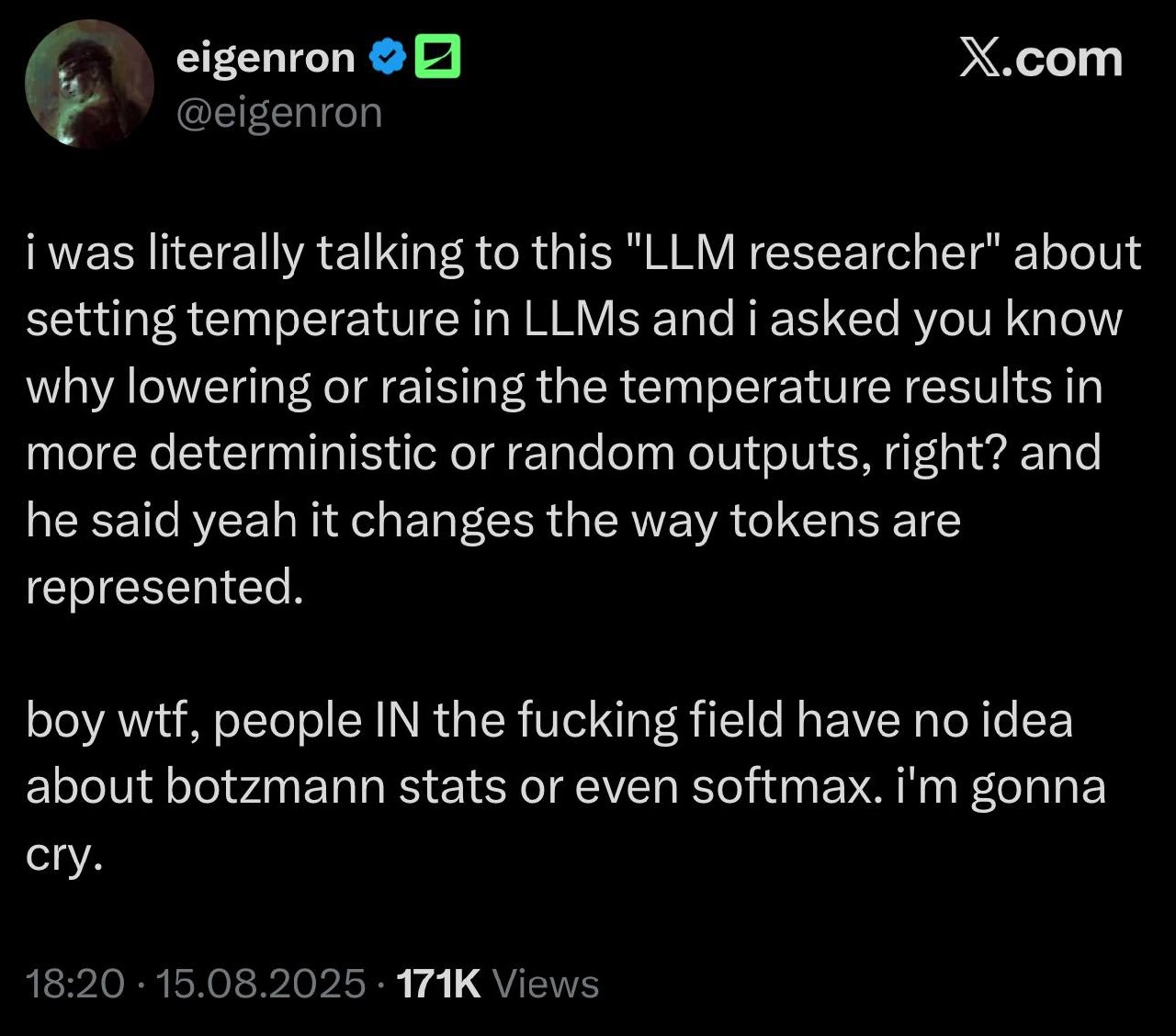
Now, what’s funny (and a bit frustrating) in the meme is that the so-called “LLM researcher” didn’t seem to know any of this. When asked why changing $T$ affects randomness, he said something completely off-base like “it changes the way tokens are represented.” That’s not true – the tokens themselves (like the words or pieces of words) don’t change at all! We’re just changing how we pick which token comes next. It’s as if he didn’t understand the core mechanism (the softmax and probability part) and was just guessing. The meme calls this out because anyone who has fiddled with an LLM parameter like temperature in code knows the real answer: it’s all about tweaking probabilities using a bit of math (exponentials and scaling).
This ties into a broader joke among AI folks about AIHypeVsReality: some people talk a big game in AIResearch or industry, throwing around trendy words (LLM, GPT, softmax_sampling, etc.), but can’t explain basic concepts when pressed. It’s like memorizing the settings of a video game without knowing what they do – you might know “temperature 0.2 makes it boring and 1.2 makes it fun,” but not why. The tweet highlights that even people “IN the field” can lack understanding of things like Boltzmann stats (a cheeky way of saying the math behind the softmax) or even the softmax itself. For newcomers or junior devs, the takeaway is: temperature is not mystical – it’s a straightforward tool. In fact, it’s often one of the first things you learn to adjust when working with text generation. And no, despite the jokey comments you might read online, it’s definitely not literally changing any hardware settings (like the GPU fan speed 😂). It’s purely an algorithmic trick to make the model’s output more conservative or more daring. So if someone confidently talks about tweaking an LLM’s temperature but has no idea about probabilities or token_sampling, that’s a red flag – and exactly why this meme’s scenario is so cringey-funny to those in the know.
Level 3: Just Vibes, No Stats
This meme strikes a chord with seasoned AI folks because it lampoons the gap between AIHypeVsReality. We’ve all met that one buzzword_expert riding the IndustryTrends_Hype wave – proudly flaunting titles like “LLM researcher” – who can name-drop GPT-4 and chat about fine-tuning, but when you ask a basic question like “What does the temperature setting actually do?” they draw a blank (or worse, spout gibberish). Here, our self-proclaimed expert says, “Yeah, it changes the way tokens are represented.” 😑 That answer is hilariously wrong to anyone who’s actually tweaked an LLM’s settings. In reality, temperature is a simple knob for token_sampling randomness, not some mysterious embedding transformation. Lower temperature values yield more predictable, tighter outputs (the model becomes a dull student always choosing the safest word), whereas higher values make it more adventurous or even hallucination-prone (the model starts acting like it had one too many creative writing classes at once). The expert in the meme clearly had no clue about this mechanism, yet they’re in the field. It’s a classic case of AI_Humor where those actually working with models facepalm at posers.
The tweet’s author (@eigenron) is basically calling out a poser: “People IN the field have no idea about Boltzmann stats or even softmax. I’m gonna cry.” That’s dripping with sarcasm and frustration familiar to senior engineers and researchers. It’s the same energy as an old sysadmin hearing a “DevOps guru” confuse RAM with storage – pure secondhand embarrassment. In AI terms, softmax_sampling with a temperature is like ABCs: it’s taught in intro ML courses that the softmax function turns model scores into probabilities, and “temperature” just scales those scores before softmax, following a Boltzmann-like formula. So when someone who claims to work with LLMs daily can’t explain why temperature changes output randomness, it hints they might only have surface-level knowledge – the kind gained from playing with high-level APIs or reading flashy blog posts, not from understanding the guts of AIResearch. The industry has been flooded with such LLMHumor scenarios where everyone’s a supposed expert since generative text models became the hot thing. This meme pokes fun at that trend: the researcher vs practitioner divide. Real practitioners know the gritty details (like how a boltzmann_distribution relates to the softmax), while hype-driven “researchers” might just know that something happens when you slide the temperature up or down – equating it to “changing vibes” of the model output.
For a senior dev or ML engineer, the absurdity is palpable. We recall countless documents and tutorials highlighting: “Temperature = 0 makes the model deterministic; higher temperature = more random outputs.” It’s practically folklore in AI_ML by now. Hearing an “expert” attribute it to “changing token representation” is comedy gold – it’s as if a chef said “I bake at a higher oven setting to make the cake’s shape rounder,” completely missing that temperature controls how fast things cook (or in our case, how entropy is injected into text generation). This senior perspective also recognizes another layer of humor: the meme references Boltzmann and softmax – concepts some newcomers skip. It implicitly gatekeeps a bit, saying “if you don’t know these, do you really deserve the title?” It’s harsh humor born from veterans seeing the hype train overload with people who haven’t done the homework. Ultimately, it lampoons the AIHypeVsReality of our times: fancy titles and vibe-based explanations versus good old fundamental knowledge. And yeah, that “fan speed on the GPU cluster” line in the post message? That’s an extra jab – joking that these clueless folks might as well believe the temperature setting is literally about the hardware’s temperature. It’s hyperbole, but it nails the feeling of how off-base the fake explanation was. Experienced devs read this and chuckle (or groan), because they’ve been there, hearing someone BS their way through an explanation of a system they clearly barely understand.
Level 4: Boltzmann Brain Freeze
In the deep underpinnings of AI_ML theory, the humor in this meme hinges on fundamental statistical mechanics principles sneaking into machine learning. The temperature_hyperparameter in an LLM (Large Language Model) isn’t about actual heat at all – it’s borrowed straight from the Boltzmann distribution in physics. In statistical thermodynamics, temperature controls randomness: higher temperature means particles (or tokens, in our context) have more energy to roam freely, while lower temperature makes them settle into the lowest energy (most likely) state. LLMs exploit this analogy in softmax_sampling of next-word probabilities. The model assigns an “energy” or score to each possible next token (called a logit). These logits get converted to probabilities by the softmax function:
$$ P(\text{token}_i) = \frac{\exp\left(\frac{s_i}{T}\right)}{\sum_j \exp\left(\frac{s_j}{T}\right)} ,, $$
where $s_i$ is the model’s score for token $i$ and $T$ is the temperature. This equation mirrors the Boltzmann statistical formula $P_i \propto e^{-E_i/(kT)}$ (with model score $s_i$ analogous to negative energy $-E_i$, and $k$ set to 1 for simplicity). Lowering $T$ (like cooling a gas) sharply peaks the distribution on the highest $s_i$ – in the limit as $T \to 0$, $e^{s_i/T}$ turns the largest score into probability 1 and everything else to 0. This yields deterministic output (always the single most likely token). Cranking up $T$ (heating things up) flattens the distribution – as $T \to \infty$, all $e^{s_i/T} \to 1$, giving a near-uniform random pick among tokens. In other words, temperature acts as a randomness dial derived from thermodynamic principles.
The meme’s punchline about “forgetting Boltzmann” highlights that temperature_sampling isn’t just a mystical new AI trick but grounded in 150-year-old physics. Historically, the use of temperature in algorithms came via simulated annealing and probabilistic models, where lowering $T$ over time helps “freeze” into a good solution, akin to cooling metal to remove defects. In language models, we’re not forging steel, but forging sentences – yet the math is the same. The self-proclaimed “LLM researcher” in the meme fails to recall these roots. They mumble something about “changing token representation,” which is as nonsensical as claiming Maxwell’s demon is just turning a knob without understanding what it does. The truth is deeper and elegant: adjusting $T$ rescales the logits before softmax, directly manipulating the probability_scaling in output token selection. Forgetting that is like forgetting that water’s wet because of $H_2O$ – a fundamental facepalm for anyone truly in the field. The meme resonates because any real AIResearch practitioner hearing such a clueless explanation would cringe at the lost chance to geek out about Boltzmann’s beautiful equation. Essentially, the “expert” in question has missed the fact that temperature is a theoretical bridge between entropy and decision-making in LLMs. It’s a reminder that behind AIHype lies real math: a softmax curve coolly obeying the laws of exponential scaling, whether the so-called experts remember it or not.
Description
A simple comic showing stick figure characters. The Windows 11 logo (blue four-pane window icon) with the text 'Windows 11' appears on the right saying 'hey guys'. One stick figure points at it and shouts 'Malware!' while a speech bubble from the Windows logo protests 'NOT WHAT I'M CALLED'. The stick figures appear alarmed with one pointing accusatively. The joke is that Windows 11 is so bloated with telemetry, forced updates, ads in the Start menu, and aggressive data collection that it's functionally indistinguishable from malware
Comments
9Comment deleted
The only difference between Windows 11 and malware is that malware doesn't require TPM 2.0 to spy on you - it's more accessible and has better hardware compatibility
The fastest way to spot a hype-driven 'AI researcher' is to ask them to explain temperature without using the words 'randomness' or 'creativity.' Their own output suddenly becomes very deterministic and very silent
Nothing says ‘2025 AI boom’ like someone citing temperature without realizing it’s just a glorified 1⁄kT on the logits - proof that even in machine learning, entropy isn’t the only thing increasing
Nothing like watching someone with 'LLM Researcher' in their bio explain temperature as 'changing token representation' - next they'll tell us gradient descent is just 'making the numbers go down' and attention mechanisms are 'when the model really focuses hard.'
When your 'LLM researcher' thinks temperature affects token embeddings rather than softmax sampling probabilities, you realize the field has more people tuning hyperparameters in notebooks than understanding the Boltzmann distribution underneath. It's like claiming you're a database expert because you know SQL syntax but think indexes physically reorder table rows on disk
My LLM hiring filter: ask them what temperature does to logits; if they can’t get from “logits/T” to softmax, we set T=0 and deterministically don’t sample their résumé
LLM 'researcher' sampling from uniform ignorance distribution - zero temperature won't fix that entropy
Temperature isn’t a creativity slider - it’s 1/T on logits before softmax; if your LLM ‘expert’ can’t name the partition function, set their prod access to T=0
Do you really think they use variable-speed fans in GPU clusters and bother setting them up? Comment deleted