Linus Torvalds: The Original Vibe Coder With Free, Non-Hallucinating Agents
Why is this OpenSource meme funny?
Level 1: The Kid With a Thousand Helpers
One post says: "This man built a whole castle alone, with no helpers!" The reply says: "Are you kidding? He's got the best helpers — he just stands on the wall, yells what he wants, and a thousand castle-builders show up and build it for free." Meanwhile, companies are charging money for robot helpers that do the same thing, only the robots sometimes make up nonsense. And the person sharing the picture adds the final giggle: "The human helpers make up nonsense too — you've clearly never read their letters." It's funny because everyone in the story is a little bit right and nobody is completely honest.
Level 2: The Terms Doing the Heavy Lifting
Vibe coding means building software by describing what you want to an AI in natural language and accepting its output with light review — coding by intent rather than by typing. The tweet's joke vocabulary maps AI billing onto open source: tokens are the text chunks LLM providers charge for; API costs are the per-call fees; a context window is how much an LLM can "remember" at once, so "infinite context window (30+ years of kernel knowledge)" recasts the community's accumulated expertise as a spec sheet. Hallucination is when an AI confidently invents false things.
The factual scaffolding is real: in 1991, 21-year-old Finnish student Linus Torvalds posted to a Usenet group that he was building a free operating system kernel ("just a hobby, won't be big and professional"), invited feedback, and accidentally bootstrapped what now runs most servers, every Android phone, and all the cloud machines your code deploys to. Development still happens substantially over email on the LKML, where patches are argued about in public — a workflow that predates and outlived a dozen generations of trendier tools. And the hustle-tweet's "no team" framing is exactly backwards, which is the punchline: Linus's superpower was acquiring the largest team in software history without hiring anyone.
Level 3: Angry-Email-Driven Development
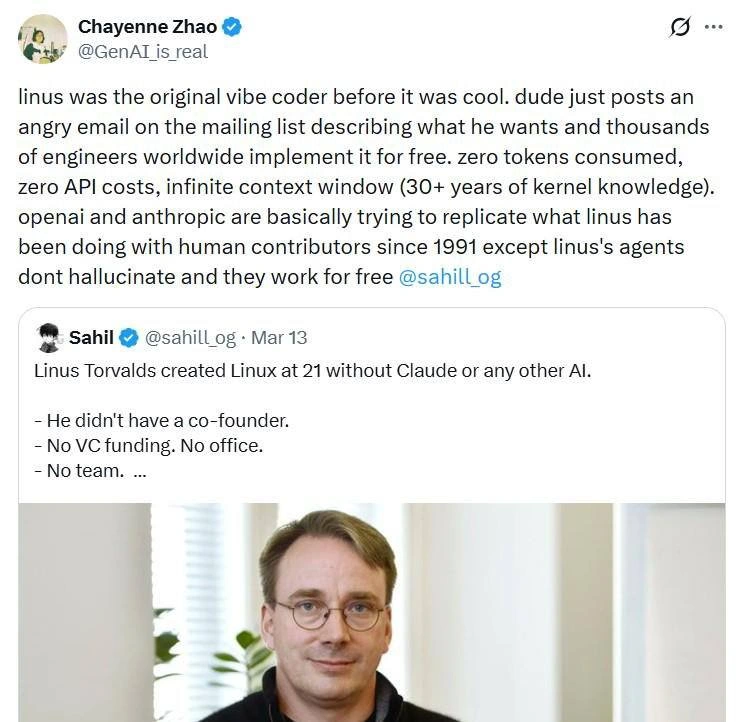
The screenshot is a two-layer artifact, and each layer skewers a different ecosystem. The inner tweet (Sahil, @sahill_og) is pure hustle-culture engagement bait over a photo of a smiling, round-spectacled Linus Torvalds:
Linus Torvalds created Linux at 21 without Claude or any other AI.
- He didn't have a co-founder.
- No VC funding. No office.
- No team. ...
The outer quote-tweet, from the magnificently named account @GenAI_is_real, refuses to engage on those terms and instead commits fully to the bit: Linus was "the original vibe coder," because he "just posts an angry email on the mailing list describing what he wants and thousands of engineers worldwide implement it for free. zero tokens consumed, zero API costs, infinite context window (30+ years of kernel knowledge)... except linus's agents dont hallucinate and they work for free."
The satire works because the mapping is uncomfortably accurate. Describe intent in natural language, have someone (or something) else produce the implementation, review the output, merge or reject — that is both the LLM-agent loop and the open-source maintainer's job description. Torvalds famously writes relatively little kernel code these days; his function is taste, arbitration, and the occasional thermonuclear code review on the Linux Kernel Mailing List. The joke reframes the largest collaborative engineering project in history as a 30-year-running multi-agent system with a single orchestrator, and dares OpenAI and Anthropic to admit their product roadmap is "LKML, but you pay per token."
The Telegram poster's own caption punctures the rosiest claim, and they're right to:
Wdym don't hallucinate? Only someone who never read actual emails would say such a bullshit
Anyone who has triaged a patch series knows human contributors hallucinate constantly — phantom benchmarks, misread specs, confident wrongness about locking semantics. The actual difference isn't hallucination rate; it's that the kernel's review machinery (maintainer hierarchy, subsystem trees, "show me the numbers") was built over decades precisely to survive unreliable agents. That's the part the AI labs are still reinventing, usually with worse manners and better grammar. Meanwhile both layers of the meme quietly flatten the same truth: the "free" agents are volunteers and salaried engineers from Intel, Red Hat, and Google — the most heavily subsidized free labor in software.
Description
A Twitter/X screenshot. Chayenne Zhao (verified, @GenAI_is_real) writes: 'linus was the original vibe coder before it was cool. dude just posts an angry email on the mailing list describing what he wants and thousands of engineers worldwide implement it for free. zero tokens consumed, zero API costs, infinite context window (30+ years of kernel knowledge). openai and anthropic are basically trying to replicate what linus has been doing with human contributors since 1991 except linus's agents dont hallucinate and they work for free.' She quote-tweets Sahil (@sahill_og, Mar 13): 'Linus Torvalds created Linux at 21 without Claude or any other AI. - He didn't have a co-founder. - No VC funding. No office. - No team...' above a photo of a smiling Linus Torvalds with round glasses in a black sweater. The joke reframes open-source maintainership through LLM-agent terminology, satirizing both AI hype and hustle-culture posts
Comments
26Comment deleted
Linus pioneered prompt engineering decades ago: one sufficiently angry email to LKML and the agents refactor it themselves - no retries, no token bill, occasional flame review
what would you expect from someone with username "GenAI is real"? :) Comment deleted
Linux is so outdated 😫🤛😅 That shit ain't made for humans no wonder why it's free Comment deleted
low-tier bait Comment deleted
https://youtu.be/9foB2z_OVHc?t=26&is=VJiKBiW21CQSgREy Comment deleted
I'll note that linus has always been and is still writing code for the kernel, especially integral internal things. most of what other people are working on are self-contained areas of code, like drivers or subsystems (which to be fair is like 99% of what the kernel is made of … there are a LOT of drivers) Comment deleted
Can kernel just load the drivers on demand from aux files? Comment deleted
it's all part of the same binary afaik, but drivers are indeed loaded on demand (again, afaik) Comment deleted
as in: there is no .so to be loaded, but the driver methods and callbacks and such aren't invoked until a matching device is detected Comment deleted
there is a .ko (kernel object, pretty much the same thing as .so but with more metadata for the kernel) Comment deleted
ah well, I was mostly talking about internal ones. good point Comment deleted
modules are mostly in linux-firmware packages, right? Comment deleted
yea Comment deleted
looking through the files rn and most of what I see is just firmware, not drivers… Comment deleted
err, as in microcode Comment deleted
no, firmware is distributed in firmware packages. modules are in /lib/modules and are usually distributed in kernel pkgs Comment deleted
yes, they're called modules Comment deleted
Linus wrote a super basic kernel for 386/486, heavily inspired by MINIX/Unix. Not portable, dependant on MINIX tools to build. And it was only the kernel, the rest was GNU tooling. In yesterdays’s terms it’s a student project, in today’s terms it’s couple hours of AI work. Linus only single-handedly authored v0.01, public collaboration began at v0.02, because hackers found the system interesting. So just like Gates he was just a person at the right place at the right time. And he grew quite an ego over the years. Comment deleted
I wonder how ai knows what kernel is Comment deleted
Today the only OS that doesn’t carry a stigma of retarded/discrediting leadership decisions is, surprisingly, MacOS. Comment deleted
i wonder where'd you get that info from Comment deleted
Linus Torvalds is like the Einstein of the 21st century Comment deleted
Only if you compare how rude and dismissive they both are/were. Comment deleted
Was Einstein rude and dismissive ? Is there somewhere I can read about that ? Comment deleted
Of course you can read about it, like, everywhere. Comment deleted
Well I'm interested but not enough to search everywhere about it Comment deleted