Skip to content
DevMeme
5780 of 7435
The Linux hobbyist's descent into a personal data center
OperatingSystems Post #6336, on Oct 16, 2024 in TG

The Linux hobbyist's descent into a personal data center

Why is this OperatingSystems meme funny?

Level 1: A Hobby Gone Wild

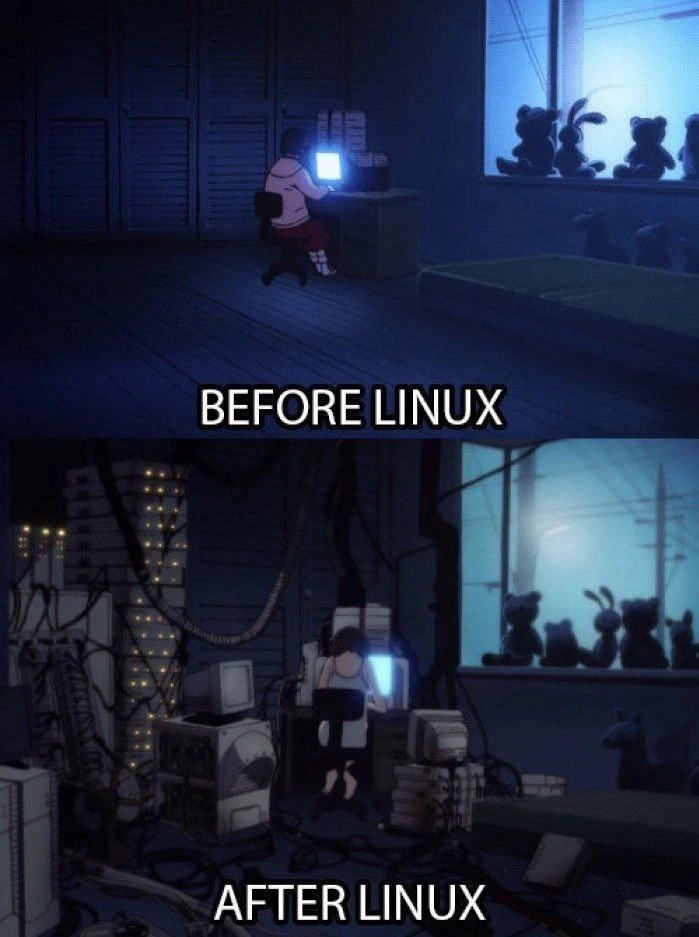
Imagine you start with a simple, neat desk where you do your homework or play games – everything is clean and there’s just one computer. Then one day you discover a new tool or hobby (in the meme’s case, it’s a new computer operating system called Linux, but don’t worry about that detail). Suddenly, that one small change makes you super excited about building and experimenting. A week later, your once tidy room looks completely different: it’s filled with all sorts of gadgets, old computers stacked on top of each other, and wires crisscrossing everywhere like vines in a jungle. There are little blinking lights in the dark, making your room glow like a spaceship cockpit at night. You’re still sitting at your same desk with the same screen, but now you’re surrounded by a whole bunch of new machines whirring and blinking. It’s as if your simple hobby of using a new computer system turned your bedroom into a mini computer lab!

Why is this funny? It’s the surprise and exaggeration. Think of it like this: you give a kid one LEGO set to play with, and the next time you check, they’ve converted their entire bedroom into a giant LEGO city, with towers and roads all over the floor. Initially, they just had one toy on a table (“before”), but after they got a taste of building things, they went all out and filled the whole room (“after”). In the meme, the girl did something similar but with computers. “Before Linux” her setup was basic and orderly. “After Linux” it became an over-the-top mess of tech, almost like she couldn’t stop adding new computer projects.

The emotional core of the joke is that feeling of a hobby running away with you. A small change – like trying out a new thing – leads to big, chaotic results because you got really into it. It’s funny and endearing because we’ve all seen or experienced a mild version of this: maybe you started drawing and suddenly art supplies are all over the place, or you started gardening and now every inch of the house is covered in plants. Here, it’s computers. The girl found something she’s passionate about (the new Linux system), and she went wild with it, turning her room into something out of a sci-fi story. The meme makes us laugh because it shows an extreme, cartoonish version of that passion: from one little glowing screen to a whole room of blinking, tangled, wonderful tech madness. It’s saying, “Watch out, one small step into nerdom, and you might end up with this!” – and that playful warning is what makes it so relatable and amusing.

Level 2: Desktop to Datacenter

At first glance, this meme shows a before-and-after of someone’s computing setup. In the “BEFORE LINUX” scene (top image), the person’s desk is simple and clean — just one computer and a dimly lit room. In the “AFTER LINUX” scene (bottom image), the same room has exploded into a homelab: multiple computer towers and servers are piled up, wires are hanging and coiling everywhere (that’s the “spaghetti” of cables), and lots of tiny lights are blinking in the dark. The lone girl is still at her desk, but now she’s surrounded by what looks like a mini industrial server room. The caption suggests that installing Linux on her computer triggered this dramatic transformation.

So why would switching to Linux turn a tidy desktop into a chaotic mini-datacenter? To break it down simply: Linux is an operating system (like Windows or macOS) but it’s highly customizable and often used by people who love to tinker with technology. When the meme says “after Linux,” it implies that once she started using Linux, she got really into computers and servers. Instead of just one machine doing everything, she now has many machines each doing different tasks. This is a playful exaggeration of what can happen when someone becomes a tech enthusiast.

Let’s clarify some terms and ideas here:

  • Operating System (OS): This is the main software that runs on a computer, managing hardware and other programs. Before, the girl likely used a consumer OS (perhaps Windows or macOS) which is generally user-friendly and hides a lot of complexity. When she switched to Linux (a family of open-source operating systems), she entered a world where you have more control and can see more of how the computer works under the hood. This often sparks curiosity to do more advanced things.

  • Linux distribution: There are many flavors of Linux (called distributions or distros), such as Ubuntu, Fedora, or Arch Linux. Each distro is like a variant of Linux tailored for certain users. Some are easy for beginners, others are very hands-on. People who dive into Linux often try out different distros, learn to configure their system manually, and in the process gain a lot of technical know-how.

  • Homelab: This term refers to a home laboratory of computing equipment. It’s essentially when someone sets up a bunch of computers, servers, or networking gear at home to learn and experiment (or to actually self-host services). In the meme’s “after” scene, the girl’s room is exactly that — a homelab. What was once a normal bedroom is now jokingly called a bedroom datacenter, meaning it resembles a professional datacenter (those large facilities with rows of servers) but crammed into a personal living space.

  • Systems Administration (Sysadmin): This is the role of managing computers and network systems. When you only have one personal computer, you’re just a user. But if you have many machines and servers, you’ve essentially become a system administrator for your own network. You have to handle installing software on each machine, connecting them, dealing with any issues, and so on. It’s like she unintentionally became her own IT department after switching to Linux. The meme finds humor in that sudden leap.

  • Over-engineering: This means solving a simple problem in an extremely complex way. In this context, perhaps all the girl needed was a reliable computer to do her tasks. But after getting Linux, she went on to build an entire complex setup (multiple servers, specialized machines) which is far more elaborate than necessary for an individual. It’s playful: nobody needs a dozen servers to, say, browse the web or do homework. But she built that setup for the joy and challenge of it.

Now, the image references an old tech-centric anime vibe (Serial Experiments Lain), but you don’t need to know that show to get the joke: basically, the darkness and wires create an atmosphere of deep, almost obsessive tech exploration. The cable_spaghetti_management tag is joking about how the cables are all tangled like a bowl of spaghetti — that’s often a real problem in server setups if you don’t carefully tie and route cables. And blinking_led_therapy is a fun way to say that for some techies, seeing those tiny blinking lights on devices is satisfying or calming (it shows things are running).

To make the contrast crystal clear, here’s a comparison of her setup before vs. after the Linux plunge:

Aspect Before Linux (tidy desktop) After Linux (homelab chaos)
Computers One personal computer, that’s it. Many machines: old PCs, servers, even a Raspberry Pi.
Operating System Windows or macOS (easy, all GUI). A Linux distro (requires using the terminal and configs).
Cables & Gear Just a few wires (monitor, power) – neatly managed. Wires everywhere – literal “cable spaghetti” running across the room. Plus extra gear like network switches and external drives.
User’s role Regular user (just uses apps, plays games, etc.). Now a sysadmin at home – setting up servers, managing network settings, fixing issues.
Room vibe Simple and quiet – like an ordinary bedroom with a desk. Buzzing and blinking – like a mini server room (fans humming, LEDs blinking in the dark).

In short, installing Linux became the gateway to a full-blown hobby. The person likely started tweaking and customizing their Linux system, then thought, “Hey, I have that old computer, I can turn it into a server for backups.” Then maybe they got a cheap used server or a Raspberry Pi (a tiny affordable computer popular for home projects) to try out other things like hosting a personal website or running home automation. One thing led to another, and soon the collection of devices grew. Each addition meant more cables and more configuration. Before they knew it, their previously tidy setup looked like an amateur datacenter.

This is funny to people familiar with tech because it’s a bit true: Linux often sparks curiosity. It’s common to see enthusiasts proudly share photos of their home setups with multiple servers and a tangle of cables, joking about how it all started with “I just wanted to try Linux.” It resonates with the SysadminHumor crowd: those who have a passion for running their own equipment will nod and laugh, “Yep, that escalated quickly.” The meme captures that escalation in a single before-and-after snapshot. It’s both a celebration of the hobby and a lighthearted roast of how over-the-top it can become.


Level 3: Welcome to the Wired

In the top panel we see a lone developer’s minimalist setup — just one PC in a dark room. By the bottom panel, after embracing Linux, that same room has transformed into a bedroom data center. This meme exaggerates a familiar saga in tech circles: you start with a tidy single-machine setup, but once you go down the Linux rabbit hole, you end up running a whole homelab with servers, cables, and blinking lights everywhere. It’s the slippery slope from casual user to full-blown sysadmin of your own private cloud. The humor lands because so many of us have felt that itch to tinker endlessly once given the power and freedom of an open-source OS.

Why does switching to Linux lead to this hardware explosion? At a senior level, we recognize that Linux (unlike a consumer OS such as Windows or macOS) gives you total control over your system. That control is intoxicating. You can resurrect old hardware with lightweight Linux distributions, configure every tiny detail of the OS, run your own network services, and basically do things usually reserved for professional IT environments. The meme’s “AFTER LINUX” scene is essentially a miniaturized production server room. What started as one machine now includes repurposed tower PCs, maybe a rack-mount server or two, external hard drives stacked like Jenga blocks, and ethernet cables snaking across the floor (the infamous “cable spaghetti”). Each blinking LED on those machines indicates another service or experiment the user has set up: maybe a personal web server on one box, a file server (NAS) on another, a Raspberry Pi running an ad-blocking DNS (like Pi-hole), and who knows what else. This explosion of equipment is overengineering to an absurd degree for a bedroom, and that’s exactly why it’s funny — it satirizes the way tech enthusiasts tend to turn a simple setup into a NASA control center just because they can.

From a seasoned perspective, this speaks to the homelab culture. Running your own mail server, your own media server, tinkering with network configurations at 2 AM for fun — it’s a hobby and a learning experience. There’s a tongue-in-cheek saying among Linux folks: Step 1: install Linux. Step 2: there is no Step 2, you’re now compiling your own kernel at 3 AM.” 😅 In practice, once you install Linux, you often end up learning about the guts of the operating system. For example, you might custom compile the Linux kernel to optimize it for your hardware, edit config files in /etc by hand, set up cron jobs, and write shell scripts to automate tasks. It’s a far cry from the plug-and-play simplicity of the previous OS world.

Notice the anime aesthetic reminiscent of Serial Experiments Lain: that’s not an accident. In that late-90s series, the protagonist Lain fills her room with computers and tangled wires to explore “The Wired” (essentially the internet). The meme artist is winking at this cyberpunk visual — the serial_experiments_lain_vibe of a dark, neon-lit room where technology has literally taken over physical space. The blinking_led_therapy mentioned in the tags is real to many sysadmins: there’s something oddly soothing about the glow of server LEDs in a dark room, a sign that your machines are alive and processing. Senior engineers might jokingly call that their “night light”. Meanwhile, the cable_spaghetti_management (those thick black cables looping everywhere) is a badge of honor and shame in homelabs. We know we should do proper cable management, but when you’re excitedly daisy-chaining one more switch or adding another old server you got on eBay, aesthetics take a backseat. It becomes a tangled mess — much like “spaghetti code”, but in physical form.

The caption “From tidy desktop to spaghetti homelab” nails the core joke: a neat, ordinary computing setup devolves (or evolves?) into a chaotic overengineered lab. Seasoned devs laugh because they either went through a similar phase or know someone who did. There’s an implicit understanding: Linux doesn’t force you to build a home server farm, but it enables and encourages that deep geekery by its nature. When everything is configurable, you find yourself wanting to configure everything. Why settle for one machine doing a few things, when you could have separate specialized boxes for each service? Why toss out old hardware, when you can network it and make it part of your personal cloud? Before you know it, your quiet computing hobby has escalated into a full-on bedroom_datacenter. The electric bill goes up, the spare time goes down, but you’ve gained some serious hands-on IT skills (and a room that looks like a hacker’s paradise). It’s hilarious and endearing because it portrays the inevitable trajectory of the enthusiastic Linux user: given an inch (a new OS), they’ll take a mile (an entire home infrastructure).

To illustrate, here’s what her home network might look like after that Linux upgrade:

# /etc/hosts - a snippet of hostnames in her growing homelab network
127.0.0.1       localhost
192.168.0.2     main-desktop    # Original machine, now running Linux
192.168.0.3     server01        # Repurposed old office PC as a server
192.168.0.4     server02        # Another salvaged tower for experiments
192.168.0.5     raspberrypi     # Raspberry Pi for Pi-hole (network ad-blocker)
192.168.0.6     media-center    # A mini PC serving as a media server
192.168.0.7     backup-nas      # An old PC filled with hard drives for backups

Each hostname in that list is a new addition to her mini-network. Where before she had just localhost (her single PC), now she’s maintaining multiple machines and services at home. In essence, she’s become the systems administrator of her own little internet. The meme exaggerates it to comedic effect (most people won’t literally stack that many servers in their bedroom), but it’s grounded in truth. Many a tech enthusiast has looked around and realized: “I started with one Linux box, and now I have a cluster.”

Ultimately, the senior-level chuckle comes from recognition. OperatingSystems like Linux unlock immense possibilities – and if you have the passion (or obsession), those possibilities run wild. This one image tells a whole story of overengineering fueled by curiosity: the girl’s posture barely changes between panels (still at her glowing screen), but everything around her has ramped up. It’s a perfect visual metaphor for how a simple OS swap can radically change a nerd’s life (and room decor). We laugh because it’s a little SysadminHumor truth wrapped in anime cyberpunk clothing: today you’re dual-booting Ubuntu, tomorrow you’re crimping ethernet cables and planning where to put your next server rack. Welcome to the wired life indeed.


Description

A two-panel meme from the anime *Serial Experiments Lain*. The top panel, labeled "BEFORE LINUX," shows the main character, Lain Iwakura, in a sparsely furnished, dark blue room, sitting at a simple desk with a single, glowing computer monitor. The room is neat and uncluttered. The bottom panel, labeled "AFTER LINUX," depicts the same room in a state of chaotic transformation. Lain is now surrounded by a massive, complex network of interconnected computers, servers, cooling systems, and a dense web of cables, resembling a home data center or a server room. This meme humorously illustrates the stereotype of how getting into Linux can escalate from a simple software choice to an all-consuming hobby of building, customizing, and managing complex hardware setups, a journey familiar to many senior developers and sysadmins who run their own "homelabs."

Comments

18
Anonymous ★ Top Pick My first Linux install was to dual-boot Ubuntu. Now my power bill is higher than my mortgage and I have a dedicated Ansible playbook just to turn on the coffee machine
  1. Anonymous ★ Top Pick

    My first Linux install was to dual-boot Ubuntu. Now my power bill is higher than my mortgage and I have a dedicated Ansible playbook just to turn on the coffee machine

  2. Anonymous

    First you apt-get install Linux; next thing you know you're calculating rack-weight limits for your IKEA desk

  3. Anonymous

    The real Linux journey isn't learning systemd or kernel compilation - it's explaining to your partner why the bedroom now requires a dedicated 20-amp circuit and why the monthly electricity bill rivals a small data center's operating costs

  4. Anonymous

    This perfectly captures the Linux journey: you install Ubuntu to 'try something new,' and six months later you're running a Kubernetes cluster in your bedroom, compiling custom kernels at 3 AM, and explaining to your partner why you need another Raspberry Pi. The transformation from 'I just want a stable OS' to 'I have 47 Docker containers, a Proxmox server, and I'm considering rack-mounting my life' is inevitable. It's not a bug, it's a feature - specifically, the feature where your simple desktop becomes mission-critical infrastructure that you're now on-call for

  5. Anonymous

    Linux: you start with one box, and six months later your apartment is a resource scheduler - k3s nodes, ZFS mirrors, SNMP on the UPS, and enough cabling to qualify as a colo

  6. Anonymous

    Linux: upgrading your desk's entropy faster than a kernel oops on boot

  7. Anonymous

    Linux doesn't give you a desktop; it gives you a procurement pipeline and turns your bedroom into an availability zone

  8. @Araalith 1y

    Same performance

  9. @farkasma 1y

    what is this image from?

    1. @jaaaaded 1y

      serial experiments lain

      1. @CammyDeer 1y

        Lain is a cognitohazard, you can't just go around telling people about it!

        1. @Hollow_Arigo 1y

          Nuh uh

  10. @callofvoid0 1y

    got an additional doll

    1. @SamsonovAnton 1y

      Or just moved it?

      1. @QutePoet 1y

        Move it, groove it, shake it, don't loose it.

  11. @casKd_dev 1y

    it doesnt hurt to have a few servers in the basement

  12. @dsmagikswsa 1y

    A rabbit hole

  13. @vrntctl 1y

    yes

Use J and K for navigation