Skip to content
DevMeme
5779 of 7435
The 'simplicity' of modern ARM architecture revealed
Hardware Post #6335, on Oct 16, 2024 in TG

The 'simplicity' of modern ARM architecture revealed

Why is this Hardware meme funny?

Level 1: Shiny New Toy

Imagine a friend complaining that their old building kit is "too complicated" because it has so many pieces and a huge instruction booklet: "This thing is terrible, it needs to go away!" But then the same friend gets a brand-new building set – one that actually has even more pieces and an even thicker booklet – and they jump up and down shouting, "OMG, this is so simple and awesome!" Pretty silly, right? If the new toy has more parts than the old one, it’s not really simpler at all. That’s the joke here: the “old toy” is like the Intel x86 computer chip (which has a lot of little operations and a big manual), and the “new toy” is like Apple’s M4 chip (which secretly has even more operations and an even bigger manual). The meme makes us laugh because the excited character is calling something simple just because it’s new and shiny, even though under the hood it’s actually more complex. It’s a playful reminder that new and cool doesn’t always mean simple!

Level 2: Less Is More (Or Not)

Let’s unpack this meme in straightforward terms. It’s contrasting two major types of CPU designs – basically the “language” that computer chips speak – and pointing out something unexpected. The two logos in the panels are Intel (top) and ARM/Apple (bottom). Intel’s chips use the x86 architecture, whereas Apple’s new M-series chips use an ARM architecture. These are like two different families of computer blueprint.

Now, what do those numbers and pages mean? They’re talking about the Instruction Set for each CPU. An instruction set is the collection of all the basic operations a processor can perform directly. Think of it like a vocabulary of commands that the chip understands in hardware. For example, common instructions are things like “add two numbers,” “load a value from memory,” or “compare two values.” When we write programs in a high-level language (like C or Python), those eventually get translated (by a compiler or interpreter) down to these low-level instructions so the CPU can execute them.

  • x86 (Intel’s architecture) is a classic example of a CISC, or Complex Instruction Set Computer. “Complex” here means the CPU’s instruction set contains a lot of different instructions, including some that are quite sophisticated. Over many years, Intel and AMD kept adding more and more instructions to x86 – to improve performance, support new features (like multimedia, graphics, cryptography), and maintain backward compatibility with old software. As a result, a modern x86-64 processor like those in many Windows PCs or older Macs recognizes over a thousand different instructions (the meme says 1152 instructions, which includes everything up to the latest additions like AVX-512). The reference manual for x86 (essentially the official guide/documentation listing and explaining every instruction and feature) is about 5000 pages long. That’s a huge document, which hints at how intricate x86 is under the hood. (AVX-512, by the way, stands for Advanced Vector Extensions 512-bit – it’s a set of instructions that can process very large chunks of data in parallel, speeding up tasks like scientific calculations or video encoding. It’s powerful, but it also made the chip design more complex, and yes, it’s part of those 1152 instructions.)

  • ARM (the architecture used by Apple’s M1/M2/M3 and presumably M4 chips) is traditionally an example of RISC, or Reduced Instruction Set Computer. “Reduced” means it originally aimed to have a smaller, simpler set of instructions. The idea was that a simpler core could be more efficient and easier to optimize. For a long time, ARM chips (found in most smartphones and tablets) did have fewer instructions than x86 and a reputation for elegance and simplicity in design. Apple’s marketing and many tech enthusiasts often emphasize how AppleSilicon (Apple’s custom ARM-based processors) are more efficient and modern. People sometimes translate that as ARM being simpler or “cleaner” than x86.

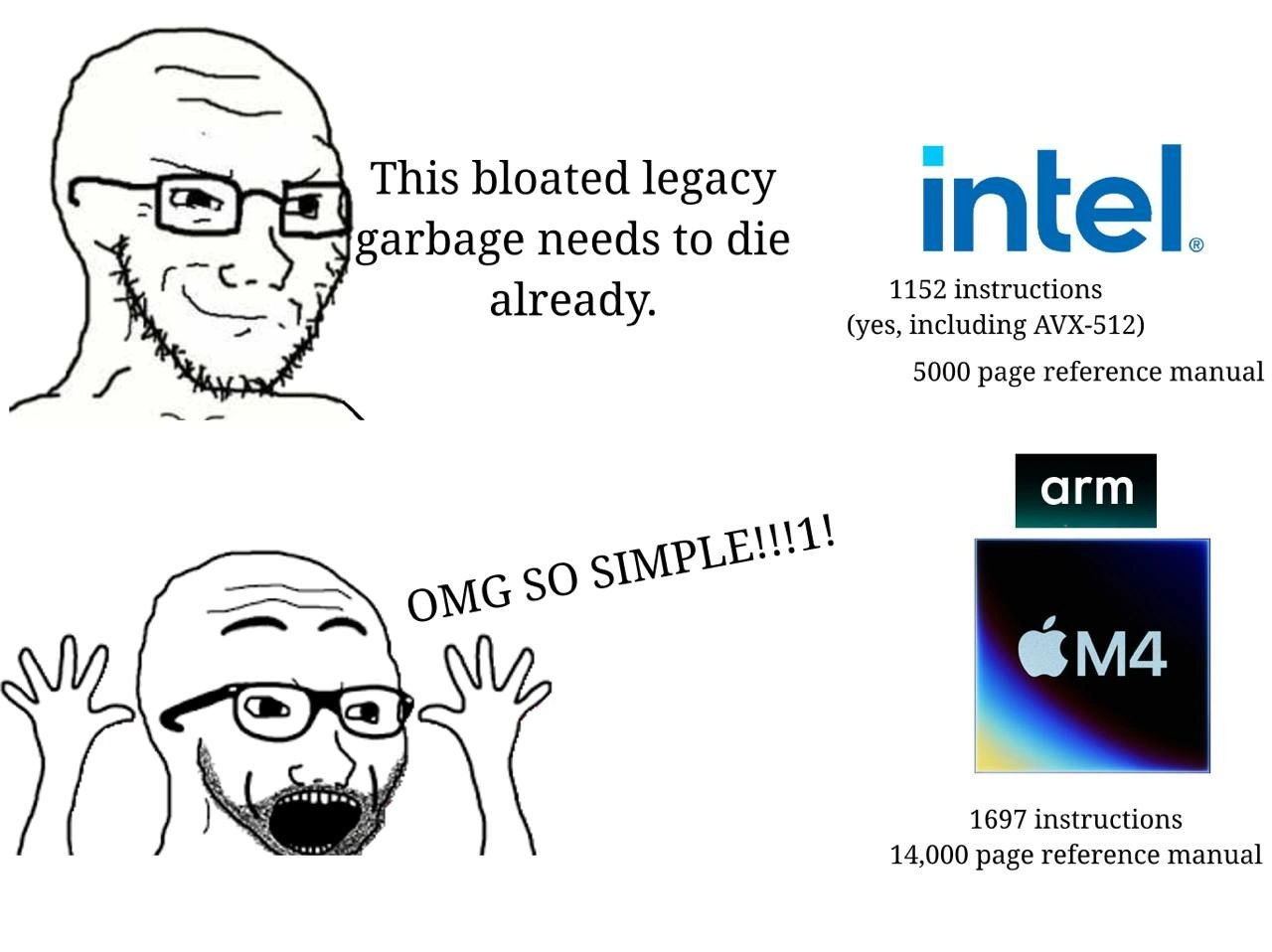
The meme reveals the twist that might surprise newer developers: the latest ARM-based Apple core actually has more instructions than the x86! Apple’s M4 (a next-generation chip) uses an ARM architecture that includes about 1697 instructions in total, and its documentation is a whopping 14,000 pages. So, if x86 was a thick textbook of CPU operations, ARM has become an even thicker one. That’s the irony: RISC was supposed to mean “less is more,” but here we see “more and more” instructions creeping in.

Let’s clarify a few terms and why this matters:

  • Instruction: one low-level command to the CPU. In assembly language (the human-readable form of machine code), an instruction looks like a short abbreviation (mnemonic). For example, ADD might add two numbers, or MOV might move data from one place to another. x86 has instructions like MOV, ADD, SUB, MUL, CALL and also fancy ones like PEXTRW (extract word from a packed vector) or VFNMADD231PS (a combined multiply-add on 8 floats – you can see the names get crazy). ARM has its own set, like MOV, ADD, SUB (similar basics) and others like LDR (load from memory) or specialized ones for cryptography and vector math.
  • Reference Manual: think of this as the encyclopedia or dictionary for the CPU’s instruction set. It details what each instruction does, how the processor’s features work, and how to use them. Engineers, compiler writers, and low-level programmers refer to these manuals to understand exactly how to write code that the CPU will run. When the meme says “5000 page reference manual” for Intel, that’s literally the combined length of Intel’s official documentation volumes for their x86-64 CPUs. The “14,000 page reference manual” for Apple’s M4 means if you printed all the technical docs for the ARM architecture that M4 uses, you’d fill 14,000 pages. In simpler terms: picture two really thick books of instructions – the ARM one is almost three times thicker than the Intel one!
  • RISC vs CISC: This is the core of the meme’s joke. RISC (Reduced Instruction Set Computer) chips traditionally have fewer, simpler instructions – meaning each instruction does a basic task. CISC (Complex Instruction Set Computer) chips have more instructions, including ones that do multi-step tasks internally. Neither is inherently “better” universally; they’re two design approaches. Historically, RISC chips were easier to optimize and CISC chips tried to do more in hardware so programmers had to write fewer instructions. Over time, as we see, RISC chips like ARM kept adding instructions too, so the line blurred.

For a junior developer who hasn’t worked with assembly or hardware, why is this funny? It’s a bit like if someone kept saying one language or tool was much simpler than another, but when you actually count the features and rules, the “simple” one has become even more elaborate. The meme is pointing out a reality versus perception gap:

  • Perception: “ARM is new and streamlined; x86 is old and clunky.” You might have heard things along these lines in tech blogs or from colleagues, especially after Apple switched Macs from Intel chips (x86) to their own ARM-based chips. People praised how Apple’s ARM chips run cooler and faster for their size, and sometimes they phrased it as ARM being a more modern, simpler design.
  • Reality: Both types of chips are extremely complex pieces of technology. The “modern” ARM-based Apple M4 isn’t simple at all when you look at the details. In fact, it has even more capabilities (and thus instructions) built into it than the older Intel design. The simplicity often referred to with RISC was about the core design philosophy, not about having a tiny manual. Over the years, ARM’s design had to grow to deliver top performance and all the features we expect (graphics, machine learning, security, etc.), which naturally adds complexity.

A newcomer might also wonder: if both are so complex now, does it even matter for me as a high-level programmer? Most of the time, if you’re writing in languages like Python, Java, or even C, you don’t need to worry about the specific instructions – that’s the compiler or interpreter’s job, and both x86 and ARM can run the same high-level programs (just compiled differently). But this meme is more aimed at low-level programming enthusiasts or those curious about what’s under the hood. It’s exposing an interesting quirk of Hardware evolution: the thing marketed as “reduced and simple” ended up accumulating a lot of baggage, just like the “complex” thing did.

For context, Apple naming their chip “M4” signals it’s the fourth generation of their Mac processors (after M1, M2, M3). These chips are based on ARM’s architecture (specifically ARMv9 for the latest ones). The black square in the meme with the “arm” logo and Apple’s stylized “M4” is basically saying “this is Apple’s new ARM-based CPU.” The joke is that the excited character is calling it simple, but the specs listed (1697 instructions, 14k pages) show it’s anything but simple in reality.

In simpler day-to-day terms: it’s like complaining your old PC’s operating system had too many features and was bloated, then bragging that your new system is sleek – even though it actually has even more features under the hood. The meme highlights that contradiction in a nerdy way. If you’ve ever heard developers argue about technologies (and we do love to argue!), you’ll notice how each side might exaggerate. Here, one side says “x86 must die, it’s bloated,” and the same people might say “ARM is great, so minimal!” – the meme simply provides the factual counterpoint that the arm_vs_x86 reality isn’t so black-and-white. Both architectures have grown complex as they’ve evolved.

So, at this level, the key takeaway is: RISC vs CISC is a classic debate in computing. RISC (like ARM) was supposed to be simpler (fewer instructions), CISC (like x86) was known to be complex (many instructions). But over time, the modern ARM chips have added so many instructions and features that they rival or exceed x86 in complexity. The meme uses the exaggerated cartoon reactions to make this point — basically saying “Ha! You call that one simple? It’s even more complicated than the one you labeled garbage.” It’s a nerdy reality check about IndustryTrends_Hype versus technical facts.

For a junior dev, the humor might also come from just the absurd image of a “14,000 page manual.” It’s an exaggeration but not by much — these engineering manuals are really that long. It makes you appreciate that under the covers of the devices we use, there is a ton of complexity. And maybe it teaches a gentle lesson: don’t believe something is simple just because it’s new or marketed well. In tech, “simple” often isn’t so simple once you open the hood.

Level 3: Reduced In Name Only

For seasoned developers and hardware enthusiasts, the humor here hits close to home. The two-panel meme dramatizes a familiar industry pattern: tech folks love to trash “old, bloated” technology and hype up the new “clean, simple” alternative – often without realizing the new thing has become just as complicated. In the top panel, our scruffy, world-weary character (a Wojak cartoon often used to represent a cynical developer) sneers at Intel’s x86 architecture: “This bloated legacy garbage needs to die already.” This captures the real-world sentiment many have had about x86-64 CPUs. And not without reason: x86 is an older architecture (x86_legacy goes back to the late 1970s) that’s infamous for accumulated cruft. It carries decades of backwards compatibility baggage (from 16-bit real mode to weird obsolete instructions). Developers who’ve dealt with low-level PC programming or read Intel’s manuals can recall the pain of those quirky conventions and the sheer volume of the documentation (roughly 5000 pages!). So the top guy’s frustration – calling it “legacy garbage” – reflects a genuine exasperation with x86’s complexity and historical warts. Many of us have jokingly said “Ugh, x86 needs to just die” after debugging some assembly issue or hitting a performance wall due to its design limits.

Enter the bottom panel: a hyper-enthusiastic Soyjak (wide-mouthed, hands in the air) exclaiming, “OMG SO SIMPLE!!!1!” in delight over what’s presented as the ARM-based Apple M4 chip. This is a tongue-in-cheek portrayal of the tech community’s ARM hype. When Apple introduced its AppleSilicon line (M1, M2, M3, and presumably an upcoming M4), a lot of fans and even tech press raved about how Apple’s ARM-based designs were more efficient, elegant, and yes, simpler than Intel’s old x86 chips. The meme juxtaposes that giddy praise with hard reality: the text right next to the Apple M4 logo reveals “1697 instructions, 14,000 page reference manual.” In other words, Apple’s shiny RISC-based CPU core actually has a larger instruction set and a much thicker reference manual than the Intel “legacy” CPU being criticized! The Soyjak’s “OMG SO SIMPLE!!!” is intentionally absurd – it’s like he’s cheering while holding up a dictionary three times thicker than the one he just trashed.

This contrast is hilarious to veteran developers because it calls out the irony and cognitive dissonance in tech trends. We’ve all seen cycles of IndustryTrends_Hype where the new thing is lauded as a panacea. In the 90s, people touted RISC workstations as the death of x86; in the 2000s, x86 (with AMD64) roared back; in the 2020s, ARM (with Apple leading the charge) is the “new hotness.” Each time, advocates claim the new architecture is so much simpler or more “pure”. Yet here we are: the Reduced Instruction Set Computer isn’t looking so reduced. A senior engineer can’t help but smirk because we recognize a pattern: architecture simplicity often starts as rhetoric and ends as a memory of version 1.0.

Why exactly is this funny and not just nerdy trivia? Because it’s a classic “gotcha” moment. The meme essentially says: Everyone: “x86 is terribly complicated.” Also everyone: “ARM is wonderfully simple!” Reality check: ARM now has more instructions and an even bigger manual. It’s poking fun at the pop-influencer narrative versus the technical truth. If you’ve been around long enough (or survived a few hype waves), you know that tech marketing and fan enthusiasm often gloss over inconvenient details. Apple’s marketing, for instance, focuses on user-visible benefits (speed, battery life) and paints their chips as magically efficient. Tech enthusiasts translated that to “ARM good, x86 bad” in simplistic terms. But the engineers who dive into AssemblyLanguageARM and AssemblyLanguageX86 know that on the ground level, both architectures are beasts in complexity. The meme serves up that reality with a side of sarcasm.

Let’s break down some real-world scenarios that make this meme “painfully relatable” to experienced devs:

  • Reading those Manuals: Seasoned low-level programmers have cracked open the Intel architecture manuals (often PDF volumes with ~5000 pages) to figure out tricky details like memory ordering or to squeeze performance out of an AVX instruction. It’s dense reading. Now imagine discovering that to fully grok the latest Apple M4’s ARM architecture, you’d have to wade through nearly 14,000 pages of spec! Talk about reference_manual_bloat – no one in their right mind would call that simple. You can almost feel the collective groan and laughter: “So, which one was the ‘reduced’ instruction set again?”
  • The Double Standard: Many of us have encountered colleagues or online commenters who dismiss technology from one camp and blindly praise another. For example, a developer might gripe that x86 assembly is ugly and outdated, then in the next breath rave about how their new ARM-based Mac is “so much smoother.” The meme exposes that double standard. It’s like pointing out, “You’re celebrating something as streamlined while its internals are actually even more elaborate.” This resonates because as professionals we value consistency and truth over hype. It’s a gentle slap on the forehead – we’ve all been guilty of drinking the Kool-Aid of a new tech at least once.
  • Architectural Déjà Vu: People who lived through earlier CPU battles (like PowerPC vs x86, or Itanium vs x86) have a sense of déjà vu. Today’s RISC vs CISC argument is just history repeating. Back in the day, PowerPC (a RISC used in old Macs) was touted as simpler/faster than Pentium (CISC). Decades later Apple traded PowerPC for x86, and now they’ve traded x86 for ARM. Each switch came with claims of elegance and simplicity. The meme’s punchline – ARM now being as instruction-heavy as x86 – is like the universe laughing at decades of marketing.
  • Blurring Lines: A senior dev knows that modern CPU designs are all hybrids. The straightforward RISC vs CISC dichotomy is more of a continuum now. In practice, Intel’s chips have lots of RISC-like tricks under the hood, and ARM chips have adopted traditionally CISC-like features. When someone naively exclaims how “simple” ARM is, experienced engineers recall the laundry list of extensions and exceptions in ARM’s architecture. We remember that simplicity isn’t measured by the brand name or the hype, but by actual design complexity. The meme’s stats make that complexity concrete (literally with page counts and instruction counts), which elicits a knowing chuckle.
  • Tech Culture and “Language Wars”: This meme also taps into a familiar cultural trope in programming and hardware circles: the almost tribal loyalty to a platform. It’s similar to LanguageWars among programmers (think Java vs Python or tabs vs spaces debates). Here it’s ARM vs x86. The top character represents the x86 detractors (tired of its idiosyncrasies), and the bottom represents the ARM cheerleaders. By showing that the “simple” camp’s favorite actually has more bloat, it humorously deflates the fanboyism. It reminds us not to take sides too blindly, because every technology has trade-offs and hidden complexity.

From an organizational angle, the meme’s situation also reflects how legacy tends to accumulate. Intel can’t easily strip out those 1152 x86 instructions because billions of existing programs rely on them. That’s the inertia of an ecosystem – what we often call technical debt in software has a hardware equivalent. Interestingly, ARM now faces its own growing legacy: once you add an instruction or feature and software starts using it, it becomes very hard to remove in future revisions. This is why both the Intel manual and the ARM manual keep swelling over the years. The meme’s comedic exaggeration (“this needs to die” vs “so simple!”) highlights that even the darlings of the industry will someday be the old-timers with too much baggage. It’s a bit of a cautionary tale wrapped in humor: today’s “clean” solution can become tomorrow’s “bloated legacy garbage.”

For a seasoned observer, this meme is funny because it reveals a truth we often grin at: every new technology inevitably gets more complex as it matures. The RISC vs CISC saga is a prime example. We laugh because the meme succinctly captures how instruction_set_complexity inevitably creeps in over time, turning yesterday’s sleek design into today’s bewildering catalog of features. The next time someone claims a new architecture or tool is “so simple,” a battle-scarred engineer might just smirk and recall this meme, thinking, “Sure, give it a few years…”.

Level 4: The Instruction Set Arms Race

At the deepest level, this meme pokes fun at fundamental CPUArchitecture theory. It highlights how the classic RISC vs CISC debate has evolved in surprising ways. In computer architecture, RISC (Reduced Instruction Set Computer) was originally proposed as a streamlined design philosophy: use a small set of simple instructions, each ideally executing in a single clock cycle. This approach was meant to simplify hardware design and enable aggressive pipelining. On the other side, CISC (Complex Instruction Set Computer) architectures like x86 embraced a large repertoire of complex instructions – even operations that perform multiple actions in one go – aiming to reduce the number of instructions needed for a given task, at the cost of more complex hardware logic (often implemented via microcode).

Historically, RISC designs did start out much leaner than their CISC counterparts. Early RISC chips (like the original MIPS or ARM designs in the 1980s) had very limited instruction sets (dozens to a few hundred instructions) and fixed-size instruction formats. The entire instruction set architecture (ISA) could be described in a relatively concise manual. Meanwhile, an x86 processor (originating from the late 1970s) accumulated decades of additions: from bit-manipulation instructions to vector math extensions and legacy modes dating back to the days of 16-bit computing. By the 2000s, x86’s ISA reference manual spanned thousands of pages, detailing everything from 8086-era real mode quirks to modern 512-bit vector instructions (yes, those infamous AVX-512 operations that are both impressive and infamously complex).

What’s fascinating – and what the meme zeroes in on – is that RISC architectures have not remained minimalistic either. Over time, the quest for performance led RISC architects to adopt some CISC-like strategies. ARM, one of the most prominent RISC families (famously used in smartphones and Apple’s M-series chips), has steadily broadened its instruction set with each new version. There are now specialized instructions for cryptography, machine learning (e.g., matrix multiply accumulators), and massive vector processing (NEON and SVE extensions). Modern ARM cores also have multiple execution modes and compatibility layers (for example, 64-bit ARMv8+ cores still support a legacy 32-bit mode until recently). All of this means more opcodes, more addressing modes, and more pages in the manual. The result? The latest high-end ARM64 implementations boast ~1697 distinct instructions and require a 14,000-page reference manual to describe all their intricacies.

This is hilariously ironic when contrasted with x86-64, which despite its baroque reputation, sits at around 1152 instructions with a roughly 5000-page manual. The meme’s numbers underscore a twist: the supposedly “bloated legacy” CISC ISA (x86) actually has fewer named instructions and a shorter architectural spec at this point than the hot new RISC contender from Apple! It’s as if the “Reduced” in Reduced Instruction Set now comes with a giant asterisk.

From a theoretical perspective, this phenomenon illustrates a kind of instruction set arms race (pun fully intended on ARM). To squeeze out more performance under physical and practical constraints (like Moore’s Law slowdown and energy efficiency limits), both camps have kept adding hardware accelerations and new capabilities into their CPUs. RISC architectures have not been exempt from this creep:

  • Vector extensions: where once RISC chips handled vector math with software loops, now they have dedicated 128-bit, 256-bit, or even scalable 2048-bit vector instructions (comparable to x86’s SSE/AVX family).
  • Cryptographic instructions: instead of making software perform bit-by-bit cryptographic algorithms, modern CPUs (x86 and ARM) include single instructions to do AES encryption rounds or SHA hashing, boosting speed but adding complexity to the ISA.
  • Memory and synchronization ops: features like atomic memory transactions, barriers for memory ordering, and virtualization support all introduce new instructions or modes.
  • Backward compatibility: Even RISC chips accumulate legacy. For instance, ARM had to carry forward support for older ARMv7 (32-bit) code for many years. Each generation, they face the choice to drop old features (simplifying) versus keep them for ecosystem support (complexifying). Often, both x86 and ARM choose to maintain backwards compatibility to avoid fragmenting software support – which means old quirks live on in the documentation.

The deeper truth hiding behind the humor is that complexity in computing is conserved; if it doesn’t live in the hardware, it lives in the software. RISC designs moved a lot of complexity to the compiler and software (since the chip did less per instruction, you needed more instructions to get work done). But as software demanded ever more performance, hardware designers started adding back specialized complexity in silicon to accelerate critical tasks. In formal terms, any general-purpose CPU – RISC or CISC – is Turing-complete and can compute the same algorithms; the difference is just the granularity and efficiency of operations provided as primitives. Over decades, both RISC and CISC machines tended to gravitate toward an equilibrium point where they borrow each other’s advantages:

  • CISC CPUs (like x86) internally translate complex instructions into simpler micro-ops (a very RISC-like idea) so they can execute them via streamlined pipelines.
  • RISC CPUs (like ARM) kept their internal pipeline philosophy but expanded the set of operations so much that they now have instructions for many high-level behaviors (a CISC-like approach to minimize instruction count for certain workloads).

So academically speaking, the meme exposes a kind of architectural convergence. The original RISC ideal from the 1980s (championed by people like Hennessy and Patterson) was to keep the ISA small and the hardware fast. That ideal succeeded wildly – so much that RISC CPUs like ARM now dominate mobile and are entering PCs – but to continue pushing performance, those “simple” chips have themselves grown more and more complex. It’s a beautiful irony of computer science: the “simplicity” of a design can evaporate as you push it to do more. In the end, no matter how elegant the initial principles were, real-world demands transform both RISC and CISC into extensive catalogs of features. The meme drives this point home by effectively saying: Look, the ARM RISC architecture you hail as “so simple” now has more documented instructions than the Intel x86 architecture you call outdated. How’s that for coming full circle?

Even at this theoretical level, it’s clear why this scenario is amusing: it’s a reminder that technology trends often repeat themselves in cycles. We started with minimalist CPUs, added complexity over time for efficiency, then invented a new minimalist approach to escape the complexity – only to watch that new approach accumulate complexity all over again. As computer architects sometimes joke, “There ain’t no such thing as a free lunch” in design: if you want maximum performance or flexibility, complexity will find a way to creep back in, RISC label or not. And apparently, it might creep in to the tune of a 14,000-page manual!

Description

A two-panel Wojak/Soyjak meme comparing Intel and Apple's ARM processors. In the top panel, a smug, bearded Wojak with glasses looks at the Intel logo and its specifications - '1152 instructions (yes, including AVX-512)' and a '5000 page reference manual' - and declares, 'This bloated legacy garbage needs to die already.' In the bottom panel, the same character, now an ecstatic, open-mouthed Soyjak, marvels at the ARM and Apple M4 logos, saying, 'OMG SO SIMPLE!!!!1!'. The joke lies in the specifications listed next to the M4 chip: '1697 instructions' and a '14,000 page reference manual,' which are significantly larger than Intel's. The meme satirizes the hypocrisy and trend-following in tech communities, where ARM-based chips like Apple Silicon are praised as being simple and modern (in the spirit of RISC - Reduced Instruction Set Computing), while the data presented shows they have become even more complex than the 'bloated' CISC (Complex Instruction Set Computing) architectures they are replacing

Comments

29
Anonymous ★ Top Pick Calling x86 'bloated' while celebrating a 14,000-page ARM manual is the hardware equivalent of rewriting a monolith in 50 microservices and calling it 'simplification'
  1. Anonymous ★ Top Pick

    Calling x86 'bloated' while celebrating a 14,000-page ARM manual is the hardware equivalent of rewriting a monolith in 50 microservices and calling it 'simplification'

  2. Anonymous

    Modern RISC: we didn’t kill complexity, we just moved it into a 14 000-page PDF - turns out your eyeballs are the new microcode

  3. Anonymous

    The real complexity isn't in the instruction count - it's explaining to management why your perfectly optimized AVX-512 code runs slower than naive scalar loops because Intel disabled it on consumer chips to segment the market

  4. Anonymous

    Ah yes, the classic 'RISC is simpler' narrative - until you realize ARM's quest for performance parity with x86 has spawned more instruction variants than a CISC architect's fever dream. Turns out when you need to compete with decades of x86 optimization, your 'reduced' instruction set grows extensions faster than a microservices architecture grows YAML files. The real kicker? That 14,000-page manual exists because ARM's 'simplicity' now requires documenting every NEON variant, SVE width, and cryptographic extension across a dozen different profiles. Intel's looking at this thinking 'at least our technical debt is honest about being technical debt.'

  5. Anonymous

    Measuring ISA simplicity by opcode count is like sizing microservice complexity by repo count - meanwhile the decoder, scheduler, and memory model are filing a 14,000-page incident report

  6. Anonymous

    ARM is “so simple” - it only takes 14,000 pages to explain why your lock-free queue that sailed on x86’s TSO now needs three fences and a prayer

  7. Anonymous

    x86: 1152 instructions for ultimate flexibility. ARM: 168 for 'simplicity.' Both manuals thicker than the spec they claim to simplify - RISC truly stands for 'Reference Increases Slightly.'

  8. @LostGhost11 1y

    Isn't CISC just RISC+microcode? So what are the upsides to the Risc architecture? Can't we have a bunch of cores with CISC?

    1. @Art3m_1502 1y

      RISC is faster. Executing fully hardware implemented instruction is more efficient than fetching bunch of small instructions from memory

      1. @LostGhost11 1y

        But isn't risc the one fetching a bunch of small instructions? Whereas with cisc, you fetch a complex instruction, decode it into small ones, and feed the pipeline. While it executes, you decode the next instruction, so the pipeline does not stall. In fact, less memory for instructions helps with fetching speed and caching

        1. @Art3m_1502 1y

          Its more like you fetch complex instruction and than fetches bunch of small instructions

          1. @LostGhost11 1y

            In any case, I think microcode makes the risc vs cisc distinction unhelpful and misleading, and we should compare processors case by case

  9. @glatavento 1y

    Wait, is it real?🙀

  10. @kvassilisk 1y

    But x86 is still bloated legacy garbage... Like they still start in 16bit real mode, am I right? The fact that you can't see it anymore because of EFI doesn't mean it's not there

    1. @Boguslavv 1y

      That means arm is even bigger legacy bloat garbage cus they try to emulate the x86 in some ways

  11. @qtsmolcat 1y

    Well you see, apple therefore good

  12. @Anfid 1y

    Does this instruction count include GPU, NPU and other modules, or is it just CPU?

  13. @SamsonovAnton 1y

    "RISC vs CISC" is not about the number of instructions (as all instructions are there for a purpose), but rather about the number of varieties of each instruction (determined by operand types).

    1. @loki8008135 1y

      Can we call this function overloading in assembly?

  14. @Art3m_1502 1y

    Intel isn't pure CISC tbh. If it was like this things would be much worse than nowadays

  15. @Art3m_1502 1y

    Pipelines exist for all processors

  16. @Art3m_1502 1y

    Its definitely easier to implement but you lack in efficiency, its like C and C#

  17. @Art3m_1502 1y

    Thats why you never see x86 in mobile or microcontrollers

  18. @LostGhost11 1y

    I don't think it's as simple

  19. @loomingsorrowdescent 1y

    Breaking news: soyjak memes don't offer nuanced commentary on complex issues

  20. @andrei_mr 1y

    Regarding x86 I' ve heard completely different claims: - Their architectural instruction count is 6000. - Their hidden (not published) instruction count is allegedly 50000. Of course, it all may depend on how you define "an instruction". Anyway, the data presented in this meme seems just plain wrong.

  21. @Hollow_Arigo 1y

    At least it doesn't self-destruct itself (and can't be used as water boiler)

    1. @Hollow_Arigo 1y

      And yeah, I know that Intel fixed that. And I don't give a fuck about that

      1. @Hollow_Arigo 1y

        Bug can be fixed But shame will be forever

Use J and K for navigation