
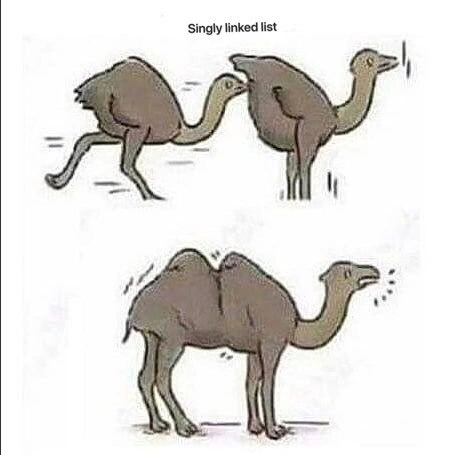
Camel anatomy explains singly vs doubly linked lists in two cartoon panels
Description
The meme is a two-panel, hand-drawn cartoon on a white background. Top panel text: “Singly linked list”. Beneath that, two camel halves are running from left to right: the front half has head, neck, front legs and one hump; a short distance ahead is the rear half with back legs and tail. The halves cannot reconnect, visually implying traversal only in one direction. Bottom panel has no caption but shows a complete camel with two clearly separated humps standing still, suggesting bidirectional connectivity. The humor relies on the data-structure analogy: a singly linked list lets you move forward node-by-node but can’t go back, whereas a doubly linked list (hinted by the two humps) supports pointers both ways. Seasoned engineers will immediately map the missing back-reference to the missing camel half and chuckle at the elegantly low-effort drawing style conveying classic CS fundamentals


Comments
6Comment deleted
When product says “just add a back-button”, remind them that half the camel isn’t included in the original spec
Wait until you see the circular linked list - it's just a camel chasing its own tail while your debugger has an existential crisis trying to find where it ends
Finally, a data structure visualization that explains why traversing a linked list always feels like a journey through the desert - you can only move forward, there's no going back, and by the time you reach the end, you've forgotten why you started. At least with this implementation, the memory overhead is literally visible as extra humps
Every time someone pitches a doubly linked list for “fast inserts,” I picture this camel - two humps, twice the pointers, and still slower than a vector thanks to cache misses and allocator thrash
Singly linked lists: O(1) appends until you cache-miss your way through N tails chasing heads
Singly-linked lists are great - until someone wants reverse iteration; then you either retrofit a prev pointer or spend O(n) walking the desert of cache misses