When legacy bug fixing becomes 'software archeology' for your LinkedIn headline
Why is this LegacySystems meme funny?
Level 1: Boring Chore, Fancy Name
Imagine your mom or dad asks you to clean up the attic. The attic is full of really old, dusty boxes and toys from a long time ago. It’s not fun at all – it’s hot, it’s dusty, and everything is messy. That’s like the “real life” part of the meme: doing a tough, boring job with old stuff. Now, let’s say after you finish, you go to school and tell your friends, “I went on a treasure hunt in my house and discovered ancient toys!” That’s the “LinkedIn” part – you’re describing the same chore but using exciting words to make it sound like an adventure. In reality, you were just cleaning old junk (just like fixing old code), but you called yourself a “treasure hunter” or “explorer” to sound cool (just like saying “software archaeologist”). It’s the same work, but with a fancy name to make it seem special. The meme is funny because we all understand the feeling: doing something boring or hard, but jokingly bragging about it like it was a big heroic adventure. It’s like calling yourself a “dinosaur detective” after dusting off Grandpa’s fossil collection. We know it’s a bit silly, and that’s why it makes us smile!
Level 2: Polishing the Resume
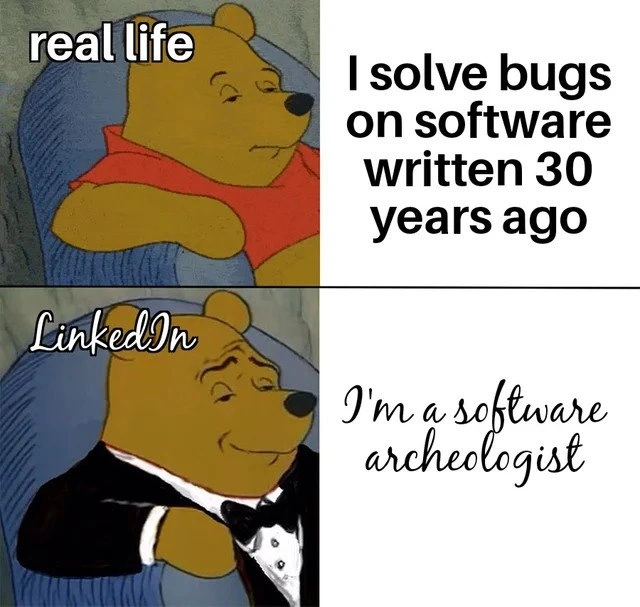
Let’s break down what’s happening in this meme in simpler terms. We have two versions of the same idea: one is plain and one is fancy-sounding. The image uses Winnie-the-Pooh in a popular meme format. In the top panel labeled “real life,” Pooh is in his normal red shirt, looking unimpressed. Next to him, the caption says: “I solve bugs on software written 30 years ago.” This is a very direct, no-nonsense description. It means “I fix problems (bugs) in a computer program that was created 30 years in the past.” That’s a pretty unglamorous job description — it sounds a bit dull or tedious, right? Fixing bugs is something all developers do, but doing it on software that’s 30 years old implies you’re dealing with something quite outdated. In technology, legacy code or LegacySoftware refers to old code that was written a long time ago but is still in use. Often, legacy code runs on outdated systems or uses old programming languages that many modern developers might not even know. For example, a 30-year-old program might be written in COBOL or in an old version of C, and could be running on an ancient server or mainframe. Maintaining it can be tricky: the original authors might have retired or moved on, and documentation (the explanations of how the code works) might be missing or incomplete. So “I solve bugs on software written 30 years ago” paints the picture of a developer doing maintenance work on a very old system – probably not the flashiest work in the tech world, but definitely important for the company that still relies on that software! This scenario falls under maintenance_of_30_year_old_code – basically keeping very old software alive by fixing it when it breaks. It’s a very relatablehumor setup for developers who have been handed an ancient codebase and told to “make it work somehow.” They might chuckle because many have been there: digging through code that feels like a time capsule from the past.
Now look at the bottom panel, labeled “LinkedIn.” LinkedIn is a professional networking site where people have profiles listing their job titles and career accomplishments – kind of like an online résumé. On LinkedIn, folks often try to present their work in the best possible light. They use impressive or creative titles to stand out. In the meme’s bottom image, Pooh is wearing a tuxedo and looking very smug and classy. This represents how someone might fancy-up their job description on LinkedIn. The caption in cursive script says: “I’m a software archeologist.” This phrase is a humorous, made-up job title. It’s not a standard job you see every day; it’s a playful way of describing the same work from the top panel. A “software archaeologist” isn’t literally an archaeologist with a shovel and brush; it’s a metaphor. It implies that the person digs through old code (like an archaeologist digs through ancient ruins). By calling themselves an archaeologist, the developer is framing their bug-fixing on old software as if it’s an adventurous and scholarly pursuit. In other words, they’re linkedin_rebranding their role – spinning it to sound cooler and more important. This is an example of professional_title_inflation, which means giving a job a more high-level or creative title to make it seem more impressive. Another example outside of tech would be calling a janitor a “Chief Hygiene Officer” or a garbage collector a “Waste Management Specialist.” Here, “software developer who fixes legacy bugs” gets inflated to “software archaeologist.” It’s the same idea as resume_glossing – polishing the way you describe your work on your résumé or LinkedIn so that it shines a bit more. It’s not lying; it’s just choosing fancy words for a normal task.
So, the meme humorously contrasts the straightforward reality with the glorified LinkedIn version. On the left of each panel, the text “real life” vs “LinkedIn” sets the context. Real life is where you talk casually or complain to your friends, “Ugh, I’m stuck fixing this 30-year-old code.” But on LinkedIn, you’d never sound so negative or plain – instead, you might say something grand like “Currently acting as a software archeologist reviving and maintaining mission-critical heritage systems.” The tuxedo Pooh meme template is commonly used exactly for this kind of joke: normal phrase vs. fancy phrase. Winnie-the-Pooh in a tuxedo has become a visual punchline meaning “here’s the deluxe classy version of that statement.” In this case, the classy version is the LinkedIn headline. By using elegant cursive font for “I’m a software archeologist,” the meme mimics how people use buzzwords or grand titles on professional profiles. We find it funny because it’s a little bit true — many of us do try to make our everyday jobs sound more important especially when writing about them publicly. And specifically for developers, working on old legacy code can feel unappreciated, so there’s an extra layer of self-irony in calling it something cool. We know “software archeologist” is tongue-in-cheek: it’s poking fun at ourselves and others who dress up a simple role with extravagant language. The bottom line is that the meme is relatable humor in tech: it plays on the difference between how a developer actually feels versus how they might present themselves in a professional setting. Anyone who’s had to explain a dull tech job to a non-tech audience or a recruiter will smirk at this — sometimes you do exactly this kind of rephrasing!
Level 3: Rebranding the Relic
In the trenches of maintaining LegacySystems, this meme hits home by highlighting the gulf between gritty reality and polished perception. In real life, a developer might be slogging through a 30-year-old LegacyCodebase, chasing elusive bugs in software older than some of their coworkers. Picture code written in the early 90s (think Windows 3.1 era or even a mainframe COBOL program) — it’s brittle, sparsely documented, and full of mysterious decisions. Fixing a bug in such a LegacySoftware system can feel like defusing a bomb wired by someone who left the company decades ago. You spend your days spelunking through dusty source files, unearthing ancient // TODO comments with dates like 1995, and encountering variables named in long-forgotten styles. It's tedious, frustrating work that requires equal parts patience and curse words. This is the “real life” panel: Winnie-the-Pooh slouched in a red T-shirt, bluntly captioned “I solve bugs on software written 30 years ago.” It’s the unvarnished truth — a mix of DeveloperHumor and pain that any engineer who’s maintained an old finance system or archaic Java app can relate to. The humor here is painfully relatable: we’ve all had that ticket to fix something in a system that feels like it predates the dinosaurs (or at least the Spice Girls). The code might even contain the remnants of last-minute Y2K patches or references to technologies that have since gone extinct (hello, PERL5, Netscape, or an <applet> tag). It’s pure BugFixing archeology, with the developer as an exhausted explorer knee-deep in spaghetti code.
Now, contrast that with how one might market this thankless task on the professional stage of LinkedIn. The meme’s bottom panel — Pooh in a tuxedo, looking smug and refined — is labeled “LinkedIn,” and the formerly plain description is upgraded to the elegant phrase “I’m a software archeologist.” Here we see a classic case of professional title inflation and resume_glossing. In the world of recruiters and Career_HR, job titles and headlines are all about spin. Nobody’s going to impress hiring managers by saying “I babysit a crusty monolithic codebase that was last updated when floppy disks were king.” So developers tongue-in-cheek rebrand themselves as Software Archaeologists. It’s both a humorous exaggeration and oddly accurate: like an archaeologist, you carefully dig through layers of code sediment, unearthed from version control vaults, to discover why a program built in 1992 is misbehaving in 2022. The tuxedo Pooh meme format brilliantly amplifies this joke — the tuxedo signifies sophistication, just as the cursive font of “I’m a software archeologist” oozes self-importance. We’re laughing at the duality: the exact same work that feels like drudgery in the office is framed as a grand, almost academic pursuit on one’s resume. This is common DeveloperHumor because so many in tech have done this mental gymnastics: if you have to wrestle with archaic tech, you might as well call yourself an “Ancient Code Custodian” or “Legacy Systems Whisperer” for a morale boost (and a few LinkedIn likes). The joke lands especially well with seasoned engineers who’ve seen resume buzzwords come and go. We’ve seen “full-stack ninjas”, “dev gurus”, and now the brave “software archaeologist” — all fancy dress-up for jobs that are often much less glamorous day-to-day.
On a deeper level, this meme speaks to an industry truth: much of our modern infrastructure is propped up by old, creaky software. Banks, airlines, governments — they often run on code written decades ago in languages like COBOL, Fortran, or early C. Fixing those systems is a niche (and crucial) skill, though not one widely bragged about at parties. The term software archaeology actually exists in tech circles to describe the process of digging into old code to understand its behavior. It implies that the original creators of the code are long gone (or have forgotten the code’s details), so the current dev must play detective and historian. There’s a shared, almost traumatic chuckle in that notion for veteran developers: they know that diving into a crusty codebase can be as challenging as deciphering hieroglyphs. The code is often layered with quick-fixes, weird workarounds, and technical debt that has fossilized over time. It’s not uncommon to find code comments like /* TEMP FIX: should revisit in 1998 */ still hanging around, which is both hilarious and horrifying. The meme’s humor also lightly mocks the self-aggrandizing culture of professional networking. On LinkedIn, everyone’s profile is a highlight reel with a glossy finish. Routine jobs are framed as moon missions. So claiming “I’m a software archaeologist” is the tongue-in-cheek embodiment of that trend: it’s taking a job that is essentially bug janitoring in an ancient codebase and branding it as if it’s a PhD field expedition in the ruins of Delphi. The Cynical Veteran perspective here is, of course, eye-rolling: we know what it really means to be a “software archaeologist” — long hours stepping through a debugger in a monster function that hasn’t been touched since Nirvana was on the radio. But hey, if calling it archaeology helps you get through the night (or helps a recruiter see your value), why not? After all, real archaeologists get a whip and a fedora; the software kind get a worn-out keyboard and the faint smell of old coffee in the server room, but at least they deserve a cool title for their troubles.
Description
Two-panel Winnie-the-Pooh meme. Top panel: the classic slouched Pooh in a red shirt, captioned at the upper left with white text “real life.” To the right on a white background in bold black sans-serif letters: “I solve bugs on software written 30 years ago.” Bottom panel: a smug Pooh in a black tuxedo and bow tie, captioned “LinkedIn” in white text at the upper left. The matching right-side white panel shows elegant cursive text: “I’m a software archeologist.” The joke contrasts the mundane reality of maintaining decades-old legacy code with the résumé-polished title one might use on professional networking sites, highlighting the everyday grind of bug-hunting in ancient codebases and the tendency to rebrand legacy maintenance work for career optics
Comments
8Comment deleted
My business card says “Digital Paleontologist” - but day-to-day it’s just `git blame` on a CVS-to-SVN-to-Git repo until a 1997 commit breaks the CI
The real software archeologists are the ones who can decipher COBOL hieroglyphics without a Rosetta Stone, navigate through layers of undocumented patches like carbon dating, and still manage to fix a bug without triggering the curse of the ancient mainframe gods
Archeologists at least get to assume the original builders are dead; software archeologists find them in git blame, still employed, two desks over
The real archaeological dig begins when you discover the original developer's comments were written in a language that predates Stack Overflow, the build system requires a compiler that only runs on Windows NT, and the 'documentation' is a single README.txt that says 'Good luck.' At least on LinkedIn, you can call yourself a 'Technical Heritage Preservation Specialist' and charge consulting rates that would make Indiana Jones jealous
Software archaeologist: unearthing GOTO spaghetti so tangled, even Indiana Jones would call for backup
LinkedIn says 'software archaeologist'; sprint says carbon‑date a 300k‑LOC VB6/COBOL monolith while git blame shrugs: 'imported from CVS'
LinkedIn: “software archaeologist.” Reality: carbon‑dating commits with git blame, decoding comment hieroglyphs, and shipping fixes that don’t break the only integration test - the nightly cron
😂😂😂😂😂 Comment deleted