
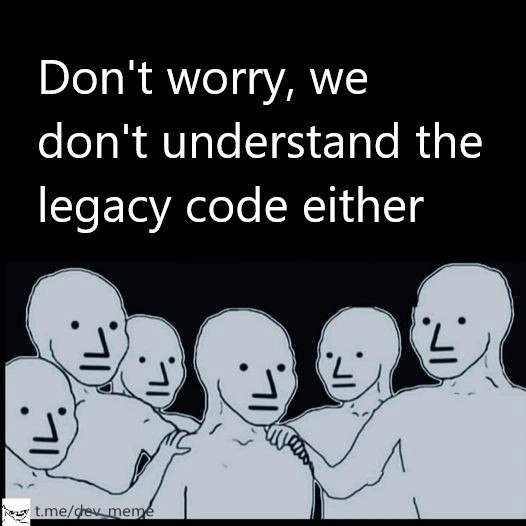
The Universal Legacy Code Onboarding
Description
A meme using the NPC Wojak format to depict a common developer experience. The image features a group of identical, grey, expressionless characters against a black background. They are gathered around one of their own, patting them on the shoulder in a gesture of consolation. The text at the top reads, 'Don't worry, we don't understand the legacy code either'. This meme perfectly captures the moment a new team member, likely feeling overwhelmed and suffering from imposter syndrome while trying to navigate an old, complex codebase, is welcomed into the fold by the senior developers who admit their own collective ignorance. It's a humorous take on the shared struggle with technical debt, poor documentation, and the archaeological nature of maintaining legacy systems. A watermark for 't.me/dev_meme' is visible in the bottom left corner
Comments
7Comment deleted
The company calls it 'legacy code.' We call it the 'Don't-Push-That-Button-Or-You-Get-To-Keep-The-Pieces protocol.'
Proof it’s legacy: git blame tags every line as “cvs2svn import,” the architecture diagram only opens in Visio 2003 on Windows XP, and the most up-to-date spec is the on-call runbook titled “good luck.”
The real horror isn't that the original developers left without documentation - it's discovering they were just as confused as you are, but had the audacity to push to production anyway. Welcome to the archaeological dig site where every artifact is cursed and the README just says 'good luck'
When the entire team realizes that the 'temporary' solution from 2008 is now mission-critical infrastructure, and the only person who understood it retired five years ago. At least you're all equally terrified of touching it - solidarity through shared incompetence is still solidarity. The real legacy isn't the code; it's the collective anxiety it produces
Legacy code: where 'refactor' means diffusing a 20-year-old bomb with zero schematics
You know it's legacy when the domain logic lives in triggers, the API docs are a Wireshark capture, and git blame returns 'vendor drop, 2009'
Nobody understands the legacy code, so governance promoted it to System of Record - now our modernization plan is a strangler fig and a very confident reverse proxy