Skip to content
DevMeme
1713 of 7435
The 'Quick' Production Push Walk of Shame
Deployment Post #1916, on Aug 14, 2020 in TG

The 'Quick' Production Push Walk of Shame

Why is this Deployment meme funny?

Level 1: Quick Task, Late Bedtime

Imagine you decide to do a quick little chore before you go to bed. Let’s say you want to put away one toy from your floor. It should only take a minute, right? But when you pick up that toy, you notice some lego pieces spilled out of the box. So you start gathering those legos, and then you realize the whole toy box is messy. You figure, “I’ll just organize it a bit.” As you’re fixing the toy box, you find a broken toy that needs gluing. You try to fix it. One thing leads to another, and suddenly a lot of time has passed. Now it’s really late – way past your bedtime – and you’re super tired, with messy hair and maybe one slipper lost under the bed. You started with one tiny task but ended up cleaning the entire room!

That’s exactly what happened in the meme. The developer thought he had a small, easy job (making a quick change to a program) and it spiraled into a big, long job that kept him at work until 11 PM. The picture shows him leaving work late at night, looking as tired as you would feel after cleaning your room for hours. His tie is hanging loose and he’s carrying his shoe in his hand, kind of like how you might drag your blanket when you’re exhausted. It’s funny because we’ve all had moments when we thought something would be easy but it turned into a huge ordeal. The meme uses this feeling to make a joke that other developers find very relatable. In simple terms: he tried to do a quick thing, it became a long thing, and now he just wants to go home and sleep – just like you would after a long, unexpected cleanup.

Level 2: Quick Push, Long Night

In simpler terms, this meme is about a software developer who intended to do a fast update to the live app but ended up working very late – leaving the office at 11 PM, exhausted and messy. The joke highlights how deployments (releasing code to the app that real users use) can go horribly wrong even if they seem easy. Let’s break down the scenario:

  • Production is the live, real-world environment where the application runs for users. It’s like the public website or service everyone sees. Doing a “push to production” means updating that live system with new code. It’s a big deal because if something breaks in production, actual customers are affected.
  • A “quick push” implies the developer thought the change was minor – maybe a small bug fix or a tiny feature tweak. They likely expected to deploy the update and leave work on time. The meme puts quotes around "quick" to hint that it turned out not quick at all.
  • The developer ended up LateNightCoding. Why? Often, even a small code change can have unexpected effects. For example, perhaps the fix worked on the developer’s computer and in testing, but in production it caused an error (maybe due to different data or heavier load). There’s a classic newbie phrase, “Works on my machine,” which means “I tested it locally, it seemed fine!” – but production can be a different story. Here, something didn’t work in the live environment, and the developer had to stay and fix it.
  • ProductionIssues are problems that occur in the live system. Maybe the site was crashing or users found a new bug right after the deployment. When such issues happen, developers can’t just ignore them – they have to jump into firefighting mode (solving urgent problems under pressure). Many teams have an on-call rotation: a specific person who must respond to after-hours problems. In this scenario, the person who did the deploy likely became the de-facto on-call hero, since they were already there to push the change. They spent the evening investigating logs, finding the bug, and deploying additional fixes or possibly rolling back the change to the previous version.
  • DeploymentPainPoints refers to the various challenges that come with releasing software. This can include things like merging code, running database migrations (updating the database structure or data for the new code), dealing with servers or cloud infrastructure, and making sure all the services restart correctly. Any of these steps can fail. For instance, if there’s a step to update a database and it takes too long or locks up, your quick push might turn into a long wait. If one microservice updates and another doesn’t, they might get out of sync and cause errors. Deployments have many moving parts, so there’s always a bit of stress that something could go wrong – that feeling is Release Anxiety.
  • CrunchTime and Deadlines also play a role. Crunch time is when everyone is working extra hard (often extra hours) to meet a due date. Perhaps a manager said, “This fix must go live today,” creating pressure to deploy it late in the day. Deadlines can tempt developers to say “Let’s just push it now,” even when it’s late, because they want to deliver on time. Unfortunately, if that rush leads to a problem, you end up spending even more hours that night. It’s a bit of a caution: doing things in a hurry at the last minute can backfire badly.
  • The late hour (11 PM) is central to the meme. Most people leave work much earlier, so seeing “11 PM” tells us this person’s quick task blew up into a major effort. It implies they probably stayed way past normal hours trying to get the production system stable. It’s not uncommon in tech – if a crucial bug appears or the website is down, developers will stay until it’s fixed, even if it means an all-nighter. That’s part of being responsible for a live service. But it’s tough, and if it happens often it can lead to SleepDeprivation (not getting enough sleep, which makes you drained).
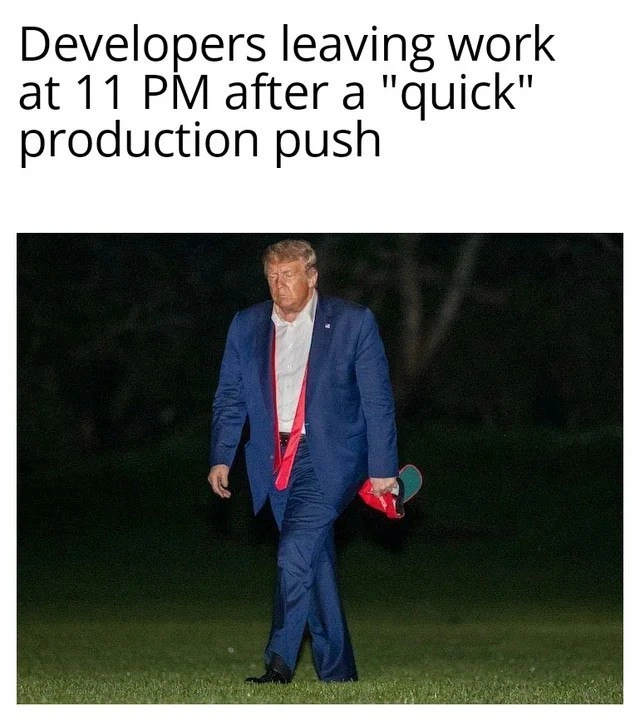
  • The image of the man in the suit with his red tie loosened, shirt unbuttoned, and holding his shoe is a humorous exaggeration of how a developer might feel after such a night. He looks totally done. The loose tie and missing shoe are universal visual cues for “rough day (or rather, rough night) at work.” It’s like when you see someone with their hair messy and dark circles under their eyes – you immediately know they’ve been through something exhausting. In developer humor, we might say he “debugged until he dropped.” The grass and darkness in the photo suggest he’s literally walking out into the night after everyone else has gone home.

For a junior developer or someone new to this world, the key takeaway is that deploying software is tricky. Even a small change can have big consequences in a complex application. That’s why teams put a lot of emphasis on testing, monitoring, and doing deployments at safe times. A best practice is to deploy in the morning or early afternoon, so that if something goes wrong, you have the whole team around and plenty of time to fix it. Another common practice is “no Friday deploys,” meaning avoid releasing new code on a Friday, because if it breaks, you might ruin your weekend (nobody wants to be stuck late on a Friday or get called in on Saturday). This meme is a funny reminder of those lessons. It’s basically telling us: Don’t underestimate any release. If someone says “It’s a quick push,” seasoned folks might jokingly grab their overnight bag – just in case!

Level 3: The 11th Hour Deploy

Famous Last Words: “It’ll be a quick push to production.” This meme captures one of those all-too-real developer nightmares: a deployment that was supposed to take minutes ends up consuming the whole evening. In the image, a disheveled man in a rumpled suit trudges through a dark lawn at night, red tie undone and one shoe in hand. He looks like he’s been through battle – and in a sense, he has. This is the post-deployment walk of shame that seasoned engineers know well. The humor here is darkly cathartic: everyone who’s done a late deploy recognizes that defeated posture, the look of a developer who just spent hours firefighting in production.

Why is this funny (and painful)? Because “just a small change” in a production environment often explodes into a cascade of ProductionIssues. The phrase “quick production push” is practically folklore for inviting Murphy’s Law to your release. It’s when a one-line fix causes a chain reaction of unforeseen bugs, or a routine update exposes that one config value you forgot in production.yml. Picture our poor developer: he probably started deploying late in the day – maybe to meet a deadline, or because someone yelled that an urgent bug needed fixing before tomorrow. 5:00 PM: code merges, confidence is high. 5:15 PM: metrics spike, error alerts start pouring in. Suddenly that “tiny” change has broken something critical in the live app (perhaps a cache invalidation that unexpectedly flooded the database, or a version mismatch in one microservice). By 6:00 PM, half the team’s on Slack trying to diagnose a mysterious failure that “never happened in staging.” Hours tick by. 8:00 PM: they’ve rolled out a hotfix (quick patch) to address one issue, only to uncover another (maybe a memory leak under real user load that testing didn’t catch). 10:00 PM: after multiple deploys, rollbacks, and maybe a database migration that locked up for an excruciating 30 minutes, things finally stabilize. Now it’s 11:00 PM – the system is mostly back to normal, and the developer drags himself out the door, looking like he just survived a war. That bright red tie hanging loose might as well be a surrender flag after a code red incident. At least he remembered to grab his shoe!

This scenario is hilariously relatable to experienced devs because it sits at the intersection of DeploymentPainPoints and cruel irony. We’ve all been that person saying, “I’ll just push this one quick fix,” only to trigger a marathon debugging session. It highlights the unwritten rule: never deploy right before you go home (especially on a Friday). If you do, you may end up like our friend in the meme, debugging in an empty office while the janitor vacuums under your desk. There’s a reason phrases like Release Anxiety and LateNightCoding exist – even the simplest releases can hide nasty surprises. Production has a way of turning what looked straightforward into a high-stakes puzzle. Maybe an environment variable wasn’t set (DEBUG=false in dev but not in prod), or an edge case in user data blows up the logic. It’s a mix of technical gotchas and bad luck: think “it works on my machine” meets “Schrödinger’s bug”, that only shows up when real users click that one button nobody tried during QA.

From a senior developer’s perspective, this meme also hints at deeper systemic issues. Why was a deployment happening so late? Perhaps crunch time culture or last-minute demands forced the release after hours – a sign of process anti-patterns. Rushing a deploy to meet a midnight deadline often backfires, as quality gets compromised. The shared laughter is a bit cynical: we laugh because we’ve felt that mixture of frustration, exhaustion, and “of course it went wrong” resignation. It’s a form of collective therapy. The image of a man stumbling out with tie askew and shoe off is basically a tech battle scar story: “I fought prod, and prod won.” Each element – the untied tie, the missing shoe, the late-night darkness – exaggerates how SleepDeprivation and defeat feel after fighting a production outage for hours. This meme is saying what every weary engineer knows: quick pushes are never quick, and if you’re leaving work at 11 PM looking like you aged 5 years, you’re officially part of the “Deployed Tonight” club. Consider it a tongue-in-cheek cautionary tale from the trenches of on-call duty, one that senior devs nod at while muttering, “yep, been there, done that, got the t-shirt (and the bags under my eyes to prove it).”

Description

A meme consisting of a caption above a photograph. The text at the top reads, 'Developers leaving work at 11 PM after a "quick" production push'. The image below features former U.S. President Donald Trump, looking weary and disheveled. He is walking on a grassy area at night, wearing a blue suit with his red tie undone and hanging loosely. His expression is one of utter exhaustion and defeat. The meme humorously captures the universal experience of software developers when a supposedly simple and 'quick' deployment to the production environment goes wrong, leading to a long, stressful night of troubleshooting and firefighting. The disheveled appearance in the photo perfectly mirrors the mental and physical state of an engineer after such an ordeal
Comments

7
Anonymous ★ Top Pick A 'quick production push' is the leading cause of developers discovering what the sunrise looks like from the office window
  1. Anonymous ★ Top Pick

    A 'quick production push' is the leading cause of developers discovering what the sunrise looks like from the office window

  2. Anonymous

    Blue/green deploys feel elegant until 11 PM, when you realize both environments have converged into “brown” and you’re limping to the parking lot with one shoe, wishing we’d just scp-ed the jar like it was 2006

  3. Anonymous

    The only 'quick' production push is the one where you push the rollback button after realizing your 'trivial' config change just took down three availability zones and triggered a cascade of PagerDuty alerts that woke up the entire SRE team

  4. Anonymous

    Ah yes, the classic 'quick production push' - where 'quick' is measured in geological time and your deployment checklist somehow spawns three incident tickets, two rollback attempts, and a Slack thread that would make War and Peace look like a haiku. By 11 PM, you've achieved that perfect blend of caffeine toxicity and existential dread, questioning every life choice that led you to approve a Friday evening release. The tie isn't just loosened - it's a visual metaphor for your carefully constructed deployment plan unraveling in real-time as you discover that 'it worked in staging' is the software equivalent of 'famous last words.'

  5. Anonymous

    That 'quick' prod push where the Helm release hooks outnumber your sleep hours, leaving you skateboarding out like it's casual Friday at 11 PM

  6. Anonymous

    Quick prod push: 4-line diff, 6-hour bridge, canary rolled back, migration half-applied, and you leaving like blue/green’s undocumented third state - exhausted

  7. Anonymous

    “Quick push” is senior-speak for: one-line fix, cascading cache invalidation, wobbly canary, manual rollback, and a postmortem invite you accept from the parking lot

Use J and K for navigation