The Only 'Pics' an On-Call Engineer Gets at 3 AM
Why is this OnCall ProductionIssues meme funny?
Level 1: 3AM Fire Alarm
Imagine it’s 3 o’clock in the morning. Your friend thinks you’re up for some fun, maybe sharing a silly or exciting picture because who else is awake at 3 AM, right? But instead of something fun, your phone suddenly blares like a fire alarm in the dead of night. 📟🚨 It turns out to be an emergency call from your work – something important has broken down. This meme compares those two situations. One person is hoping for a late-night treat (like getting candy), but the other person is an on-call engineer who basically just got a midnight emergency call. It’s like your friend asked for a cool surprise photo, and you answered by showing them the equivalent of a house fire. The humor is in how completely opposite the two ideas are. It’s funny in a goofy way: “I wanted a fun picture, but all I got was an alarm screaming that something’s wrong!” Even if you don’t know the tech details, you can laugh because it’s as if someone expected a nice bedtime story and instead got a firefighter’s wake-up call. Not the kind of 3 AM surprise anyone wants!
Level 2: Midnight Fire Drill
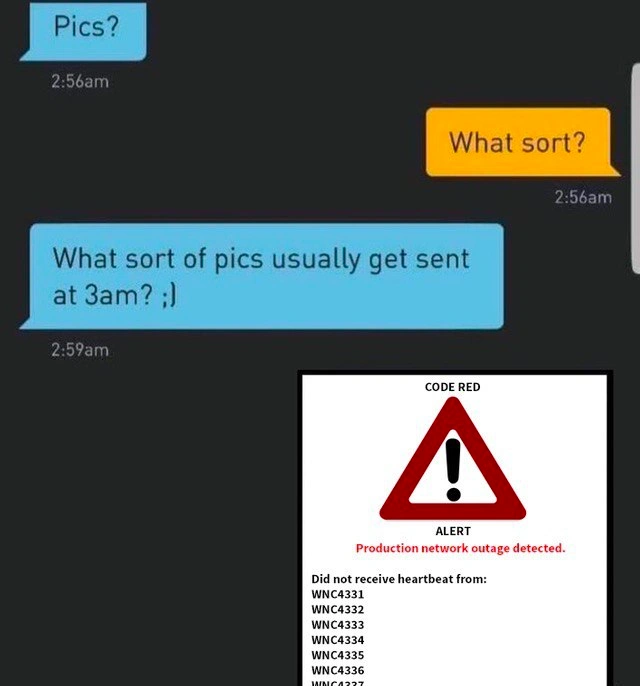
If you’re new to this, let’s break down the scenario. This meme is about being on-call for a tech system, and how life can interrupt you with a work emergency at the worst hours. On-call means a specific engineer is responsible for handling any issues that come up in the Production environment (the live site/app that real users use) during off hours. Companies have on-call rotations so someone is always available 24/7. When you’re the unlucky one on the night shift, you carry a phone or pager that can alert you if something breaks. And yes, that often means being woken up at 3 AM by a loud alert – just like a firefighter might be woken by a fire alarm. This meme’s chat shows a friend texting “Pics?” at 2:56am – usually, getting a “pics?” text at that hour implies they’re asking for personal or NSFW pictures (a late-night flirt). The on-call engineer replies “What sort?” because, well, maybe they’re half-awake and confused. The friend clarifies with a winky face, “What sort of pics usually get sent at 3am? ;)” – meaning: you know, the naughty kind.
Now here’s the twist: instead of sending a spicy photo, the engineer responds with a screenshot of a production outage alert. The bottom part of the meme is that alert: a white card with a big red triangle and the words CODE RED – ALERT – Production network outage detected. Below that, it lists several hosts (computers/servers) named WNC4331 through WNC4336 that “did not receive heartbeat.” In plainer terms, those servers have stopped responding or checking-in. In monitoring jargon, a heartbeat is like a regular “I’m okay” signal that servers send to a monitoring system. If the monitor doesn’t hear from a server for a while, it assumes the server is down or unreachable. So here, not one but six servers in a row missed their heartbeat signals. That is a major red flag – it’s very likely a serious network or system failure affecting a whole chunk of the infrastructure. That’s why the alert is labeled CODE RED, which usually means critical severity. This isn’t a minor glitch; it’s a “wake the on-call person up right now” emergency. ⏰🔥
For someone learning DevOps terms: DevOps/SRE (Site Reliability Engineering) folks set up monitoring and observability systems to keep tabs on production. Observability means having tools and data (logs, metrics, traces) to understand what’s happening inside your system. Monitoring is specifically watching certain metrics or heartbeat pings and alerting humans if something goes outside acceptable bounds. An OnCallDuty engineer often uses services like PagerDuty, which will phone/text them when an alert like this happens. In the meme, that white alert card looks a lot like a PagerDuty or OpsGenie alert notification. It has the timestamp (3am-ish), a title (Production network outage), and details (which hosts are down). The engineer basically “answered” the friend’s picture request with this alert image. It’s a way of saying, “You want to see what I’m dealing with? Here it is – my servers are on fire!”
From a junior perspective, it’s highlighting the lifestyle: when you’re on-call, your personal plans can get interrupted anytime. Instead of fun texts from friends, you might be getting texts from automated systems telling you something broke. ProductionOutage means some part of the live service is failing – could be a server crashed, a data center lost connectivity, etc. Engineers often call these incidents “fires” and fixing them is “firefighting”. They have to respond ASAP, investigate, and restore service. It’s a high-pressure situation, especially at 3 AM when you’re groggy. There’s also a reference to Alert Fatigue – if you get too many alerts (some might even be false alarms), you start to get stressed and exhausted. Good teams try to minimize 3 AM alerts to only truly critical issues. But as the meme jokes, sometimes you can’t avoid it – things do break at ungodly hours. And when that happens, the on-call engineer’s reality is very different from someone casually texting late at night. The meme is basically a funny illustration of “my 3 AM is not like your 3 AM.” The friend expects a certain kind of picture 💃, but the only thing this engineer is sending is a screenshot of a system crisis. In summary: OnCallNightmares meet regular life, and the result is both funny and all-too-real for those in tech.
Level 3: PagerDuty Booty Call
At 2:56 AM, someone sends a flirty “Pics?” text, expecting the usual late-night selfies or something spicy. But this on-call engineer lives in a different reality: by 2:59 AM, instead of a risqué photo, they’re sending back a screenshot of a CODE RED production outage alert. The meme mashes up a booty call with a PagerDuty call – a perfect storm of expectation vs. OnCall reality. It’s darkly comic because anyone who’s done OnCallDuty in DevOps/SRE can relate: the only thing blowing up your phone at 3 AM is a production incident, not a steamy chat. 😅
This scenario is painfully accurate OnCall humor. The friend quips, “What sort of pics usually get sent at 3am? ;)” – implying something NSFW and fun. The on-call engineer’s response: an alert card blaring “Production network outage detected.” Talk about a mood killer! The humor comes from the absurd juxtaposition: one person expects late-night thrills, the other delivers a nightmare ProductionIncident report. It’s a shared trauma joke among engineers: you might be awake at 3 AM, but not for the reasons your non-tech friends imagine. Instead of “pics or it didn’t happen,” it’s “P1 incident or nobody sleeps.”
Look at the alert details in the meme’s second panel: “Did not receive heartbeat from: WNC4331, WNC4332, … WNC4336.” Six hosts have flatlined simultaneously – a DevOps engineer’s version of a heart attack. In system monitoring, a heartbeat is a regular “I’m alive” ping from a server. All those WNC433x hosts missing heartbeats at once suggests something big is borked. Perhaps a whole rack of servers went dark or a network switch feeding those machines failed. Code Red is no exaggeration: that’s the highest alert level, essentially screaming “WAKE UP NOW, everything’s on fire!” The on-call’s phone probably made an awful siren noise, jolting them awake right as they were texting. Because of course, a ProductionOutage loves to strike at 3 AM – when you’re bleary-eyed and least prepared, upholding the tradition that nothing good happens after 2 AM in prod.
This meme nails several industry in-jokes. The phrase Alert Fatigue comes to mind: after enough 3 AM false alarms and real crises, on-call engineers get conditioned to dread any buzz or ringtone (some even get minor PTSD from the PagerDuty ringtone 🤣). The friend in the chat clearly isn’t on-call and has no clue our engineer’s pulse just spiked from panic, not passion. The Observability_Monitoring setup behind this alert likely involves tools like Nagios, Zabbix or modern cloud monitors that detect lost heartbeats. It’s a standard DevOps/SRE practice to have health checks; when they fail, an Alert is dispatched to whoever’s on duty. In a perfect world, good Observability means catching issues before they become ProductionFirefighting nightmares – but the joke here is that no amount of monitoring magic prevents the sheer timing of these incidents. The veteran cynicism: “Of course it decided to die at 2:59 AM. Typical.”
Real on-call war stories echo this meme’s setup. The combination of multiple hosts dropping off (WNC4331–4336) hints at a cluster-wide issue. Seasoned engineers know when you see a list of sequential hostnames all dead, it’s rarely a single server’s fault. It could be:
- Network partition – e.g. a top-of-rack switch or a router failed, isolating an entire group of servers (naturally at 3 AM, because network hardware has a twisted sense of humor).
- Bad deploy or script gone wild – maybe someone pushed an update at midnight that slowly crashed every instance in that cluster by 3 AM. A cron job or backup script could have kicked in and overloaded the system (late-night batch processes have no mercy).
- Misconfiguration – perhaps a DNS or firewall change inadvertently cut off these hosts. (It’s always DNS! 🙃) Suddenly none of the servers can call home with their heartbeats, triggering a cascade of alerts.
- Power outage or Cooling failure in one rack – less likely but if a power distribution unit blew, an entire rack (with hosts numbered in sequence, like 4331-4336) could go dark.
Whatever the cause, the poor on-call engineer has to drop everything (including that personal conversation) and jump into ProductionFirefighting mode. The friend’s “😉” quickly becomes the engineer’s “🚨!”. The meme is both funny and a little tragic: it highlights how on-call engineers live in a different world. While others might be out partying or sending flirty texts at 3 AM, the on-call person is tethered to their monitoring system, ready to receive the next night_shift_meme worthy alert. It’s DevOps gallows humor – we laugh to keep from crying, and then we go fix the outage.
Description
A meme that juxtaposes a flirtatious late-night text conversation with a critical system alert. The top portion of the image displays a screenshot of a chat. A message at 2:56 AM asks, 'Pics?'. A reply asks, 'What sort?'. The original sender responds at 2:59 AM with, 'What sort of pics usually get sent at 3am? ;)'. Below this conversation, an inset image shows a system alert notification. It has a 'CODE RED' header, a large red triangular warning symbol with an exclamation mark, and the text 'ALERT' and 'Production network outage detected.' The alert details that it 'Did not receive heartbeat from:' a list of servers (WNC4331, WNC4332, etc.). The humor comes from the bait-and-switch: the expectation of receiving intimate photos is subverted by the reality of a production emergency, a scenario all too familiar to developers, SREs, and anyone on pager duty
Comments
8Comment deleted
Ah, the classic 3 AM booty call from PagerDuty. It's not looking for a good time, just a root cause analysis
They asked for 3 AM pics, so I replied with a PagerDuty screenshot - nothing says “intimate” like six missing heartbeats and our single-AZ architecture laid completely bare
After 15 years in tech, you learn that "Netflix and chill" means watching your Grafana dashboards while six production servers lose heartbeat simultaneously, wondering if your relationship with PagerDuty is healthier than your actual relationships
The only relationship where 'u up?' at 3am is guaranteed a reply is the one between you and your monitoring system
Nothing kills the mood quite like a cascading failure across six production nodes. The real tragedy here isn't the missed romantic opportunity - it's that the monitoring system waited until 3am to detect what was probably a network partition that started at 2:45am. Classic eventually-consistent alerting: your relationship status and your cluster health both degraded simultaneously, and you found out about both with perfect timing
3AM pics from the cluster: no heartbeat, just cold outage - the SRE equivalent of being ghosted mid-deploy
3am pics? The ones with red triangles and “did not receive heartbeat” - the only “u up?” that opens a runbook when the cluster loses quorum
At 3am, the only pics I send are Sev1 CODE RED heartbeat screenshots - CAP theorem for SREs: pick any two of consistency, availability, or sleep