Skip to content
DevMeme
4665 of 7435
The Unironic Need for Governance in a Counter-Culture Tech Stack
Containerization Post #5115, on Mar 25, 2023 in TG

The Unironic Need for Governance in a Counter-Culture Tech Stack

Why is this Containerization meme funny?

Level 1: Biking Without a Helmet

Imagine you have a friend who says, “Rules are for losers!” and decides to ride his bike really fast down a hill without wearing a helmet because he thinks it makes him look cool and daring. At first, he’s whooping and enjoying the wind in his hair – that’s the “punk rock” vibe of doing something rebellious. But then, as you might guess, he hits a bump. 😬 He loses control, crashes hard, and ends up with a big scrape on his head and a trip to the doctor. Not so cool anymore, right?

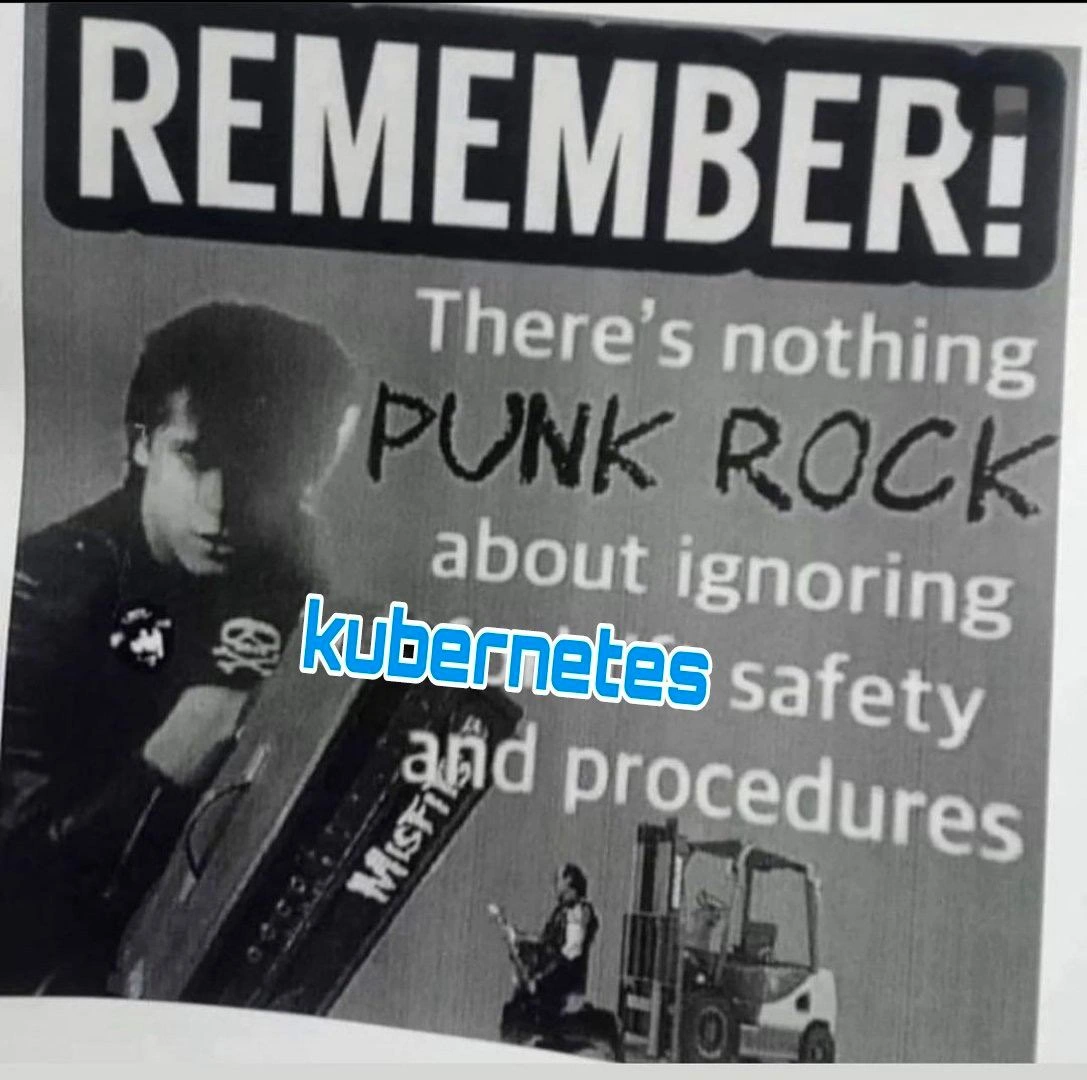
This meme is basically saying the same thing, but about computers. It’s telling us: just because you think skipping safety rules makes you look bold or edgy, in reality it just gets you hurt (or in trouble). In the picture, there’s a big “REMEMBER!” sign, like a safety poster, saying there’s nothing punk rock (nothing truly cool or awesome) about ignoring safety and procedures. They even show a punk rock musician and a forklift to make the point. The forklift is like a big machine that can hurt you if you play around without rules, and the punk rocker is that friend who might say “yeah, no rules!”

So in super simple terms: following safety rules in tech (or anywhere) isn’t lame – it’s how you avoid crashes. Being safe is actually smart, not boring. The joke in the meme comes from comparing a rebellious rock star attitude with something as un-glamorous as safety guidelines, and saying, humorously, that even in the wild world of tech, you should put on your helmet (follow best practices) before you do your stunt jump (deploy something big). It’s funny and true: being reckless isn’t truly badass when the result is a mess. Just like wearing a helmet doesn’t make you uncool on a bike (it just keeps you from bleeding), using caution in managing your computer systems doesn’t make you uncool – it just keeps your site from crashing.

Level 2: Kubernetes Safety 101

Let’s break down what this meme is saying in simpler terms, especially for those new to Kubernetes or just starting out in DevOps/SRE. Kubernetes (often abbreviated “K8s”) is a system that helps manage containerization – basically running your applications in isolated packages called containers across a bunch of machines (nodes). It’s a powerful tool for deploying and scaling apps, but with great power comes great responsibility. Running things on Kubernetes in production (meaning real-world, user-facing environments) requires following certain guidelines and best practices – the “safety procedures” – to keep everything running smoothly and securely.

The meme uses the idea of a “workplace safety” poster, like something you’d see in a factory, to drive the point home. It even has a forklift image, which is a classic symbol of heavy machinery that requires training and caution. Think about a warehouse: you have rules like “wear a hard hat”, “don’t speed with the forklift”, “check the load balance” so you don’t drop a pallet on someone. Now translate that to a tech workplace: our “machines” are software and servers, and our forklift is the Kubernetes cluster handling containers. The blue Kubernetes logo slapped over the word “safety” is telling us that Kubernetes safety is what we should remember. In other words, follow the rules when you deploy your containers, because doing it carelessly isn’t being cool or clever; it’s dangerous – just like driving a forklift recklessly would be.

Some key safety practices in Kubernetes (and general DevOps) that this meme is alluding to include:

  • Testing and gradual rollout: Instead of just blindly releasing new code to everyone (which might feel “fast and loose”), you test it, maybe deploy to a small subset or a staging environment first, use continuous integration/continuous deployment (CI/CD pipelines), etc. This is the opposite of a punk “just do it live!” approach. It might seem dull, but it catches bugs and prevents major Production issues like crashes or downtime.
  • Health checks (Probes): Kubernetes allows you to set up liveness probes and readiness probes. A liveness probe is like a heartbeat check – if the app is not responding, Kubernetes will automatically restart that container. A readiness probe checks if the app is ready to handle traffic; if it’s not, Kubernetes temporarily removes it from the network so users don’t hit an unready service. Ignoring these is risky; it’s like not wearing a seatbelt – maybe you’ll be fine for a while, but when trouble happens (and in tech, it eventually does), you’ll wish you had that protection.
  • Security settings: Running containers with least privilege – for example, not running them as the all-powerful root user and not giving them more permissions than necessary. Kubernetes has features like RBAC (Role-Based Access Control) which means you set who/what is allowed to do certain actions. If you ignore that (e.g., give every service admin rights, or open your cluster dashboard to the internet with no password), you’re basically leaving the warehouse door wide open for thieves or accidents. The meme’s context in Security is clear: following security best practices isn’t optional if you want to avoid nasty surprises like hacks or data leaks.
  • Resource limits and monitoring: In Kubernetes, you can specify how much CPU or memory a container should use at minimum (requests) and the maximum it’s allowed (limits). This prevents one app from using all the machine’s power and starving others – think of it like a circuit breaker or a speed governor on a forklift. A new developer might not see why that’s important (“let the app use what it needs, why limit it?”), until the day one buggy process eats 100% CPU and everything else on that machine freezes. So, these “guardrails” are based on hard-earned experience.
  • Following procedures: Things like runbooks (step-by-step guides for common operations or emergencies), change management (letting your team know before you push a big change), and using proper tools (like using helm or manifests stored in git, instead of ad-hoc manual changes). It’s similar to how a forklift operator has a checklist (check battery, test brakes, etc.). In DevOps culture, having a checklist or automated pipeline is considered a mark of professionalism, not lameness.

So when the meme says “There’s nothing PUNK ROCK about ignoring safety and procedures,” it’s a fun way of telling junior engineers: don’t romanticize being a rebel who breaks the rules in tech. In software teams, the “rebel” who skips all the steps usually ends up causing an outage or a security incident. There’s a famous tongue-in-cheek term “cowboy coding” for when someone just codes and deploys on their own without team process – sounds wild and free, but usually it leads to a lot of bugs and 3 AM phone calls to fix things. The DevOps humor here turns that into an image: a punk rocker might break his guitar on stage (cool in music), but if you “break” your production server intentionally, nobody’s clapping – your coworkers are just upset and your users are having a bad time.

The inclusion of the punk rock theme (with the Misfits band logo and the punk guitarist) is there to symbolize that rebel mentality. Misfits as a band were all about horror punk aesthetics and anti-establishment vibes. The meme cleverly flips this: being a misfit in a dev team by ignoring established best practices isn’t something to brag about; it’s more like being the guy who never reads the manual and then blames the machine when things go wrong. The truth is, even punk bands practice their songs, tune their instruments, and follow some “rules” (like staying in rhythm) – otherwise their performance falls apart. Similarly, no matter how cutting-edge or “cool” your tech is (Kubernetes, Docker, you name it), you still need structure and procedures to not mess it up.

If you’re early in your career, it might actually feel impressive to do something risky and pull off a quick fix. Maybe you deploy a change at midnight directly to production and it solves a problem – you might think “see, we didn’t need all that process.” But this meme is the seasoned voice of experience telling you that it’s a slippery slope. Nine times out of ten, bypassing safety leads to a bigger failure. The first time a newbie engineer accidentally deletes a database or takes down the company website because they didn’t follow the deployment checklist, they realize why those boring procedures exist. Production is unforgiving: one command run in the wrong context (kubectl delete ns kube-system – yikes!) or one configuration mistake can have massive consequences. That’s why teams put in place things like confirmation prompts, peer reviews, and detailed runbooks for, say, “How to deploy without downtime.” It’s not about being uptight; it’s about protecting the service and users.

So, in a nutshell, Level 2 translation: Kubernetes is powerful but complicated. Treat it with the same respect as heavy machinery. DevOps culture may seem chill and innovative (and it is), but it actually relies on a lot of smart safety nets built over years of hard lessons (memorably summarized as security best practices and automation). You’re not being a “cool punk” by ignoring those – you’re just setting yourself up for failure and a tough learning moment. Or as the meme bluntly puts it: there’s nothing cool about causing an incident that could have been prevented. Real coolness is deploying without drama.

Level 3: Rebel Without a Runbook

This meme strikes a chord with experienced DevOps and SRE folks by lampooning the “cowboy” attitude some engineers have towards production. The image is styled like an old industrial workplace safety poster, complete with a forklift and a punk guitarist, announcing: “REMEMBER! There’s nothing PUNK ROCK about ignoring safety Kubernetes and procedures.” It humorously replaces the word “safety” with the bright blue Kubernetes logo, reframing the slogan to target our beloved container orchestration platform. The juxtaposition is funny because punk rock is all about anti-establishment, no-rules rebellion, whereas production Kubernetes clusters thrive on rules, guardrails, and careful procedures. Essentially, it’s saying: “Hey hotshot, deploying to your cluster with a total disregard for best practices isn’t edgy – it’s just a forklift accident waiting to happen.”

Why is this humorous to seasoned developers? Because we’ve all seen (or been) that overconfident engineer treating a live cluster like their personal playground. The meme drips with sarcasm: calling out the idea that skipping safety protocols is somehow “punk.” In reality, those protocols (like thorough testing, gradual rollouts, monitoring, and security checks) exist because someone, somewhere learned their necessity the hard way. It’s a shared industry joke that “move fast and break things” might sound cool until you’re the one fixing the 2 AM outage. There’s an entire DevOps culture built around post-mortems and learning from failures — a culture that often originates from some rebel decision gone wrong. So seeing a sign sternly reminding us “There’s nothing punk rock about ignoring procedures” evokes a knowing grin: it’s a callout to all the weekend-warriors who hit deploy on a whim and ended up paging the whole on-call rotation.

Let’s unpack the elements: the Misfits decal on the bass guitar, the skull patch on the punk’s leather jacket, and the very phrase “punk rock” conjure a spirit of rebellious nonconformity. In tech, the equivalent stereotype is the “rockstar developer” or “10x engineer” who scoffs at processes, rolls code directly into production, and perhaps bypasses QA – basically “deploys it live” because rules are for conformists. The meme pointedly tells us this behavior isn’t admirable; it’s as reckless as a forklift driver doing stunts in a warehouse. The forklift in the corner reinforces the industrial safety analogy: operating a forklift recklessly can cause it to tip over or injure people, just as operating your Kubernetes cluster recklessly can cause a production outage or a security breach. In both cases, it’s not badass – it’s a disaster in the making.

In real-world DevOps terms, what does “ignoring safety and procedures” look like? It could be deploying new versions to production without any CI/CD pipeline, bypassing code review and automated tests. It might be editing live Kubernetes resources by hand (kubectl edit or kubectl apply on the fly) with no change control, or disabling critical safety features like liveness probes because “they’re hard to configure” (so punk!). Perhaps it’s neglecting PodSecurityPolicies (or the newer Pod Security Standards) and running containers as root, exposing the cluster to compromise. Or ignoring resource limits/requests, which might let one container hog all the memory and crash a node (we’ve seen those multi-tenant cluster incidents – one rogue app brings down the whole host, and suddenly everyone’s down). These aren’t hypotheticals; many of us have stories of an “innocent” change that bypassed procedure and took down production. The meme resonates because it's basically the Ops team’s tongue-in-cheek way of saying, “We have change management and runbooks for a reason, kid.”

To illustrate, imagine a Kubernetes deployment done the reckless way versus the safe way:

# A "YOLO" Kubernetes Deployment with minimal safety
apiVersion: apps/v1
kind: Deployment
metadata:
  name: rebellious-deploy
spec:
  replicas: 50
  template:
    spec:
      containers:
      - name: unsafe-app
        image: mycorp/unsafe-app:latest
        # No health checks, no resource limits, running as root - punk rock? More like ops nightmare.
        securityContext:
          runAsUser: 0                # 0 = root user, extremely risky in containers
          allowPrivilegeEscalation: true  # container can gain host-level powers
        # livenessProbe: omitted (container might hang and Kubernetes won't restart it)
        # readinessProbe: omitted (traffic could be sent to a failing pod)
        # resources: {} (no CPU/memory limits, this pod can starve others or crash the node)
# A "Safe" Deployment with proper procedures
apiVersion: apps/v1
kind: Deployment
metadata:
  name: safe-deploy
spec:
  replicas: 50
  strategy:
    rollingUpdate:
      maxUnavailable: 5   # Controlled rollout to avoid full downtime
  template:
    spec:
      containers:
      - name: safe-app
        image: mycorp/safe-app:v2.0
        securityContext:
          runAsUser: 1000           # use a non-root user ID inside container
          allowPrivilegeEscalation: false
        resources:
          requests:
            memory: "512Mi"
            cpu: "0.5"
          limits:
            memory: "1Gi"
            cpu: "1" 
        livenessProbe:
          httpGet:
            path: /health
            port: 8080
          failureThreshold: 3      # restart container if unhealthy
        readinessProbe:
          httpGet:
            path: /ready
            port: 8080

In the first YOLO deploy example, the attitude is “I don’t need your rules.” No liveness probe means if the app deadlocks, Kubernetes won’t automatically restart it – potentially leaving users with a hung service. No readiness probe means the app could be added to load balancing before it’s fully started, causing user requests to fail (classic rookie move that can take down an app behind a load balancer). Running as root with privilege escalation means if an attacker finds a way out of the container or a simple misconfig, they now own your entire node (a security nightmare — definitely not what you want in production). And no resource limits means this container can suddenly gobble up all CPU/RAM if something goes wrong (like an infinite loop or memory leak), which might knock out the Kubernetes node or degrade other services – a one-“punk” container DDoS-ing its neighbors. This is the tech equivalent of joyriding a forklift through the warehouse: it’s only fun until you knock down all the pallets (or in Kubernetes terms, crash critical pods).

In the second safe deploy snippet, we see the opposite: careful procedures in place. Non-root user, so even if compromised, the container has limited access. Resource requests/limits to give the scheduler the info it needs and to prevent any one service from cannibalizing resources. Liveness and readiness probes act as that safety harness – ensuring the orchestration system can proactively handle failures or delays (if the app isn’t healthy, Kubernetes will kill and replace it; if it isn’t ready, it won’t send traffic to it yet). The rolling update strategy ensures we don’t take down all instances at once during a deploy (preventing a full outage if the new version is bad). These are Kubernetes best practices – the mundane “safety procedures” the meme is championing. They might not seem rock ’n’ roll, but they’re what keep your site up and your pager silent. As any battle-scarred SRE will tell you, uptime is way cooler than edgy negligence.

The meme’s punchline really comes from calling out a cultural truth in tech: While punk rock music celebrated smashing guitars and defying rules, successful DevOps culture has learned (sometimes the hard way) that stability and security are not enemies of innovation – they’re prerequisites for it at scale. The text “There’s nothing punk rock about ignoring Kubernetes and procedures” is a sardonic reminder that being a rebel in a production environment just makes you a “root cause” waiting to happen. If you swagger into a Kubernetes cluster thinking you’re Sid Vicious, you’ll end up more like a Spinal Tap drummer (in a puff of smoke). Real rockstars in tech are the ones who deploy without drama because they respect the process. They use Infrastructure as Code, they double-check their Helm charts, they have observability tools in place and follow security best practices like it’s the gospel.

Finally, that little forklift image in the meme is gold. It invokes the classic OSHA safety posters one might see in a factory or warehouse: “Days since last accident” and all. It implies that running a Kubernetes cluster is serious business, involving heavy lifting and potential hazards, just like operating heavy machinery. In a factory, nobody sane would brag about ignoring the safety lockout procedures on a machine press – that’s not “punk,” that’s grounds for getting fired (or killed). The same in tech: deploying to production without regard for procedures can wreak huge financial and reputational damage. And guess who has to clean up? The whole team. It’s not cool. The shared laugh here is that we’ve all been tempted by the “quick fix” or the “just this once” bypass, and memes like this jerk us back to reality: Procedure might be unglamorous, but downtime and security breaches are a whole lot less glamorous. In the end, this is a DevOps humor PSA: stay safe, not because management said so, but because scars from Production issues have taught us better. Rock on – but wear your helmet.

Level 4: Anarchy in the K8s

At the most theoretical level, this meme highlights a fundamental principle of complex distributed systems like Kubernetes: chaos without control leads to catastrophe. Kubernetes is essentially a large-scale control system managing numerous containerized processes across nodes. It operates via feedback loops and controllers to maintain desired state. If an operator ignores safety protocols and bypasses those control mechanisms, it’s akin to removing the feedback regulators from an engine – you invite unstable oscillations or total breakdown. In control theory terms, Kubernetes provides damping and governance (through quotas, health checks, and policies) to prevent runaway conditions. Stripping those away is literally courting entropy: containers might proliferate or consume resources unchecked until the system collapses under load (the dreaded “cluster meltdown” scenario).

Under the hood, Kubernetes relies on some heavy-duty distributed algorithms to keep the cluster consistent and available. For instance, the cluster state is stored in etcd, which uses the Raft consensus algorithm to maintain a single source of truth across the control plane. Consensus algorithms have well-defined guarantees – and expectations – about system behavior. Overriding safety (say, by manually altering cluster state or ignoring error conditions) can violate these assumptions, leading to split-brain scenarios or inconsistent state. You can’t be “punk rock” and break the laws of the CAP theorem; if you frivolously sacrifice consistency or partition tolerance without a plan, the laws of distributed computing will bite back. Eventual consistency isn’t a charming philosophy when it’s your user data that’s “eventually” consistent due to a reckless deploy that bypassed transactional safeguards.

There’s also a hint of computational complexity beneath this humor. Kubernetes’ scheduler is effectively solving a multi-dimensional bin-packing problem (assigning pods to nodes respecting CPU/memory constraints and affinities), which is NP-hard. We use heuristics, sensible defaults, and resource limits to guide the scheduler. If you ignore those “safety and procedures” – for example, not setting any resource requests or limits – you turn the scheduling into a anarchic free-for-all. The cluster’s performance becomes unpredictable because the scheduler lacks the necessary hints to do its job efficiently. It’s like telling a CPU scheduler “whatever, run these 1000 threads with no priorities” – thrash city ensues as the system struggles to allocate resources fairly. In theoretical terms, you’ve removed the constraints that make the solution tractable, so the system might end up in suboptimal or even pathological states (e.g. all pods cramming onto one node and causing an OOM crash).

From a security theory perspective, reckless deployments violate the bedrock principle of least privilege and defense-in-depth. Skipping Kubernetes RBAC (Role-Based Access Control) rules or running containers as root is essentially ignoring decades of security research. The meme’s warning “There’s nothing punk rock about ignoring safety” channels the same wisdom as classical security models: your system’s integrity is only as strong as its weakest link. If you think it’s edgy to expose your cluster’s kubelet API to the world or to use default credentials, the adversary (be it Murphy’s Law or actual attackers) will demonstrate the folly. Cryptographers and security engineers have mathematically shown how quickly an insecure configuration can be compromised – it’s not rebellion, it’s negligence.

In summary, at this deep level, the humor lands because it juxtaposes the counter-culture ethos of punk (“no rules!”) against the unforgiving scientific reality of large-scale systems. There are inviolable laws – in math, physics, and computer science – that govern system reliability and safety. Ignoring Kubernetes best practices isn’t some avant-garde act of tech rebellion; it’s more like defying gravity on a skateboard – you will come crashing down. The meme wittily reminds us that even the edgiest tech stacks are bound by the same old principles of consistency, resource limits, and secure design. In the world of DevOps, order and chaos are a delicate balance, and thinking you can just exclaim “YOLO” at a cluster without consequences is a naive fantasy. As punk rock as it may sound to “tear down the rules, man”, a Kubernetes cluster will just throw the rulebook (and a cascade of pagers) right back at you.

Description

A meme presented as a black-and-white, grainy workplace safety poster with a punk rock aesthetic. At the top, bold white text in a black banner reads 'REMEMBER!'. Below, the main text states, 'There's nothing PUNK ROCK about ignoring [kubernetes] safety and procedures'. The word 'kubernetes' is conspicuously photoshopped in a bright blue, sans-serif font, covering part of the original text. The poster features a person in a punk rock attire, with a leather jacket and dark hair, next to what appears to be a roadie case with a 'Misfits' logo. In the bottom right, a small image of a person driving a forklift is visible, hinting at the original meme's focus on workplace safety. The meme humorously juxtaposes the rebellious, anti-establishment ethos of punk rock with the highly structured, rule-based necessity of managing Kubernetes. It implies that avoiding best practices in K8s isn't edgy rebellion but simply professional negligence, framing operational discipline as the 'new punk.'
Comments

7
Anonymous ★ Top Pick Real punk rock in 2023 isn't ignoring K8s security policies; it's writing a Mutating Admission Webhook that secretly changes every container's entrypoint to 'rickroll'
  1. Anonymous ★ Top Pick

    Real punk rock in 2023 isn't ignoring K8s security policies; it's writing a Mutating Admission Webhook that secretly changes every container's entrypoint to 'rickroll'

  2. Anonymous

    Shipping :latest with privileged=true and no readiness probe isn’t punk - it’s why the 3 a.m. forklift keeps hauling etcd out of the wreckage

  3. Anonymous

    Nothing says 'living on the edge' quite like running kubectl delete without --dry-run first, except maybe deploying on Friday afternoon with resource limits set to 'unlimited' because YOLO is definitely a valid orchestration strategy

  4. Anonymous

    Ah yes, the classic 'move fast and break things' approach to Kubernetes - nothing says punk rock like a cascading pod failure at 3 AM because someone skipped RBAC policies and resource limits. Turns out the real rebellion isn't ignoring safety procedures; it's actually reading the documentation, implementing proper health checks, and having a rollback strategy. Because when your entire production cluster goes down because of a misconfigured HPA, the only thing getting forked is your on-call rotation and your sleep schedule

  5. Anonymous

    Ignoring k8s safety feels punk - until you're authoring the postmortem on why your namespace became a free-for-all breach vector

  6. Anonymous

    Kubernetes isn’t punk rock; running pods as root, mounting hostPath /, and skipping NetworkPolicies just books you as the 3am incident headliner

  7. Anonymous

    Granting everyone cluster-admin and skipping RBAC feels rebellious until the 3am pager; real punk is Gatekeeper, Pod Security, and NetworkPolicies making Friday deploys boring

Use J and K for navigation