Enthusiastic Adoption of Kubernetes for a Comically Trivial Use Case
Why is this Containerization meme funny?
Level 1: Cannon to Kill a Fly
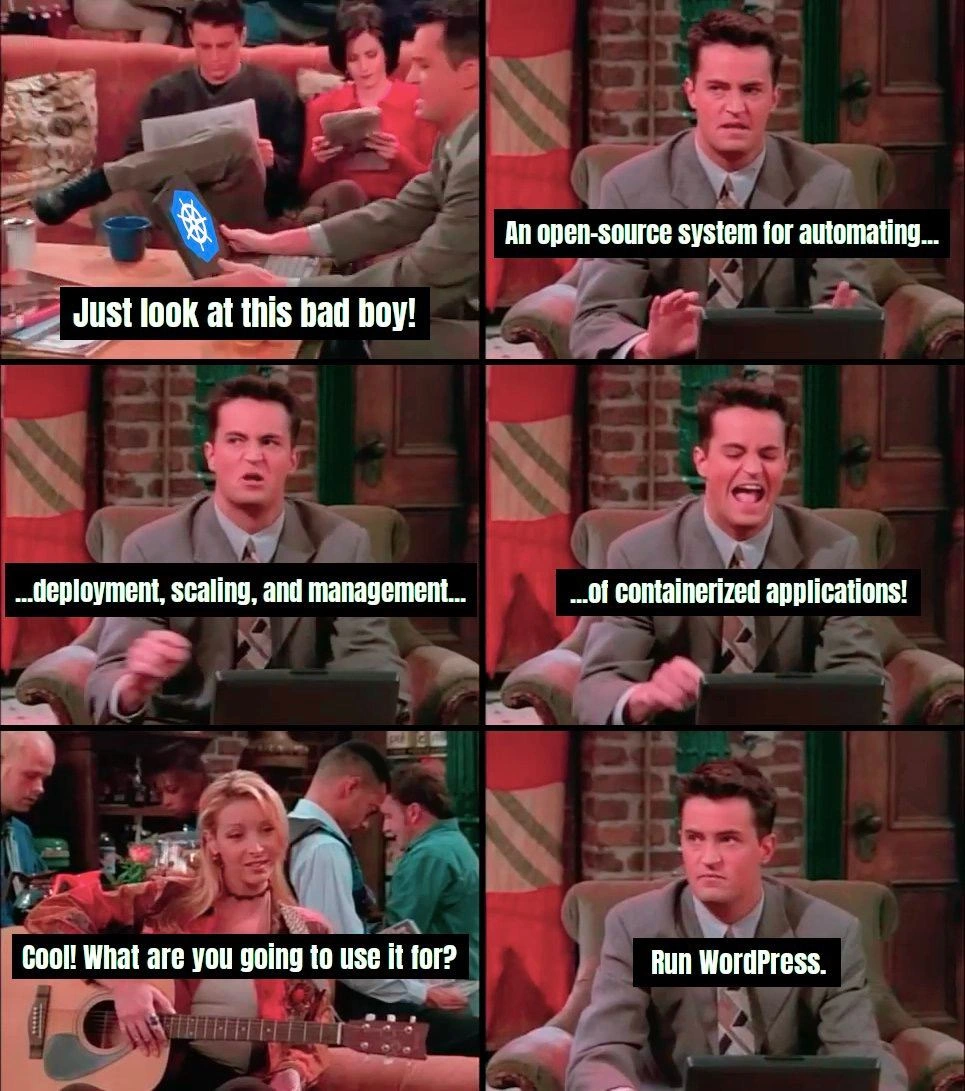
Imagine you have a tiny job to do – like watering a single houseplant – but instead of a cup of water, you set up an entire automatic sprinkler system across your whole yard just for that one plant. Sounds like way too much, right? That’s what’s happening in this meme, but with computers. One friend got a super fancy setup (like a giant machine) that can manage a lot of things at once. He’s really proud and excited about it, kind of like a kid showing off a new toy. But when his friend asks what he’s actually going to do with this powerful machine, it turns out the plan is to do something very small and simple with it. It’s like bragging about buying a huge truck with 18 wheels, and then admitting you only got it to bring home groceries for one meal.
This is funny because it’s overkill – using something really big and complex to do a tiny job that didn’t need all that power. Both friends (and we, the audience) realize how silly that is. It’s as if someone built a rocket ship and then said, “I’m just going to use it to go to the store down the street.” You’d probably laugh and say, “You don’t need a rocket for that!” In the same way, using Kubernetes (which is like a whole team of robots working together) just to run a simple website (like a personal blog) is doing a lot of unnecessary work.
The emotion behind the humor is a mix of surprise and gentle ridicule. We’re amused that the proud friend didn’t match the tool to the task. The friend with the guitar basically calls him out with a simple question, and his proud expression turns embarrassed. It reminds us of times we might have gone way over the top for something small, and our friends good-naturedly pointed out, “Was that really necessary?” So even if you don’t know what Kubernetes or WordPress are, you can laugh at the idea of using a massive, complicated thing for a basic little task. It’s a goofy exaggeration that teaches a simple lesson: sometimes, doing things the simplest way is perfectly fine – you don’t always need to bring out the biggest, fanciest tools for a small job.
Level 2: Over-Engineering 101
Let’s break down the buzzwords and why this scenario is funny for those newer to these concepts. Kubernetes is a technology often used in modern DevOps to manage applications. Think of it as a very clever conductor for an orchestra, but instead of musicians, it’s managing containers (which are like little isolated packages containing an app, similar to how a shipping container holds goods). Kubernetes helps automatically deploy these containers, scale them up or down if there’s more or less load, and heal them if something crashes. It’s like having a smart robot babysitter for your software, ensuring everything is running smoothly across lots of computers. Sounds cool, right? It is! That’s why the guy in the meme is so excited – he’s basically saying “Check out this powerful open-source system for automating our app deployments and scaling!” with stars in his eyes.
Now, on the other side, we have WordPress. WordPress is a super popular Content Management System (CMS) used to build websites and blogs. If you’ve ever made a blog or small website, you might have clicked a one-button installer for WordPress or used a simple hosting service. WordPress traditionally runs on a web server with PHP and a MySQL database – often all on a single machine or a basic shared host. In non-technical terms, WordPress is like a single, big program that can handle a whole website by itself (with some help from a database). It’s monolithic, meaning it’s one chunk of software, not split into lots of little pieces. Typically, to get a WordPress site live, you don’t need much: one server (or even a modest laptop) could do it.
So why is it funny to use Kubernetes for WordPress? Because Kubernetes is usually reserved for complex setups where you might have dozens of different little services (microservices) that need coordinating. It’s kind of heavy-duty. Imagine you have a simple task – like delivering a pizza across town. The normal approach is you’d maybe drive it yourself or hire a single delivery driver (that’s like running WordPress on one server). But using Kubernetes for this task is like hiring a whole fleet of drones and trucks, plus a control center with operators tracking the delivery, just to get that one pizza delivered. Sure, it will get there, but the process was over-complicated for no extra benefit. This is essentially over-engineering: using a far more elaborate solution than necessary.
In the meme, the woman asks, “Cool! What are you going to use it for?” after hearing the big Kubernetes spiel. When he replies, “Run WordPress,” it’s the punchline because WordPress is such a simple use-case relative to Kubernetes’s capabilities. It’s as if someone bragged about buying an industrial 3D-printer that can build houses, and then admitted they only plan to print a small toy. You’d probably smile and think, “Wasn’t there an easier way to do that?”
Let’s clarify a couple of terms from the meme and tags for any newcomers:
- Containerization: This is a method of packaging software so it runs reliably when moved from one environment to another. A tool called Docker is commonly used for this. If you package WordPress into a Docker container, it includes everything WordPress needs to run. Kubernetes can then take those containers and deploy them.
- DevOps/SRE: These are roles or mindsets focused on automating and smoothing out the process of software delivery and server management. DevOps folks love tools like Kubernetes because it helps automate a lot of server work.
- CMS (Content Management System): Software like WordPress that lets people create and manage website content easily without coding everything from scratch.
- Over-engineering: When an engineer designs a solution that's far more complex or powerful than what’s needed for the problem at hand. It often happens when someone is excited about new tech or anticipates a much bigger scenario than reality.
For a junior developer or someone just learning: it’s common to be excited about tools like Kubernetes (it’s a hot skill!), and you might want to try it on everything. The meme is a lighthearted caution. It’s saying: “Just because you can use this advanced tool, doesn’t mean you should for a simple project.” There are usually simpler solutions that are easier to set up and maintain. In our case, hosting WordPress could be as easy as using a managed WordPress hosting service or running a single Docker container with WordPress. That would avoid the extra steps of maintaining a full Kubernetes cluster.
However, the guy in the suit is portraying a relatable newbie mistake (one many of us have made in some form): getting so swept up by a technology’s impressive description that we deploy it for something trivial. It’s like assembling a whole Lego Death Star when you only needed a little Lego house. Sure, you end up with something massive and impressive, but you could have achieved the goal with far fewer pieces. The humor also comes from contrast – Kubernetes’ description sounds very grand and enterprise-grade, whereas “Run WordPress” is mundane. The friend with the guitar (Phoebe) acts as the reality check, bringing the conversation down to earth with that simple question.
In sum, this level demystifies why techies chuckle at the meme: it’s the incongruity of using an extremely powerful, complex tool (K8s) for an extremely simple, common task (hosting a single website). As a newcomer, it’s a reminder that while it’s great to learn and experiment with the latest tech, always consider the right tool for the job. Sometimes simplicity is the smarter choice, and you don’t need to deploy a whole container orchestra to sing a solo.
Level 3: Orchestrating Overkill
This meme strikes a chord with seasoned DevOps folks because it lampoons a common phenomenon: over-engineering for the sake of clout. In the first panels, our suited character (with Chandler’s comic bravado from Friends) proudly brandishes the Kubernetes logo and rattles off the textbook definition: “an open-source system for automating deployment, scaling, and management of containerized applications!” — essentially the elevator pitch for K8s. This is the DevOps brag culture in action: someone showing off a cutting-edge tool as if it’s a shiny new sports car. Kubernetes is indeed powerful; it industrialized how we deploy and scale applications with containers. In theory, it can handle complex microservice architectures, continuous deployment, and dynamic scaling without breaking a sweat. The joke, however, comes when his friend (Phoebe with the guitar, innocently curious) asks the simple question: “Cool! What are you going to use it for?” Reality comes crashing down in the final frame: “Run WordPress.” 🤦♂️
To anyone who’s been in tech a minute, that punchline is both hilarious and painfully relatable. We’ve all seen the scenario: a small, simple project being hosted on a massively oversized infrastructure just because the engineer wanted to play with the latest tech. WordPress is the poster child of straightforward web apps – it’s a single monolithic application (mostly PHP code) that you can run on a basic LAMP stack (Linux, Apache, MySQL, PHP) or a $5 cloud VM. It doesn’t need container orchestration, distributed scheduling, or auto-replication across nodes. Yet here we have someone spinning up a whole K8s cluster (which typically involves multiple VMs/nodes, a control plane, perhaps even cloud load balancers and ingress controllers) just to host one website. This is what we call “using a sledgehammer to crack a nut.” It’s funny because it’s true – engineers sometimes deploy an entire microservices infrastructure for what’s essentially a one-box problem.
Why does this happen? Often it’s the allure of new technology and the resume-driven development mindset: running your personal blog on Kubernetes sounds cool at meetups and looks great on a CV. There’s also FOMO – a fear of missing out on the latest trend – leading folks to containerize everything (“Kubernetes all the things!”) even when the benefits don’t justify the complexity. The meme highlights that dissonance. On one hand, our enthusiastic friend is reciting the holy scripture of DevOps scalability. On the other, his actual need is comically small. The over-engineering here introduces unnecessary cost and complexity: maintaining a cluster, writing and debugging Kubernetes YAML manifests, setting up CI/CD for deployments, monitoring the cluster health – all overhead that a simple apt install wordpress or single Docker container wouldn’t incur.
Real-world DevOps war stories echo this humor. Perhaps a startup decided to go “cloud-native” from day one, containerizing a tiny app and deploying on a multi-node Kubernetes setup, only to spend more time fixing their Helm charts and cluster issues than improving the app. Or a team migrates a perfectly fine monolithic service into Kubernetes “for scalability,” and ends up fighting obscure networking issues and Deployment misconfigurations for a trivial load. The shared laughter is “we’ve been there, we’ve seen this movie.” It’s not that Kubernetes is bad – it’s an amazing tool for large-scale, complex systems. It’s that using it for a single WordPress site is like renting a full cargo ship to deliver one birthday present. The trade-off just doesn’t make sense, and everyone in on the joke recognizes the pattern. We nod knowingly because behind the humor is the gentle reminder of the KISS principle – Keep It Simple, Stupid. If your use-case is small, a simpler solution is usually more reliable and easier to manage. Over-engineering often backfires: more moving parts (in this case, K8s components, container runtime, network proxy, etc.) mean more things that can go wrong. Who’s going to get paged at 3 AM when the cluster’s etcd service crashes or a node mysteriously dies? Probably the guy who insisted on this setup – the same now-sheepish guy in the meme.
To crystallize the absurdity, compare the two approaches side by side:
| Goal | Simple Approach | Kubernetes Approach |
|---|---|---|
| Host a personal blog | One small VM running WordPress (LAMP stack) (easy, minimal setup) |
Multi-node K8s cluster running a WordPress container + MySQL (complex, lots of setup) |
| Deployment time | A few minutes with a one-click installer or docker run command |
Days/weeks provisioning cluster, writing YAML configs, dealing with ingress, etc. |
| Maintenance | Basic updates (WordPress auto-updates, OS updates occasionally) | Continuous upkeep (monitoring nodes, upgrading Kubernetes versions, managing certificates, etc.) |
| Cost (for a hobby site) | ~$5/month on a cheap host | Far higher (multiple cloud instances, load balancer, storage volumes) – paying cloud fees to run one site |
It’s clear which side is overkill. The meme exaggerates to make a point: sometimes engineers adopt a because we can mentality. The suited character’s proud proclamation of Kubernetes features is basically flexing – he sounds like a sales brochure for a Ferrari, only to reveal he’s driving it to get groceries next door. The DevOps/SRE community finds this relatable and humorous because we champion using the right tool for the job, yet we all know someone (maybe ourselves, at times) who got carried away. This gentle ribbing reminds us: just because Kubernetes is the hot new tool doesn’t mean your simple CMS needs a distributed orchestration solution. After all, WordPress has happily run millions of sites without a single Pod or microservice. As the saying goes, “If all you have is Kubernetes, everything starts to look like a container.” 😉
Level 4: Borg for Blogs
At its core, Kubernetes (often stylized as K8s) descends from Google's internal Borg system – a planetary-scale container orchestration platform. K8s brings serious distributed-systems engineering: a control plane with an etcd-backed hive mind data store achieving consensus via the Raft algorithm, controllers continuously reconciling desired state, and a scheduler performing bin-packing algorithms to optimally place containers (Pods) across nodes. This machinery was designed to keep thousands of microservices running across clusters even in the face of node failures and network partitions (think about the CAP theorem implications when your app is spread over many machines!). In practice, K8s acts like a vigilant robot manager: it constantly monitors the cluster’s health, restarts crashed containers, load-balances traffic, and can auto-scale workloads based on demand. It’s basically an autonomic nervous system for cloud applications – ensuring high availability and scalability through sophisticated automation.
Now imagine unleashing this complex orchestration beast for a single WordPress site. WordPress is a classic monolithic PHP application with a MySQL database – a far cry from the cloud-native, stateless microservices Kubernetes was built to handle. Running WordPress on K8s means you’re spinning up at least one Pod for the app (and probably another for the database), managed by a Deployment controller, possibly with a Service object for networking, plus a PersistentVolume and PersistentVolumeClaim to handle the database storage (since containers are ephemeral by nature). The control plane will dutifully keep watch over this lone site, using the same algorithms and distributed consensus needed for a hundred microservices, all to keep one blog container alive. Technically, it works – you get automated restarts and maybe the illusion of horizontal scaling – but it’s like hiring an entire orchestra to play a ringtone. The deep irony tickling senior engineers here comes from that disparity: the elegant complexity of cloud orchestration being marshaled to serve a trivial use-case. All those carefully designed scheduling heuristics, service meshes, and replica sets end up babysitting a single PHP process and a database. It’s an academic-overkill-meets-real-world moment. Underneath the humor is a lesson about system design and appropriate scale: just because our industry has invented brilliant solutions to hard distributed problems (self-healing clusters! automated rollouts! multi-zone failover!), it doesn’t mean every project – especially a simple CMS – needs to deploy those solutions. In short, the meme highlights the almost absurd scenario of using Google’s Borg-level infrastructure cunning to host a humble blog, illustrating the gap between theoretical capabilities and practical needs.
Description
A six-panel meme using the 'Chandler Bing presenting' format from the TV show 'Friends.' In the first panel, Chandler excitedly points to a laptop with the Kubernetes logo, saying, 'Just look at this bad boy!'. The next three panels show him passionately explaining its purpose: 'An open-source system for automating...', '...deployment, scaling, and management...', '...of containerized applications!'. The fifth panel shifts to Phoebe Buffay, who asks innocently, 'Cool! What are you going to use it for?'. The final panel shows Chandler's enthusiasm completely drained, as he replies with a deadpan, defeated expression, 'Run WordPress.'. The humor stems from the massive over-engineering of using Kubernetes, a complex and powerful container orchestration system designed for large-scale applications, to run a simple, monolithic application like a standard WordPress blog. It satirizes the tech industry trend of adopting hyped technologies for a resume boost ('resume-driven development') rather than for solving a genuine business need that matches the tool's scale
Comments
10Comment deleted
Using Kubernetes to run a single WordPress instance is the cloud-native equivalent of buying a datacenter to host your personal blog. Sure, it has 100% uptime, but so does a static site on S3 for a fraction of the YAML
Why pay $10 for shared hosting when you can burn two sprints writing Helm charts, nursing etcd quorum, and debugging CNI so WordPress can serve a “Hello world” post about avoiding premature optimisation?
Next you'll tell me you need Istio service mesh for the contact form and Prometheus to monitor the 3 visitors per month
Ah yes, Kubernetes for WordPress - because nothing says 'I understand distributed systems' quite like running a monolithic PHP application across a cluster of nodes with service meshes, ingress controllers, and persistent volume claims, all to serve a blog that gets 47 visitors a month. At least when it goes down at 3 AM, you'll have the satisfaction of debugging YAML indentation issues across multiple namespaces instead of just restarting Apache. Bonus points if you've also implemented GitOps, added Istio for service mesh capabilities, and set up Prometheus/Grafana monitoring - all so your contact form can achieve five nines of availability
Nothing screams cloud‑native like three control planes, a service mesh, and a CSI driver… to keep wp-config.php highly available
WordPress on Kubernetes: because nothing says “company blog” like Helm, Istio, ArgoCD, and a platform team - plus an RDS because we still don’t trust StatefulSets
Kubernetes for WordPress: bringing a cluster to a shared-hosting knife fight
So what? With Doker the one can install WP in 5 minutes. On any linux or windows machine. But I dare you to try to install WP a fresh Gentoo... Comment deleted
emerge wordpress 😐 Comment deleted
You guys still use WP? Comment deleted