PHP: The Forbidden Knowledge
Why is this Languages meme funny?
Level 1: Bad Word in Code
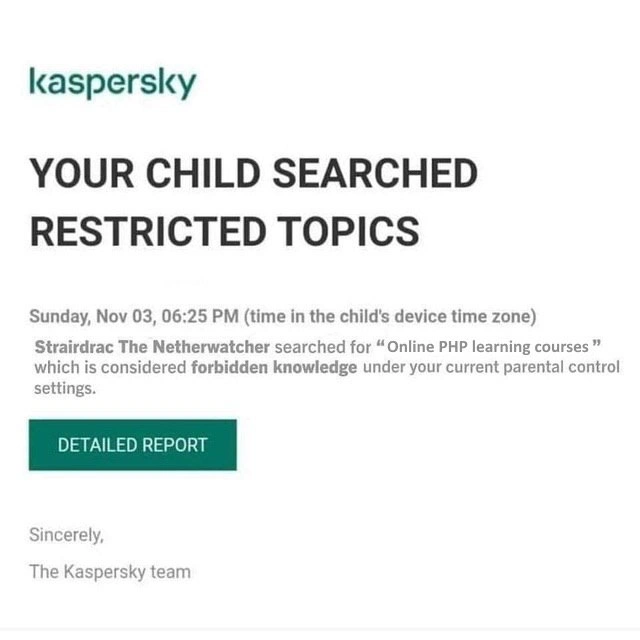
Imagine you’re a kid and you say a bad word you heard somewhere. Your parent suddenly gasps and scolds you, maybe even threatens to wash your mouth out with soap because they think that word is super inappropriate. But maybe you didn’t even know it was a bad word — to you it was just something you picked up innocently. This meme is joking in a very similar way, but with computer code. Here, the “bad word” is PHP, which is just the name of a computer language used to make websites. Learning a coding language is usually a good thing (kind of like learning a new spoken language or a cool skill), but the joke is that some programmers treat PHP like it’s a naughty word or a forbidden magic spell. The picture pretends that a parental control program (like the kind that might block violent cartoons or unsafe websites) caught a kid trying to learn PHP and sounded an alarm to the parents. It’s funny because it’s an overreaction — like a parent freaking out over something harmless. In real life, no one’s going to ground you for writing code! The meme just plays with the idea that, in the programming world, PHP has a “bad reputation” kind of like a bad word among some grown-up programmers. So the joke is really: “Haha, what if a security app treated learning this unpopular language as if the kid did something terribly wrong?” It’s a silly make-believe scenario that makes programmers laugh at how exaggerated it is.
Level 2: Forbidden Language
This meme might look confusing at first if you’re new to programming, so let’s break it down. It’s styled to resemble a parental control alert – the kind parents use to stop kids from seeing inappropriate stuff online. The big twist is what it’s blocking: an “Online PHP learning course.” PHP is a programming language (it stands for PHP: Hypertext Preprocessor) commonly used to make websites work behind the scenes. For example, PHP runs many blogs and forums (WordPress, a huge blog platform, is built with PHP). Normally, learning to code is a positive thing, not something any parent would block. That’s why it’s funny: the meme pretends that learning PHP is as bad as looking up, say, violent videos or curse words. It calls PHP tutorials “forbidden knowledge,” as if this coding language is some dark secret no kid should ever discover!
Why joke about PHP this way? The humor comes from the programmer community’s long-running LanguageWars and inside jokes. “Language wars” are friendly (sometimes heated) debates over which programming language is the best or worst. Think of it like gamers arguing PlayStation vs. Xbox, but for coding. In these debates, PHP often gets a lot of teasing. Many developers poke fun at PHP for its quirks and historically messy design. For instance, PHP code can be written very loosely – it doesn’t force strict rules on you – which is great for beginners making quick projects, but it also means it’s easy to write sloppy code if you’re not careful. Over the years, PHP gained a reputation for powering cringe-worthy spaghetti code (code that’s tangled and hard to maintain). Experienced folks sometimes share horror stories of old PHP projects full of security holes or confusing naming conventions. (One running joke: PHP’s standard functions seem inconsistently named, like strpos vs stripos vs str_replace – try guessing what each does or why one has an underscore and another doesn’t!). These are language quirks that make seasoned devs roll their eyes. So in tech circles, saying “I’m learning PHP” might get a playful gasp or a teasing “oh no, not PHP!” — not because PHP is truly evil, but because it’s a well-known meme to rib the language for its past.
Now, Kaspersky – that’s a real company known for antivirus and internet security software. They make programs that can do things like block bad websites or send parents reports about their kid’s online activity. In a genuine scenario, a Kaspersky parental control alert might say something like, “Your child tried to access a gambling site” or “...a violent game,” and it would notify the parents. Those are the kind of restricted topics these tools usually care about. But in this image, Kaspersky is “alerting” the parent that the child searched for a PHP coding course. 😄 It’s a security software spoof where a legit security brand and format are used to amplify the joke. Everything down to the green “DETAILED REPORT” button is copied from what a real alert email might look like. This attention to detail makes it convincing at first glance – and that’s why it’s hilarious when you read it and realize the “threat” is just a kid trying to code! The phrase “forbidden knowledge under your current parental control settings” is deliberately melodramatic. Usually, that wording would apply to seriously harmful content (like self-harm tutorials or how to build a bomb – things a parent absolutely would want to block!). By using those ominous words for a simple programming course, the meme is winking at us: Programming in PHP is treated like black magic or taboo.
Let’s talk about “forbidden knowledge” for a second. In everyday terms, that’s knowledge you’re not supposed to have – maybe it’s dangerous, illegal, or just age-inappropriate. Of course, learning a coding language isn’t actually forbidden! But the meme pretends it is, to lampoon PHP’s dodgy reputation. It’s like saying, “OMG, learning PHP??? That’s forbidden!” with a sarcastic tone. The subtext is: some programmers jokingly act like no one should even touch PHP because it’ll teach you bad habits or “corrupt” your coding style. This is the developer cynicism coming through – a kind of techie tongue-in-cheek pessimism that comes from hard-earned experience. Those who have dealt with buggy PHP code might dramatically warn others away from it, much like a cautionary tale. It’s important to know they’re exaggerating on purpose for a laugh. In reality, PHP is just another tool – it can be used to write good software or bad software, like any language. Modern PHP, with frameworks like Laravel or Symfony, is actually much more organized and robust. But the jokes persist, partly because early PHP (we’re talking 2000s-era PHP 4 and 5) had a lot of rough edges that scarred some developers.
For someone new to this meme, remember that coding humor often involves hyperbole (extreme exaggeration). No parent truly thinks PHP is an off-limits topic, and there’s no tech rule that learning PHP will get you in trouble. In fact, many developers (even the ones joking here) started their careers with PHP! It was one of the easiest ways to create a dynamic web page, so lots of us have written our first forms and guestbooks in PHP before moving on to other languages. That’s why it’s a bit of a love-hate inside joke. We riff on PHP’s flaws, but we also know it got a whole generation of programmers started. So this meme is a playful nod to that history: a mix of “Haha, remember how messy PHP could be?” and “Wouldn’t it be funny if someone treated it as contraband for kids?”
In simpler terms, the meme is blending tech humor with a familiar parental scenario. Parental controls usually guard kids from harm; here they’re comically guarding a kid from… learning a programming language. It’s a ridiculous mismatch that makes developers laugh. Think of it like a movie rating joke: coding in Python or Java is “Rated G” (good for everyone), but PHP is jokingly labeled “Rated R – Restricted, under 17 requires parent/guardian permission.” It’s all in jest. So if you’re a new coder, don’t worry – you won’t actually get a virus from learning PHP and your parents aren’t going to get a real alert like this. This is just the developer community poking fun at one of our own inside stereotypes, wrapped in the costume of a serious security warning for comedic effect. 😉
Level 3: The Dark Arts of PHP
On the surface, this meme mocks a Kaspersky parental control alert, but instead of flagging a violent video or adult website, it flags PHP programming tutorials as “forbidden knowledge.” The humor hits experienced developers right away: PHP has long been the punchline of LanguageWars in dev communities. Seeing a security tool treat learning PHP like accessing some arcane banned content exaggerates the language’s infamous reputation. It’s as if the meme is saying, “We’ve locked away PHP for your own safety.”
In developer culture, calling a language “forbidden” is an over-the-top satirical jab. Here it plays on developer cynicism about PHP’s code quality issues. Seasoned coders remember the wild-west days of PHP: tossing raw SQL into web forms, $variable names everywhere, and pages of spaghetti code mixing HTML and logic. Many of us have inherited a legacy PHP codebase that felt like a cursed grimoire – full of inconsistent function names and scary security bugs lurking in the dark. (There’s an old joke that opening a PHP manual might summon Eldritch horrors of bad design – a tongue-in-cheek reference to how chaotic the language felt.) By framing “Online PHP learning courses” as forbidden knowledge, the meme channels that shared trauma. It’s hyperbole that rings true if you’ve ever muttered “Not PHP, please...” when choosing a project’s tech stack.
This parody alert nails the corporate security tone, which makes it even funnier. Kaspersky is a real antivirus company, known for flagging malware and dangerous websites. So the meme mimics a Kaspersky security software spoof email: it’s got the official green logo, the serious “YOUR CHILD SEARCHED RESTRICTED TOPICS” header, a timestamp, and even a polite closer (“Sincerely, The Kaspersky team”). Everything looks legitimate – except the “threat” is a kid trying to learn PHP! That contrast is pure satirical gold. The formal phrasing “considered forbidden knowledge under your current parental control settings” parodies how parental filters normally describe blocked content (like violence or self-harm topics) with gentle corporate concern. Here, that serious tone is applied to a totally innocuous search for a programming course. It’s an absurd misclassification that pokes fun at how dev communities jokingly classify PHP itself as a “bad influence.”
To highlight the absurdity, consider what parental controls usually block versus what this meme pretends to block:
| Parental Controls Normally Block | In This Meme They Block |
|---|---|
| Adult content (inappropriate websites) | PHP content (programming tutorials) |
| Violence or extremism sites | Language documentation (like the PHP manual) |
| Hacking or illicit forums | Online coding courses (for PHP) |
| Excessive gaming or social media | Web development lessons (if it’s PHP-related) |
Clearly, “PHP tutorials” don’t belong on a blacklist with hacker forums and sketchy websites, and that’s exactly the point. The meme exaggerates to mock PHP’s notoriety. It resonates with veteran developers who have joked for years that introducing someone to PHP is like handing them a dangerous tool without the safety manual. It’s a caricature of code quality quarantine – treating a language as if it’s a virus to be contained. (To be fair, PHP’s early ecosystem did spawn some scary security exploits, so security-minded devs still shudder at certain PHP code patterns.)
Even the child’s account name, Strairdac The Netherwatcher, adds a nerdy chuckle. It sounds like a gamertag or a fantasy RPG character, which makes the scenario even more tongue-in-cheek. It’s as if this “kid” is a young adventurer venturing into the forbidden realm of PHP, only to have the parental guardians (armed with antivirus software) drag them back from the brink of dark coding arts. The name reinforces the parody: this isn’t a real parental crisis – it’s a geeky tall tale.
Underlying the humor is a grain of truth about developer culture: every programming community has its taboos and running gags. PHP is a robust and widely-used language (powering tons of websites and apps), yet it’s the poster child for tech jokes about messy code. Seasoned devs who have been burned by unmaintainable PHP projects share a camaraderie in these jokes. The meme plays on that shared knowledge – we laugh because we’ve either lived the nightmare or heard the horror stories. It’s a way to bond over collective DeveloperCynicism: “Haha, PHP is so bad even antivirus would try to save you from it!” Of course, most of us know it’s all in jest – a bit of gallows humor learned from late-night deployments and tangled code. In reality, no security suite is going to sound the alarm over a programming tutorial. But for those in the know, the mere idea of banning a language “for your own good” hits the sweet spot between absurd and “okay, I kind of get it.”
Description
This image is a fake parental control notification from the antivirus company Kaspersky. The email-style notification has a bold headline: 'YOUR CHILD SEARCHED RESTRICTED TOPICS'. The body of the message explains that a child, amusingly named 'Strairdrac The Netherwatcher', searched for 'Online PHP learning courses', which is flagged as 'forbidden knowledge under your current parental control settings'. The humor is a direct jab at the PHP programming language, which has a long-standing negative reputation among many developers for its inconsistent syntax, historical security issues, and perceived clunkiness compared to more modern languages. The joke elevates this common developer disdain to the level of a moral panic, as if learning PHP is a dangerous activity that parents should actively prevent
Comments
7Comment deleted
The only thing more dangerous than a kid searching for PHP courses is them actually finding one and thinking `mysql_real_escape_string` is a modern security feature
Kaspersky just alerted me that my kid googled “learn PHP” - good call; once they meet $GLOBALS and loose ==, even Zero-Trust can’t protect prod
Finally, a parental control system that understands the real danger isn't inappropriate content - it's letting your child grow up to maintain a WordPress site that's been "temporarily" using mysqli_real_escape_string() since 2009
Kaspersky's AI has clearly been trained on Stack Overflow sentiment analysis - it correctly identified PHP as something parents should protect their children from. Though in fairness, classifying PHP tutorials as 'forbidden knowledge' is technically accurate if you consider the eldritch horrors of `==` vs `===`, magic quotes, and the architectural decisions that haunt legacy codebases. The real question: is this a bug or the most sophisticated security feature ever shipped?
Finally, a DLP policy with an opinionated tech stack: block ‘php’ right after ‘torrent’ - proactive SRE to avoid inheriting a LAMP monolith with magic_quotes, register_globals, and 3 a.m. on-call
Kaspersky gets it: shielding kids from PHP's true horrors - extract() and eval() - before they inherit our superglobal PTSD
Kaspersky blocking “learn PHP” isn’t censorship, it’s risk mitigation: one course later and their side project becomes the company’s ERP - deployed over FTP, no tests, and impossible to retire