Recursion: The ultimate binge
Why is this CS Fundamentals meme funny?
Level 1: Can't Stop, Won't Stop
Think about how hard it can be to stop when you’re enjoying something. Imagine a kid allowed to take one cookie from the jar, but every time they grab a cookie they say, “Okay, just one more!” and end up eating the whole jar. Or picture yourself watching cartoons and after one episode you say, “One more episode and then I’ll stop,” but you keep watching because each episode makes you want another. In the end, you’ve watched TV all night! This meme is joking that a computer program can have the same kind of problem.
In simple terms, the last line “just one more recursion” means the computer is being told to do something again and again with no end. It’s like a loop that never breaks. If you never tell the program to stop, it will keep going forever – just like someone who keeps saying “one more” and never stops. The reason it’s funny is because it connects a common human experience (not being able to quit after “just one more” of your favorite thing) with a programming mistake where the code gets stuck. In both cases, the message is the same: sometimes one more is never enough, and you end up with no end at all!
Level 2: Binging on Recursion
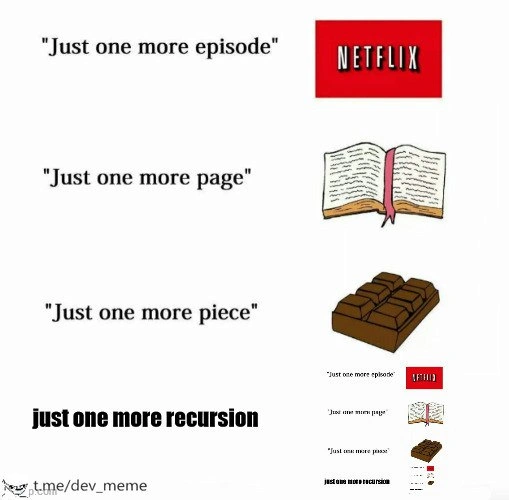
Let’s unpack the joke in more straightforward terms. The meme compares everyday “just one more” habits with a programming scenario:
"Just one more episode" – You’ve probably experienced this while streaming on Netflix. You finish an episode of a show and tell yourself just one more. One episode turns into five because the next episode auto-plays, and it’s hard to stop (Netflix even nudges you with that next episode button!). This is the binge-watching habit: it’s tough to break out once you’ve started a streak.
"Just one more page" – For book lovers (a.k.a. bookworms), this phrase is equally familiar. It’s late at night, you’re reading a gripping novel, and you keep saying, one more page then I’ll sleep. But that one page leads to another, and another… Soon you’ve read far more than you planned, because the story pulls you in. It’s the literary equivalent of a Netflix binge.
"Just one more piece" – This refers to snacks, illustrated with a chocolate bar. Imagine telling yourself I’ll have just one more piece of chocolate. It tastes so good that after that piece, you reach for another, and then another. Before long, half the chocolate bar is gone. We call this over-snacking: when something is delicious or rewarding, it’s hard to stop at just one.
After listing these relatable scenarios, the meme delivers the punchline:
- "just one more recursion" – This one is for the programmers. Recursion is a programming technique where a function calls itself to solve a problem. Saying “just one more recursion” is a tongue-in-cheek way to imply calling the function one more time, and then again, and again... If a recursive function doesn’t have a clear stopping condition (the base case), it will keep calling itself forever. In other words, the code gets stuck in an endless cycle, much like a person who can’t stop binge-watching or snacking.
In a typical recursion example, you always include a base case. For instance, if you write a function to calculate factorials recursively, you tell it, “when you reach 1, stop.” That stop condition is crucial. Infinite recursion happens when the function never reaches a stop – it’s like a story that keeps starting over. There’s no final episode or last page; the function just continues. Computers aren’t smart about stopping on their own – they will literally try to execute the next call endlessly until something breaks. When a program runs into infinite recursion, it usually results in a crash or an exception. Often, you’ll encounter a stack overflow error (named because the call stack, which keeps track of function calls, has overflowed with too many recursive calls). This is the computer’s way of saying, “I can’t take any more, I’ve gone too deep!” In Python, for example, if you exceed a certain recursion depth, it raises a RecursionError with a message about maximum recursion depth being exceeded. In other languages like Java or C++, an infinite recursion might cause a StackOverflowError or segmentation fault. These are all fancy terms for “you went one recursion too far, and the program stopped in a bad way.”
To make this concrete, here’s a tiny Python-like pseudocode example of what infinite recursion looks like:
def just_one_more():
print("Another recursion...")
just_one_more() # Uh-oh, this calls itself again with no end in sight!
If you run the just_one_more() function above, it will print "Another recursion..." over and over until the program eventually crashes with an error. There’s no base case (no if condition to stop), so it just keeps going. This is the programming equivalent of someone saying “just one more” indefinitely.
Now, notice in the meme’s final panel, there’s no image next to "just one more recursion". That’s probably because recursion is an abstract concept – you can’t draw a picture of a function calling itself easily. Or perhaps it implies there’s no final object to show; the process is invisible and never-ending. The absence of an image subtly emphasizes the idea of an infinite loop: it’s just blank, going on forever.
For a junior developer or a student, the humor here comes from recognizing that “just one more X” is a slippery slope in real life, and in code it literally creates a problem. The meme is basically an inside joke: if you know what recursion is, you’ll see that doing it “one more time” without a plan to stop is a recipe for an infinite loop. It’s saying, in a funny way, programmers can get stuck in loops just like anyone binge-watching a show or devouring snacks. Once you grasp what recursion means, the joke lands: just one more recursion is like saying just one more… forever!.
Level 3: Recursion Rabbit Hole
At the highest level, this meme dives into algorithm humor rooted in a classic concept from CS fundamentals: recursion. To seasoned developers, the punchline "just one more recursion" immediately screams infinite recursion – a scenario where a function keeps calling itself with no end. In coding terms, it’s what happens when you forget to implement a base case (the condition that tells a recursive function when to stop). Without a base case, the function will call itself over and over, deeper and deeper, until the program runs out of stack space (memory for function calls) and crashes. Any experienced coder has felt the shock-and-groan of a runaway recursive call triggering a stack overflow. (And yes, Stack Overflow here isn’t referring to the Q&A website, but the actual error you get when the call stack is exhausted!) This meme gets a knowing chuckle because we’ve all debugged that nightmare or learned about it the hard way.
From the senior perspective, the structure of the meme itself is a clever escalation of indulgences: "Just one more episode" (Netflix binging) leads to "Just one more page" (bookworm habits) then "Just one more piece" (chocolate over-snacking). Each item is an addictive loop in everyday life. The final line – "just one more recursion" – delivers the tech punchline by paralleling those endless human habits with a programmer’s infinite loop of function calls. It’s an inside joke that blends an ordinary struggle (not knowing when to quit) with a coding catastrophe (not coding when to quit!). The humor lands because it equates our developer tendency to push code a little further with the same lack of self-control we show on Netflix or with snacks.
There’s even a cheeky meta touch here: in the meme image, a tiny thumbnail of the meme appears in the bottom corner – a visual nod to recursion itself (the image contains a smaller copy of itself, like a hall-of-mirrors effect). In other words, the meme is recursing! This kind of self-referential detail is catnip for experienced devs, reminiscent of the classic recursive joke definition, “Recursion (n.): See recursion.” It reinforces the theme by literally embedding an instance of the meme within the meme.
Ultimately, at this advanced level, we appreciate the meme as a witty commentary on both human and software behavior. It pokes fun at our binge tendencies and the “just one more” mentality, then wryly shows how that exact mindset in code leads to a logic error. It’s developer humor with a sardonic lesson: whether you’re streaming video or writing a recursive algorithm, one more can turn into forever before you know it. A veteran engineer can’t help but smirk because we’ve all created that accidental infinite recursion or witnessed code that ran out of control. This meme wraps a cautionary tale in comedy – we laugh, but we also nod, knowing how true it is that just one more can spiral into too many in an instant.
Description
The image presents a four-panel meme in a vertical list format against a plain white background. The first three panels compare common addictive or hard-to-stop activities. Panel one shows the text '"Just one more episode"' next to the red Netflix logo. Panel two has '"Just one more page"' next to a simple drawing of an open book. Panel three displays '"Just one more piece"' beside a cartoon illustration of a chocolate bar. The final panel delivers the punchline for a tech audience: bold black text reads 'just one more recursion,' and next to it is a smaller, scaled-down version of the entire four-panel meme itself. This creates a visual recursion, where the image contains a copy of itself, which in turn contains another, ad infinitum. This meme humorously equates the programming concept of recursion - a function calling itself - with common binge-worthy activities. For developers, the joke is twofold: it captures the sometimes-compulsive nature of diving deep into a recursive algorithm, and it cleverly visualizes the self-referential structure of recursion. It also subtly alludes to the danger of infinite recursion (a function that never reaches its base case), which inevitably leads to a stack overflow error, the software equivalent of a binge gone wrong
Comments
7Comment deleted
This is what my call stack looks like after I promise myself 'just one more' debugging session at 2 AM
“Just one more recursion,” he said - 10 ms later the call stack was 30 k frames deep and everyone finally agreed tail-call optimization should be a P1, not folklore
The only difference between tail recursion and regular recursion is that with tail recursion, you convince yourself the stack won't overflow until 3am when production goes down
This meme perfectly captures why senior engineers always ask 'What's your base case?' during code reviews - because we've all shipped that 'just one more recursion' that turned production into an infinite loop at 3 AM. The real recursion happens when you're debugging the recursion bug while Netflix autoplays another episode in the background, and you think 'just one more stack trace' before realizing you've been reading the same recursive call chain for an hour. At least the chocolate bar has a finite number of pieces... unlike that time someone forgot to decrement the counter in a recursive function and took down the entire microservices mesh
“Just one more recursion” is Netflix autoplay for your call stack - great until your runtime reminds you it doesn’t do TCO and ships a stack overflow to prod
Recursion: the only 'just one more' where the base case is optional... until the stack parties like it's 1999
“Just one more recursion” is the engineer’s Netflix binge - if your runtime doesn’t do tail-call optimization, the season finale is a stack overflow