
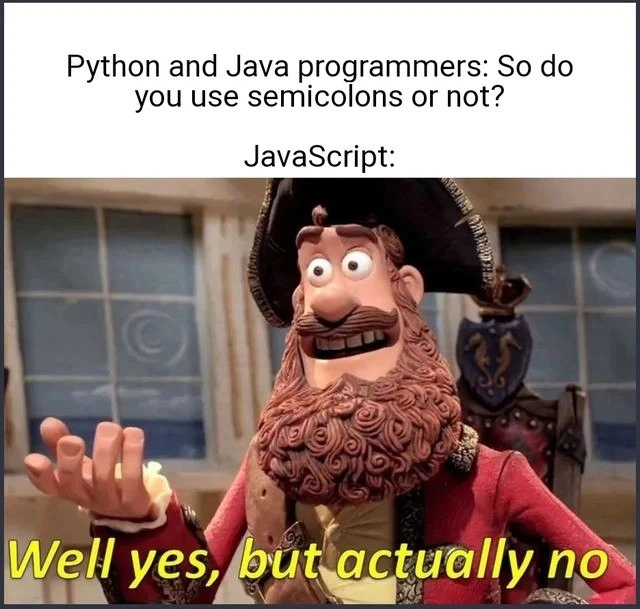
The Schrödinger's Semicolon of JavaScript
Description
This meme uses the popular 'Well yes, but actually no' format, featuring the Pirate Captain character. The top text sets up a scenario: 'Python and Java programmers: So do you use semicolons or not?'. Below this, 'JavaScript:' is written, pointing to the image of the Pirate Captain who seems to be answering with the subtitled phrase, 'Well yes, but actually no'. The humor lies in its perfect encapsulation of the semicolon situation in JavaScript. Unlike Java (where they are mandatory) or Python (where they are absent), JavaScript has an Automatic Semicolon Insertion (ASI) mechanism. This means that while semicolons are technically part of the language's syntax, the JavaScript engine will automatically add them in most cases where they are omitted, making their explicit use a subject of endless debate among developers regarding coding style and safety against edge cases


Comments
7Comment deleted
Automatic Semicolon Insertion is the most passive-aggressive feature in any language. It's like a linter that fixes your code while quietly judging you for your life choices
JavaScript semicolons are like invisible feature flags - 95 % of the time ASI flips them on for you, and the other 5 % it converts `return\n{}` into undefined exactly when the CFO refreshes the dashboard
JavaScript's ASI is like having a junior dev who randomly fixes your code at 3am - sometimes helpful, usually terrifying, and the reason your return statements mysteriously return undefined
JavaScript's semicolon policy is the perfect embodiment of 'it depends' - ASI will helpfully insert them for you, except when it catastrophically won't, leading to that one production bug where your return statement got separated from its value by a newline. It's Schrödinger's syntax: simultaneously required and optional until you hit a minifier that doesn't agree with your life choices
JS ASI: optional semicolons today, mandatory postmortem tomorrow
JavaScript semicolons: Schrödinger’s punctuation - optional until ASI drops one after “return” and your object literal quietly becomes undefined in prod
JavaScript’s semicolons are basically eventual consistency - fine until a newline partitions your return from its object and you quietly ship undefined