Skip to content
DevMeme
5743 of 7435
Political Campaign Mistakenly Targets JavaScript Runtime as a Voter
DevCommunities Post #6296, on Oct 5, 2024 in TG

Political Campaign Mistakenly Targets JavaScript Runtime as a Voter

Why is this DevCommunities meme funny?

Level 1: Inviting a Toaster to Vote

Imagine you told a robot to send party invitations to everyone in town. The robot only has a list of names and contacts, but it doesn’t really understand what those names represent. So the robot sees a contact named “Bun” and sends an invite there. But “Bun” isn’t a person – let’s say Bun is actually a friendly kitchen oven with a phone number (silly, right?). The oven gets the message: “Please come to vote in the big election!” The oven blinks and replies, “Um, I’m an oven. I can’t vote.” Pretty goofy, huh? In this meme, something similar happened: a computer program (a bot) meant to remind people to vote accidentally sent that reminder to a thing that isn’t a person at all (it’s a piece of software named Bun). And just like the oven, the software basically answered, “I’m not a person.” It’s funny because the robot made a big mistake that a human never would – it tried to invite a toaster to do a person’s job!

Level 2: Bots Lack Context

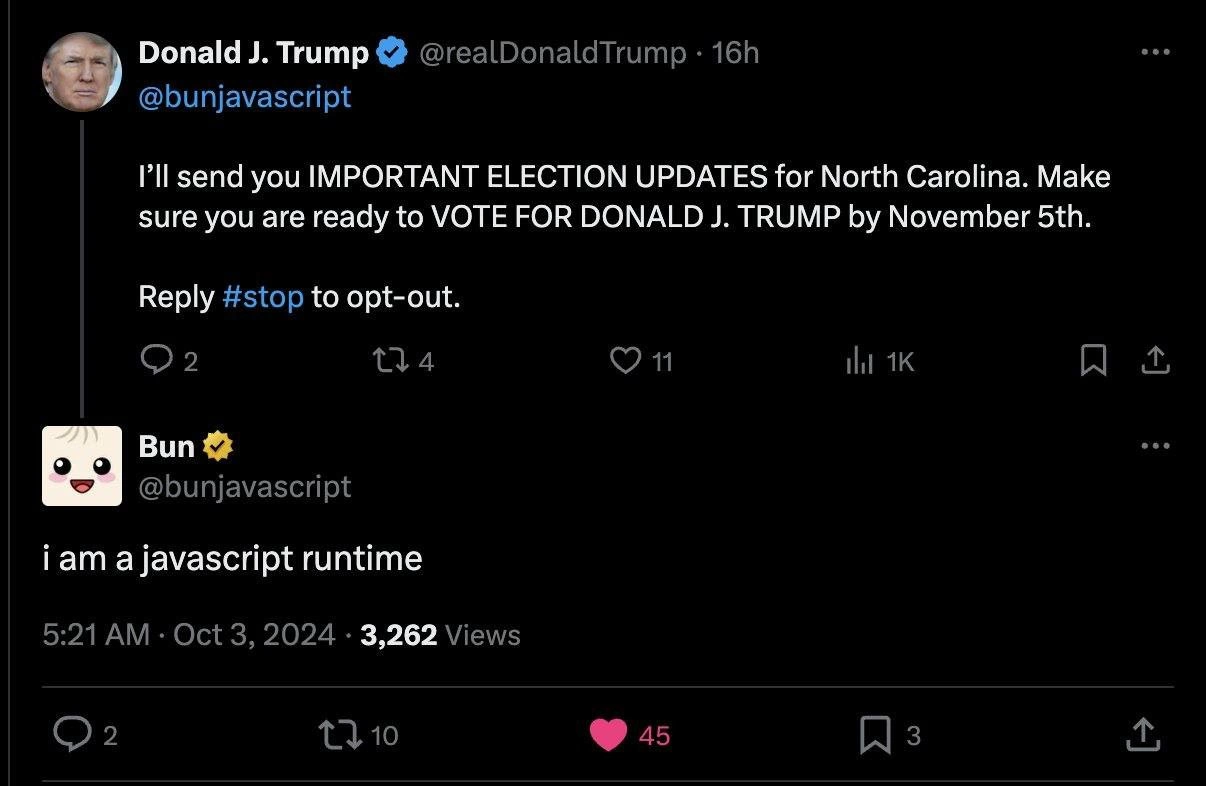
So what’s going on here? We have a Twitter exchange where a political outreach bot sent a voting reminder to “@bunjavascript,” which is the official account of Bun, a JavaScript runtime. Let’s break that down in simpler terms. A campaign bot is basically a program or script used by a political campaign to automatically send messages or tweets to lots of people. It’s like an automated phone dialer, but for social media. The bot in this meme was trying to get people in North Carolina excited (or at least informed) about voting for Donald Trump by November 5, 2024. It likely had a list of Twitter handles it thought belonged to North Carolina folks. But — and here’s the fail — one of those handles was @bunjavascript, which doesn’t belong to a person at all. It belongs to a piece of software!

Bun (the one with the cute smiling bao avatar) is a JavaScript runtime, meaning it’s a system that can run JavaScript code outside of a web browser. Think of how Node.js works: you can write a JavaScript file and run it on your computer or server, not just in a website. Bun is a newer tool in this space (alongside others like Node and Deno), and it’s gained a lot of hype for being super fast and developer-friendly. In the JavaScriptEcosystem, Bun is the hot new thing — developers are excited about it, tweet about it, and the project has its own Twitter account to engage with the community. That account, Bun@bunjavascript, tweets about new releases, funny programming moments, and interacts with devs. However, what it doesn’t do is vote in U.S. elections, because, well, it’s not a person! It’s software. The phrase “runtime_not_registered_voter” from the tags is a tongue-in-cheek way to say “this tech tool isn’t exactly showing up in any voter registry.”

Now, the bot that contacted Bun clearly had some kind of campaign_targeting_bug. When political campaigns use bots or mass messages, they usually try to target actual humans who might support them. For example, they might target followers of certain accounts, people who live in a certain area (if location data is available), or users who have used certain keywords. We don’t know exactly how this bot built its target list, but it clearly lacked context-awareness. “Bots lack context” is a good lesson here: the software only knew to send a generic “IMPORTANT ELECTION UPDATES” message to whatever handle was in its list. It didn’t know that Bun’s account represents a tech project. It didn’t stop to think, “Hmm, this is a verified brand/project account with a cartoon avatar and the word ‘JavaScript’ in the name — maybe not an ordinary North Carolinian voter.” A human doing outreach would immediately skip an account like that, but the bot just went blip bloop and posted the message. It was an accidental @ mention in the truest sense. The bot “mentioned” (tagged) Bun by replying to Bun’s account, presumably by mistake.

The comedic apex of this is Bun’s response. The Bun account replied to the thread saying, “i am a javascript runtime.” No hello, no emoji, just that one lowercase sentence. It’s the equivalent of someone looking up from their desk and saying, “I think you have the wrong person, pal.” 😅 In developer circles, this reply became an instant screenshot-and-share moment because it’s so blunt and factual. It’s basically Bun saying: “Dear campaign bot, I am not a human voter, I am literally a software platform.” The simplicity makes it funny — it’s like if a Roomba vacuum had a Twitter account and tweeted back at someone trying to sell it homeowner’s insurance: “I am a robot vacuum.”

For a newcomer or junior dev, there are a few key takeaways and definitions here:

  • JavaScript runtime – This is the environment or engine that executes JavaScript code. Historically, JavaScript ran in web browsers (that’s what it was made for), but now we have runtimes like Node.js, Deno, and Bun that let us run JS on servers or our local machines for general-purpose programming. Bun is one of these, focusing on speed and modern developer conveniences.
  • Social media automation – This refers to using software to manage social posts or messages instead of doing it manually. Companies and campaigns do this to reach a lot of people quickly. A political outreach bot is a specific case where a campaign uses automation to contact voters. It could be through DMs, replies, or tweets. It saves time, but as we see, it can misfire if not carefully configured.
  • At-mention (@ mention) – On platforms like Twitter (now X), when you want to talk to or about someone directly, you use their handle with an “@”. For example, tweeting “Hello @bunjavascript” will notify that account. Here, the bot replied to Bun’s tweet (or maybe just mentioned Bun in a reply), meaning Bun got tagged in a political message unexpectedly. An accidental at-mention means the bot tagged the wrong account by mistake.
  • Campaign targeting logic – This is the set of rules or code that decides who gets a campaign message. Good targeting logic tries to ensure you only message relevant people (like residents of a certain state, or people likely to support you). A campaign targeting bug means there was a flaw in those rules. In this case, the bug allowed a non-person account to slip into the contact list. It’s like an email list that forgot to take out the test addresses.
  • Dev community humor – Developer humor often comes from technical mix-ups or literal interpretations by machines. This incident became popular in dev circles (especially on TechTwitter) because it perfectly illustrates a techie joke: a runtime being asked to vote. It’s the kind of thing you’d see someone post with a laughing comment like, “AI has gone too far 😜” or “Automation at its finest.” It’s relatable because many new devs have already seen how a script or bot can do something really off-base if you don’t account for edge cases.

One interesting aspect is how LanguageWars or rivalries in tech take a backseat when humor strikes. Bun and Node.js enthusiasts often debate which runtime is better, but here everyone united to laugh at the poor bot. The meme doesn’t directly involve any coding languages battling it out, but the tags include it perhaps because Bun is part of the JavaScript language ecosystem hype. In any case, the situation is a lighthearted reminder: when programming real-world interactions, always double-check your assumptions. Is your user actually a person? Is your data source accurate? It’s a cautionary tale for juniors: even outside of code, when software meets the real world (like contacting voters), a small bug can lead to public silliness. The consequences here were just some embarrassment and chuckles, but it shows why attention to detail matters. Today it’s a meme; in other contexts, a similar lack of context could cause bigger issues. Always remember, computers do exactly what you tell them to — which isn’t always exactly what you want!

Level 3: Half-Baked Targeting

This meme captures a scenario that is equal parts hilarious and telling for seasoned developers. A political campaign bot (likely an automated Twitter outreach tool) attempted to canvass the official Bun account on Twitter, imploring “@bunjavascript” to get out and vote for Donald Trump in North Carolina. In other words, the bot treated a JavaScript runtime’s social media profile as if it belonged to a potential voter. The punchline lands when Bun’s account bluntly replies: “i am a javascript runtime”. That deadpan response functions like a unit test asserting the obvious: this target does not meet the preconditions for voter outreach. It’s developer humor gold because it highlights a glaring logic failure in automation that we can all imagine debugging.

Why is this so funny to those of us in the JavaScript community? It’s the absurd intersection of two worlds: serious political campaigning and the tongue-in-cheek realm of tech on Twitter. Bun is a rising star in the JavaScript ecosystem – a high-performance runtime (written in Zig) that’s been hyped in DevCommunities as a competitor to Node.js and Deno. Its Twitter account (with a cute bao bun avatar) is well-known in developer circles for sharing project updates and memes. In contrast, a campaign outreach message is about as non-tech as it gets: boilerplate calls to action and a Reply #stop to opt-out footnote, basically spam we’d normally filter out of our SMS inboxes. When these two universes collide, you get a perfect IndustrySatire snapshot. It’s as if a political phone-banking list somehow included the number for the office coffee machine, and the coffee machine politely informed them, “I’m just an appliance.” It’s the sheer wrongness of the recipient that makes tech folks cackle and hit retweet.

From a senior engineering perspective, we see a story of automation gone awry. Likely there was a script or social media tool configured to mention or reply to a list of Twitter handles associated with North Carolina voters or supporters. Maybe someone compiled a list of usernames to contact, or scraped anyone who tweeted about North Carolina politics. The campaign_targeting_bug here is that whoever built the list didn’t filter out organizational or non-personal accounts. It’s easy to imagine the code behind it: perhaps iterating over a CSV of Twitter handles without an adequate sanity check. The bot might have simply done:

const targets = ["@someperson", "@bunjavascript", "..."];  
for (const handle of targets) {  
  twitterClient.reply(handle, electionMessage);  
}

No verification of whether handle is a real individual or even eligible to vote – a half-baked approach to targeting. The result: an accidental_at_mention of a tech project. This is the sort of edge case a junior dev might not anticipate and a senior dev would catch in code review with a facepalm: “Should we maybe skip accounts that look like companies or, you know, JavaScript runtimes?”

It’s worth noting how the Bun team’s response amplified the humor. The reply “i am a javascript runtime” is so minimalistic and perfect. No anger, no long explanation – just a straightforward statement of identity that doubles as a punchline. It reads almost like an error message the runtime itself would throw: Error – not a human. In a community that loves anthropomorphizing programming tools (we jokingly talk about languages and frameworks as if they have personalities in the ongoing LanguageWars), seeing the Bun account speak up in first person adds to the comedic effect. The runtime literally speaks for itself here. And the timing – early morning on Oct 3 – suggests that by the time developers woke up and saw this, it had become prime TechTwitter fodder. Many devs shared it joking “AI is getting out of hand – now even the JavaScript runtimes are being asked to vote!” or quipping about registered voter databases needing a npm install filter.

Beyond the laughs, this incident is also a teaching moment in data quality and targeting logic. Real-world data (like social media handles) is messy. If you’re writing a program to interact with humans, you need guardrails: cross-check that the user is in the demographic or location you intend, filter out brand or bot accounts, etc. Here, a simple check like if (account.isPerson && account.location == "North Carolina") might have prevented the embarrassment. It appears the outreach program lacked such filters, or they failed. It’s a reminder that casting a wide net with automation can drag in some bootless catches (in this case, a bootloader catch? 😅). In the rush of campaign season, someone likely took a shortcut – a quick script rather than a robust solution – and it shows. As senior devs, we’ve been there: an SQL query or API call that wasn’t thoroughly vetted ends up sending emails to the wrong distribution list or, say, tweeting at a JavaScriptEcosystem project that obviously can’t vote. Those are the moments you hope your monitoring or a quick rollback can save you – except on Twitter, there’s no undo, and the internet memory is forever.

The developer community’s reaction also says a lot about RelatableDeveloperExperience. We’ve all dealt with machines being too literal or code doing exactly what we told it to (to our chagrin). Seeing a high-profile political operation fall into a trap that feels like a 101 programming gotcha is perversely satisfying. It’s a form of DeveloperHumor that cuts across tech stacks: whether you’re into JavaScript, Python, or Go, you know that feeling when a script blindly does something ridiculous. And specifically for JavaScript folks, the irony is rich: imagine if the outreach bot itself was written in Node.js – it essentially pinged its newer rival (Bun) by mistake! It’s almost poetic, like a Node script mistakenly emailing Deno or Bun with “Dear sir/madam...”. In the ongoing IndustryTrends_Hype, Bun has been trying to get traction and attention – well, it certainly got some extra attention thanks to an unrelated domain’s blunder. Free publicity, courtesy of a campaign bot.

In sum, this level of analysis sees the meme as more than a random screenshot – it’s a commentary on how our tech and societal systems can comically misalign. The Trump campaign’s bot operated with the obliviousness of a poorly written script, and the Bun runtime’s social persona responded with the clarity of an assert statement. It’s a modern fable: if you’re going to automate human interaction, make sure you know who (or what) you’re talking to. Otherwise, the runtime will stop your run at the polls with a witty one-liner.

Level 4: TypeError: Not a Voter

At the most fundamental level, this meme highlights a classic computational mismatch: a program mistakenly treated a software entity as a human user. In theoretical terms, the campaign’s outreach script experienced a kind of type error—it passed an object of the wrong class (a JavaScript runtime’s Twitter account) into a function expecting a human voter. In a strongly-typed system, you'd define a Voter type and ensure your data matches it; here the bot operated more like a dynamically typed script, blurring distinctions between humans and non-humans. The result? An absurd interaction that a type-checker (or better data validation) would have caught: Bun is not an instance of class RegisteredVoter.

This speaks to a deeper issue in computing: computers inherently lack semantic understanding. The bot likely relied on surface identifiers (a Twitter handle in a list or matching some keyword) without any context of what that handle represents. It saw @bunjavascript as just another string to target. In formal language terms, the system was essentially context-free — processing symbols without grasping their meaning. We’re bumping against the AI-hard problem of knowledge representation: distinguishing a programming tool’s account from a person requires context that naive algorithms don’t possess. It’s reminiscent of the Turing Test flipped on its head: here a machine failed to discern machine from man, treating a code runtime as if it could walk to a voting booth. The bot flunked this implicit Turing Test because it had zero perception beyond raw data input.

From a data standpoint, this mishap underscores the garbage in, garbage out principle. If the campaign’s dataset or logic doesn’t encode the difference between a tech project and a person, the algorithm will happily proceed with a nonsensical action. This is a limitation of automation that lacks robust data modeling. In theoretical computer science, one might say the system’s ontology was incomplete: there was no category for “non-human account” to exclude from outreach. A more rigorous design (perhaps using a knowledge graph or at least an API check for account type) could have prevented this. But incorporating such semantic checks is non-trivial — it edges into the unsolved territory of making software truly understand real-world context.

In essence, the humor here is born from a violation of type safety in our social algorithm: the campaign bot’s program blindly accepted an invalid input (a JavaScriptEcosystem actor rather than a North Carolina resident) and produced an absurd output (election reminders to a piece of software). It’s a reminder that even as software eats the world, not everything in the world is software-eatable. Without explicit guardrails, the map will never know it’s not the territory. The result is a quirky scenario that feels as if some logical rule in the universe was momentarily broken — a voter outreach function invoked on a non-voter object, yielding a truthy laugh for developers witnessing this IndustrySatire moment.

Description

A screenshot of a Twitter (now X) interaction. The top tweet is from the verified account of Donald J. Trump, directed at '@bunjavascript'. The message is a political solicitation: 'I'll send you IMPORTANT ELECTION UPDATES for North Carolina. Make sure you are ready to VOTE FOR DONALD J. TRUMP by November 5th. Reply #stop to opt-out.' Below this, the account for 'Bun', with its cute ghost-like avatar, has replied with a simple, lowercase sentence: 'i am a javascript runtime'. The humor originates from the absurd category error of a political campaign's automated outreach apparently mistaking a piece of software infrastructure - Bun, a modern JavaScript runtime - for a human voter. The deadpan, literal response from the Bun account perfectly highlights the failure of the targeting script or strategy, creating a moment of comedy that resonates with developers who understand the technical nature of the 'user' being addressed

Comments

17
Anonymous ★ Top Pick The campaign's voter targeting script threw an exception it couldn't catch. Bun's reply was the most polite 'TypeError: 'voter' is not a function' you'll ever see
  1. Anonymous ★ Top Pick

    The campaign's voter targeting script threw an exception it couldn't catch. Bun's reply was the most polite 'TypeError: 'voter' is not a function' you'll ever see

  2. Anonymous

    Proof that even modern runtimes can’t escape legacy CRM systems - next up, Bun gets a robocall in ES6

  3. Anonymous

    When your JavaScript runtime achieves sentience just to clarify it's not a voter in North Carolina - though to be fair, Bun probably executes faster than most election systems and has better error handling than political campaign bots

  4. Anonymous

    When you're a blazingly fast JavaScript runtime built in Zig with native TypeScript support and sub-millisecond startup times, but someone mistakes you for a political spam bot - so you respond with the most technically accurate statement possible. Classic case of 'I'm not that kind of runtime' - Bun doesn't execute political campaigns, just your async/await code at speeds that make Node.js sweat

  5. Anonymous

    When your CRM’s entity resolution defaults to TRUE, you end up messaging a JavaScript runtime - the only thing Bun registers is microtasks on the event loop

  6. Anonymous

    Bun's opt-out: skips 'STOP', drops existential 'I am a JS runtime' - faster cold start than Node dodging spam

  7. Anonymous

    When your growth team’s CDP does fuzzy entity resolution on social handles, the GOTV cron ends up cold-calling a JavaScript runtime - proof that a bad JOIN scales faster than any A/B test

  8. @Vlasoov 1y

    fuck I read ELECTION as electron

    1. @ZgGPuo8dZef58K6hxxGVj3Z2 1y

      True developer moment

    2. @eddsakey 1y

      Yeah I also thought that at first

    3. @loves_frogjs 1y

      Same

    4. @dsmagikswsa 1y

      Whenever someone mentioned to me "Library", I always think of the library in Programming first.

      1. @TheFloofyFloof 1y

        What about Halo CE: The Library

      2. @azizhakberdiev 1y

        package, container and other stuff as well

  9. @ZgGPuo8dZef58K6hxxGVj3Z2 1y

    Elon: twitter has too many bots. Also Elon: X will remind people to vote for trump. Also Also Elon: In my defense twitter doesn’t exist anymore so drop the case.

  10. @s2504s 1y

    The couple of idiots :)

  11. @shinysyntax 1y

    I am a passionate dev, so far attended various kinds of projects.so if you have some recommendations or looking for extra devs, I'd love to collaborate together. 🤝

Use J and K for navigation