A JavaScript Deal-Breaker
Why is this Languages meme funny?
Level 1: Shared Interests
Imagine two kids on a playground. One says, “I have a red bicycle.” The other kid gasps, “No way, I have a red bicycle too!” They get excited and one blurts out, “Does that mean we will be best friends?!” Now, just both having red bikes doesn’t automatically make them best buddies – it’s neat, but they might still like different games or cartoons. The second kid says, “Not necessarily.” The first kid thinks for a second and says, “Oh, is it because having the same bike is just one thing and we should get to know each other more?” That’s a really good point – people become friends when they discover more about each other, not just one coincidence. But here comes the funny twist: the first kid then reveals he’s wearing a T-shirt of a super cool cartoon that he loves. The second kid’s eyes light up because he loves that cartoon too. Suddenly he’s like, “OH! Now this is why we’ll be best friends!” 😄 In other words, sharing a big interest or hobby (like a favorite cartoon) is what really makes them click.
This meme is just like that story, but for grown-up programmers. In the comic, two people find out they’re both gay. That’s like the red bikes – it’s something they share, but by itself it doesn’t mean they’ll be instant best friends. The funny part is when they realize they both love JavaScript (which is a programming language one might really enjoy using, kind of like a favorite game or cartoon for grown-ups who code). That shared passion is what gets them truly excited to be friends. It’s poking fun at how people who like the same thing – whether it’s a cartoon, a game, or in this case a coding language – often feel a special connection. It makes us laugh because we know that feeling: when you find someone who loves the same thing you do, you can become friends really fast, sometimes even faster than with someone who just happens to be like you in some other way. The meme uses a silly comparison to show that for these two characters, loving JavaScript was the real friendship magic all along.
Level 2: Bonding Over JavaScript
JavaScript is a very popular programming language, most famous for making web pages interactive. If you click a button or see content update without reloading the page, that’s probably JavaScript at work. These days, JavaScript isn’t just in your browser – thanks to tools like Node.js, it also runs on servers, and even desktop apps (like Electron apps) use it. Because it’s so widely used, many programmers either love it or love to complain about it. It’s known for being very flexible and forgiving (you don’t have to declare types for your variables, for example), which is a double-edged sword: it lets you build things quickly, but it can also lead to weird, unexpected behavior. Every language has its quirks, and JavaScript has plenty. For instance:
console.log("5" - 3); // Output: 2
console.log("5" + 3); // Output: "53"
// In JavaScript, using + with a string concatenates (joins) instead of adds.
Above, when we use the + operator, JavaScript treats the number 3 like a text string and glues it onto "5", resulting in "53" (a string). But with -, it treats "5" like a number, so we get the numeric result 2. These kinds of LanguageQuirks are well-known among JS developers and often become inside jokes. (Ever heard a dev joke about NaN? In JS, NaN means “Not-a-Number” but ironically, typeof NaN returns "number"! 😜) Knowing these odd facts is like a secret handshake in the JavaScript community – it shows you’ve been in the trenches with the language.
Now, developer communities often form around specific languages and technologies. A DevCommunity is basically a group of programmers who share knowledge, tools, and sometimes a certain mindset. For example, there are forums, chat groups, and meetups dedicated just to JavaScript developers. They swap tips on the newest frameworks (like React or Angular), help each other debug code, and yes, share a lot of jokes that only fellow coders would find funny. Being part of such a community can feel like belonging to a club. You even get culture elements like memes and T-shirts as in-jokes. The comic’s detail of a shirt reading “I ❤️ JavaScript” is a perfect example: it’s a playful way a developer might express “I’m a JavaScript fan!” to others. It’s common to see stickers on laptops saying things like “Pythonista” or “JavaScript Ninja” – techie folks love showing off their favorite tools.
LanguageWars is a lighthearted term for the debates and rivalries between fans of different programming languages. Don’t worry, it’s not a real war! It’s more like sports team rivalries or Marvel vs DC, but for code. One classic example: some developers argue “JavaScript is the best because it can run everywhere (browser, server, etc.)” while others counter “Java (or C# or Python) is better for large applications or for clarity.” These debates can be half-serious, half-joking. New developers (junior devs) quickly notice that many experienced devs have strong opinions on languages – often the one they’re most skilled in or the one they struggled with the least. It’s pretty relatable humor once you’ve seen a few flame wars on programming forums. You’ll find endless threads comparing languages’ speed, ease of use, community, and even which has the funniest mascot. (Yes, Go language gophers and the PHP elephant have come up in arguments!)
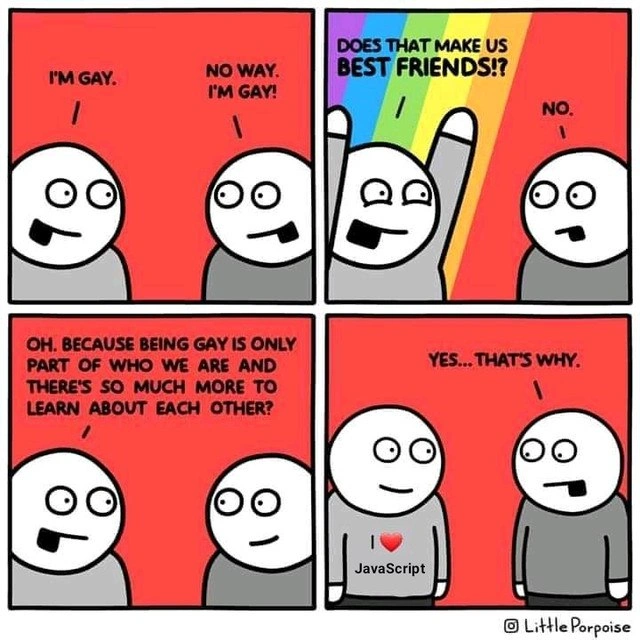
In the meme’s panels, the rainbow background in the second panel is a reference to the LGBTQ pride flag, setting up the context that both characters share being gay. The first character excitedly asks, “DOES THAT MAKE US BEST FRIENDS?!” because sometimes people hope that having one thing in common means instant friendship. The second character simply says, “No.” This moment is both comedic (because it deflates the expectation super fast) and truthful – just one common trait doesn’t automatically make two people close friends, especially something like sexual orientation which doesn’t guarantee you have similar hobbies or personalities. The first character then tries to reason: “Oh, because being gay is only part of who we are and there’s so much more to learn about each other?” That’s a thoughtful, mature idea: basically “we shouldn’t assume we’re alike in everything just because of one thing.” But the punchline comes in the last panel when suddenly the first character is shown wearing the “I ❤️ JavaScript” shirt. That visual gag tells us he’s a big JavaScript fan – and presumably, the second character is too (otherwise the joke wouldn’t land). The second character now says “YES… THAT’S WHY.” In other words: No, we’re not instantly best friends just because we’re both gay. But wait – you love JavaScript? Oh heck yes, now we’re best friends! 😂
What this is satirizing is how programmers often bond over coding. If two devs discover they both enjoy the same programming language or technology, they’re likely to get excited and chat for hours about it. It’s like two gamers finding out they both play the same game, or two kids learning they both love the same cartoon. Within the world of programming, languages are a bit like favorite sports teams or fandoms. There’s a whole DeveloperCulture of identifying with what you use: “I’m a JavaScript developer”, “I’m a Python person”, “I do mostly Java”. And each of those has its community with its own jokes and friendly rivalries. So, the meme humorously implies that a shared coding language (JavaScript in this case) can feel like a stronger friendship foundation than something more personal but abstract, like orientation. It’s an absurd comparison meant to make us laugh at how passionate tech folks can be about code. If you’re a junior dev, don’t worry – you don’t actually have to choose a “side” like it’s a real war. It’s more about finding people who enjoy the same tools as you do, which can be a great way to learn and have fun together in your early coding journey. After all, spending late nights debugging or building projects in the same language can create a special camaraderie – you understand each other’s joy when things work and the frustration when TypeError: undefined is not a function pops up yet again. That shared experience is exactly what’s being joked about here.
Level 3: Syntax Soulmates
At first glance, this comic sets up an expectation about identity, then punchlines with programming language allegiance. Two characters excitedly realize they share an orientation (“I’m gay.” — “No way. I’m gay!”), hinting at an instant bond. But the twist is that their true kinship isn’t about personal orientation at all – it’s about a shared obsession with JavaScript. The second character’s deadpan “No.” followed by the reveal of the “I ❤️ JavaScript” shirt lampoons how, in developer culture, language loyalty can trump almost anything else. The humor hits because many developers recognize this absurd yet relatable hierarchy of identity: being gay is an important personal trait, sure, but loving JavaScript – now that is what makes someone your BFF in the programming world. It’s exaggeration, of course, but it satirizes a real phenomenon in tech circles where programmers often form tribes around the technologies they love (or love to hate).
This joke brilliantly pokes fun at DevCommunities and their sometimes overzealous LanguageWars. In real life, just sharing one aspect of personal identity (like orientation) doesn’t guarantee friendship – people are multi-faceted. The comic even acknowledges that with the first character’s thoughtful guess: “because being gay is only part of who we are and there’s so much more to learn about each other?” That’s a sensible, mature take. But the punchline undermines the serious tone with nerdy glee: the true instant friendship here comes from geeking out over the same programming language. It highlights how developers often treat their favorite language as a badge of identity. Wearing an “I ❤️ JavaScript” shirt is the coder equivalent of waving a flag – an invitation to others in the JavaScript tribe. The second character’s “YES… THAT’S WHY.” is hilariously blunt: Of course we’re best friends, you love JavaScript just like I do! This is the comic’s playful jab at tech culture – implying that among programmers, sharing a coding language can create a tighter bond than even major personal similarities.
Anyone who’s spent time among programmers knows that language preference can feel tribal. There are well-known rivalries and bonds formed over languages and frameworks (cue the endless debates of JavaScript vs Python vs Java vs C++). This meme zeroes in on JavaScript, arguably one of the most polarizing and omnipresent languages today. JavaScript has a massive community and a reputation for odd quirks, which means it inspires both fervent fans and exasperated detractors. The ones who proudly declare “I ❤️ JavaScript” often do so with a mix of irony and pride – they know it’s a language full of warts (undefined is not a function, anyone?) but it’s their language. Meeting another developer who’s also deep into JS can indeed spark instant camaraderie. It’s like discovering someone speaks your native dialect in a foreign country: finally, someone who gets all my jokes about NaN and null!
Let’s face it, DeveloperCulture encourages strong language identity. People attend meetups for “Ruby enthusiasts” or wear t-shirts from the “Python conference”. The comic exaggerates it to hilarious effect, but rings true: developers often bond over shared tools and experiences:
- Tribal Swag: It’s common to see laptops plastered with stickers like Node.js, React or dinosaurs from the latest JS framework, proudly signaling allegiance. That “I ❤️ JavaScript” shirt in the panel is exactly that kind of tribal swag. Spot someone wearing it at a conference and instantly you’ve got an ice-breaker – “Hey, I love JS too! What are you working on?”.
- Shared Struggles & Inside Jokes: Every language comes with its pain points and inside jokes. JavaScript folks bond over coping with things like callback hell, bizarre type conversions, or the endless stream of new frameworks. Surviving these experiences together feels like a rite of passage. Mention “npm install” around another JS dev and you might both roll your eyes about bloated
node_modulesfolders. It’s a war-story bond. - LanguageWars: Good-natured (and sometimes not-so-good-natured) rivalries are everywhere. For instance, a JavaScript dev might teasingly say to a Java dev, “Enjoy writing all those types and interfaces while I whip this up in one line of JS.” The Java dev fires back, “Have fun debugging at runtime – I’ll let the compiler catch my bugs.” They’re joking, but only half joking. Picking sides in these debates (JavaScript’s dynamic freedom vs a statically-typed safety net, etc.) gives a sense of belonging to a camp.
In the end, the meme is affectionately mocking how relatable humor in programming often comes from these very specific shared passions. It’s not minimizing the importance of personal identity; rather, it’s highlighting how ridiculously intense developers can be about their tools. The absurdity that two people wouldn’t automatically be best friends just from a shared human experience, yet might instantly click over a coding language, makes us laugh because it caricatures our reality. If you’ve ever seen two JavaScript devs who just met immediately dive into comparing their favorite build tools or swapping war stories about TypeScript vs plain JS, you know this comic isn’t far off. It’s a tongue-in-cheek reminder that in tech, sometimes “it’s not about who you are, it’s about what you code.”
Description
A four-panel comic strip by 'Little Porpoise' with a red background, featuring two simple cartoon characters. In the first panel, one character says, 'I'M GAY,' and the other excitedly replies, 'NO WAY. I'M GAY!'. In the second panel, the first character celebrates with a rainbow behind them, asking, 'DOES THAT MAKE US BEST FRIENDS!?,' to which the second character bluntly says, 'NO.' In the third panel, the first character, looking puzzled, asks, 'OH. BECAUSE BEING GAY IS ONLY PART OF WHO WE ARE AND THERE'S SO MUCH MORE TO LEARN ABOUT EACH OTHER?'. The final panel reveals the punchline: the second character is wearing a shirt that reads 'I ❤️ JavaScript' and says, 'YES... THAT'S WHY,' with a shifty expression. The comic uses a bait-and-switch, setting up a wholesome message about identity only to reveal the true reason for the rejection is the character's affinity for JavaScript, humorously playing on the strong, often negative opinions some developers have about the language
Comments
7Comment deleted
Some friendships are broken by politics or money. In tech, they're broken by a weakly typed language with a confusing 'this' keyword
At our “bring your whole self” company, any identity is welcome - right up until you show up in an “I ❤️ JavaScript” shirt; then the principal engineer quietly hands you the pager and says, “Congrats, you now own every NaN incident caused by implicit coercion.”
I've reviewed your code and I can see you're using `==` for type coercion, `var` for block scoping, and promises without async/await. We need to talk about your definition of 'love.'
This perfectly captures the moment when you meet another developer at a conference, bond over both using JavaScript, then discover they're unironically excited about class-based inheritance while you've been writing functional React with hooks for five years. Suddenly that 'I ❤️ JavaScript' shirt feels like it's covering a theological chasm wider than the gap between 'var' and 'const'. Shared language choice is just the beginning - wait until you discuss semicolons, TypeScript adoption timelines, or whether 'this' binding is elegant or a design flaw
Java & JS devs: 'Best friends!' until one mentions prototype chains and the other invokes the JVM - then it's callback hell vs. verbose boilerplate for life
We were fine until he said “I ❤️ JavaScript” - I only commit to relationships that use === and don’t bring 1,200 transitive dependencies to dinner
Friendship survives 3 a.m. incidents; it doesn’t survive someone who unironically loves JavaScript - next thing you know, == slips into prod and you’ve adopted 1,600 transitive deps