A 2013 Prophecy on Full-Stack JavaScript
Why is this Languages meme funny?
Level 1: The Kid Who Ate Cereal for Dinner
Imagine a kid who announces he's going to eat cereal for breakfast, lunch, and dinner — and insists it's great, practical, delicious. All the adults shake their heads and say "well, of course they had to send him away." Then, ten years later, everyone is eating cereal for dinner and calling it meal-prep efficiency. The meme is funny because of the dry "of course" — treating a slightly weird preference as certified insanity — and funnier in hindsight, because the supposed madman turned out to be early rather than wrong.
Level 2: Client, Server, and One Language to Rule Them
A few terms, decoded:
- Client and server: a web app has two halves. The client is the code running in the user's browser (buttons, animations, form validation). The server is the code running in a datacenter (databases, authentication, business logic). Traditionally these were written in different languages — JavaScript in the browser (because browsers run nothing else natively), and Java/PHP/Python/Ruby on the server.
- Node.js: a runtime released in 2009 that took Chrome's JavaScript engine (V8) out of the browser and let it run on servers. Suddenly "JavaScript on the server" was possible, and the person in the meme is an early adopter of exactly that.
- Full-stack JavaScript: the practice of using JS for everything — frontend, backend, build tooling. The promised benefits are real: one language to learn, code you can share between both halves, one ecosystem of libraries.
- Дурка (durka): Russian slang for a psychiatric hospital. In runet meme grammar, "его в дурку забрали" ("they took him to the durka") is the stock punishment for anyone whose enthusiasm crosses into heresy.
If you're early in your career, you've probably only known the world this comment found insane — Express or NestJS on the backend, React on the front, npm install everywhere. That's the joke's second life: what reads to you as a normal Tuesday was, in 2013, grounds for commitment. It's a useful calibration: today's "obviously crazy" stack choice is sometimes just early.
Level 3: Atwood's Law, Patient Zero
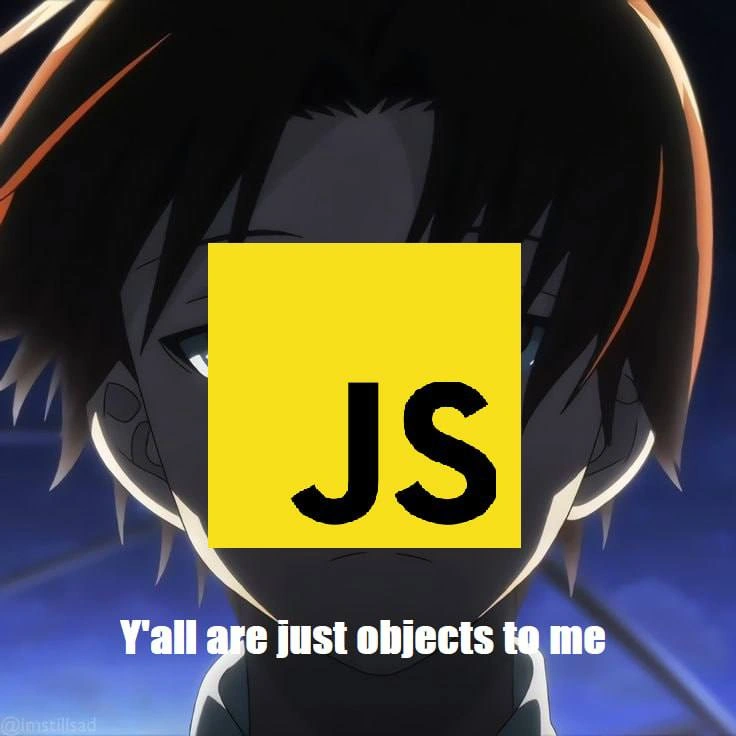
The screenshot is a single forum comment by user MagNet, timestamped 29 октября 2013, sitting at a modest +4 karma:
Один пацан писал все на JavaScript, и клиент, и сервер, говорил что нравится, удобно, читабельно. Потом его в дурку забрали, конечно.
("One guy wrote everything in JavaScript — both client and server — said he liked it: convenient, readable. Then they took him to the madhouse, of course.")
That last word — конечно, "of course" — is doing all the comedic work. The structure is a classic Russian copypasta template: a deadpan anecdote where the punchline treats institutionalization as the obvious, inevitable consequence of the preceding behavior. No argument is made against full-stack JavaScript. None is needed. The joke asserts that enjoying it is prima facie evidence of madness, and the +4 karma tells you the room agreed.
To appreciate why this landed in 2013, you need the archaeology. Node.js was four years old and in its peak evangelism phase — "JavaScript everywhere" was the pitch, isomorphic JS the buzzword, and Jeff Atwood's 2007 quip ("any application that can be written in JavaScript, will eventually be written in JavaScript") was transitioning from joke to roadmap. Meanwhile, the JavaScript of 2013 was pre-ES6: no let, no classes, no modules in the language itself, == coercion tables circulating as horror memes, and callback(err, data) pyramids as the official concurrency model. Claiming this language was "удобно, читабельно" (convenient, readable) for backend work, where engineers had Java, Python, and C# with actual type discipline or at least sane equality semantics, genuinely read as a provocation.
The deeper irony is that history sided with the madman. Within a few years of this comment, Node conquered the server-side startup world, npm became the largest package registry in existence, ES2015 fixed half the language, TypeScript fixed half of what remained, and "full-stack JavaScript developer" became one of the most-posted job titles in the industry. The meme survives precisely because of this reversal — it gets reposted (here with the caption "Шел 2013 год", "The year was 2013") as a time capsule, ambiguous about who the real patient is: the guy in the asylum, or the industry that followed him in and redecorated.
There's also a quieter satire of how developer communities police taste. The comment doesn't engage with trade-offs — shared validation logic between client and server, one hiring pipeline, one mental model of async I/O. It just reaches for the most efficient rhetorical weapon a forum has: ridicule. Every technology that later won — Git, Docker, even JavaScript itself — spent its early years as the punchline of exactly this kind of comment. The durka is, historically speaking, a waiting room.
Description
A screenshot of a comment from a Russian-language forum, dated October 29, 2013. The text reads: 'Один пацан писал все на JavaScript, и клиент, и сервер, говорил что нравится, удобно, читабельно. Потом его в дурку забрали, конечно.' This translates to: 'One guy wrote everything in JavaScript, both client and server, said he liked it, it was convenient, readable. Then, of course, they took him to the madhouse.' This meme is a historical snapshot of developer sentiment during the rise of Node.js. For senior engineers, it's a hilarious reminder of the initial widespread skepticism towards server-side JavaScript. The joke captures the 'language wars' of the early 2010s, where using JavaScript for anything beyond the browser was considered a foolish and radical idea, in stark contrast to its ubiquitous use in backend and full-stack development today
Comments
8Comment deleted
In 2013, using JavaScript on the backend was considered insane. Now, the NPM dependency tree for a 'hello world' app is what's truly insane
In 2013 writing both client and server in JavaScript got you committed; in 2023 it gets you funding - the real psych ward is tracing one bug through 27 Lambda functions named after Star Wars planets
Looking back at 2013 when they institutionalized someone for using JavaScript everywhere, meanwhile in 2024 we're debugging TypeScript build configs that are longer than the actual application code
The asylum was the natural endpoint: he finally achieved code sharing between client and server - they now share the same undefined behavior
Ah yes, the classic 2013 full-stack JavaScript pioneer - discovered you could run JS on the server with Node, in the browser, and even in MongoDB with its JavaScript query language. Achieved the holy grail of 'write once, debug everywhere' and got so excited about callback hell spanning three tiers that the team had to intervene. The real tragedy? He probably would've been promoted to Staff Engineer if he'd just waited until 2020 when this became the industry standard everyone pretends to love
JS: the language where optimistic timelines always coerce to NaN, no matter the transpiler
Full‑stack JS really nails reuse: one model, one language, and one npm CVE to take down client and server in a single afternoon
Full‑stack JavaScript: reduces context switching and doubles the blast radius - one transitive npm update and both your SPA and your auth service go dark