Skip to content
DevMeme
694 of 7435
JavaScript: The Language of Nightmares
Languages Post #786, on Nov 6, 2019 in TG

JavaScript: The Language of Nightmares

Why is this Languages meme funny?

Level 1: Dreams vs. Nightmares

Imagine you ask your friend what language they dream in at night – maybe they know English and Spanish, so you expect them to say “I dream in Spanish” or something. But instead, they joke, “I dream in JavaScript!” Now, JavaScript isn’t a spoken language for people; it’s what computers understand. That answer is silly and unexpected, like someone saying they dream in robot talk. Then another friend laughs and says, “Hey, the question was about nice dreams, not nightmares!” They’re joking that dreaming in JavaScript code would be a nightmare. Why a nightmare? Because for programmers, JavaScript can be a bit like a tricky puzzle – sometimes it does weird stuff that makes your head hurt. So if your brain is stuck thinking in JavaScript even when you sleep, that sounds more stressful than relaxing!

It’s like this: imagine in your dream you’re trying to build a toy castle, but every time you pick up a block, it changes shape into something that doesn’t fit – how frustrating would that be? You’d wake up all anxious. That’s the feeling a programmer might get when their code behaves in surprising ways. So the meme is funny because it takes a normal question about dreams and turns it upside down: dreaming in a computer language? Yikes! It’s a playful way to say coding can follow you into your dreams and that might not be so peaceful. Even if you don’t code, you know how a bad dream can make you feel tired? Here the “bad dream” is just doing more work (coding) in your sleep. In short, the first person’s answer is goofy, and the second person’s comeback makes everyone chuckle by comparing JavaScript code to a bedtime monster.

Level 2: Language Quirks Awake

At its core, this meme plays on the double meaning of “language.” In the original Reddit question, “what languages do you speak in your dreams?” most people would answer with human languages like English, Spanish, or Chinese. But a crafty developer answered with JavaScript, which is a programming language. This twist immediately tells other developers, “Ah, we’re talking about coding even in our sleep.” It’s funny because it’s unexpected – mixing a normal question with a techie answer – and it hints that the person spends so much time coding that even their dreams are full of code. Talk about subconscious coding!

Now, why does another commenter call that a “nightmare”? Here’s where JavaScript’s reputation comes in. JavaScript is the main language for web pages (and also used on servers with Node.js). It’s known as a dynamic language, meaning you don’t have to declare exact data types for your variables. That flexibility is great for quick scripting, but it also leads to weird surprises (aka language quirks). A runtime error is an error you only see when the program is running, not beforehand. In a statically-typed language (like Java or C#), many bugs are caught when you try to compile your code. But JavaScript skips that – it’s interpreted on the fly, so mistakes often show up only when you actually execute the code (sometimes in front of users, oops!). For a junior developer, it’s like finding out about a typo only when someone reads your essay out loud, instead of when you ran spell-check.

One infamous quirk in JavaScript is type coercion – the language sometimes automatically converts values to another type in an attempt to make an expression work. This can produce baffling results. For example:

console.log("5" + 5); // Outputs "55"  (string + number = string concatenation)
console.log("5" - 5); // Outputs 0    (string - number = number subtraction, "5" becomes 5)

See how adding "5" and 5 gave "55" (because JavaScript treated it like string concatenation), but subtracting gave 0 (because it treated the string "5" as the number 5)? These kinds of inconsistent behaviors can surprise developers – you expect one thing, but JavaScript’s trying to be “helpful” and does something else. The result can be bugs that are hard to figure out. When a bug like that happens while the program is running, it’s a runtime error. And if you’ve spent late nights trying to hunt down a bug caused by something like an undefined value or a wacky type coercion, it can indeed feel like a nightmare.

So in the meme, calling JavaScript a “nightmare” is lighthearted developer humor about these frustrations. It’s a bit of a gentle jab in the ongoing LanguageWars – programmers often poke fun at languages (especially ones as ubiquitous as JavaScript) for their flaws. JavaScript is actually very powerful and not literally evil, of course! But jokes about it breaking unexpectedly (like a nightmare_language) are super common, because many people learning it or working with it have run into confusing issues. It’s relatable humor: almost every web developer remembers the first time they saw something like NaN (which stands for “Not a Number”) or the infamous error "undefined is not a function". These “WTF moments” are practically a rite of passage in learning JavaScript.

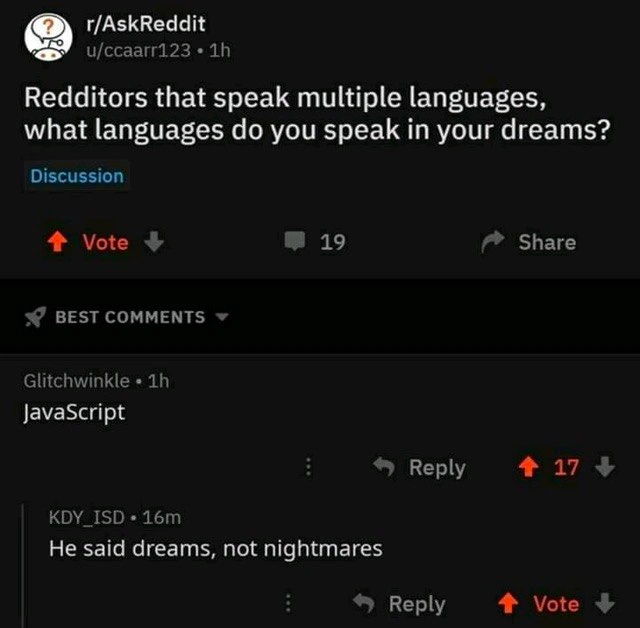
The Reddit screenshot itself shows this in a familiar internet format: a question on AskReddit (where anyone can ask anything) and the top answers. It’s in dark mode (black background, white text – a style many coders prefer to ease eye strain). The first answer “JavaScript” got upvoted because people found it funny and true. The reply “He said dreams, not nightmares” also got a lot of upvotes, meaning many readers appreciated the joke. Essentially, one person answered with a programming language (JavaScript) implying “I even dream in code,” and another person quipped that dreaming in code, especially that code, isn’t a pleasant dream at all. If you’re new to coding, imagine someone asking about nice dreams and someone else bringing up a frustrating homework problem – it’s humor through contrast.

To break it down:

  • JavaScript – A very popular programming language, mainly for making websites interactive. Also used on servers. It’s known for being easy to start with, but with some gotchas that can surprise you.
  • Runtime-error nightmare – Suggests that if you dream in JavaScript, your dream might go wrong unexpectedly, just like a JavaScript program might throw an error while running.
  • Dream vs Nightmare – The meme’s joke is literally playing on the difference. Dreams are nice, nightmares are scary. The second commenter is teasing that JavaScript belongs in the “scary” category for developers.
  • Multiple languages – The original question was using “languages” in the sense of human languages (like being multilingual). The humor is that the answer twisted it to mean programming languages. Many developers do kind of “speak” in code, so it’s a fun crossover joke between normal life and programming life.

All of this makes the meme a quick laugh for anyone who codes, especially those who have battled a tricky JavaScript bug. It’s saying, “I tried to relax and even in my dreams I’m debugging JavaScript... send help!” And a lot of us, even junior coders, can relate to having code on the brain a bit too much. It’s a friendly reminder that maybe we all need a vacation – or at least to switch off the text editor before bedtime!

Level 3: The Runtime Terror

This meme hits seasoned developers right in the JavaScript. Instead of listing a spoken human language, one commenter deadpans “JavaScript” – and every experienced dev immediately smirks (or shudders). Why? Because dreaming in JavaScript is the coding equivalent of a stress dream. It implies you’re so deep in frontend programming hell that your subconscious is writing scripts at 3 AM. The punchline comes from the reply: “He said dreams, not nightmares.” In other words, JavaScript isn’t a blissful multilingual dream; it’s a runtime-error nightmare. This quip taps into developer humor about JS’s notorious language quirks. Seasoned coders joke that if you’re dreaming in JavaScript, you’re trapped in an endless loop of [object Object] horrors. It’s a relatable humor moment: anyone who has wrestled with JavaScript’s dynamic types or bizarre type coercion at 3 AM instantly feels seen.

On a platform like Reddit’s AskReddit, a normal question about multilingual dreams took a geeky turn. The top-voted answer “JavaScript” shifts the context from spoken tongues to programming languages – a classic nerdy non-sequitur. Then the follow-up retort delivers the developer irony: calling JavaScript a nightmare language. This is a wink to the collective trauma of countless developer pain points using JS. Think of those famous TypeError messages:

// A classic JavaScript nightmare:
let result = dream.world;  
// Oops, dream is undefined at runtime...
// Throws: "TypeError: Cannot read property 'world' of undefined"

That error above – “Cannot read property of undefined” – is the kind of midnight surprise that gives even senior developers cold sweats. In a statically-typed language, the compiler would’ve caught the bug before you ran the code. But in JavaScript, you often don’t discover the mistake until it blows up live (gulp, hope it wasn’t production!). Such runtime errors are so frequent that developers half-joke JavaScript’s real name should be “WTF-scripting language.” This meme brilliantly compresses that entire senior_dev_js_rant down to a single word and a sarcastic rebuttal.

By calling JavaScript a “nightmare,” the commenter nods to endless debates in language wars. JavaScript is immensely powerful and everywhere (the lingua franca of web browsers and beyond), but it’s also infamous for weird gotchas. For example, its == vs === equality rules or how array and object addition produce surreal results. Any dev who’s stepped on these landmines gets the joke. The absurdity of dreaming in a programming language underscores a work-life imbalance so extreme it’s funny. It’s developer irony: the thing we “speak” all day (code) invades our dreams, turning a peaceful multilingual fantasy into a debugging session from the Twilight Zone.

In short, this meme resonates because it’s a relatable inside joke. It masquerades as an innocent Reddit Q&A but delivers a punchline that only programmers fully appreciate. It’s the shared PTSD of JavaScript devs: we’ve all had those nights where code follows us to bed, and trust us, if it’s JavaScript, it ain’t a sweet dream – it’s a runtime terror.

Description

This image is a screenshot of a thread on the social media platform Reddit, specifically from the 'r/AskReddit' subreddit. The original post, by user u/ccaarr123, asks 'Redditors that speak multiple languages, what languages do you speak in your dreams?'. Below this, in the comments section, user Glitchwinkle replies 'JavaScript'. The humorous punchline comes from the subsequent reply by user KDY_ISD, who retorts, 'He said dreams, not nightmares'. The joke plays on the long-standing reputation of JavaScript within the developer community as a language full of quirks, inconsistencies, and frustrating behaviors (like type coercion and the 'this' keyword), which can make working with it feel like a nightmare. It's a classic example of developer in-humor that finds comedy in shared professional suffering
Comments

7
Anonymous ★ Top Pick Dreaming in JavaScript is just an infinite loop of 'undefined is not a function' errors, where every object is secretly a string, and 'this' refers to the pillow
  1. Anonymous ★ Top Pick

    Dreaming in JavaScript is just an infinite loop of 'undefined is not a function' errors, where every object is secretly a string, and 'this' refers to the pillow

  2. Anonymous

    At least my subconscious handles type coercion better than the V8 engine

  3. Anonymous

    I dream in JavaScript too, but only the async parts ever resolve

  4. Anonymous

    The real nightmare isn't dreaming in JavaScript - it's waking up to realize your subconscious has better error handling than your production code, yet still returns 'undefined' when you try to remember what you were supposed to fix yesterday

  5. Anonymous

    Dreams: TypeScript; nightmares: the transpiled JS where NaN is a number, undefined isn’t a function, and your stack trace gets queued as a microtask

  6. Anonymous

    Dreaming in JavaScript: hoisted variables from yesterday's regrets, awaiting resolution that never comes

  7. Anonymous

    Dreaming in JavaScript means therapy keeps getting scheduled on nextTick while == swears it’s basically ===

Use J and K for navigation