Skip to content
DevMeme
1920 of 7435
Java Needs Orthogonal Monitor Scaling
Languages Post #2131, on Oct 8, 2020 in TG

Java Needs Orthogonal Monitor Scaling

Why is this Languages meme funny?

Level 1: Screens for Big Words

This is like needing one tall piece of paper for a very long list of what went wrong, and one wide piece of paper for very long names. The joke is that Java can make both the error messages and the names so big that normal screens feel too small.

Level 2: Tall Errors, Wide Names

In Java, an exception is an error-like event that interrupts normal program flow. A stack trace is the list of method calls that led to that exception. It is useful because it tells you where the program traveled before it failed.

The problem is that Java applications often use many layers. A web request might move through a controller, service, validator, database repository, framework proxy, and security filter. When something breaks, every layer can appear in the stack trace, so the error message becomes very tall.

Java class names can also be long because Java developers often use descriptive names and organize code into packages. A class name might try to explain exactly what the object does, where it belongs, and what role it plays. That can help a team understand a large codebase, but it can also make simple code visually heavy.

So the meme turns two normal developer tools into a joke:

  • A vertical monitor helps you read long logs and stack traces.
  • A horizontal monitor helps you read long code lines and long class names.
  • Java is the language being teased because it is famous for explicit, verbose style.

For a junior developer, this is the moment when "just read the error" becomes less simple than it sounded. Sometimes the error is there, but it is buried under a stack trace wearing seventeen layers of framework clothing.

Level 3: Orthogonal Java Pain

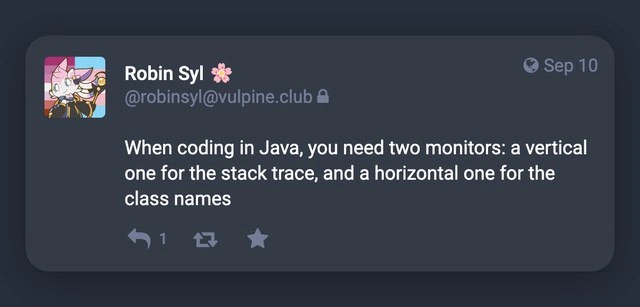
The post says:

When coding in Java, you need two monitors: a vertical one for the stack trace, and a horizontal one for the class names

That is a precise little jab at two different Java readability problems that stretch in opposite directions. Stack traces grow vertically because one exception can pass through controllers, services, repositories, proxies, framework dispatchers, reflection calls, and test runners before the actual cause appears. Class names grow horizontally because Java culture often rewards explicit naming: CustomerAccountValidationServiceFactory may be considered more maintainable than something short, at least until it wraps halfway across the editor like a tax form.

The humor is not just "Java is verbose." That line has been beaten into the floorboards for decades. The sharper joke is that the physical workspace has to adapt to the shape of the language's pain. A vertical monitor is genuinely useful for logs and traces because it shows more call frames at once. A wide monitor is genuinely useful for package-heavy, object-oriented code where a single line can include access modifiers, generics, dependency names, and a method call that looks like it was named by a committee locked in a room with a UML diagram.

This is also a Debugging_Troubleshooting joke because Java failures often arrive wrapped in ceremony. The real bug may be "config value was null," but the visible artifact can be fifty frames of framework plumbing. Experienced developers learn to scan for the first meaningful Caused by, then ignore the ceremonial parade above it. It is the software equivalent of asking for the receipt and getting the store's entire corporate org chart.

The social-media card format makes it feel like a casual observation, but it captures a real DeveloperExperience_DX truth: tooling shapes habits. IDEs, stack trace folding, package imports, line wrapping, and log viewers all exist partly because human eyes were never designed to read EnterpriseWidgetInitializationContextProvider at 2 AM.

Description

A dark social-media post card shows an avatar and the account name "Robin Syl" with a flower emoji, the handle "@[email protected]", a small lock icon, and the date "Sep 10". The post text reads: "When coding in Java, you need two monitors: a vertical one for the stack trace, and a horizontal one for the class names". Small reply, repost, and star icons appear below the post, with a visible count of "1" near the reply icon. The technical joke combines two Java stereotypes: extremely tall exception stack traces and very long, namespace-heavy class names that can make code and logs feel like they require specialized display geometry.

Comments

6
Anonymous ★ Top Pick Java achieved multi-monitor support by making errors vertical and class names horizontal.
  1. Anonymous ★ Top Pick

    Java achieved multi-monitor support by making errors vertical and class names horizontal.

  2. @Kyngo 5y

    Pole

  3. @j1mmy_hendr1x 5y

    and a mirror to see the hindu in front

    1. @BerZerg 5y

      Именно индуиста, а не индуса? Т.е. писать хороший код религия не позволяет? 😎😎

      1. @freeapp2014 5y

        я тут написал говнокод, можешь исправить? идея годная, но почистить код мне религия не позволяет

    2. Deleted Account 5y

      😂

Use J and K for navigation