The Programmer's Arms Race for Screen Real Estate
Why is this Languages meme funny?
Level 1: Big Names, Big Screen
Imagine you have a friend who has a really, really long name – so long that when they try to write it on a name tag, it doesn’t fit in one line. One funny solution would be to go get a huge name tag so that the entire name fits on it without having to write on a second line. This meme is joking about the same idea, but with computer stuff.
Think of the computer complaining with a super long error message that’s like a big sentence, or a file with a very long title. On a normal computer screen, you’d have to scroll or the text would wrap around because it’s too lengthy. The meme jokes that programmers would buy an extra-wide computer screen so they can see that whole huge line of text all at once. It’s a silly exaggeration – instead of making the error message shorter or the name shorter, they just use a giant screen to show it.
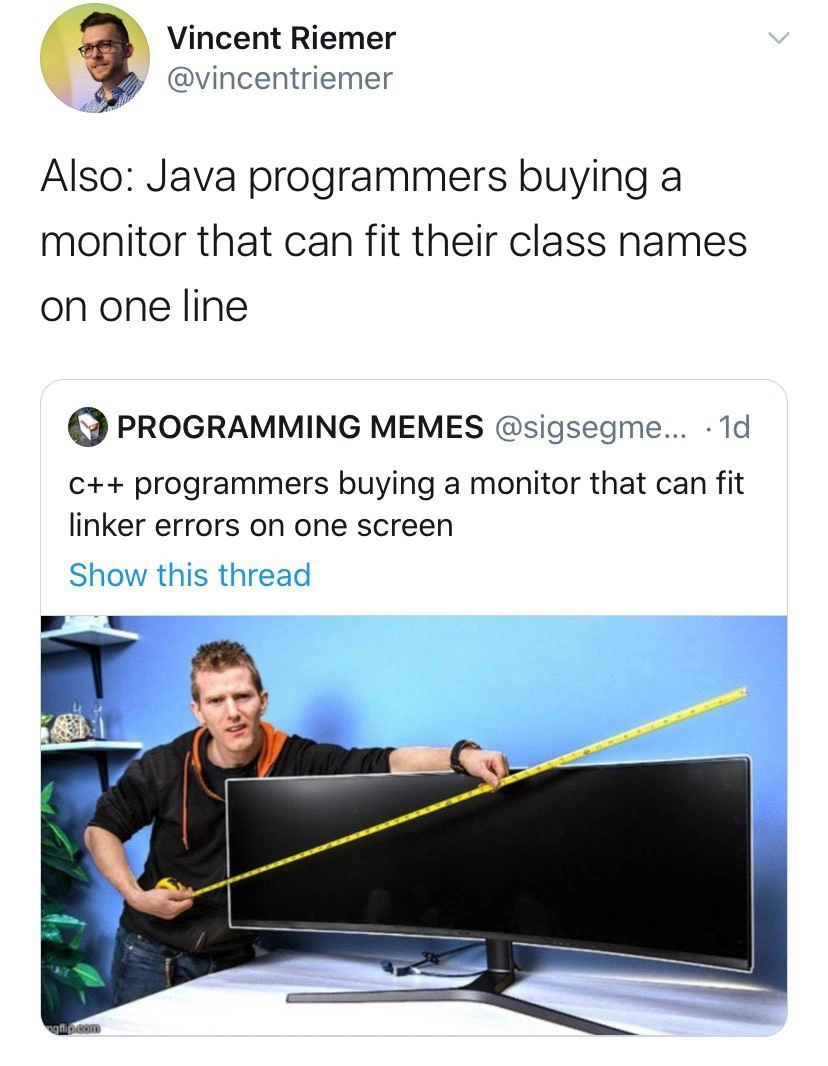
So, why is this funny? It’s like if you had a book with one really long line that didn’t fit on a page, and instead of hyphenating the word or changing the layout, you made a super wide page to print it on. It’s a playful way to say: sometimes computer programs give us messages or have names that feel as long as a train, and dealing with it can be a bit overwhelming. The picture even shows a guy measuring a ridiculously wide monitor to drive home how over-the-top this “solution” is.
In simple terms, the meme is laughing at how programmers sometimes have to deal with very long text (whether it’s the name of something in Java or an error message in C++). Instead of actually fixing the length of that text, the joke is they’d rather just get a bigger screen to fit it. It’s funny because it’s turning a common annoyance (text that doesn’t fit on the screen) into an absurd visual gag (an outrageously wide screen). Even if you’re not a programmer, you can relate a bit – it’s like needing a bigger notepad because one word you want to write is insanely long. The humor is in the exaggeration and the overly literal “solution” to the problem.
Level 2: Verbose by Design
At this level, let’s unpack the joke in more straightforward terms. The meme compares two scenarios side by side:
C++ Linker Errors: In C++, when you compile a program, the process happens in stages. First, each source file is compiled into machine code (producing object files). Then the linker takes over to join these pieces together into the final program. A linker error happens if something is missing or inconsistent in that last stage – for example, you declared a function but never actually wrote (defined) it, or you called a function from a library but forgot to include that library when linking. The error message from a linker can be really long. Why? Because it often shows the exact name of the thing it couldn’t find. C++ “mangles” names (encodes extra information like namespaces, classes, and template parameters into the name) behind the scenes. When the linker complains, it might spit out the full, unmangled (or partially mangled) name. These names can include a lot of technical detail – imagine a function name that includes types like
std::vector<std::string>or a template class with multiple parameters; it ends up like a long chain of characters. If several things are missing, you’ll get multiple error lines. All together, a linker error output can scroll through many lines on your terminal or IDE. The meme suggests that C++ programmers are buying extra-wide, possibly high-resolution monitors so that one entire linker error (which might normally be a scroll-fest) can fit on a single screen without needing to scroll. It’s exaggerating, of course, but it’s based on truth: C++ error messages are notorious for being wordy and intimidating to newcomers. Experienced C++ developers often joke about needing a bigger screen (or a bigger brain!) to parse these messages. Tools actually exist to pretty-print or shorten template errors, but the meme humorously imagines the hardware fix instead.Java Class Names: In Java, code is organized into packages (which are basically folder-like namespaces). Java developers also tend to name classes in a very descriptive way. Instead of short names like
MgrorCalc, you’ll see names likeCustomerAccountProfileManagerorDatabaseConnectionInitializationErrorHandler. There’s a culture of clarity: a class name should tell you exactly what the class is or does. This is great for readability, but it means the names get long. Furthermore, the package name is usually written at the top of the file or referenced when using the class, and those package paths can be quite lengthy too (often they’re the company’s reversed domain name plus project structure, e.g.com/yourcompany/yourproject/module/submodule/ClassName.java). When you combine the package and the class, it might not even fit in a typical code editor window without wrapping to the next line or requiring you to scroll horizontally. The tweet is joking that Java programmers purchase monitors that are so wide, they can display an entire extra-long class name on one single line. A normal monitor might cut it off or wrap text after, say, 100-120 characters, but an ultrawide monitor (those huge 21:9 aspect ratio screens) could show, for example, 200+ characters in one line if you use a small font. The idea is humorous because instead of adopting shorter names (or just living with line-wrapping), these Java devs supposedly just get a bigger screen so they can keep their verbose naming style without compromise.
Now, why is this funny to developers? It’s because it rings true in an exaggerated way. Both C++ and Java are popular programming languages with their own quirks. C++ is powerful and allows low-level control, but one side effect is that its error messages (especially those related to templates or linking) can be overwhelming. Java emphasizes object-oriented design and clarity, but that often leads to very wordy class and method names. Developers have all seen a console output where an error ran off the side of the window, or a piece of code where the name was so long it needed its own line break. We usually cope by resizing windows, scrolling, or abbreviating names when possible. The meme imagines a tongue-in-cheek extreme solution: just make the screen so wide or so large that the problem is nullified. This also slyly references how developers love multi-monitor setups or high-resolution displays to fit more code and logs visible at once. The ultra-wide curved monitor shown is a real product type – these things sometimes span 3 or 4 feet across. They’re often used for immersive gaming or finance traders with lots of data, but developers might use them to see multiple files side-by-side... or apparently, one really long line of text!
The photo itself (from the tweet) shows a man measuring a massive curved monitor with a tape measure. This visual is emphasizing just how exaggeratedly wide that screen is. The background with the shelves and plants looks like a normal office or studio, which makes the absurd size of the monitor stand out even more. It’s essentially saying “how big a monitor would you need to never have a newline or scroll for these languages?” The answer is comically large – and that’s the joke.
To spell out the technical terms in simpler words:
- Monitor: the display screen for your computer. An ultrawide monitor is a screen that is much wider than a normal one. For example, a standard monitor might be 16:9 ratio (like a TV), while an ultrawide might be 21:9 or even wider, giving you a lot of horizontal space.
- Linker error (in C++): after compiling code, the linker tries to put the program together. If a piece is missing (like a puzzle piece), the linker complains. The error message that comes out is the linker error. It often includes technical names of functions or variables it can’t find. These names can be very long because C++ is telling you exactly what’s missing, down to type details.
- Class name (in Java): when programmers create a new class (a blueprint for objects in object-oriented languages like Java), they give it a name. Java conventions encourage longer, descriptive names. If those names get too long, they might not fit neatly in one line in an editor or on a printout. “On one line” literally means without needing to break the text onto a new line.
- Package name (Java): Java files start with a package declaration (like
package com.example.myapp.util;). This is part of the full name of a class. It’s common in big projects for this to be several words long (with dots separating levels). When you refer to a class, you might include the package, adding to the length.
Finally, the phrase “fit on one screen” vs “fit on one line” in the tweets: “one screen” for the C++ case implies the entire error output (possibly multiple lines of text) can be viewed at once on the display (no scrolling up/down). “One line” for the Java case implies that a single identifier (which is one very long line of text) can be seen without wrapping or horizontal scroll. Both are about making all the text visible at once. The humor is that normally you’d solve this by adjusting software (maybe shorten the name, or use tools to condense the error), but here they solve it by sheer screen size.
In summary, this meme is a lighthearted jab at how verbose programming languages can get. By using a fantastically oversized monitor as the solution, it exaggerates the problem and makes us laugh. If you’re a junior developer, don’t worry – you won’t actually need to buy a giant monitor for your code! It’s just highlighting real challenges (reading C++ errors, dealing with Java naming) in a silly way. Once you experience a gnarly C++ error message or work on a Java project with endless subclass names, this meme’s joke will resonate even more. It’s basically saying: “We know our tools produce crazy-long text sometimes. Rather than fix the tools, haha, let’s just get bigger tools (monitors)!” 😉
Level 3: One Screen to Show All
In this meme, developers are poking fun at overly verbose software outputs by jokingly “solving” the issue with absurdly large hardware. It’s a classic hardware solution to a software problem. Specifically, it satirizes two notorious sources of long text in programming: C++ linker errors and Java class names. Both can get so lengthy that a normal monitor just can’t display them in a single glance. The meme’s punchline is that these programmers resort to buying an ultrawide monitor so they can finally see the whole darn thing at once, without scrolling. Let’s break down why these lines of text get so out-of-hand:
C++ Linker Errors: If you’ve ever worked on a sizable C++ project, you know the build process has multiple stages. After code is compiled into object files, the linker step tries to glue everything together. When something’s missing or mismatched (say you declared a function but didn’t define it, or you forgot to link in the right library), the linker throws an error. Rather than a short message, a C++ linker error often includes the full demangled symbol name of whatever couldn’t be linked. In C++, symbol names can explode in length thanks to things like namespaces, classes, function signatures, and especially templates (which instantiate separate versions of code for each type combination). For example, a missing function template instantiation might generate an error referencing a name like
veryLongNamespace::MyTemplateClass<int, std::string, 42>::doSomething(std::vector<std::string> const&). That single line is huge – it’s basically encoding the entire generic recipe of the function. Some linker errors also list multiple undefined references in one go. The result? A wall of text so wide and tall that on a normal screen you’re frantically scrolling horizontally and vertically to read it. Seasoned C++ devs have seen some things – sometimes an error message feels longer than the code that caused it! The meme jokes that instead of simplifying their code or using tools to pretty-print errors, these battle-hardened C++ programmers throw money at a 49-inch curved monitor, hoping the compilers can’t outrun the screen real estate.Java Class Names: Now enter the Java world, which has its own breed of verbosity. Java encourages descriptive naming conventions and organized packaging of code. Every class sits in a package (often a long dot-separated path reflecting company or project structure), and Java folks love CamelCase multi-word class names that explicitly spell out the class’s role. This leads to gems like
EnterpriseCustomerAccountProfileManagementServiceFactoryImpl– which is exaggerated but not far off from some enterprise codebases! When you include the full package, e.g.com/bigcorpsystems/customer/account/profile/EnterpriseCustomerAccountProfileManagementServiceFactoryImpl.java, the name becomes ridiculously long. A name that barely fits in a tweet’s character limit might actually exist in a large Java project. Sure, such verbosity can improve clarity (you immediately know what the class is meant to do), but it means the code will regularly hit the horizontal text limit in editors. You might need to resize your IDE panels or scroll right just to read the whole class declaration. The tweet quips that Java programmers solve this by buying a monitor wide enough to fit an entire verbose class name on one line without wrapping. In other words, rather than abbreviating their class names (heaven forbid we drop a few letters!), they opt for a mega-wide display so theAbstractSingletonProxyFactoryBeanand its friends finally stop breaking onto multiple lines.
The image included in the meme underscores the absurdity: it shows a guy (famous tech YouTuber Linus Sebastian, for those curious) holding a tape measure across an extremely wide curved monitor. It’s like he’s ensuring it’s long enough to fit these monstrous strings. The background looks like a studio set with calming blue tones and houseplants – a normal scene, except for this comically oversized screen taking center stage. The visual punchline resonates with developers because we’ve all grimaced at an error message or class name that just keeps on going. There’s a shared understanding that both C++ and Java, in their own ways, can produce output so unwieldy that it feels like you need special equipment to handle it. It’s TechHumor blending real developer pain with an exaggerated solution: you can’t easily change the language’s verbose tendencies, but hey, you can upgrade your hardware. The meme gets a knowing laugh from anyone who has squinted at a multi-line error dump or scrolled through a mile-long class name.
Under the hood, this humor points to real contrasts in language design: C++ trades simplicity for power, often exposing the programmer to raw, barely human-readable compiler and linker messages (especially pre-C++17, error messages for templates were famously horrific). Java, on the other hand, trades brevity for explicitness – the language and its community value readability through long, descriptive identifiers and structured package names. Combine that with deep class hierarchies or design patterns (think of all the FactoryFactory or ManagerController style names in big frameworks), and you end up with identifiers that are mouthfuls. Neither language is doing this just to be evil – these are side effects of design philosophies. But to a frustrated developer trying to debug or quickly navigate code, it can feel like overkill. The meme exaggerates the scenario to ridiculous proportions: “If our text is too long for screens… time to get bigger screens!” It’s funny because it’s both absurd (no one really buys a new monitor just for one line of text… right? 😅) and a tiny bit relatable (we’ve definitely wished for more screen space when facing a 200-character line of error).
So at this senior level of understanding, the meme is highlighting a convergence of Languages and Compilers quirks: the verbosity that advanced programmers tolerate or even expect. It’s winking at those in the know – the C++ gurus who wrestle with their linker and the Java veterans who have seen class names that read like sentences. It’s a gentle roast of both the tools we use and of ourselves as developers (we could choose shorter names or better error formatting, but nah, let’s flex with that ultrawide display!). In summary, the humor comes from the extreme length of technical text and the equally extreme (and tongue-in-cheek) measure taken to accommodate it. We’re laughing both at C++ and Java’s worst offenders and at the idea that the solution is to literally widen our view – pun very much intended.
// Example C++ linker error excerpt (long symbol name that might not fit on a normal screen):
undefined reference to `veryLongNamespace::MyTemplateClass<int, std::string, 42>::doSomething(std::vector<std::string> const&)'
collect2: error: ld returned 1 exit status
// Example of a verbosely named Java class (the package name makes it even longer!)
package com.example.enterprise.customer.account.profile;
public class EnterpriseCustomerAccountProfileManagementServiceFactoryImpl {
// Imagine trying to view this class name in one line without wrapping...
}
Description
A screenshot of a Twitter thread making fun of different programming languages. The original tweet by 'PROGRAMMING MEMES @sigsegme...' reads, 'c++ programmers buying a monitor that can fit linker errors on one screen.' Below this is a popular meme image of Linus Sebastian from Linus Tech Tips using a tape measure on an extremely wide, curved monitor. A reply tweet from 'Vincent Riemer @vincentriemer' adds, 'Also: Java programmers buying a monitor that can fit their class names on one line.' The meme humorously exaggerates well-known stereotypes: C++ is infamous for producing incredibly long and cryptic linker errors, especially with templates, while enterprise Java is notorious for its verbose and lengthy class names (e.g., 'AbstractSingletonProxyFactoryBean'). The joke is that developers for both languages need massive monitors just to deal with the verbosity of their respective ecosystems, one for errors and the other for naming conventions

Comments
7Comment deleted
My monitor is so wide I can fit a C++ template metaprogramming error on the left, a Java stack trace on the right, and still have enough room in the middle for my terminal to remind me I have a merge conflict
The 49″ ultra-wide was an easy sell to finance - still cheaper than refactoring AbstractFactoryBeanPostProcessorConfigurationAdapter or figuring out which template instantiation actually owns “undefined reference to std::__cxx11::basic_string…”
The real enterprise architects are the ones who convinced management that AbstractSingletonProxyFactoryBean was more maintainable than just calling it ConfigLoader
The real reason ultrawide monitors were invented: so Java developers could finally see 'AbstractSingletonProxyFactoryBean' without line wrapping, while C++ devs could read the first three lines of their template instantiation error before the stack trace scrolls off into the heat death of the universe. Both camps agree on one thing though - no amount of horizontal pixels will ever be enough to display the full Maven dependency tree or a Boost compilation error
We claim to scale horizontally, but it’s cheaper to add 49 inches of pixels so Spring’s AbstractSingletonProxyFactoryBeanPostProcessor fits while the Itanium‑mangled “undefined reference” epic still wraps at column 512
Procurement rule of thumb: monitor width >= the longest Java class name or a single C++ template linker error - whichever hurts less
Java class names so verbose they need their own domain; C++ linker errors so long, they qualify as technical debt documentation