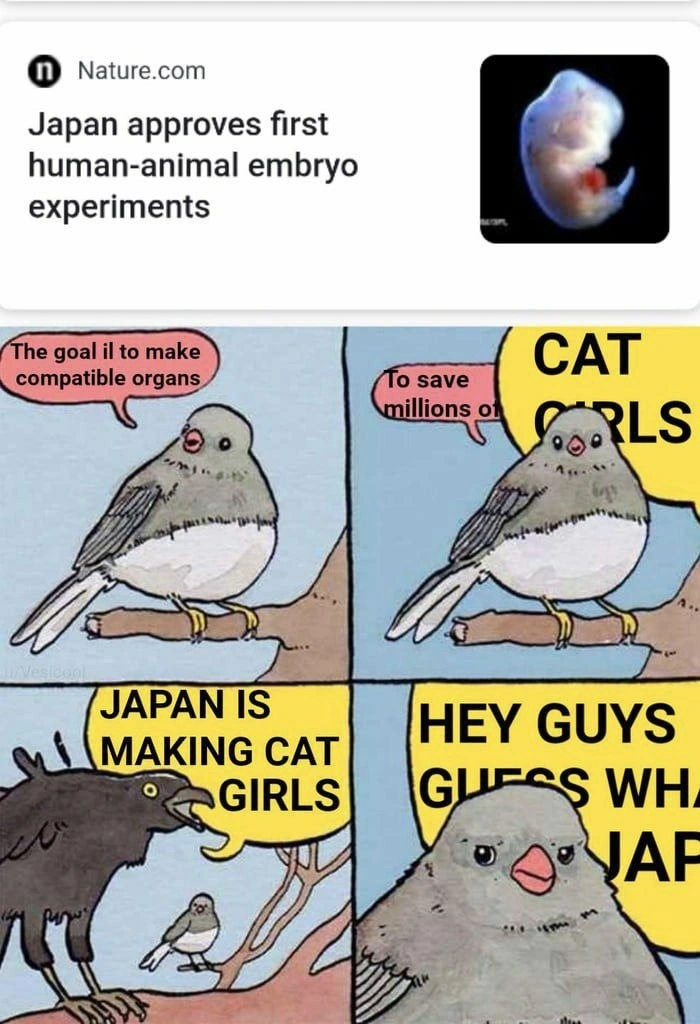
Bird meme lampoons tech hype: human-animal embryo research becomes “Japan is making catgirls”
Why is this IndustryTrends Hype meme funny?
Level 1: Candy Tree Rumor
Imagine your teacher tells the class, “We’re going to plant a vegetable garden at school so we can grow healthy food for everyone.” That’s the real plan. But one excited kid in the back only hears a fun part and yells, “We’re going to grow a magic candy tree that gives us endless candy!” Pretty soon, all the kids are jumping around talking about a giant candy tree. 🥳 The important idea about planting veggies to help people got completely lost because the candy story sounded way more exciting. This meme is funny for the same reason: a serious science plan (growing organs to help sick people) got turned into a crazy story about making cat-people just because that wild idea was more exciting to shout. It’s like a big kid spreading a silly rumor on the playground — everyone ends up talking about the wrong thing, and that mix-up makes us laugh.
Level 2: Buzzwords vs Reality
In simple terms, this meme is showing how a complicated science idea turned into a crazy-sounding story because people focused on one flashy term instead of the facts. The original news (from Nature.com, a respected science publisher) is that Japan approved the first human-animal embryo experiments. This means scientists in Japan got permission to grow an embryo (a very early-stage organism) that has a mix of human and animal cells. Why do that? The real goal is to eventually grow human-compatible organs inside animals. In other words, a doctor might one day take an organ grown in, say, a pig and transplant it into a human patient who needs it. If it works, it could save millions of lives by providing new hearts, livers, or kidneys for people who are sick and waiting for donors. This is a complex form of bioengineering, and it’s a serious, noble endeavor — nothing to do with making weird hybrid creatures, just solving an urgent medical problem.
The meme then shows what happens when that nuanced message meets the internet’s TechHypeCycle mentality. Instead of focusing on organ transplants, someone latches onto “human-animal” and imagines something far more sensational: “cat girls.” In geeky pop culture, a catgirl (often spelled as one word) is a fictional girl with cat ears, a tail, and sometimes other feline traits — basically a human-cat hybrid character you see in anime or video games. It’s a totally fantastical idea, not a real scientific goal. So when the crow in the meme yells “JAPAN IS MAKING CAT GIRLS,” it’s highlighting an extreme misinterpretation of the news. It’s like someone read only the shocking words “Japan,” “human-animal,” and their mind jumped to an outrageous conclusion that “They’re creating cat-person anime characters in a lab!” Even though that sounds absurd, it’s exactly the kind of headline or rumor that gets attention.
Let’s break down the panels so it’s clear: The two gray sparrows on the branch are calmly explaining the science. One says, “The goal is to make compatible organs,” and the next continues, *“to save millions o[f lives].” They’re basically voicing the true purpose: growing organs that humans won’t reject, in order to save lives. Now, mid-explanation, a bright yellow box with huge text “CAT GIRLS” appears — as if someone literally shouted over them or an intrusive thought popped in. Then we see a black crow with beak open, screaming “JAPAN IS MAKING CAT GIRLS.” Crows are loud and can be seen as annoying, so here it represents the loudmouth who distorts the message. Finally, the last panel shows a larger bird repeating on a yellow background, “HEY GUYS GUESS WHA— JAP…” (likely about to repeat “Japan is making cat girls!” to others). This mimics how an exaggerated story gets spread around excitedly. Essentially, it’s a visualization of a communication breakdown, almost like the children’s Telephone Game: the original message (“grow organs to help people”) gets garbled into a wild tale (“they’re making catgirls!”) as it’s passed along.
For a junior developer or anyone new to the tech world, this highlights an everyday issue: miscommunication and hype can twist the truth. You might have already seen how buzzwords work in the tech industry. For example, maybe you read a headline like “Artificial Intelligence Is Writing Its Own Code” and thought, “Wow, are programmers out of a job?” — only to learn the actual story was about a simple program that can generate some basic scripts (far from a full-fledged coder). Or perhaps at a startup you interned at, you heard the founder drop a trendy term like “blockchain” or “microservices.” Suddenly everyone in the company chat was excited, talking as if this one tech would transform the whole product overnight. In reality, maybe the team was only experimenting with it in a limited way. These are examples of the TechHypeCycle and buzzword culture: a new technology or idea gets introduced, and people immediately inflate expectations, sometimes completely misunderstanding what it’s for. As a newcomer, it’s a bit funny and a bit overwhelming to see how a tiny bit of info can blow up into something it isn’t.
This meme is basically a cautionary tale wrapped in humor. The phrase “cat girls” here is the ultimate buzzword bait that grabs attention, much like “AI” or “Big Data” or “Cloud” do in tech conversations. The lesson for a junior dev is: always dig deeper than the hype. If someone in a meeting says a buzzword, try to understand the actual details behind it. Likewise, when you explain your own work, be aware that non-technical folks might latch onto one familiar word and potentially misunderstand your whole project. Communication is key. The sparrows in the meme had the right info, but it wasn’t delivered in a way that could stop the crow from hijacking it. As you grow in your career, you learn to spot these situations. You’ll get better at communication to ensure that “we’re optimizing a database query” doesn’t get warped into “the system is getting an AI brain transplant!” 😅 In short, the meme is relatable because even early in your career, you’ll see how important it is to bridge the gap between complex ideas and how they’re perceived. And it does so in a lighthearted way: by showing birds literally shouting past each other about something as crazy as catgirls.
Level 3: Peak of Inflated Expectations
This meme showcases how easily a nuanced tech or science message can be smothered by sensational buzzwords. It uses the famous bird-yelling comic format to lampoon a classic IndustryTrends hype scenario. In the top panel, a serious Nature news headline announces “Japan approves first human-animal embryo experiments” – a real, complex development in biotechnology aimed at solving organ donor shortages. Two small sparrow characters (representing the rational experts) begin to explain the truth: “The goal is to make compatible organs… to save millions…” But then, abruptly, a big bold phrase “CAT GIRLS” overrides the frame. A black crow (a loud outburst personified) screams, “JAPAN IS MAKING CAT GIRLS!” and another bird excitedly squawks, “HEY GUYS, GUESS WHAT, JAP—” before cutting off. In an instant, the careful explanation about growing transplantable organs is drowned out by a flashy, completely off-base takeaway. The meme brilliantly exaggerates this communication meltdown, where a complex human-animal embryo experiment gets reduced to “Japan is making catgirls.” It’s a piece of sharp IndustrySatire: the sober scientific goal is lost under a neon sign of internet-fueled misinterpretation.
For seasoned developers, this pattern is painfully familiar. We’ve all watched a nuanced technical plan morph into a ridiculous game of telephone as it travels up the management chain or across social media. It’s essentially the TechHypeCycle in comic form. In Gartner’s terms, people leap straight to the “Peak of Inflated Expectations” the moment they hear about a new innovation. Here, the serious biomedical initiative (growing human-compatible organs in animals) rockets to an absurd expectation (“making anime cat-people”) because that wild idea is more exciting to the uninformed. This mirrors how emerging tech at work often gets overhyped. Mention a modest machine learning prototype in a meeting, and suddenly a rumor circulates that your product has full AI capabilities that will “revolutionize the industry.” Say you’re exploring a small blockchain ledger for data integrity, and next thing you know a VP is boasting, “We’re a blockchain-powered company now!” The meme’s crowing “cat girls!” is just the comedic extreme of these miscommunication leaps – the same kind of leaps that put developers in facepalm mode on a regular basis.
Why is this so funny (and a little painful)? Because it shines a light on the gap between expert communication and public perception. The gray sparrows are like engineers or scientists carefully explaining a project’s true purpose, while the crow represents the loud buzzword chaser who only hears a tantalizing phrase and runs with it. It’s common in tech: the more complex and nuanced the project, the more likely someone will distill it down to a catchy (and usually misleading) snippet. Experienced devs know that hype sells — sensational stories spread faster than the boring truth. There’s even a tongue-in-cheek coping mechanism in offices: Buzzword Bingo, where engineers secretly mark off jargon like “AI-driven”, “disruptive blockchain”, or “synergy” during big meetings. Here, “cat girls” would score a bingo instantly. The humor comes from recognizing that this meme isn’t far from reality. We’ve all had to debunk wild misconceptions (“No, our cloud migration doesn’t mean actual clouds…” 🙄). The crow literally shouting nonsense over the experts is an exaggerated version of that one stakeholder or clickbait headline that drowns out your detailed explanation with a simplistic, flashy takeaway.
To drive the point home, consider a few parallel scenarios we’ve seen in tech:
| Actual Project Goal | How the Hype Sounds |
|---|---|
| Grow human-compatible organs in pigs for transplant (science news) | “They’re creating pig-men or catgirls!” |
| Introduce a small ML model to tune recommendations | “Our app uses AI to read your mind!” |
| Refactor one legacy module using microservices | “We’re rebuilding EVERYTHING with cutting-edge microservices!” |
| Use a blockchain ledger for audit logging | “The whole product runs on crypto now!” |
In each case, the left side is a careful, specific goal, and the right side is the exaggerated buzzword version that a non-tech storyteller might spread. The meme zeroes in on this disconnect. It resonates with developers because we’ve battled the misinterpretation of our work before: whether it’s a higher-up misunderstanding a proposal or the media oversimplifying a breakthrough. The emotional core here is equal parts frustration and comedy. We laugh because it’s true — a communication breakdown this extreme has probably happened to all of us in some form. At the same time, it’s a cautious reminder: if we don’t control the narrative of our complex projects, someone else (probably a “crow” with a megaphone) will do it for us, and they’ll likely get it hilariously wrong. In the end, the meme is both cathartic and instructive: it pokes fun at our industry’s hype addiction, and nudges us to remember how easily a message can devolve once the Buzzwords take wing.
Description
The image combines a news screenshot and a four-panel bird-yelling meme. At the top, a Nature.com headline on a white card reads, “Japan approves first human-animal embryo experiments,” accompanied by a small embryo photo. Below, two sparrows try to explain: left bubble says “The goal il to make compatible organs,” the next reads “To save millions o,” but a bright yellow panel with oversized text interrupts: “CAT GIRLS.” A black crow then screams, “JAPAN IS MAKING CAT GIRLS,” and a larger sparrow concludes on yellow, “HEY GUYS GUESS WHA JAP.” The joke highlights how nuanced scientific or engineering goals are instantly drowned out by sensational buzzwords - a dynamic familiar to engineers whenever complex tech initiatives get reduced to hype in stakeholder chatter
Comments
14Comment deleted
I said we’re cultivating plug-and-play “organs” to keep the monolith alive - by the next steering meeting it had morphed into a Q3 roadmap item titled “AI-generated Catgirls on Kubernetes.”
When your CRISPR pull request gets approved but the code reviewers didn't read past the abstract - now production is full of unexpected side effects and the anime community is your biggest stakeholder
When your stakeholders read the technical specification for 'cross-species cellular compatibility framework' and somehow the product roadmap ends up including anime features. This is what happens when you let marketing interpret your research paper abstracts - suddenly your organ transplant breakthrough becomes a feature request for genetically engineered waifus. It's the biological equivalent of that time management thought 'microservices' meant we were building really small products
Pitch: grow human-compatible organs; roadmap: catgirl MVP behind a feature flag - stakeholder creep mutates specs faster than CRISPR
This is how hype-driven development starts: an exec skims a Nature headline and you’re story-pointing a Q2 catgirl MVP with no PRD, threat model, or legal sign-off
Japan's chimera merges: skipping abstraction layers for direct hybrid inheritance. Expect runtime organ rejection errors in 9 months
Old but gold Comment deleted
Foxgirls are better Comment deleted
both. both are good Comment deleted
А я то вижу, что ты переводишь Пиривиде ито Comment deleted
https://t.me/dev_meme/3667 Please use English in this chat. > "ты" (you) is who? Comment deleted
Sorry, I didn't see at first Comment deleted
Porque no los dos Comment deleted
is there any news or updates related to this or it is just a joke? Comment deleted