Skip to content
DevMeme
3348 of 7435
When the candidate turns 'any questions?' into free Hibernate support call
Interviews Post #3677, on Sep 11, 2021 in TG

When the candidate turns 'any questions?' into free Hibernate support call

Why is this Interviews meme funny?

Level 1: Interview or Helpline?

Imagine you’re applying for a new school, and you’re sitting with the principal for an entrance interview. The principal smiles and asks, “Do you have any questions for me?” This is usually when you might ask things like what classes are like or if the school has a soccer team. But instead, you pull out your math homework from your current school and say, “I’m stuck on this one problem. Can you help me solve it?” Can you picture how surprised the principal would be? It’s completely unexpected and not what you’re supposed to do in that situation. Chances are the principal would give you a funny look (or a big sigh) because you turned a school interview into a help session for something unrelated.

That’s exactly what happened in the meme, but with a programmer in a job interview. The interviewer asked if the person had any questions about the job, and the person basically said, “Yes, I have a problem I need help with,” and tried to get the interviewer to fix a tricky issue in his code. It’s like treating the interview as a tech helpline. It’s funny because it’s such a bold and out-of-place thing to do. Most people would never dare to ask an interviewer to do their work for them! The interviewer probably couldn’t believe it was happening and felt a mix of shock and amusement (imagine someone slapping their forehead in disbelief). The whole situation is humorous in the same way a silly misstep in a social situation is funny – someone did something so wrong for the moment that all you can do is laugh and shake your head.

Level 2: Interview Overflow

Let’s break down what’s happening here in simpler terms. In almost every job interview, there’s a moment when the interviewer asks the candidate, “Do you have any questions for me?” It’s a normal part of the process, meant to give the candidate a chance to learn more about the job or the company. For example, a candidate might ask about the team structure, what a typical day looks like, or what technologies the company uses. It’s a way to show you’re interested and engaged.

In this story, though, the candidate’s response was anything but normal. Instead of asking about the job, he decided to ask for help with a debugging problem he was facing at his current job! He literally started to open his laptop and launch his IDE (Integrated Development Environment – basically the application programmers use to write and debug code, like Eclipse or IntelliJ for Java developers). He was about to show the interviewer a piece of code or an error and said he had a Hibernate issue. Hibernate is a popular framework in Java programming used for working with databases. It’s an ORM, which stands for Object-Relational Mapping. That means Hibernate helps translate data between the way we represent information in code (objects, classes, etc.) and the way data is stored in a relational database (tables, rows, SQL queries). In simpler terms, Hibernate saves programmers from writing a lot of database code manually by handling it behind the scenes.

Now, Hibernate is powerful, but it’s also infamous among developers for being tricky to debug when something goes wrong. You might misconfigure a mapping between a class and a database table, or a subtle bug might cause queries to run much slower than expected. Figuring out these issues – what we call troubleshooting – can be quite challenging. It often requires digging into documentation, reading error logs, or asking colleagues for help. In fact, there’s a running joke in backend development that when something mysteriously fails, “It’s probably the ORM’s fault.” So the candidate in this meme was dealing with a frustrating Hibernate problem in his current project and was presumably stuck enough that he wanted expert help.

However, an interview is definitely not the right time or place to ask for that help! During an interview, the interviewer is evaluating the candidate’s skills and fit for the job. The question “Any questions for me?” is meant for things like “What are the biggest challenges of this role?” or “What tech stack do you use?” It’s not an opening to request a personal debugging session. What this candidate did is so out-of-bounds that it’s both shocking and comical. He treated the interviewer like a tech support agent or a mentor, basically saying, “Hey, since I have you here, can you fix this bug for me?” That’s why the meme caption calls it a “free Hibernate support call.” It means the candidate tried to get free expert consulting about Hibernate during an interview, which is supposed to be about him getting a job. It’s a complete role reversal. Instead of the candidate answering technical questions, he was asking the interviewer to solve a technical question.

Think about how the interviewer must have felt. Probably very surprised and a bit annoyed or amused (or both). The interviewer likely expected to discuss the candidate’s qualifications or answer normal questions about the team. Suddenly, they’re looking at someone else’s code, being asked to debug a Hibernate issue unrelated to their own company. That’s why the original post includes three face-palm emojis 🤦‍♂️🤦‍♂️🤦‍♂️ – in internet language, a face-palm represents frustration or disbelief at someone’s mistake or audacity. The interviewer was basically signaling, “I can’t believe this guy actually did that.”

This story became popular in developer circles because it’s a form of InterviewHumor – a funny (and awkward) anecdote from the hiring process. It also touches on DebuggingAndTroubleshooting in a big way: any programmer knows the feeling of being stuck on a bug and desperately wanting help. But typically you might ask a teammate, post on Stack Overflow (a Q&A forum for programming questions), or consult documentation – not ask the person interviewing you for a new job! The meme is a lighthearted reminder of what not to do in an interview. It underscores the importance of respecting interview boundaries: even if you’re really struggling with a problem, an interview should stay professional and on-topic.

For a newcomer to programming or someone early in their career, the takeaway here is part cautionary tale, part humor. Yes, debugging is hard and sometimes you’ll seek help in creative ways, but always be mindful of context. An interview should focus on putting your best foot forward, not on soliciting help for your current job’s tasks. Save those support requests for the proper channels (like your team, your mentor, or online communities), and keep interviews about you and the prospective job. That contrast between proper interview behavior and what happened here is exactly why developers found this story so amusing. It’s a little slice of developer life that’s easy to laugh at – as long as you’re not the one in that interviewer’s chair!

Level 3: The Hibernate Hijack

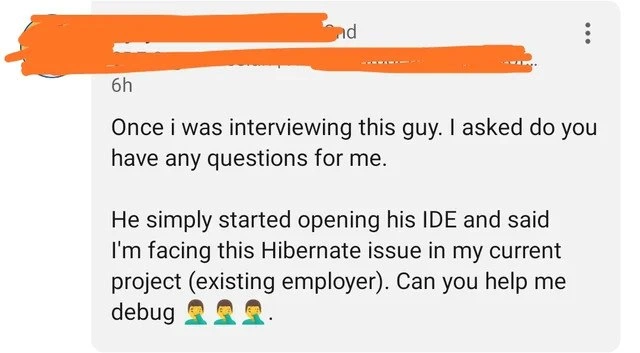
This meme recounts a jaw-dropping interview moment where a routine hiring question turned into an impromptu debugging session. In a typical software engineering interview, when the interviewer asks, “Do you have any questions for me?”, they're expecting queries about the role or company. Here, the candidate flipped the script completely. He opened up his IDE on the spot and essentially said, “Actually, yes – I’m facing this Hibernate issue in my current project. Can you help me debug it?” Talk about an audacious ask! Instead of the interviewer grilling the candidate, the candidate tried to get the interviewer to solve a backend bug for him. It’s as if the interview suddenly morphed into a free Hibernate support call.

For seasoned developers, this scenario hits a vein of dark humor. First, there’s the blatant breach of interview etiquette – the candidate basically hijacked the Q&A portion to get free consulting. That’s a bold move (hence the meme’s caption "That's a pro move," delivered with heavy sarcasm). It crosses a professional boundary that we all assumed was obvious: interviews are for evaluating fit, not debugging your current employer’s codebase. The sheer nerve is both cringe-worthy and hilarious. Imagine being the interviewer, expecting a question about team culture, and suddenly being asked to roll up your sleeves and troubleshoot someone else’s Java code. No wonder the post is punctuated with multiple facepalms 🤦‍♂️ – it’s the universal developer signal for “I can’t believe what just happened.”

Beyond the etiquette blunder, the meme also pokes fun at the perennial pain of debugging ORM issues under pressure. Hibernate is a well-known Java ORM (Object-Relational Mapping) framework that abstracts away SQL and helps map Java objects to database tables. It’s powerful, widely used in enterprise applications, and notoriously fickle at times. Senior backend engineers reading this have likely wrestled with mysterious Hibernate errors or performance puzzles – the kind that appear at 4 PM on Friday and ruin your weekend. Maybe it’s the classic LazyInitializationException that pops up when an object wasn’t fetched in time, or the dreaded N+1 queries bogging down performance, or some complex mapping quirk causing data not to save. Debugging such issues can be an exercise in frustration and deep knowledge. We’ve all been stuck on a baffling bug and daydreamed about having a Hibernate guru on call. So on one level, fellow developers get the desperation. The candidate was basically thinking, “Here’s a senior engineer right in front of me – maybe they can solve in 5 minutes what I’ve been stuck on for 5 days.” It’s a wildly inappropriate context, but you can almost sympathize with that feeling of debugging desperation.

The humor really lands because it’s a shared industry absurdity: interviews are serious business, and here someone treated it like a Stack Overflow forum. It’s a collision of two worlds – the formal interview process meets the raw, unfiltered reality of a developer knee-deep in troubleshooting. In a way, the candidate reverse-interviewed the interviewer, putting them in the hot seat to answer a live debugging question. The interviewee essentially tried to turn the hiring manager into on-demand tech support for his existing employer’s code. That’s just unheard of! The situation is so outrageous that it becomes a war-story every engineer can appreciate: “You won’t believe this one: I had a candidate who literally asked me to debug his code during the interview!” It highlights how sometimes, in tech, people can be so fixated on solving a problem that they forget time, place, and professional boundaries. The result is a perfect storm of second-hand embarrassment and geeky humor. This meme nails that intersection of InterviewHumor and DeveloperHumor, where everyone reading it is shaking their head and laughing, thinking, “Did that really just happen?!”

Description

Meme-style screenshot of a social-media post on a light gray card UI. The author’s name and avatar are aggressively scribbled over in orange, hiding their identity. Timestamp reads “6h”. The post’s text (shown verbatim): “Once i was interviewing this guy. I asked do you have any questions for me. He simply started opening his IDE and said I'm facing this Hibernate issue in my current project (existing employer). Can you help me debug 🤦‍♂️🤦‍♂️🤦‍♂️.” The visual is minimalist - black sans-serif text on white/gray, three face-palm emojis conveying exasperation. Technically, it pokes fun at an interviewee who pivots the customary “questions for us?” segment into a live troubleshooting session for a Java/Hibernate bug, conflating recruiting time with free senior-level consulting. Seasoned engineers will recognize the intersection of interview etiquette, boundary-setting, and the perennial pain of debugging ORM mapping issues under time pressure
Comments

11
Anonymous ★ Top Pick Bold move: treating the onsite like Stack Overflow-Live, but with the hiring manager forced into pair-debugging your lazy-loaded N+1 query
  1. Anonymous ★ Top Pick

    Bold move: treating the onsite like Stack Overflow-Live, but with the hiring manager forced into pair-debugging your lazy-loaded N+1 query

  2. Anonymous

    The only thing worse than debugging Hibernate lazy loading issues is realizing your interview candidate thinks you're Stack Overflow with a hiring budget - though honestly, given how many senior devs still struggle with N+1 queries, maybe he was just testing if you'd be a good technical lead

  3. Anonymous

    When a candidate treats 'Do you have any questions for me?' as a Stack Overflow bounty opportunity, you know they've truly mastered the art of resource optimization - just not in the way their current employer hoped. Bonus points for the live debugging session pitch; at least they're confident their Hibernate mappings are more interesting than discussing your company's engineering culture

  4. Anonymous

    If 'Any questions?' launches an IDE and a LazyInitializationException, you’re not interviewing - you’ve joined someone else’s incident bridge; please attach a PO number to your @Transactional

  5. Anonymous

    Turning “any questions for us?” into a screenshare of a Hibernate LazyInitializationException - aka upgrading the interview to free consulting, OpenSessionInView-as-a-Service

  6. Anonymous

    Hibernate lazy loading in action: candidate's professionalism failed to eager-fetch basic interview etiquette

  7. @QutePoet 4y

    That's 🔥 trick!

  8. @nuntikov 4y

    In what world does this supposed to work?

  9. @waifu_anton 4y

    Couldn't he just ask his colleges?

    1. Deleted Account 4y

      Colleagues

      1. @waifu_anton 4y

        Yeah, sorry. English is not my native language

Use J and K for navigation