It Works, Ship The Sink
Why is this TechDebt meme funny?
Level 1: Broken But Usable
Imagine a toy car with one wheel missing, held together with tape, still rolling downhill if you push it carefully. You can say "it works," but everyone can see it is not really okay. The meme is funny because software teams sometimes celebrate a thing working once, even when it is obviously fragile and messy.
Level 2: Workaround Plumbing
A workaround is a quick solution that avoids the proper fix. It can be useful when something is urgent, but it often creates problems later.
Technical debt is the cost of choosing a faster, messier solution now instead of a cleaner solution. Like financial debt, it can be manageable if tracked and paid down. If ignored, it grows until every change becomes expensive.
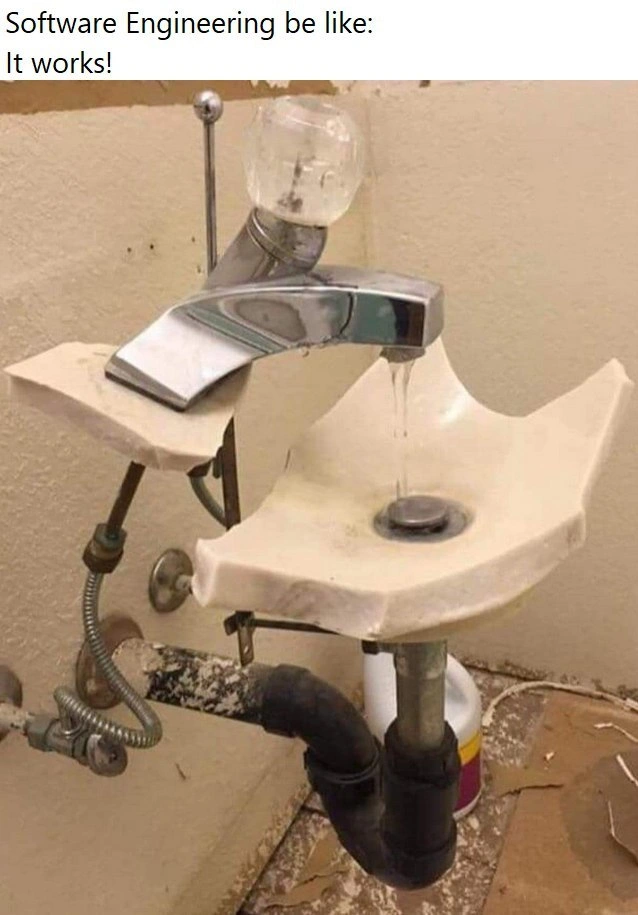
In the image, the sink still performs the basic job: water comes out and goes toward the drain. But the setup is fragile. The broken basin, exposed pipe, improvised bottle, and awkward supports all suggest that the next repair will be much harder.
That maps directly to software. A beginner might write a quick patch to make a feature work, then later discover that the patch made testing harder, confused other developers, or broke when a new input appeared. The code did the job once, but it was not healthy.
This is why teams care about software maintenance, code smells, and production hacks. A code smell is something that might not be a bug yet, but hints that bugs will be easier to create. The sink is one giant code smell with plumbing attached.
Level 3: Acceptance Test Passed
The visible caption says:
Software Engineering be like: It works!
Under it is a bathroom sink that has clearly lost its argument with reality. The basin is cracked and missing a large side section, the faucet is rigged with an upside-down plastic bottle, hoses are exposed, and water still manages to trickle into the drain. That is the joke: the system technically satisfies the narrow success condition, but every surrounding quality attribute is screaming.
This is technical debt in porcelain form. A product manager says, "Can users wash their hands?" The demo answers, "Yes, observe water reaching drain." Nobody asks whether the installation is safe, maintainable, clean, documented, testable, or likely to survive the next person touching it. The meme captures the catastrophic difference between functional and engineered.
Developers know this pattern because software often accumulates exactly this kind of shape. A service has a hardcoded environment variable because the deploy pipeline broke once. A cron job restarts a worker every hour because nobody found the leak. A payment integration depends on an undocumented side effect because the vendor API changed during launch week. Each workaround is locally rational. Together they become the sink.
The brutal part is that these hacks usually begin as pragmatic emergency repairs. The first fix is not evil; it is a response to a deadline, outage, missing dependency, or executive promise already sold to a customer. The debt appears when the temporary fix becomes load-bearing and the organization quietly reclassifies "we need to come back to this" as "seems stable enough." That phrase should have its own incident severity.
The image also nails why code quality arguments are hard. The broken sink can be defended: water flows, the drain catches it, and the user gets an outcome. Similarly, ugly code can pass tests and serve traffic. But maintainability is about future change. When the next requirement arrives, the question is not "does it work today?" It is "how many hidden assumptions explode when we touch it?"
Description
The image has the caption "Software Engineering be like: It works!" above a broken bathroom sink. The sink basin is cracked and missing a large side section, while a makeshift faucet setup uses an upside-down plastic bottle, improvised supports, exposed hoses, and a drain pipe that still lets water trickle into the basin. The visual joke compares a barely functional plumbing hack to software systems that satisfy the immediate happy path while being fragile, unsafe, and nearly impossible to maintain. For engineers, it captures the familiar gap between "operational" and "designed well."
Comments
24Comment deleted
The acceptance test passed because water reached the drain; maintainability was marked out of scope.
MVP Comment deleted
How is this dev related Comment deleted
how are you a dev if you do not see how it is related Comment deleted
did you ever mock mvp hardcoded apis for the client presentation? this is about right Comment deleted
It works! Comment deleted
The preview cuts off the text part of the image Comment deleted
Admin is degrading Comment deleted
guys Comment deleted
stop repling to me Comment deleted
on mobile phone upper text is cut Comment deleted
so go do your mvps without me Comment deleted
>2022 >phoneposting Comment deleted
баянище еще тот Comment deleted
please write in english or provide an english translation Comment deleted
Tr: this meme is old Comment deleted
My translator says else. Comment deleted
"the accordion is still the same" lol what the fuck? Comment deleted
Try different languages too then it may make more sense Comment deleted
I can only understand english and german, and it's the same in both languages lol Comment deleted
the russian sitting next to me said it's a phrase which means "I've seen this countless times and it's getting old" Comment deleted
No idea, I was just guessing because thats what makes the most sense Comment deleted
Lol Comment deleted
Alright in russia Boyan is a musican instrument but it very often used to point on very old memes Comment deleted