Skip to content
DevMeme
3890 of 7435
Self-Custody Explains Itself To Court
Blockchain Post #4236, on Feb 21, 2022 in TG

Self-Custody Explains Itself To Court

Why is this Blockchain meme funny?

Level 1: No Remote Control

Imagine you buy a lock, keep the only key, and the lock company only gave you the instructions. Later, someone asks the lock company to open your box. The company cannot do it because it never had your key. That is why the screenshot is funny: the court request expects a company remote control, but self-custody means the remote control is with the user.

Level 2: Wallet Without A Master Key

A crypto wallet does not necessarily store coins the way a physical wallet stores cash. In Bitcoin, coins are recorded on the blockchain, and a wallet manages the keys needed to spend them.

A private key is secret information that proves you are allowed to spend funds from a Bitcoin address or script. If you have the key, you can authorize movement. If you do not have the key, you cannot. A self-custody wallet means the user holds that power instead of handing it to a company.

A custodial service, like many exchanges, can often freeze or restrict an account because it controls the account system and may hold the keys. A non-custodial or self-custodial wallet provider may only provide software. If it never receives the user's private keys, it cannot freeze the user's bitcoin, even if someone demands it.

Multisig adds another layer. It can require several keys to approve a transaction. For example, a wallet might need two valid signatures out of three possible keys. This can protect against one lost key or one compromised device, but it also means no single party can act unless the signing rules allow it.

So the meme is developer humor because it is really about access control. The request assumes a central admin exists. The response says the system was designed so that admin does not exist in the relevant place. That is either a feature or a nightmare, depending on whether you are the user, the support team, the regulator, or the person holding the pager.

Level 3: Compliance Meets No Custody

The humor comes from the tone mismatch. The tweet frames a serious institutional request from a court. The embedded response reads like a company explaining a missing feature to someone who skipped the onboarding docs, except the "feature" is the whole point of self-custody. The visible letter says Nunchuk does not collect user identification information beyond email addresses, does not hold keys, and cannot know the existence, nature, value, or location of users' assets. That is a direct answer to the compliance wish list: identify the user, locate the asset, freeze the asset. No, no, and still no.

Developers recognize this pattern from every system boundary argument ever. Someone outside the system assumes there is a privileged operator account, because in traditional infrastructure there usually is. Admins can reset passwords. Banks can freeze accounts. SaaS teams can suspend tenants. Cloud providers can revoke keys. But some architectures are intentionally designed so the operator cannot do the powerful thing. That design can be inconvenient, politically explosive, operationally annoying, and still technically real.

The joke is not simply "law does not understand crypto." The better version is sharper: compliance requirements often assume custody, identity, and reversibility. Self-custodial Bitcoin wallets deliberately remove or minimize those handles. That creates a governance gap. If the software provider lacks the private keys, a freeze order against that provider may be perfectly serious as paperwork and still useless as an execution plan.

This is the same reason security engineers obsess over who holds keys, where keys are generated, whether recovery flows exist, and what metadata gets logged. Key ownership is not a decorative implementation detail. It defines the power structure. If a vendor can recover everything for you, it can also be pressured, breached, subpoenaed, or compromised into recovering it for someone else. If the vendor cannot recover anything, then support tickets become tragic little poems.

The final visible jab, asking the recipient to look up self custody and private keys, is funny because it says the quiet part loudly: the architecture documentation is now the legal response. Somewhere a lawyer asked for an account freeze; somewhere a cryptographic access-control model replied, "Wrong trust boundary."

Level 4: Keys Are Authority

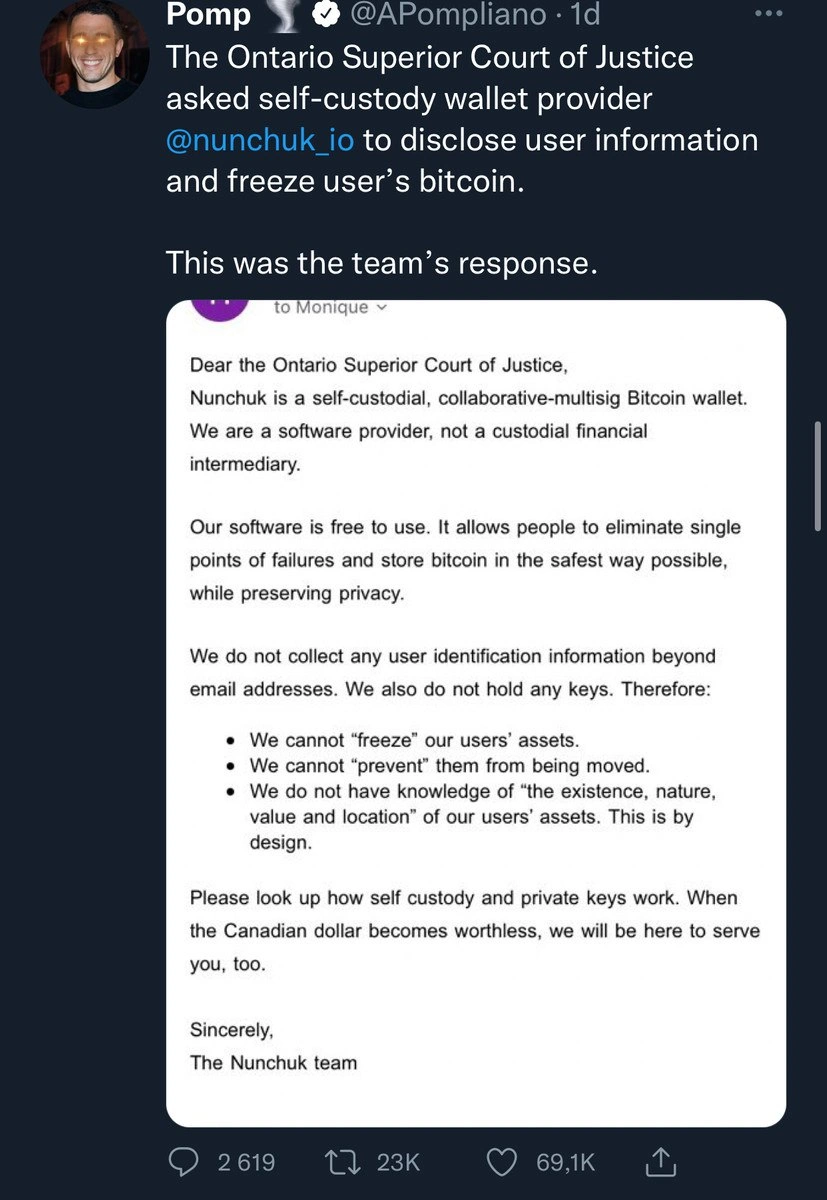
The screenshot shows a tweet saying the Ontario Superior Court of Justice asked a self-custody wallet provider to disclose user information and freeze a user's bitcoin, followed by an embedded response from Nunchuk. The key visible lines are:

We also do not hold any keys. We cannot "freeze" our users' assets. Please look up how self custody and private keys work.

That is not just sass. It is the entire security model. In Bitcoin, control over coins is expressed through cryptographic spending conditions. To move funds, someone must produce a valid signature for the relevant private key or key set. A wallet application can help create, store, coordinate, and broadcast transactions, but if it does not possess the signing keys, it cannot sign on behalf of the user. There is no admin panel where support can click freeze.

Nunchuk is described in the visible response as a self-custodial, collaborative-multisig Bitcoin wallet and as a software provider rather than a custodial financial intermediary. Self-custody means the user controls the keys. Multisig means spending can require signatures from multiple keys, such as 2-of-3 or 3-of-5 arrangements. That can reduce single points of failure, but it also means the software vendor is not automatically a central custodian with unilateral authority.

The legal request and the technical architecture are therefore aimed at different layers. Courts and regulators are used to intermediaries: banks, exchanges, payment processors, brokers, custodians. Those entities have accounts, identity records, compliance departments, reversible ledgers, and operational controls. A non-custodial wallet provider may instead distribute software that talks to a public blockchain while leaving the decisive secret material with the user. Telling that provider to freeze funds is like asking a text editor to revoke a sentence after the author kept the only copy of the password-protected notebook.

The post date, February 21, 2022, matters here because it sits inside the Canadian convoy funding conflict, when emergency financial measures and court orders around donations, bank accounts, crowdfunding, and cryptocurrency were active public issues. At that moment, the meme was not abstract crypto evangelism. It was a screenshot of legal authority colliding with a design goal of decentralized key control: if nobody at the company can move the user's bitcoin, then nobody at the company can be compelled to move it either. That is not magic. It is threat modeling with consequences.

Description

The image is a dark-mode Twitter screenshot from "Pomp" / "@APompliano" marked "1d", saying: "The Ontario Superior Court of Justice asked self-custody wallet provider @nunchuk_io to disclose user information and freeze user's bitcoin. This was the team's response." The embedded email-style response begins "Dear the Ontario Superior Court of Justice," and explains that Nunchuk is a self-custodial, collaborative-multisig Bitcoin wallet and a software provider, not a custodial financial intermediary. It says the software is free, helps eliminate single points of failure, preserves privacy, collects no user identification information beyond email addresses, and holds no keys, so Nunchuk cannot freeze assets, prevent movement, or know the existence, nature, value, or location of users' assets; it ends with "Please look up how self custody and private keys work" and is signed "The Nunchuk team." The visible tweet UI shows engagement counts around 2,619 replies, 23K reposts, and 69.1K likes, and the technical humor is a legal request colliding with the basic threat model of non-custodial cryptographic key ownership.
Comments

11
Anonymous ★ Top Pick A court order against a non-custodial wallet is basically `chmod` on a filesystem you never mounted.
  1. Anonymous ★ Top Pick

    A court order against a non-custodial wallet is basically `chmod` on a filesystem you never mounted.

  2. @beton_kruglosu_totchno 4y

    noice

  3. @beton_kruglosu_totchno 4y

    technically they could throw their reputation under the bus and backdoor the wallet to please the court

    1. @kitbot256 4y

      Do you think they don’t have a backdoor to their software?

      1. @beton_kruglosu_totchno 4y

        Answering for the purposes of risk management of large sums of money: yes their software has backdoors or exploitable bugs Answering considering it's open source: I do not know but I could read their issues and code to deduce what are the risks

        1. @kitbot256 4y

          Open source openssl had a critical vulnerability (which could technically be a backdoor) for years. The idea of a good backdoor is to be not accessible and ideally even noticeable by anybody but the author.

          1. @beton_kruglosu_totchno 4y

            okay thanks for showing how your initial question is moot what's your point?

            1. @kitbot256 4y

              The letter is bullshit, however funny.

              1. @beton_kruglosu_totchno 4y

                demonstrate it

                1. @kitbot256 4y

                  I lol’d. Do you need a video?

  4. @kandiesky 4y

    Based

Use J and K for navigation