Skip to content
DevMeme
133 of 7435
IPv4 address space orders a CIDR to cure weekly exhaustion
Networking Post #168, on Feb 23, 2019 in TG

IPv4 address space orders a CIDR to cure weekly exhaustion

Why is this Networking meme funny?

Level 1: The Tired Phone Book

Imagine the internet has a giant phone book, and every computer needs its own number. Years ago, people picked a book size that seemed enormous — billions of numbers! — but then everyone on Earth got phones, laptops, and talking doorbells, and the book completely ran out of numbers. It's been working overtime ever since. So the joke imagines that exhausted phone book trudging into a bar and ordering a "cider" — except spelled CIDR, which happens to be the name of the clever trick engineers invented to make the numbers last longer. It's a pun where the tired worker orders a drink that is also its own medicine — funny, and just a little bit sad if it's your job to keep the phone book going.

Level 2: Slashes, Subnets, and Why Addresses Ran Out

The pieces a newcomer needs:

  • IPv4 address: the numeric label identifying a device on the internet, like 203.0.113.42. It's 32 bits, so there are about 4.3 billion possible addresses — fewer than there are humans, let alone phones, laptops, servers, and smart fridges. Hence: exhaustion.
  • Address space: the entire set of possible addresses, here personified as one very tired bar patron.
  • CIDR: pronounced "cider." The notation you'll meet constantly in cloud consoles — 10.0.0.0/16 means "the first 16 bits are the network, the rest are for hosts." The smaller the number after the slash, the bigger the block. You'll type these into AWS VPC configs and firewall rules within your first months on the job.
  • Subnetting: splitting a network block into smaller ones — the everyday skill CIDR notation expresses.

The joke is your first networking flashcard disguised as a pun: IPv4 ran out, CIDR was the coping mechanism, and it sounds like something you order at a bar.

Level 3: Self-Consistent on Every Layer

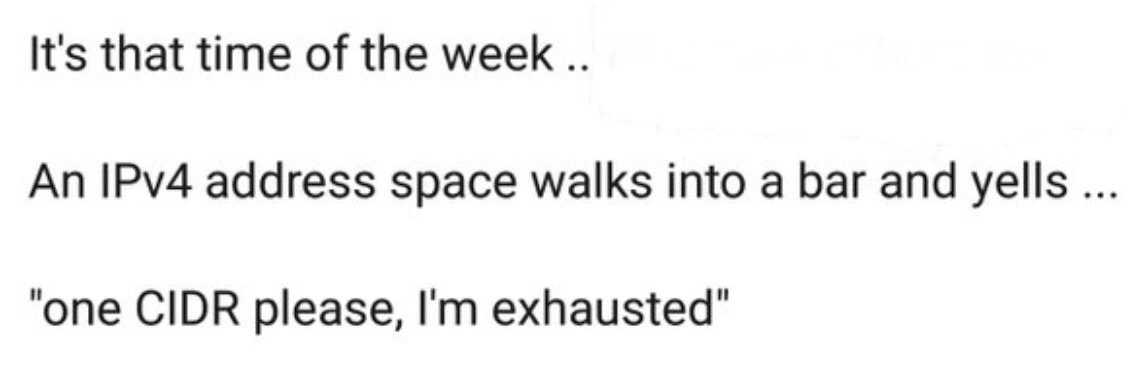
An IPv4 address space walks into a bar and yells ... "one CIDR please, I'm exhausted"

What elevates this above standard dad-joke networking is that the pun is load-bearing in both directions, which is rare. CIDR is pronounced "cider," so the exhausted patron ordering a drink scans as ordinary bar-joke wordplay. But the technical reading is also coherent: CIDR is literally the remedy the industry administered to IPv4 because it was exhausting — the address space ordering a CIDR is a patient correctly requesting its own historical prescription. Most tech puns sacrifice one layer for the other; this one type-checks on all of them.

The melancholy subtext that makes network engineers smile ruefully: the prescription only delayed the diagnosis. IPv4 exhaustion stopped being hypothetical years before this meme circulated — regional registries ran dry, a gray market emerged where /16s trade for serious money, and the "transition" to IPv6 became the industry's longest-running deferred migration, a multi-decade we'll do it next quarter. The opener, "It's that time of the week ..", frames it as recurring ritual humor — networking's equivalent of the Friday standup joke — which fits: IPv4's exhaustion is the chronic condition everyone has normalized, ordered a round for, and stopped treating as an emergency. The bartender, presumably, can only pour a /32 — a single address — because that's the allocation reality now.

Level 4: Longest Prefix Match at the Bar

The joke's load-bearing acronym deserves its full archaeology. Before 1993, IPv4 allocation was classful: the 32-bit address space was carved into rigid Class A (/8, ~16.7M hosts), Class B (/16, 65,534 hosts), and Class C (/24, 254 hosts) blocks, determined by the leading bits of the address. The granularity was catastrophic — an organization needing 2,000 addresses had to choose between a wasteful Class B or eight awkward Class Cs. Two crises followed: address waste accelerating exhaustion of a $2^{32}$ (~4.3 billion) space never designed for a planetary consumer internet, and routing table explosion, since every Class C block needed its own entry in backbone routers whose memory was measured in megabytes.

CIDR (Classless Inter-Domain Routing, RFC 1519, 1993) fixed both with one move: let the network/host boundary fall at any bit position, written as the now-ubiquitous slash notation (192.168.0.0/22). This enabled allocation right-sized to need, and — crucially — route aggregation: a provider holding 256 contiguous /24s advertises a single /16 supernet. The cost is that forwarding becomes a longest-prefix-match problem: a destination may match /8, /16, and /24 entries simultaneously, and the router must select the most specific, which is why hardware routers burn TCAM and software ones grow trie structures (Patricia/radix tries) to answer in nanoseconds. CIDR was explicitly a stopgap — the designers said so — to buy time for IPv6's $2^{128}$ space. The stopgap is now in its fourth decade, propped up further by NAT, and IANA handed out its final /8s in 2011. The address space in this joke isn't being dramatic. It is clinically, formally exhausted.

Description

Meme with plain black text on a white background. Lines read: "It's that time of the week ..", a blank line, "An IPv4 address space walks into a bar and yells ...", another blank line, then in quotes, "one CIDR please, I'm exhausted". The joke plays on real-world IPv4 address exhaustion and the practice of classless inter-domain routing (CIDR) to conserve space, framing it as a weary customer ordering a drink at a bar. The humor is immediately recognizable to network engineers who battle subnet allocation, NAT, and the looming push toward IPv6

Comments

7
Anonymous ★ Top Pick Only in networking do we celebrate “scaling” by carving a /8 into 16 million /32s and pretending NAT is just address-space compression with lossy decompression at 2 AM
  1. Anonymous ★ Top Pick

    Only in networking do we celebrate “scaling” by carving a /8 into 16 million /32s and pretending NAT is just address-space compression with lossy decompression at 2 AM

  2. Anonymous

    Meanwhile, IPv6 sits in the corner nursing the same drink it ordered in 2012, watching everyone panic about running out of addresses while it has enough for every atom in the solar system

  3. Anonymous

    The bartender hands it a /32 - the smallest possible pour - because that's all anyone's been able to allocate since 2011

  4. Anonymous

    This joke perfectly captures the existential crisis of every network architect who's had to justify yet another NAT layer to management because someone in 1981 thought 4.3 billion addresses would be 'enough for everyone.' The IPv4 address space isn't just exhausted - it's been running on fumes since IANA handed out the last /8 blocks in 2011, and we're all still here playing Tetris with RFC1918 ranges and praying our CGNAT implementation doesn't become sentient and quit

  5. Anonymous

    Capacity planning for IPv4 now means creative VLSM and a prayer that your overlapping CIDRs never meet in a peering session

  6. Anonymous

    IPv4 exhaustion: the legacy tech debt no NAT bandage or CIDR crutch can fully cure - cheers to another decade of IPv6 promises

  7. Anonymous

    IPv4’s happy hour: one CIDR to aggregate the regrets, three layers of NAT to stay in denial, and yet another promise that IPv6 is coming “next quarter.”

Use J and K for navigation