Skip to content
DevMeme
235 of 7435
The Escalating Sophistication of Database Updates
Databases Post #287, on Mar 31, 2019 in TG

The Escalating Sophistication of Database Updates

Why is this Databases meme funny?

Level 1: Burning Down the House

Imagine you have a small chore to do, like dusting a shelf. The normal thing to do is take a cloth and wipe off the dust. Now picture someone who, instead of dusting, decides to empty the whole room of furniture and then put everything back once it’s clean. Pretty over-the-top, right? Let’s go even further: suppose there’s a tiny spider in the house. One person might calmly trap the spider and release it outside (that’s like using a simple, precise update). Another person might grab a big can of bug spray and fumigate the room (that’s like the delete-and-insert approach – a bit much, but it works). But our final person – he sees the spider and decides to burn down the entire house and then rebuild it just to make sure the spider is gone. That sounds crazy, but it would definitely get rid of the spider (along with everything else)!

This meme is funny for the same reason this story is funny – it’s showing someone using a ridiculously extreme solution for a pretty ordinary problem. Instead of doing the small fix, they escalate step by step to a gigantic, catastrophic fix. We all recognize that nobody in real life would actually burn down their house to get rid of a single bug, because it’s a huge overreaction. In the same way, no sane developer would actually drop an entire database just to update some rows of data. The humor comes from imagining someone doing that and the absurd, puffed-up pride they might take in such a wild move. It’s laughing at how silly it would be to solve a simple problem by blowing everything up and starting over. We find it funny because it’s so exaggerated – it reminds us not to take ourselves too seriously, and that sometimes the “big gun” solutions are downright comical when you step back and look at them.

Level 2: SQL Sledgehammer

Let’s step back and explain what’s going on in this meme in simpler terms, especially if you’re a newer developer or not super familiar with database commands. The meme is referencing four different ways to change or replace data in a database table, each one more extreme than the last. We’ll go through them to see what they mean:

  • MERGE INTO table – This is a single SQL command (available in some database systems like Microsoft SQL Server or Oracle) that essentially does an upsert. Upsert means “update if the record exists, or insert if it doesn’t.” It’s a very handy, high-level operation. Think of it as telling the database: “Make sure the table has this data, either by updating what’s there or adding a new row.” The database figures out the rest behind the scenes. It’s one of the safer, more efficient ways to synchronize data because it’s all done in one go. No surprise Pooh is relaxed in this panel – this is pretty standard and reliable.

  • DELETE FROM table; INSERT INTO table – Now we have two separate SQL commands. DELETE FROM table removes data from the table (without a WHERE clause it means delete every row in the whole table, which is pretty drastic by itself!). Then INSERT INTO table adds new data in. Essentially, this is what you’d do if you wanted to refresh the table’s contents completely: wipe it out, then populate it anew. Developers might do this if, say, they have a fresh set of data that should replace the old data entirely. Pooh’s expression here is less impressed – and for good reason. Doing a delete-then-insert is like saying, “I don’t want to bother figuring out what changed, I’ll just throw everything away and start fresh.” It can work, but if you imagine doing this in a live system, it’s risky: for the period between the delete and insert, that table is empty! If some other part of your application looks at the data at that unlucky moment, it’ll think there are no records. Also, if something goes wrong after the delete and before the insert (like your app crashes or loses connection), you’ve lost data without replacing it. It’s a bit like taking apart an engine completely and hoping you remember how to put it back together – not something you do if you can avoid it.

  • DROP TABLE; CREATE TABLE – These are also two SQL commands, but now we’re not just removing the rows in the table; we’re removing the table itself from the database, then making a new one. DROP TABLE table_name deletes the table’s definition (bye-bye, table!) along with all its data. After you do that, it’s as if the table never existed. Then CREATE TABLE table_name (...) will create a brand new empty table, presumably with the same structure (columns) as before. This is even more extreme than the delete/insert combo. Why would anyone do this? One reason could be if you needed to change the table’s structure significantly – for example, maybe it’s easier to drop and recreate than to issue a bunch of ALTER TABLE commands to modify columns or constraints. Some developers might also do this in development environments to reset everything quickly. But doing it in a real system is dangerous. Imagine the chaos if some code expects that table to be there at all times – dropping it could make queries or applications error out (“table not found”) until it’s recreated. Also, if you had things linked to that table (say another table with a foreign key pointing to it, or some stored procedure using it), those will break when the table is dropped. It’s not a casual thing! That’s why we find the tuxedo Pooh panel funny – he’s acting all suave about something that is actually a pretty radical maneuver. In real life, a database engineer would be triple-checking before running a DROP TABLE in production (and probably doing it during a scheduled maintenance window, with a backup on hand and sweaty palms).

  • DROP DATABASE; CREATE DATABASE – This is the final, most drastic step. A database is like a whole collection of tables (plus other objects like views, procedures, etc.). DROP DATABASE myDB will completely delete the entire database named “myDB” – all tables, all data, gone in one command. It’s equivalent to deleting an entire library, not just a book. CREATE DATABASE myDB would bring back an empty database of that name, as if you just installed a brand new, clean database instance. This is something you almost never do unless you really mean to wipe everything. For example, when setting up unit tests or spinning up a fresh environment, a script might drop and recreate a test database to start from a clean slate. But on a production server with real user data, dropping the database is basically the doomsday button – it destroys everything inside. No wonder Pooh in panel four looks like he’s on top of the world; the meme jokes that only a fancy, out-of-his-mind character would consider this a good solution. In practice, if someone even suggested doing this to solve a problem, everyone else would probably laugh nervously and make sure that person doesn’t have access to the production systems.

So what’s the pattern here? It’s an escalating series of operations:

  1. A targeted, single-command solution (MERGE) – minimal impact, precise.
  2. A two-step brute force reload of one table’s data (DELETE then INSERT) – more impact, potential downtime for that table.
  3. Dropping and recreating the table – even more impact, affecting not just data but the structure itself.
  4. Dropping and recreating the entire database – total impact, affecting everything.

The meme is funny to developers because it exaggerates a common temptation: sometimes, when faced with a tricky update or migration, you joke “let’s just restart from scratch.” It’s like an inside joke in DatabaseHumor circles. We laugh because we all know one should never actually do step 4 in any serious setting – but the mere idea of it being presented as a solution is absurd and therefore comedic.

It also touches on the idea of using a sledgehammer for a fly. Instead of fine-tuning the solution (like writing a proper update script to merge data), the progression shows solutions that are over-the-top. It’s humor built on the principle of escalation: taking something reasonable and pushing it to ridiculous extremes. Each panel ups the ante:

  • Panel 1: Okay, normal database operation, nothing crazy.
  • Panel 2: Hmm, a bit heavy-handed, but it might happen.
  • Panel 3: Whoa, that’s drastic for just one table.
  • Panel 4: That’s completely bonkers (but Pooh looks so classy doing it!).

For a junior developer, if some of these terms are unfamiliar:

  • SQL (Structured Query Language) is the language used to communicate with relational databases (which store data in tables).
  • A table is like a spreadsheet inside the database – it has rows and columns of related data.
  • A database is a collection of tables and other related objects, usually for a whole application or project.
  • MERGE, DELETE, INSERT, DROP are all commands in SQL:
    • MERGE (in certain SQL systems) can do an upsert (update existing rows and insert new rows in one shot).
    • DELETE removes rows from a table.
    • INSERT adds new rows to a table.
    • DROP TABLE completely removes a table (the structure and the data).
    • DROP DATABASE completely removes a database (all tables and data in it).
  • Overengineering in this context means using a solution that is far more drastic or complex than necessary. Here, dropping and recreating everything is way more than what’s needed to update some data.

To visualize the difference, here’s how each step might look in pseudo-SQL:

-- Panel 1: Use MERGE (upsert) to update or insert rows as needed
MERGE INTO target_table AS t
USING source_data AS s
ON t.id = s.id
WHEN MATCHED THEN 
    UPDATE SET t.value = s.value
WHEN NOT MATCHED THEN 
    INSERT (id, value) VALUES (s.id, s.value);

-- Panel 2: Delete then Insert to replace data
DELETE FROM target_table;
INSERT INTO target_table (id, value) VALUES (1, 'new value for id 1');
INSERT INTO target_table (id, value) VALUES (2, 'new value for id 2');
-- ... (In practice, you'd insert all the needed new rows after deleting the old ones)

-- Panel 3: Drop and recreate the table
DROP TABLE target_table;
CREATE TABLE target_table (
    id INT PRIMARY KEY,
    value VARCHAR(255)
);
-- (Then presumably re-insert all data into the new table structure)

-- Panel 4: Drop and recreate the entire database
DROP DATABASE my_database;
CREATE DATABASE my_database;
-- (Then you'd have to recreate all tables in that database and reload all data)

As you can see, the code goes from a precise operation in Panel 1 to basically starting over from scratch by Panel 4. Each step is a bigger hammer.

For someone early in their career, the takeaway (besides having a laugh) is: be mindful of the scope of your database operations. There’s a huge difference between updating a few items and rebuilding the whole storage from ground zero. The meme humorously exaggerates to make that point. It’s a form of TechHumor that also carries a little cautionary tale about not reaching for drastic solutions when a simple one will do. After all, any senior engineer will tell you, “Sure, it works on your machine when you drop and recreate the DB... just don’t try that in production!”

Level 3: Refined Overkill

This four-panel Pooh meme paints a hilariously relatable picture of a database engineer’s escalating frustration and overengineering. Each panel cranks up the destruction (and the absurdity) of the solution, and the humor lies in how disproportionate the later solutions are to the initial problem. It’s a classic bit of DeveloperHumor that database folks smirk at (perhaps a bit nervously), because we’ve all seen someone go down that path – or at least joked about it during late-night deployments.

Let’s break down the scenario:

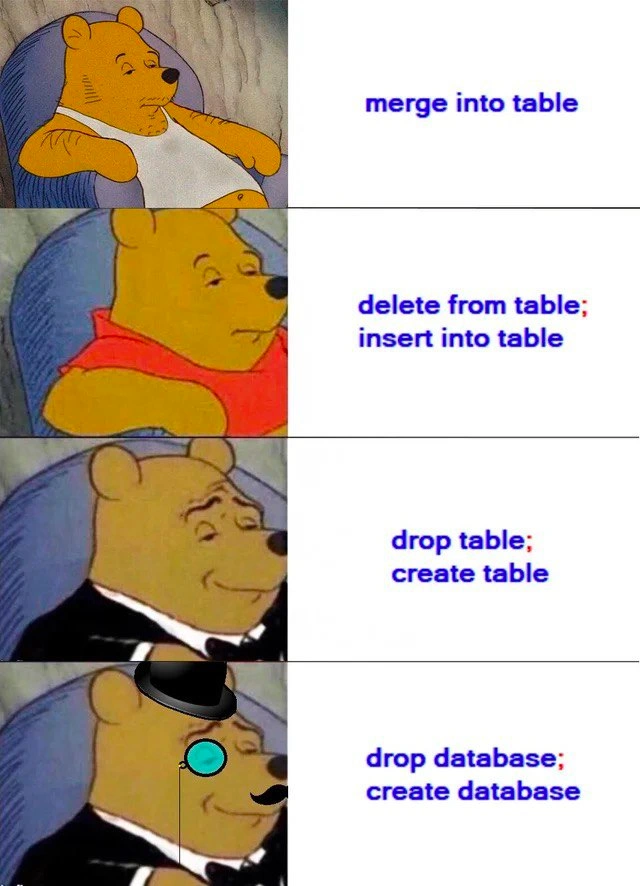
In the first panel, we have Pooh looking relaxed next to the text "merge into table". This is the sane, civilized approach to updating data – the upsert. In many SQL dialects (like T-SQL or Oracle), MERGE is a single elegant command that says, “if a record exists, update it; if not, insert it.” Pooh is chill because this is the intended feature for such a task: it's efficient, set-based, and keeps the database consistent without fuss. This is the kind of code that makes DBAs nod in approval. It’s the boring, correct solution – no drama here.

Now, panel two: Pooh looks a bit displeased (half-lidded eyes, mild frown) beside "delete from table; insert into table". Here the developer didn’t use MERGE; instead they wrote two separate queries to achieve something similar. This is a manual upsert approach. They first delete existing data (likely all rows in the table, given no WHERE clause is shown) and then insert new data. Why is Pooh giving side-eye? Because this approach is already a step down the slippery slope:

  • It’s riskier if not done carefully: If the INSERT fails after the DELETE (perhaps due to a bug or constraint violation), you’ve just wiped out data and have nothing to show for it. Oops.
  • Even if wrapped in a transaction to be atomic, it’s inefficient. Deleting and reinserting rows can be slower and heavier on the database (all those rows being removed, then re-added).
  • It hints at a bit of under-engineering: maybe the dev didn't know about MERGE (or the DB doesn’t support it) so they cobbled together this two-step solution. It works, but it’s not elegant. It’s the kind of hack that would make a code reviewer raise an eyebrow. Pooh’s expression says, “Alright, that works… but it’s not great, is it?”

By the third panel, Pooh has donned a tuxedo and is smirking in smug satisfaction next to "drop table; create table". Now the developer has gone fully into scorched-earth mode for a single table. This means instead of just replacing the data, they decided to blow away the entire table schema and data, then recreate that table from scratch. This is an even bigger hammer. To someone who’s been around databases, this is both hilarious and horrifying:

  • It’s hilarious because who in their right mind thinks dropping a whole table (structure and content) is a “fancy” solution to what started as a simple data update? The meme portrays it as high-class (tuxedo Pooh) for comedic contrast, as if this destructive move is something to be proud of.
  • It’s horrifying because in real life, doing this on a production system would send shivers down a DBA’s spine. You’d better have a darn good reason (and recent backups!) if you drop a table in a live environment. You’re not just removing data; you’re potentially invalidating application code, foreign key relationships, indexes – basically ripping out a part of the database’s foundation and then hastily putting it back. Even if you recreate it, you have to ensure the new table has the exact same definition. One misstep, and something will break. And heaven forbid you forgot to copy the data elsewhere first – you’ve just lost it all.
  • Yet, this scenario isn’t purely imaginary. In some DatabaseMigration scripts or big refactoring jobs, developers do sometimes drop and recreate tables, especially if they need to change the schema significantly. It can actually be simpler than meticulously writing ALTER TABLE statements or migrating data in-place… but it’s a shortcut that usually requires downtime and nerves of steel. It’s the kind of risky migration shortcut you only attempt when you’re either very confident or very desperate (or it’s 3 AM and that bug just won’t die).

Finally, the fourth panel escalates to absurd heights: Pooh now sports a top hat, monocle, and moustache – the full aristocrat treatment – next to "drop database; create database". This is the nuclear option in SQL, the ultimate act of database destruction: completely dropping the entire database. In other words, “let’s delete the whole thing and start over fresh.” This is portrayed as the most “sophisticated” solution in the meme (hence Pooh looking like a distinguished gentleman), which is dripping with irony. It’s like the meme is saying, “Ah yes, the connoisseur’s choice: total annihilation of all data.” The humor here relies on our shared understanding that:

  • No sane developer would do this for a minor update. Dropping a production database is basically every engineer’s worst nightmare (and a quick route to unemployment if done accidentally). It’s the kind of catastrophic event we usually only joke about to cope with the anxiety. When something is going wrong and someone quips, “Should we just drop the database and walk away?”, it’s gallows humor – we laugh because we’d cry otherwise.
  • The fact that Pooh looks more refined as the solution becomes more outrageous is a classic ironic contrast. It mocks the idea that a more extreme solution could somehow be “classy” or technically enlightened. It’s as if the meme is parodying an overconfident engineer who thinks, “Why do a careful surgical fix when I can just rebuild everything? I am a genius!” – said with a posh accent, of course.
  • This panel hits home for any DBA who’s had that heart-stopping moment of running a command on the wrong database or forgetting a WHERE clause on a DELETE. The difference is, here it’s deliberate! The meme takes that fear and turns it into a joke: TechHumor at its darkest.

In reality, steps 3 and 4 are massive blunt-force approaches. They’re sometimes jokingly referred to as the "rebuild from scratch" strategy. Believe it or not, in some tightly controlled scenarios (usually in development or testing), engineers do reset databases like this. For example, during automated test runs, you might drop and recreate a test database to ensure a clean state each time. Some ORMs even have a mode to auto-drop and reinitialize the database schema on startup – but you’d never enable that in production. The meme exaggerates this practice to highlight how ridiculous it would be to use such a heavy hand for routine updates.

This resonates as CodingHumor because it’s essentially making fun of overkill born out of desperation. Everyone in the industry has seen cases of a simple problem getting an overly complex (or in this case, overly destructive) solution. It’s funny and painful because it hints at truth: sometimes, out of laziness or panic, developers choose a path that’s total overkill. It’s the software equivalent of using a chainsaw to trim your nails – sure, it gets the job done, but at what cost?

So, why is this so relatable among devs? Because it satirizes that morbid little thought we’ve all had when a migration script fails or data just won’t sync up: “What if I just drop everything and start over? Ha ha... kidding! (Unless...?).” It’s a form of gallows humor – we joke about the worst possible idea as a way to remind ourselves never to actually do that. The meme cleverly uses the well-known tuxedo Winnie-the-Pooh format to depict this escalating bad idea as if it’s an ascending scale of sophistication. And the punchline is that the most catastrophic action is presented as the most elegant. That role reversal – treating a database nuke as a gentleman’s move – is what gets the laughs from an audience that knows the context.

Level 4: Atomic vs Nuclear

At the highest level, this meme highlights the clash between atomic operations and outright nuclear options in database management. In relational database theory, a truly atomic change means all or nothing: either the data update fully succeeds or it doesn’t happen at all, preserving consistency (that’s the "A" in ACID principles). For example, a MERGE statement is usually a single transaction – it either inserts or updates the target row entirely or rolls back if something goes wrong. It’s a controlled, contained explosion: precise and ACID-compliant.

Now contrast that with the final panel’s approach: DROP DATABASE; CREATE DATABASE. That is basically a nuclear blast to your data store. Unlike a contained transaction, a DROP DATABASE isn’t something you casually wrap in a rollback – it irrevocably deletes the entire dataset (unless you have backups handy). There’s no fine-grained control or partial credit here; you’re vaporizing everything in one go. This is the difference between using a surgical scalpel and dropping a warhead.

From a systems perspective, the escalation shown also touches on how different SQL operations play out under the hood:

  • DML (Data Manipulation Language) commands like MERGE, DELETE, and INSERT operate within transactions. They can be atomic and logged so that the database’s state changes predictably. A well-formed MERGE is optimized by the database engine to handle the upsert set-based, affecting only the necessary rows.
  • DDL (Data Definition Language) commands like DROP TABLE or DROP DATABASE change the structure of the database itself. These operations often force an immediate commit and can’t be easily rolled back on many platforms. They’re blunt – for instance, DROP TABLE might just deallocate the storage and purge the metadata. It’s fast, but all previous data is gone, and any dependent objects (like indexes, foreign key relationships) are instantly invalidated.

So when Pooh dons the monocle and top hat in the last panel, we’re ironically celebrating a move that violates the usual safety nets of transactional integrity. The meme exaggerates a progression where each step sacrifices a bit more control and precision for brute-force simplicity. It’s poking fun at how a developer might go from a refined, idempotent upsert (which keeps history and integrity intact) to a complete teardown-and-rebuild, which basically says: “Consistency? What consistency? Let’s just start over!”

In short, the meme is a tongue-in-cheek nod to the extremes of database operations – from the elegance of atomic transactions to the point-of-no-return drama of full-on database resets. It shines a light on an underlying truth: while computers allow us to do incredibly granular updates, they also equip us with commands that are equivalent to a digital self-destruct button. And as any seasoned database engineer knows, the difference between using the precise tool or the nuclear option is the difference between a routine day and an epic outage.

Description

This image utilizes the four-panel 'Tuxedo Winnie the Pooh' meme format to satirize progressively more destructive methods of updating data in a database. The first panel shows a sleepy, casual Pooh next to the SQL command 'merge into table', representing the standard, efficient approach. The second panel has the normal Pooh in his red shirt, paired with 'delete from table; insert into table', a common but less optimal alternative. The third panel features a smug-looking Pooh in a tuxedo, alongside 'drop table; create table', a drastically inefficient and risky method. The final panel shows the ultimate form of 'sophistication': Pooh in a tuxedo with a top hat, monocle, and mustache, next to the catastrophic command 'drop database; create database'. The humor lies in the absurd escalation, equating increasingly reckless and destructive actions with higher levels of elegance. For experienced developers, this is a relatable joke about the brute-force solutions one dreams up when frustrated with complex data state management, and it mocks the idea that the biggest hammer is always the best tool
Comments

8
Anonymous ★ Top Pick The final panel is just my standard procedure for applying schema migrations in the test environment after the ORM gets confused for the third time
  1. Anonymous ★ Top Pick

    The final panel is just my standard procedure for applying schema migrations in the test environment after the ORM gets confused for the third time

  2. Anonymous

    Nothing screams “immutable infrastructure” like a migration script that ends with DROP DATABASE; CREATE DATABASE - just tell the DBAs it’s Kubernetes for data

  3. Anonymous

    The evolution of a senior engineer's data migration strategy: starts with MERGE, ends with explaining to the board why the audit logs from 2019 are gone but at least the foreign key constraints are finally consistent

  4. Anonymous

    Every 'idempotent data load' design review eventually reaches the fourth panel - usually around the same time someone asks where the backups are

  5. Anonymous

    The evolution of a database migration strategy: start with elegant MERGE statements, progress to DELETE/INSERT when you're tired of debugging, escalate to DROP/CREATE when the schema drift is too painful, and finally achieve enlightenment with DROP DATABASE when you realize the entire data model was fundamentally flawed from the start. Bonus points if you do this on a Friday afternoon in production without backups - truly the monocle-and-top-hat tier of database administration

  6. Anonymous

    Senior dev: MERGE. Intern: DROP DATABASE; CREATE HUNGRY; -- Pooh approves

  7. Anonymous

    After enough 2 a.m. migrations, you learn MERGE is optimism; “drop database; create database” is just blue/green with better branding

  8. Anonymous

    When ‘use MERGE for upsert’ turns into a phoenix migration, the runbook is just DR testing in disguise - drop DB, recreate, restore snapshot, and pray the RPO wasn’t aspirational

Use J and K for navigation