CTO's Personal Bias vs. Engineering Team's Logic
Why is this Management PMs meme funny?
Level 1: No Common Language
Imagine you and your friends are all working together on a school project. At first, you agree to do everything in English because all of you are comfortable with it. You can easily communicate and share your work. Now picture a new teacher comes in and says, “I don’t like the English language, so you’re not allowed to use it at all.” Instead, this teacher insists that each friend must speak and work in a different language. So one of your friends now has to use Spanish, another must use Chinese, another French, and another Arabic, and you maybe have to use German – and none of you know these languages well. Suddenly, your team has no common language to understand each other. It’s a total mess! One friend is trying to talk or write in Spanish while another responds in Chinese – everyone is confused and nothing connects anymore.
What do you think would happen to your group project? Most likely, everyone gets frustrated and upset. Instead of making progress on the project, you’re all struggling just to communicate or learn basics of a new language. In the end, your friends decide, “This is impossible,” and they all quit the project. You’re left sitting there maybe with one friend who’s also about to give up.
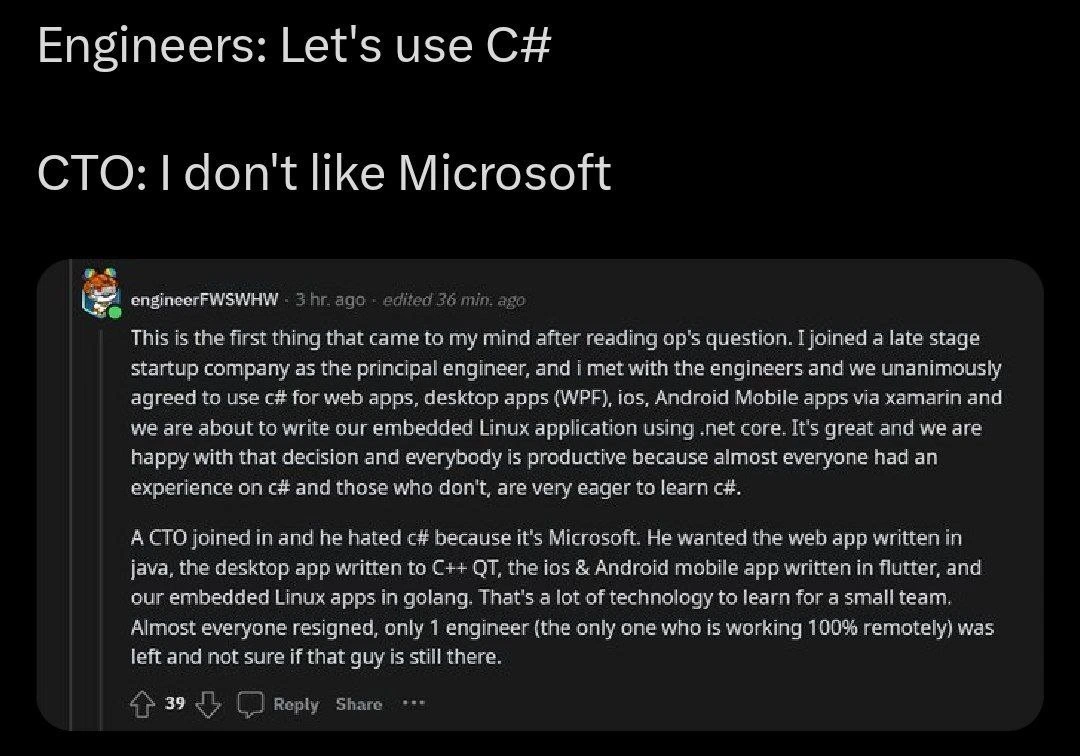
This is exactly what the meme is joking about. Originally, the engineers (like the friends in the first scenario) all wanted to use one programming language they knew – C#, which is like the “English” in our story. They would have worked well together that way. But the new boss (the CTO, like the teacher in our story) didn’t like C# for a personal reason (kind of like disliking English just because). He made each part of their software use a different programming language (like forcing everyone to use different human languages). That made the project so complicated and unpleasant that almost all the engineers left (just like your friends quitting the project). It’s funny in a way because it’s such a silly situation – of course nothing gets done if nobody can share a common way to work or communicate. The meme uses this scenario to poke fun at how one person’s bias or preference – “I don’t like Microsoft” – can wreck a great team plan, leaving everyone confused or gone. It’s like a cartoonishly exaggerated lesson: if you want a team to succeed, let them speak the same “language”!
Level 2: Language Overload
At its heart, this meme is about a conflict in a startup between the engineers and a new CTO (Chief Technology Officer, the executive in charge of technology choices). The engineers had all agreed on using C#, which is a programming language created by Microsoft, for everything they were building. C# is part of Microsoft’s .NET platform, and it’s a versatile language – you can use it to make web applications (with ASP.NET), desktop applications (with frameworks like WPF, which stands for Windows Presentation Foundation), mobile apps (with Xamarin, a technology that lets you write mobile app code in C# and share it between Android and iOS), and even run back-end services on Linux using .NET Core (a cross-platform, open-source version of .NET). In other words, the team wanted one unified tech stack: the same language (C#) and ecosystem (.NET) for every component of their product. This is great for a small team because everyone can help on any part of the project without learning a new language from scratch, and they can reuse a lot of code. It keeps things simple and efficient.
Now, the meme shows that a new CTO joins the company and basically says, “No, we’re not doing that,” for no technical reason other than “I don’t like Microsoft.” This is the CTO’s personal bias. Maybe he had bad experiences with Microsoft technologies in the past, or he’s a fan of open-source alternatives – we don’t know exactly, but he completely dismisses C# and .NET just because of the Microsoft association. This is an example of ManagementVsEngineering conflict: the engineers had one plan based on productivity, but the management (the CTO) overrules it based on opinion. It’s also an example of what developers call LanguageWars – arguments or decisions about programming languages driven by preference or ideology rather than purely technical merit.
So what did the CTO do? He split up the once unified stack into multiple different technologies. Specifically, he wanted: the web application to be written in Java (a different programming language, often used in big enterprise systems, and notably not a Microsoft product), the desktop application to be written in C++ using the Qt framework (Qt is a library for building graphical user interfaces; C++ is a lower-level language known for performance but also complexity), the mobile apps to be written using Flutter (Flutter is a UI toolkit by Google for building cross-platform mobile apps, and it uses the Dart programming language), and the embedded Linux application to be written in Go (also known as Golang, a language created at Google that’s good for system scripts and server programs). That is a huge mix of completely different tech stacks. Each of those (Java, C++/Qt, Dart/Flutter, Go) has its own syntax, its own tools, its own quirks.
For a small team of engineers, being told to suddenly work with four different programming languages (after they’d settled on one they all liked) is overwhelming. It’s like if you were comfortable speaking one language and someone told you to do one task in English, another in Spanish, another in Chinese, and another in Russian, all at once. The term tech_stack_fragmentation describes this situation well: the “tech stack” (all the technologies used to build the product) got fragmented into many pieces. Instead of one cohesive set of technologies, it’s now scattered. We also call this language_stack_overload, because the team is overloaded with how many languages and frameworks they have to handle.
The engineers in the story quickly realized this was a bad idea. Each part of the product would become a silo – a separate island of code that doesn’t share anything with the others. An engineer who’s an expert in C# would have to become a beginner in three new languages (and frameworks) to work on all parts of the product. It’s extremely inefficient and slows down development. The meme even mentions “That’s a lot of technology to learn for a small team,” which is exactly the issue. Instead of focusing on building features, the team would spend months just learning these new systems or rewriting perfectly good C# code into other languages. This kind of situation creates DeveloperFrustration: the developers feel their productivity and preferences are being ignored due to a decision that doesn’t make practical sense.
In real life, when software developers talk about overengineering or unnecessary complexity, this is what they mean. The CTO effectively forced an over-engineered solution – lots of moving parts, no clear gain. For example, using Flutter might produce nice mobile apps, and using Go might create a fast server – but the team already had working solutions (Xamarin mobile apps, .NET Core on the server) in a language they knew. The change wasn’t because Xamarin or .NET couldn’t do the job; it was just personal preference. So the team saw it as a destructive move.
The consequence? Team attrition – which means people quitting. The story in the meme says almost everyone resigned. Imagine being a developer who joined a company excited to work in C#, and suddenly you’re told to throw away all that work and pick up four different projects in four languages you might not know. Many would update their résumés and start looking elsewhere, which is exactly what happened. Only one engineer (and notably, that person was remote, possibly less impacted by the office turmoil) stayed on. Developer turnover is very costly: when a bunch of developers leave at once, the company loses a ton of knowledge and momentum. For a startup, losing your engineering team can be fatal.
So the meme is pointing out, in a humorous way, how a ManagementHumor scenario can lead to disaster: a CTO’s dislike for Microsoft led to a “quadruple rewrite” and essentially blew up the product and team. It’s funny to developers because it’s an exaggerated example of something we do see in the industry – bosses making technically unsound decisions due to personal bias or fad-chasing. The bold text at the top, “Engineers: Let’s use C#” vs. “CTO: I don’t like Microsoft,” is a simple setup that immediately tells any programmer what’s about to happen: a dreaded LanguageWar where logic loses to ego. And the Reddit comment shown in the meme provides the full story, which is equal parts hilarious and horrifying to anyone who’s been in those trenches. The lesson for a junior developer: choosing a consistent, appropriate tech stack is important, and be wary of decisions that add complexity for no good reason. And perhaps, that sometimes office politics or personal biases can override solid technical choices – when that happens, the results can be as chaotic as this story (and that’s why we laugh, so we don’t cry!).
Level 3: Fragmentation Fallout
This meme nails a classic startup nightmare: a unified tech stack blown to bits by managerial whim. Imagine a late-stage startup where the engineering team finally achieved the holy grail – one C# codebase to rule them all. They agreed to use C# (and the .NET ecosystem) for everything: the web backend, a desktop app with WPF, mobile apps via Xamarin, even an embedded Linux service using .NET Core. It was a cohesive plan leveraging a single language and platform. This meant maximum code reuse, easy knowledge sharing, and minimal context-switching. The engineers were happy and productive; they'd sidestepped the usual LanguageWars by unanimously choosing a stack everyone knew or was eager to learn. Fewer technologies, fewer headaches – what every overworked startup dev dreams of.
Enter the new CTO. His first decree? No C#, because "I don't like Microsoft." 🤦♂️ In one swift move, a perfectly sane engineering decision was torpedoed by personal microsoft_bias. Instead of sticking with a proven unified stack, he imposed a patchwork of different languages and frameworks purely due to his vendor prejudice. The web app must now be rewritten in Java (because hey, if it's not Microsoft, it must be better, right?). The Windows desktop app? Scrap WPF and go with C++ and Qt. Mobile apps? Forget Xamarin – he mandates Flutter (with Dart, a completely different language) for iOS/Android. And the embedded Linux component can’t possibly be C# on .NET Core anymore; it has to be rebuilt in Go (Golang). In the CTO’s mind, each part gets a "best" tool from a different ecosystem. To the engineers, he basically detonated a tech_stack_fragmentation bomb in their faces.
Suddenly this small team is drowning in a language_stack_overload. Four distinct tech stacks for four components means four times the complexity. The principal engineer and the devs went from working in one familiar language to needing expertise in:
- Java – a completely different ecosystem (likely with Spring for web, plus JVM tuning pains).
- C++/Qt – low-level memory management and a huge GUI framework, worlds apart from C#’s managed environment.
- Flutter/Dart – a brand-new UI toolkit and language (Dart) they never used before, replacing all their Xamarin mobile code.
- Go – yet another language with its own idioms, for reimplementing the embedded logic that .NET Core was already running just fine.
It’s an absurd language comparison checklist, as if the CTO cherry-picked one technology from each shelf of the programming store. The result? A textbook case of overengineering and tech stack fragmentation in the name of personal preference. The team’s DeveloperFrustration is through the roof. Instead of building features, they’re now forced to do four simultaneous flutter_rewrite-style projects and learn four new sets of tools. Context-switching hell has arrived: one day you’re chasing a null pointer in C++, the next you’re debugging a memory leak in Java, then wrestling with Dart’s widget state, and finally dealing with Go’s quirks. What could possibly go wrong? (Spoiler: everything.)
To seasoned developers, the humor here is equal parts comedy and trauma. We've all seen management make technically irrational calls due to ManagementVsEngineering power trips or biases. This CTO exhibits a twist on the classic "Not Invented Here" syndrome – call it "Not Microsoft Here syndrome." 🙄 He’s rejecting a solid solution not because of technical merit, but because of who made it. Ironically, modern csharp_language and .NET (especially Core/.NET 6+) are open-source and cross-platform, but old biases die hard. It’s a StakeholderExpectations farce too: the CTO likely expected a “best-of-breed” architecture by mixing Java, Qt, Flutter, Go – buzzword bingo! – perhaps thinking it would impress investors or meet some abstract ideal. Instead, he created a maintenance nightmare.
Let’s break down the ManagementHumor vs reality of this decision:
| Unified .NET Stack (Engineers’ Plan) | Fragmented Multi-Stack (CTO’s Mandate) |
|---|---|
| One language: C# everywhere | Four languages: Java, C++, Dart, Go |
| Shared .NET libraries across apps | No shared code – each app in isolation |
| Single build/test pipeline | Separate build tools: Maven/Gradle, qmake, Flutter, Go toolchain |
| Team expertise aligned (C#/.NET) | Team spread thin learning unfamiliar tech |
| Rapid development (common patterns) | Slower progress (constantly switching context) |
| Cohesive architecture | Fractured architecture (“Jack of all stacks”) |
| Engineers content and confident | DeveloperTurnover: frustrated engineers quitting |
The table above paints it clearly: the Engineers’ plan was simple and efficient, whereas the CTO’s plan is an overcomplicated stack overload. Each column of the table could be a case study in why cohesive stacks matter. The unified C# approach meant the web, desktop, and mobile could potentially share code (for example, the business logic could be in a .NET Standard library used by all). Developers could jump between projects easily. On the other side, the CTO’s multi-language cocktail ensures nothing can be reused – the web backend can’t share code with the mobile app, the mobile app can’t share with desktop, etc., because each is written in an incompatible language. It’s a OverEngineering caricature: using more tools and languages doesn’t equal a better product, especially when your team is small.
The StartupCulture context makes this especially painful (and darkly funny). In a big company, you might have separate teams for each tech (a Java team, a C++ team, etc.), but in a startup you have a handful of developers wearing all the hats. Forcing a tiny team to become polyglots overnight is a recipe for disaster. Instead of being productive in one stack they all know, now each engineer would need to absorb three or four new technologies. StakeholderExpectations aside, no amount of all-hands meetings or platitudes can change the reality that this is beyond a small team’s capacity. It’s like asking a single chef to cook one dish in Italian, another in Japanese, another in Mexican, simultaneously, because the new manager dislikes Italian for personal reasons – you end up with a very angry chef and a ruined kitchen.
And indeed, in the story the meme shares, the team_attrition was immediate and severe. Almost the entire engineering team resigned in protest or despair. These were presumably good developers who had rallied around a common C# vision – and they noped out once the CTO’s ManagementVsEngineering folly became clear. That level of developer turnover can be lethal to a startup. The meme’s punchline: only one engineer (working 100% remotely, perhaps safely out of reach of the CTO’s day-to-day dictums) stayed on, and even the commenter isn’t sure if that person stuck around. The image of a lone programmer trying to juggle Java, C++, Dart, and Go by himself is both hilarious and heartbreaking. It’s the ultimate DeveloperHumor cautionary tale.
In summary, the humor here comes from how perfectly it captures a scenario that is absurd yet relatable in tech circles: a myopic leader’s personal bias wrecking a well-laid technical plan, leading to an exodus of talent. Seasoned engineers chuckle (perhaps with a wince) because we’ve seen similar dynamics – maybe a CTO forcing a rewrite in a “trendy” language or a manager banning a tool they personally dislike. The meme exaggerates it to four different languages at once, which is hilariously extreme. But the core is true: ignore your engineers’ collective wisdom, fragment your tech stack without good reason, and you’ll end up with a demoralized team or no team at all. The new CTO basically won a LanguageWars battle against his own developers, but utterly lost the war for a functioning product and team. The fallout of this fragmentation speaks for itself: an empty office and a cautionary story on Reddit for the rest of us. 😅
Description
The image presents a stark contrast between an engineering team's pragmatic decision and a CTO's arbitrary veto. The top text, in large white font on a black background, reads 'Engineers: Let's use C#' followed by 'CTO: I don't like Microsoft'. Below this is a screenshot of a detailed comment from a user named 'engineerFWSWHW'. The comment recounts a real-world story where a principal engineer joined a startup, and the team unanimously agreed to use C# and the .NET ecosystem (WPF, Xamarin, .NET Core) for all their projects. A new CTO then joined and rejected this plan purely out of a personal hatred for Microsoft, mandating a fragmented and diverse stack of Java, C++, Flutter, and Go. This decision, which ignored the team's existing expertise and productivity, led to the mass resignation of almost every engineer. The meme is a classic example of the frustrations senior developers face when leadership makes poor, biased technical decisions that undermine team morale and productivity

Comments
25Comment deleted
Some CTOs think a diverse tech stack shows versatility. What it really shows is that their opinions are so strong, they'd rather manage a mass resignation than a single line of C#
The CTO called it “strategic diversification”; the burnout curve called it O(n stacks) cognitive load - and the bus factor hit zero before the first Java build passed CI
The only thing more cross-platform than .NET Core is the team's unanimous decision to cross over to new companies after the CTO's platform-agnostic bigotry kicked in
Nothing says 'visionary technical leadership' quite like a CTO who'd rather maintain four separate build pipelines, CI/CD configurations, and hiring pipelines across Java, C++, Dart, and Go - just to avoid admitting that Microsoft actually shipped something useful this millennium. The real kicker? That one remaining remote engineer is probably still there because they're too busy context-switching between four IDEs to update their LinkedIn
The only truly cross-platform outcome of that CTO decision: engineers' resumes deploying everywhere
CTO banned Microsoft, so we avoided vendor lock‑in by locking ourselves into Java web, Qt desktop, Flutter mobile, and Go embedded - the only monolith left is the team’s cognitive load
We replaced a boring monostack with an exciting polyglot: four package managers, five build systems, zero engineers
Lol sure Comment deleted
Dude killed the comp in a moment Comment deleted
Yeah should have been kotlin Comment deleted
what Comment deleted
the what. Comment deleted
how does "tranny" relate to this?? Comment deleted
what is the connection between your hatred to "trannies" and a person advicing using kotlin? Comment deleted
(and this is how the community tries to manage itself) Comment deleted
lmao Comment deleted
WTF Comment deleted
This bot is kinda more broken than average junior devs project @RiedleroD /jkjkjkjkjk Comment deleted
actually, no Comment deleted
i'd argue might produce more bugs in simple code Comment deleted
👍 Comment deleted
oh Comment deleted
Absolutely based. Comment deleted
I don't get it. What CTO said wrong? Comment deleted
You know, people on such position are expected to maintain company alive and moving to better results. Sure it’s could be (maybe) not a bad idea to change tech stack. And it’s CTOs responsibility to plan steps of that change in least harmful way for both company and employees P.s. I have weird feeling of being trolled but whatever :D Comment deleted