On the Council of Editors, But Not the Rank of IDE
Why is this IDEs Editors meme funny?
Level 1: No Sunglasses, No Entry
Imagine you have a club of super cool friends who love to play a game. These friends have one silly rule: everyone in the club must wear sunglasses while playing, because they think it makes them look cool and it keeps the bright sun out of their eyes. Now, you bring a new friend who’s really good at the game. This friend can definitely play, and they have all the skills. But – uh oh – your friend doesn’t have sunglasses on. The cool kids look at your friend and say, “Well, you can play the game with us, but… we’re not going to call you an official club member because you’re not wearing sunglasses.”
Sounds unfair, right? It’s like they’re saying: “You’re doing everything right, but because you don’t follow our style, you’re not one of us.” It’s a pretty silly reason to not accept someone fully, since wearing sunglasses doesn’t actually make you better at the game. It’s just a preference or a comfort thing (the sun is bright, after all).
This meme is making the same kind of joke, but with computer programs that coders use. Programmers often work in dark rooms or late at night, and looking at a bright screen can hurt their eyes, kind of like looking at the sun. So many of them like to use a “dark mode” — basically, a darker, gentler screen color — in their coding tools. It’s like their version of sunglasses for the computer. Over time, they started joking that any coding tool that doesn’t have a dark mode is not part of the “cool tools club.” In the picture from the meme, a group of wise movie characters (the Jedi Council from Star Wars) are being used to represent those experienced programmers. They’re humorously telling a new coding tool, “Sure, you can do the job, but you’re not a real member of the team because you don’t have dark mode.” In plain speak: “We won’t call you a proper coding tool since you don’t let us switch to a comfy dark screen.”
So the funny part is seeing grown-up, serious movie heroes acting like those picky cool kids with sunglasses. It highlights how silly but relatable it is when people set an unofficial rule like that. Even though it’s exaggerated, it makes us laugh because we know how it feels to really prefer something (like wearing sunglasses or using dark mode) and jokingly act like nothing is good enough without it.
Level 2: Embrace the Dark Theme
Let’s break down the joke in simpler terms. First, what is an IDE? It stands for Integrated Development Environment – basically a feature-rich application for writing and testing code. An IDE usually includes tools like a code editor, debugger, and build automation all in one, making it easier for developers to write software. Examples are Visual Studio, IntelliJ IDEA, or Eclipse. On the other hand, a plain code editor (like Windows Notepad or simpler text editors) can open and edit code, but might lack those advanced features. The meme is playing on this distinction: not every program that lets you write code is honored with the title “IDE” by developers. There’s a bit of gatekeeping here – a feeling that only software with certain qualities deserves to be in the prestigious IDE club.
Now, what’s the deal with dark mode? Dark mode (or dark theme) is a display setting where the background is a dark color (usually black or deep gray) and the text is light-colored (white or pastel). This is the opposite of the traditional light mode (black text on white background, like a sheet of paper). Many developers love dark mode for a few practical reasons:
- Less eye strain: When you’re staring at the screen for hours, a bright white background can feel harsh, especially in a dimly lit room. A dark background with light text tends to cause less glare. It’s easier on the eyes late at night or in low-light environments.
- Focus: Some people find that a dark screen with color-highlighted code makes it easier to focus on the content of the code, as opposed to a bright screen that lights up the whole room.
- Personal preference & aesthetics: Dark themes often just look cooler or more modern to many programmers. There’s a bit of a “hacker chic” vibe – think of classic console windows with green text on black, or the black screens with colorful code you see in movies. It feels like you’re in a high-tech command center rather than an office document.
Because of these reasons, having a dark theme option has become a standard feature for modern coding tools. If an IDE or code editor doesn’t offer a dark mode, developers might get annoyed or even avoid using it. It’s similar to how you’d expect a modern car to have air conditioning – it’s not strictly required to drive, but if it’s missing, people will complain and consider the car incomplete.
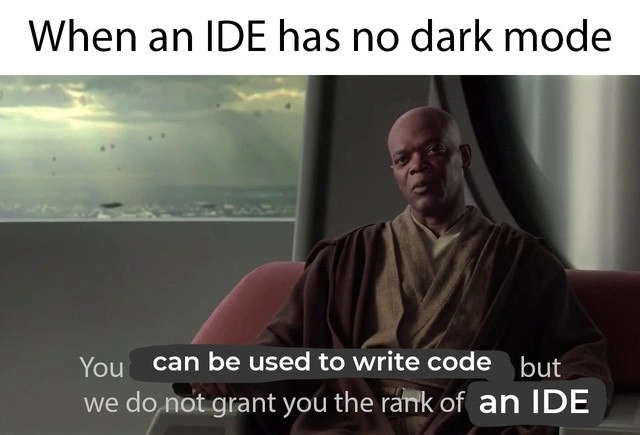
Now, the meme title says: “When an IDE has no dark mode.” The image shows the Jedi Council (from Star Wars) telling someone (in the movie it was Anakin Skywalker) a line adapted to programming: “You can be used to write code, but we do not grant you the rank of an IDE.” In plain terms, they’re saying: “Yes, technically you can write code with this software, but we refuse to call it a true IDE.” Why? Simply because it lacks dark mode. This is a joke about how seriously developers take their dark themes. It’s exaggerating our priorities – as if the absence of a dark theme alone is enough to disqualify a tool from being taken seriously.
There’s also the funny Star Wars reference itself. In the film, the Jedi Council tells Anakin, “You are on this Council, but we do not grant you the rank of Master.” It was a serious, dramatic moment – basically a big snub to Anakin, implying he’s talented but not trusted enough to be a Master. Translating that into dev terms, the meme implies the IDE is useful but not worthy of full respect. The “rank of an IDE” phrase is deliberately melodramatic. We don’t usually talk about software having ranks, of course! But that grandiose language makes it funny. It’s like personifying the software: the IDE is an aspiring Jedi Knight coming before a council of elder coders, hoping to be recognized as a “master” tool. And the council elder (the senior devs) deliver this crushing verdict solely because the tool lacks a dark theme setting.
To a newer developer or someone outside the field, this might seem odd. Is dark mode really such a big deal? For many developers, yes – it’s one of the first settings they look for when installing a new editor or IDE. In fact, ToolingFrustration is real: there have been real-world instances of dev tools getting backlash from the community for not including a dark mode. It’s considered a basic feature of Developer Experience (DX) now. So the meme is funny because it’s rooted in that truth, just dramatized. Imagine a junior coder excitedly recommending a new code editor to a senior colleague, and the senior colleague’s first question is, “Does it have dark mode?” If the answer is no, the senior might jokingly respond, “Then it’s not a real IDE, I’m not touching it.” They might be half-joking, half-serious. That scenario is essentially what the meme depicts, but using the pomp and drama of a Star Wars council chamber for comedic effect.
Let’s unpack a couple of the key terms and references to ensure it’s all clear:
- Dark Mode Supremacy: This phrase (tagged in the context) humorously describes the attitude that dark-themed interfaces are inherently superior. “Supremacy” hints that some developers treat their preference for dark mode almost like an ideology – if it’s not dark, it’s not right.
- Developer Eye Strain: Staring at a bright screen can cause eye fatigue, headaches, or just make you squint uncomfortably. Developers often work long hours, sometimes late at night or in low-light conditions, so eye strain is a common concern. That’s why features like dark mode, or tools like f.lux/night shift (which reduce blue light) are popular. It’s all about making the screen easier on the eyes.
- IDE Authenticity Gatekeeping: “Gatekeeping” means setting some arbitrary rules about what counts as authentic or “true” in a community, and keeping out those who don’t meet the criteria. “IDE authenticity gatekeeping” here refers to the idea that some folks might insist, only software that has X and Y features (like dark mode, or fill-in-your-favorite-feature) can be called a real IDE. It’s a slightly negative term because gatekeeping often excludes or belittles others over petty reasons. In this meme, the gatekeeping is obviously tongue-in-cheek — nobody literally has the authority to declare what is or isn’t an IDE, but among developers chatting, you might hear, “Psh, that’s basically just Notepad with plugins. No dark mode? Not an IDE.”
- Star Wars Jedi Council Scene: The context tags mention this specifically. It’s referring to the scene from the Star Wars prequel movies where the Jedi Council (a group of wise, powerful Jedi Masters) meet. By using that scene, the meme instantly conveys a sense of seriousness and authority — in a jokey way. We see a Jedi Master (Mace Windu, played by Samuel L. Jackson) looking stern as he passes judgment. By overlaying the custom subtitles about the IDE, the meme maker equates that fictional seriousness with how seriously developers take dark mode. It’s funny because obviously deciding the fate of the galaxy is not the same as deciding if an editor is good, but it feels huge to the people involved (the Jedi or the devs, respectively).
For a junior developer, the takeaway is this: the meme mocks how senior devs sometimes act like the Jedi Council of tools, with strong opinions on what’s acceptable. UI themes, especially dark vs light mode, are one of those surprisingly passionate debates in programming circles. While it’s mostly in good fun, it’s true that if you ever open your laptop in a room full of developers and your editor has a bright white background, you may get some teasing comments like, “Whoa, turn down the sun on your screen!” or “Working in light mode, are you okay?” It’s part of DeveloperHumor culture. Everyone knows you can perfectly well write code in a light-themed editor (and some people even prefer it), but the running joke is that serious programmers always choose the “dark side” (dark theme) because it looks cool and saves your eyes.
So, the meme is a playful way to say: if an IDE doesn’t have a dark mode, experienced devs won’t take it seriously. They might use it begrudgingly, but they won’t grant it the rank (the respect) of calling it their primary IDE. It captures a shared sentiment and exaggerates it using a famous movie scene – making it instantly recognizable and funny to those in the know.
Level 3: No Dark Mode, No Master
“You can be used to write code, but we do not grant you the rank of an IDE.”
In this meme’s Jedi Council scene, a senior developer sits like Mace Windu, gravely informing a new code editor that despite its functionality, it’s unworthy of the title “Integrated Development Environment”. The humor here is a high-level inside joke about gatekeeping in developer culture: the Council of seasoned coders is effectively saying, “Sure, you technically work for coding, but without dark mode you’re not a real IDE.” This playful parallel to Star Wars lore exaggerates a real industry quirk.
Dark mode has become a near-sacred feature among experienced programmers – almost a “Dark Side” of the Force that developers are actually encouraged to embrace. In day-to-day development, using a bright white theme (light mode) in your editor at 2 AM can feel as blinding as twin Tatooine suns. Many veteran devs strongly prefer darker color schemes to avoid eye strain during marathon coding sessions. Over years of late-night debugging and on-call emergencies, they’ve learned the hard way that staring into a bright white screen can fry your retinas (and your patience). A code editor lacking a dark theme is seen as hopelessly primitive, much like a Padawan lacking a lightsaber. It works, but it doesn’t command respect.
The meme cleverly riffs on the rank of Master scene from Star Wars: Episode III – Revenge of the Sith. In that scene, Anakin is told he’s on the council but not granted the rank of Master – a huge snub. Here, the council of devs acknowledges the tool “can be used to write code” (so it’s functionally adequate), but denies it the rank of IDE because it’s missing the one feature serious devs obsess over: a built-in dark theme. It’s a tongue-in-cheek nod to how developer experience (DX) often hinges on seemingly “minor” features. We’ve all seen ToolingFrustration like this: a new editor or IDE comes out boasting revolutionary features, yet if it ships with no dark mode option, the developer community’s response is outrage: “How can you call this an IDE?” Forums and Twitter threads flare up with dramatic flair, much like Anakin exclaiming, “It’s outrageous! It’s unfair!”
This reflects a broader pattern of developer humor where we elevate our preferences into almost Jedi-level doctrines. Just as Jedi Masters guard the knowledge of the Force, senior devs guard the sanctity of their development environment. Color theme preference becomes a solemn criterion of tool legitimacy. It’s funny because it’s an exaggeration of reality: no one is literally convening a council to banish IDEs without dark mode, but the attitude is real. Many of us have that battle-scarred colleague who scoffs, “A real IDE would never lack a dark theme,” with the same gravitas as a Jedi dismissing a failed apprentice. IDE authenticity gatekeeping is being parodied here — the idea that unless a tool meets an elite checklist (and dark mode has somehow become the critical item), it’s not worthy of the title. It’s a satirical commentary on how DevExperience considerations can turn into almost religious requirements in tech culture.
On a technical level, implementing a dark theme is not rocket science, yet the absence of one signals that a tool is outdated or not developer-friendly. Modern IDEs and advanced code editors (VS Code, IntelliJ, Sublime Text, etc.) ship with multiple dark themes by default. They learned from industry history that dark_mode_supremacy is real — developers will judge and even reject tools that don’t accommodate their preferred working style. It’s a bit absurd: you could have the most advanced compiler integration or AI code completion, but if the UI is blindingly bright, expect “No thanks, not using that” from late-night coders. The meme distills this absurdity. The Jedi Council, representing the collective voice of senior developers, isn’t asking about the editor’s refactoring tools or debugging support (things that actually make an IDE powerful). They jump straight to visual theme. The line “we do not grant you the rank of an IDE” implies an almost ceremonial withholding of status — as if dark mode is the trial by fire for any code editor to be considered a true Jedi Master among tools.
There’s also a rich irony in the Star Wars parallel: in the movies, the “Dark Side” is forbidden and feared, but in programming, the dark side (UI theme) is virtuous and expected. The Council here is essentially saying, “If you haven’t embraced the Dark Side, you cannot be one of us.” This flips the script for comedic effect. Senior devs often joke that working under bright IDE themes feels like succumbing to the Light Side – an ironic reversal where the normally “good” light is now the enemy, causing headaches and squinting. In practice, many coders physically feel the difference: a dark background with syntax-highlighted text in soothing colors can reduce glare, especially when you’re working in a dim room or pulling an all-nighter. It’s about developer eye strain and also about the vibe: a dark-themed editor makes you feel like a 1337 hacker in “the zone” (there’s a reason the stereotypical movie hacker furiously typing has green or amber text on a black screen!).
By invoking the Jedi Council scene, the meme also pokes fun at how overdramatic we can be about our tools. The council masters in their solemn chamber mirror developers on forums acting as self-appointed arbiters of what counts as a “real” tool. It’s a form of satire on tech elitism: judging colleagues for using default light theme or a plain editor, as if they’re not true experts. The phrase on the meme’s image uses UI-style labels for “can be used to write code” and “an IDE”, emphasizing that these terms are being almost programmatically substituted into the famous quote. It’s a clever way to contextualize the Star Wars meme reference in a modern UI flavor. You can almost imagine a code snippet behind the scenes:
if (!editor.supportsDarkMode()) {
council.reject(editor);
console.error("Not granted rank of IDE");
}
In essence, the joke lands because it highlights a shared experience: nearly every coder has encountered the dark mode supremacy attitude or felt it themselves. We laugh because we recognize the kernel of truth – yes, we do feel a sense of betrayal launching a new dev tool and finding no dark theme. It’s as if the tool failed an initiation test. The Jedi Council framing gives that feeling an epic, cinematic twist. After all, why settle for saying “I don’t like this editor, it has no dark mode” when you can dramatize it as banishment from the Order of Real IDEs? The DeveloperHumor here comes from that contrast in scale: trivial feature vs. life-or-death gravitas. Senior devs, battle-hardened by countless all-night coding sessions under dim monitors, will nod knowingly at this meme (and probably double-check their own IDE’s theme settings with a smirk). It’s a humorous reminder that in the culture of programming, Tooling choices can spark almost doctrinal fervor – where even color theme preference might determine if a tool is accepted among the ranks of “serious” development environments.
Description
This meme uses a scene from the Star Wars prequel 'Revenge of the Sith' featuring Jedi Master Mace Windu to comment on developer tooling. The top text reads, 'When an IDE has no dark mode'. The image below shows Mace Windu with a serious expression, and the subtitled dialogue has been altered to say, 'You can be used to write code but we do not grant you the rank of an IDE'. The original line from the movie is 'You are on this council, but we do not grant you the rank of Master.' The joke hinges on the modern developer's strong preference for dark mode in their coding environments to reduce eye strain. It humorously implies that the absence of this single, crucial user experience feature is enough to disqualify a tool from being considered a legitimate Integrated Development Environment (IDE), regardless of its other functionalities
Comments
17Comment deleted
A light-theme-only IDE isn't just a tool; it's a flashbang deployed against your productivity every time you open it
If your IDE can’t invert its own color palette, why would I trust it with inversion of control?
After 20 years in the industry, I've seen IDEs come and go, but the one constant is developers treating dark mode like it's a POSIX standard - and honestly, watching junior devs discover an IDE without it is like watching them discover their CI pipeline runs on a single-core Pentium 4
In the eternal debate of what constitutes a 'real' IDE versus a glorified text editor, the developer community has spoken: syntax highlighting, intelligent code completion, and integrated debugging are all negotiable features - but dark mode? That's the hill we're willing to die on. After all, you can't claim to understand developer ergonomics if you're still shipping blinding white backgrounds in 2024. It's like offering a race car without a steering wheel and calling it 'minimalist design.'
True IDEs embrace the dark side; light-themed editors are just force-choked productivity pretenders
In our ADRs, dark mode is a P0 nonfunctional requirement; without it, your 'IDE' fails the 2am on-call acceptance test
Architecture review verdict: an “IDE” without dark mode fails production readiness - MTTR for eye strain violates the SLO, so it’s downgraded to a text editor with plugins
😂🤣👍👍 Comment deleted
bayan Comment deleted
because as we all know, light attracts bugs and we don't want those in our code Comment deleted
🤣🤣🤣 Comment deleted
I prefer light mode lol Comment deleted
This Comment deleted
fuck I read it as I prefer night mode lol Comment deleted
My condolences Comment deleted
yes Comment deleted
vim supremacy Comment deleted