Skip to content
DevMeme
2124 of 7435
When the HTTP Status Code is a Little Too Literal
Observability Monitoring Post #2373, on Nov 27, 2020 in TG

When the HTTP Status Code is a Little Too Literal

Why is this Observability Monitoring meme funny?

Level 1: Pretending It’s Fine

Imagine you walk into the kitchen and the toaster is on fire, the smoke alarm is beeping, but your friend is just sitting at the table, smiling and sipping coffee. You shout, “Hey, everything okay?!” and your friend calmly replies, “Yep, everything’s fine,” without even looking at the growing flames. Clearly, everything is not fine, and that’s what makes it funny in a crazy way. We know they’re just pretending nothing’s wrong.

This meme is showing that exact idea with a little cartoon dog. The dog says “This is fine” while his room is burning down around him. It’s humorous because he should be concerned, but instead he acts completely calm. In a real-life sense, it’s like when someone or something insists “all is well” even though you can plainly see a big problem. We find it funny (and a bit relatable) because sometimes we do this too – acting like everything is okay to avoid panicking. The meme pokes fun at the idea that saying “it’s fine” doesn’t magically fix the fire; it just makes for a silly scene that we can laugh at.

Level 2: Unexpected Success Signal

Let’s break down the joke in simpler technical terms. In web development, when you make a request to an API (an Application Programming Interface, usually a web service), the server responds with an HTTP status code – a number that tells you how things went. For example, if everything went well you get a 200 OK, if you requested a page that isn’t there you might get a 404 Not Found, and if the server had a problem you could see a 500 Internal Server Error. These are standard codes defined by the HTTP protocol that everyone is supposed to use and recognize.

Now, 218 is not one of the standard status codes you’ll find in any official list or textbook. It’s an unusual, non-standard code. However, notice that it starts with 2. All codes in the 200–299 range are considered “successful” responses in HTTP. That means if a web browser or program sees status 218, it doesn’t have a definition for it, but it knows “Well, it starts with 2, so I guess the request was successful... sort of.” The result is a confusing situation: you got a success indicator that you’ve never seen before. It’s like a teacher handing you a report card with a mysterious grade that isn’t A, B, C, etc., but since it’s in the “good” range you’re told, “I guess that means you passed.” You’d be a bit puzzled, right?

For a developer (especially someone new), encountering an HTTP 218 would prompt some debugging and troubleshooting. Debugging is the process of investigating what went wrong (or in this case, what this odd thing is). You might check logs, documentation, or search online: “What is HTTP 218?” Chances are you won’t find an official answer, because it’s not an officially recognized code. This makes it tricky – you have to rely on clues and context. Did the API documentation mention any custom codes? Is there a message in the response body? Could it be a mistake? All these questions would race through your mind.

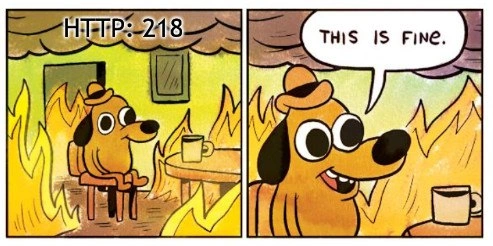
If you’re on call (meaning you’re the person responsible for keeping the software running smoothly at odd hours), an unexpected status code like 218 can be stressful. Monitoring tools might not flag it as an error because it’s technically in the “success” category. So you, as the on-call developer, have to interpret it: Is everything truly okay, or is something secretly broken? This duality is what the meme humorously points out. The first panel shows the dog in a room that’s on fire with the label "HTTP: 218" at the top. The second panel has the dog saying, "This is fine."

That dog is a famous meme used to depict denial or staying calm during a disaster. “This is fine.” has become a running joke meaning we’re pretending everything is okay, even if it clearly isn’t. In our context, the HTTP 218 status is like the system’s way of saying "This is fine," even though the surrounding “fire” represents something going very wrong in the application. The developer (or anyone watching the system) sees flames – maybe users are having issues or the output is nonsense – but the only status code coming back is a weird “218” that basically translates to “No problems here!”

Let’s connect it all: The API’s job is to tell your program if a request succeeded or failed via these codes. Error handling in your program usually looks for known failure codes (like anything in the 400s or 500s) to flag something’s wrong. If it only sees a code in the 200s, it will assume everything went well. So if an API returns a 218, your app might just treat it like a 200 OK because it doesn’t know any better. Meanwhile, something might actually be broken (that’s the fire in the room). The meme is funny to developers because it’s a exaggeration of a real concern: sometimes our tools say “All good!” when in reality, things are falling apart, and we have to dive in and figure out the truth despite those reassuring green lights.

Level 3: Status OK, Everything’s Burning

From a senior developer’s perspective, this scenario is darkly familiar. It’s late at night, you’re on call, and suddenly an alert (if one even triggers) leads you to a baffling sight: an API responded with HTTP 218. Huh? 218 isn’t in the usual playbook of status codes. It sits there in the logs like a smug little gremlin—technically a success (2xx) but completely out-of-spec. You can almost hear the system saying, “Nothing to see here, move along,” while behind the scenes all you see are flames. It’s the developer equivalent of that meme dog sipping coffee in a burning room.

The humor (and horror) here comes from the absurd calm in the face of an obvious problem. In real life, when an API returns something completely unexpected, it’s a huge red flag. Maybe a backend deployed some custom status without telling anyone. Maybe an intermediate proxy or load balancer went haywire and spat out a bizarre code. Or perhaps it’s an honest-to-goodness bug – an uninitialized variable or off-by-one error that accidentally turned a 200 OK into a 218 on its way out. And yet, because 218 falls in the “success” range, all the outward systems are treating this like a green light. Monitoring dashboards stay blissfully green (they usually only scream when they see 5xx errors). Automated retry logic doesn’t kick in, because hey, the request succeeded as far as HTTP is concerned. No immediate pages go out, since technically it’s not an error code. In the war room of production, the alarms are mute while the servers quietly smolder.

Every seasoned dev can relate to this Kafkaesque situation where metrics and reality diverge. The deployment pipeline says “✅ All good,” but users are getting blank responses. Logs show “everything executed normally,” except nothing actually happened. It’s that infuriating scenario where something is clearly wrong but all your tools insist it’s fine. This meme nails that feeling: the calm facade over chaos. The dog’s blank smiling expression is basically the on-call developer at 3 AM, staring at an unexpected API response and wondering if they’re dreaming.

We also recognize an underlying industry anti-pattern here: sometimes developers or systems refuse to admit failure. For example, some poorly-designed APIs always return 200 OK even when an operation fails, opting to put the real error details in the response body. It’s a way of saying “Look, no HTTP error!” – essentially pretending everything is fine so as not to trip up clients expecting a 2xx. This is exactly the “This is fine” mentality in software form. Code 218 in the meme is a perfect symbol of that — it’s not an official code, but imagine a developer inventing it to mean “Alright, technically we handled your request... but something’s definitely weird.” It’s a success that masks failure. And if you’ve been in the trenches, you’ve seen how dangerous that can be. Silent failures, or successes that aren’t truly successful, are the ones that come back to bite you hardest. They’re the fires that burn unnoticed until the whole room is engulfed.

So experienced folks laugh (maybe with a groan) at this comic because it captures a universal truth of being a developer: things can be on fire, and yet the system will tell you “This is fine.” Maybe it’s due to a monitoring blind spot, a lazy error-handling shortcut, or just the absurdity of unknown unknowns in complex systems. The meme is a coping mechanism — we’ve all been the dog in the burning room, forced to maintain composure and troubleshoot calmly while everything around us is going wrong. It’s funny because it’s true, and it’s true often enough to hurt.

Level 4: Schrödinger's Success

At the protocol level, HTTP is designed with a kind of Schrödinger’s flexibility: a response can be both okay and not okay at the same time, depending on what you know about it. The HTTP standard groups status codes by their first digit (1xx, 2xx, 3xx, 4xx, 5xx), which means any unrecognized code in the 2xx range is still interpreted as a general success. This clever design allows new status codes to be introduced without breaking older clients. In other words, if a server one day decides to return a weird code like 218, a well-behaved HTTP client will shrug and treat it as "some kind of success". The IETF (the folks who write the HTTP specs) anticipated that developers might one day need more codes—be it serious ones or even whimsical ones—and built in this extensibility.

Historically, we've actually seen humorous or experimental status codes sneak in. The infamous 418 I'm a teapot (an April Fools’ joke from RFC 2324) is a 4xx error code that asserts the server is, quite literally, a teapot and refuses to brew coffee. It’s a joke, but it’s instructive — it shows how the protocol can handle unexpected codes: clients see 418, say "well, it's a client error (4xx), even if I don't know what exactly", and move on. Similarly, developers have floated unofficial codes like 218 as a tongue-in-cheek "This is fine" status: a success code that technically means “okay,” while hinting that things are actually on fire. Of course, you won’t find 218 in any official IANA registry of HTTP status codes – it’s a non-standard HTTP code, essentially a ghost. But thanks to HTTP’s design, that ghost code can live among real codes without causing a protocol meltdown. The underlying theory here is robustness and forward-compatibility: be conservative in what you send (ideally stick to standard codes), but be liberal in what you accept (don’t crash just because you got a weird success number). This meme capitalizes on that principle: we have a bizarre success code that the computer world treats as “fine” by category, creating a perfect setup for dark comedy when reality is anything but fine.

Description

This is a two-panel comic strip featuring the popular 'This is Fine' meme. In the first panel, a cartoon dog wearing a hat sits calmly at a table with a mug, while the room around him is completely engulfed in flames. Superimposed in the top left corner is the text 'HTTP: 218'. In the second panel, the comic zooms in on the dog's face, which has a cheerful, unconcerned expression as he says, 'THIS IS FINE.' in a speech bubble. The humor is layered for a technical audience. The 'This is Fine' meme itself represents a state of denial or willful ignorance in the face of disaster. The technical joke is the reference to 'HTTP 218', which is an unofficial, April Fools' Day status code used by some platforms (like Apache Traffic Server) that literally means 'This is fine'. The meme brilliantly captures the feeling of a system being in a catastrophic state of failure while monitoring tools report a deceptively positive or neutral status

Comments

13
Anonymous ★ Top Pick The service is returning HTTP 218. The good news is that our uptime dashboard looks great. The bad news is that the server rack is currently being used to roast marshmallows
  1. Anonymous ★ Top Pick

    The service is returning HTTP 218. The good news is that our uptime dashboard looks great. The bad news is that the server rack is currently being used to roast marshmallows

  2. Anonymous

    HTTP 218 - “OK-ish”: Raft lost quorum, only one shard swallowed the write, replicas are three hours behind, but the dashboard’s still green so apparently we’re fine

  3. Anonymous

    After 20 years in tech, I've learned that HTTP 218 should be the official status code for 'The monitoring dashboard is green, the CEO is happy with uptime metrics, and technically the API is still responding... just ignore the fact that our Kubernetes cluster is literally computing the heat death of the universe one pod restart at a time.'

  4. Anonymous

    When your monitoring dashboard lights up like a Christmas tree at 3 AM and you've already burned through your error budget for the quarter, but the SLA technically says 'best effort' and management is still asleep - HTTP 218: This Is Fine. It's the unofficial status code for when your circuit breakers have tripped, your fallbacks are falling back to fallbacks, and you're one kubectl command away from a resume-generating event, but hey, at least the health check endpoint still returns 200

  5. Anonymous

    HTTP 218: This Is Fine - the custom status you invent so the liveness probe stays green and the SLO survives while the Kafka cluster is actively on fire

  6. Anonymous

    HTTP 218: The unofficial status code for when 'eventual consistency' means 'the data center's on fire, but the API gateway disagrees'

  7. Anonymous

    HTTP 218: the status when healthchecks return 200 while Kafka partitions, the DB fails over, and the load balancer’s retries keep the dashboard green

  8. @RiedleroD 5y

    I don't get it.

    1. @v_kotey 5y

      https://en.wikipedia.org/wiki/List_of_HTTP_status_codes#Unofficial_codes

      1. @RiedleroD 5y

        aaa lol thanks

    2. @FLIPFL0P_T 5y

      Then get it, whats your problem?

  9. @Vitalis11 5y

    This is just so accurate 👌

  10. @mvolfik 5y

    Hmm, maybe I could start using this code for the 200 {"ok": false} responses

Use J and K for navigation