From gentle hotfix to ruthless refactor: bugs never stood a chance
Why is this Bugs meme funny?
Level 1: Bugs in the House
Imagine you spot a cockroach in your house. Yikes! Your first reaction might be to grab a shoe and squash that one bug quickly. That’s like a fast fix – the problem (the bug you saw) is gone for now. This is what we’d call a quick fix in coding: see a problem, whack it immediately. Now, think a moment longer. If there’s one cockroach, there might be more hiding somewhere (maybe a whole cockroach family behind the wall!). So instead of just one squish, you put on a big helmet, get a can of bug spray, and spray the whole wall and room to make sure all the roaches are gone for good. This is like a big fix in programming: you take extra time and effort to clean up everything so the problem doesn’t come back.
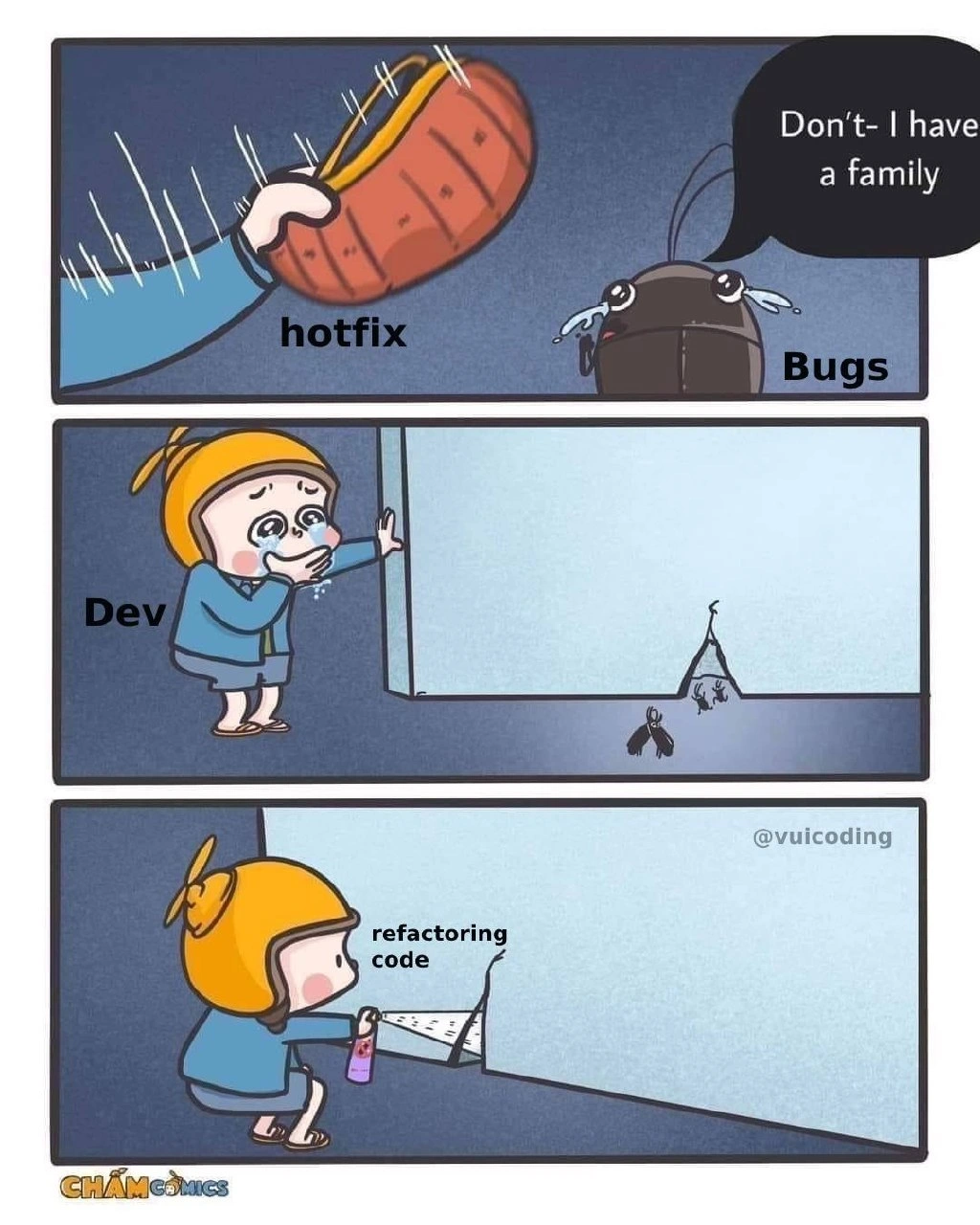
In the picture, the little developer first feels sad for the cartoon bug saying “Don’t – I have a family.” It’s a funny moment because we usually don’t think of bugs having families! The developer is a bit like someone feeling guilty about tearing down a tiny spiderweb because of the poor spider family. But then the developer realizes the bugs will just cause more trouble, and goes full-on exterminator with a helmet and spray. The joke is how the developer goes from gentle to super strict in a second. It’s silly and cute: one moment we see mercy (“aww, the bug has a family…”), and the next moment it’s “sorry bugs, no mercy!” All the bugs get sprayed away. We laugh because it’s an extreme solution to a small bug – kind of like burning down a house to get rid of a single ant. It’s exaggerated on purpose. But it also makes a point a kid can get: sometimes you have to clean up really thoroughly to stop a problem, even if it seems a bit much. The meme is basically a funny cartoon way of saying “I fixed it, and I made sure absolutely nothing was left to break again!” It’s that over-the-top thoroughness that makes it so amusing and easy to understand.
Level 2: Band-Aid vs Surgery
Let’s break down the meme in more straightforward terms. It’s showing two different ways a developer might fix bugs in software – one quick-and-simple, and one thorough-but-extreme. In the first panel, the developer uses a slipper labeled “hotfix” to smack a cockroach (the bug). A hotfix in programming is just like that slipper: it’s a fast patch you apply to your code, often while the program is “hot” (running in production). Think of a hotfix as an emergency band-aid for your code. For example, if users discover a nasty error on your website, you might write a quick one-line change to fix it immediately, without waiting for a long review process. It’s not always pretty or permanent, but it stops the bleeding. In the comic, the poor cockroach pleading “I have a family” is a humorous way to show that a bug in code often isn’t isolated – there could be related issues (a whole family of bugs) hiding in that part of the system. When you’re new to development, it might surprise you that fixing one thing often reveals two more things that are wrong. It’s like discovering one cockroach and realizing, uh oh, there might be a nest!
Now, the second approach the meme shows is the developer going full exterminator mode with a can of spray labeled “refactoring code”. Refactoring means cleaning up or reorganizing the code without changing what the program actually does. It’s like cleaning and renovating a messy room: everything should work the same afterward, but the “inside” is neater and more solid. In our bug analogy, refactoring code is comparable to calling pest control to fumigate the house and seal up entry holes, rather than just stomping on one bug. It addresses the root causes of problems. For instance, instead of just patching that one error, a developer might decide to rewrite an entire function or module to make the code more logical and prevent a whole class of bugs from happening in the future. That’s a bit like doing surgery: it’s a bigger intervention than a band-aid, but it can solve deeper issues. The comic exaggerates this by showing the Dev with a safety helmet and serious spray can – meaning this is a major operation on the codebase, not just a quick swat.
The middle panel with the Dev crying at the sight of the bug’s family is a funny touch that new developers can understand once they’ve dealt with legacy code. Sometimes you look at a quick fix and realize the code around it is a mess (technical debt), which can be overwhelming. Technical debt is a term for all those shortcuts and clunky code decisions that accumulate over time, making a codebase fragile – basically, an environment where bugs breed. A junior dev might fix a typo-level bug and then notice the entire file is full of strange, outdated code. It’s that “uh oh” moment depicted by the teary-eyed Dev peering into the wall. You feel a mix of sympathy and horror: “This bug has… a family? What have I stumbled into?” In everyday development, that might translate to discovering that the one error you fixed is actually part of a wider pattern of errors.
When the Dev decides to put on the helmet and spray the hole, it’s showing the choice to go for a comprehensive solution: refactor the problematic code completely. Early in your career, you learn that bug fixing can be done at two levels. The first level is the quick fix (the slipper method) – you solve the immediate problem so your app keeps working. The second level is the deep fix (the refactor spray) – you improve the overall code so that type of bug (and its “relatives”) won’t come back later. Refactoring often means simplifying complex code, renaming things clearly, breaking a big function into smaller ones, or even redesigning how components talk to each other. For example, if a bug was caused by two modules miscommunicating, a refactor might involve creating a cleaner interface between them or introducing a well-defined data format – essentially reorganizing the code’s “architecture” to be more solid. It’s a lot more work than a quick patch, but it leads to better CodeQuality and fewer headaches down the road.
However, as the meme humorously points out, doing a big refactor is sometimes overkill for a small bug – and that’s the joke. The bug begged for mercy, the Dev momentarily felt bad (“maybe we don’t need drastic measures…”), and then… whoosh! out comes the code pesticide. The developer experience (DevX or DeveloperExperience_DX) angle here is that working in messy code full of bugs is painful, so it’s tempting to clean it all up in one go. Everyone who’s worked on a codebase with bugs can relate: part of you wants to just fix the one error and move on (especially if you’re on a deadline), but another part of you itches to refactor the whole thing properly. The comic uses a cute visual metaphor to show that itch turning into action. As a less experienced developer, you might not always get to make that call – often you’ll apply the needed fix and maybe note in the comments or Jira ticket that “this section needs refactoring later.” But occasionally, you or your team decide it’s worth going in and spraying the whole nest.
In summary, panel by panel, the meme equates:
- Hotfix (Slipper) – a fast, direct bug squish. This is the band-aid solution in coding: quick relief, might not address underlying issues.
- Bug’s Family (Hidden in Wall) – the larger problem context. One bug often lives with others in a messy code area. This hints at the presence of technical debt or a structural issue in code.
- Refactoring (Insecticide Spray) – an extensive cleanup or rewrite of code. This is the surgical solution: it takes more time and planning but can eliminate the entire class of bugs by improving the code’s structure.
The meme is funny because it escalates from a simple slap to all-out warfare on the bugs. New developers learn about these approaches and the comic exaggerates them in a way that’s easy to visualize. It’s like seeing a small leak and deciding to repipe the whole house – it sounds ridiculous, but in software it sometimes happens! The terms might be new, but the idea is clear: a hotfix is a quick fix for now, while refactoring is a big fix for the future. And yes, sometimes we developers do feel like pest control, chasing those pesky bugs in our code. 🐛🔨💥
Level 3: Refactor from Orbit
This meme humorously dramatizes the classic software dilemma: quick hotfix versus scorched-earth refactoring. In the first panel, a giant slipper labeled "hotfix" is about to slam down on a cockroach labeled "Bugs". This slipper represents an immediate patch to squash a bug in production. Seasoned developers recognize this as the frantic 2 AM fix – the kind of BugFixing done under pressure to stop an outage or a critical error. The cockroach crying, “Don’t– I have a family,” is a tongue-in-cheek way of saying that one bug may be part of a larger cluster of issues (a whole family of bugs lurking in the codebase). It’s a nod to the rueful truth: in code, if you spot one cockroach, there are probably more bugs in the wall. A senior engineer would smirk here, recalling that one innocent bug report often uncovers a nest of technical debt behind it.
In the second panel, the developer character (captioned “Dev”) kneels with tears in their eyes, peering at a tiny hole in the wall where a whole bug family huddles. This is the moment of realization. The Dev’s empathy – feeling sorry for the bug’s family – mirrors a developer’s hesitation when they realize a quick fix might not be enough. It’s like suddenly seeing how messy the surrounding code is: “Oh no, this bug isn’t alone. The entire module is crawling with problems.” Senior devs know this feeling well. You fix one null-pointer crash, only to realize the design itself is breeding errors. The tearful Dev is a funny exaggeration of that pang of conscience or dread a coder feels on discovering deeper issues. Perhaps the dev initially thinks, “Maybe I shouldn’t hit this poor bug with a slipper – its family (i.e., related features or legacy code) might suffer.” In real terms, that’s the brief contemplation of whether a small targeted fix will anger other parts of the system or if there’s a more humane (elegant) solution.
Then comes panel three: our once-gentle Dev now dons a hardhat and wields a can of pesticide labeled "refactoring code". Sympathy is gone – it’s extermination time. This sudden shift to a helmet and industrial-strength spray is a brilliant metaphor for an over-engineered refactor. Instead of just patching the tiny bug-hole, the developer chooses to rewrite or restructure the code to wipe out not only the original bug but its entire “ecological niche” in the codebase. This is the “nuke it from orbit” strategy (to borrow a phrase). In software terms, it’s like saying: “You know what? Let’s redesign this whole component so thoroughly that none of these bugs (or their cousins) can ever survive.” It’s a comical magnification of what senior engineers jokingly call the “kill it with fire” approach to bugs.
Why is this funny to experienced devs? Because we’ve sat in those meetings where a simple bug leads someone to propose a massive refactor or even a complete rewrite of the application. It’s an exaggeration grounded in truth: sometimes a one-line fix snowballs into a plan for an entire system overhaul. For example, imagine a minor flaw in how user input is validated. The hotfix approach might add a quick check to handle the specific error. But someone on the team might respond, “If this part is flawed, who knows what else is? Let’s refactor the whole input handling module.” Suddenly a tiny bug becomes a multi-week refactoring sprint. Every senior developer has seen this “go big or go home” reflex – sometimes it’s justified by awful code quality, other times it’s using a bazooka on a fly. The meme nails that absurd contrast with a cute cartoon analogy.
Notice the wording on the spray can: "refactoring code". True refactoring, as defined by Martin Fowler, means improving internal code structure without changing external behavior. In practice, a major refactor aims to eliminate entire classes of bugs by making code cleaner and more robust. It’s like fumigating the house so not a single roach survives. No more quick band-aids – this is a permanent fix (hopefully). The humor is that the Dev’s gentle compassion flipped into ruthless determination. It’s a playful jab at our inner turmoil: part of us feels bad for the legacy code (“Aw, it’s worked for so long, it has a family of dependent modules!”), but another part of us puts on the hardhat and says, “Time to rewrite this mess from scratch.” The phrase “bugs never stood a chance” in the title encapsulates that gung-ho confidence we get during an aggressive refactor: we’re not just fixing one bug, we’re making sure no survivors remain. Of course, in reality, seasoned devs know that large refactors are risky – you might accidentally introduce new bugs (collateral damage to innocent features, so to speak). But the fantasy of utterly exterminating all bug families in one sweep is deeply satisfying.
We can also appreciate the cockroach metaphor from a technical angle. Cockroaches are famously hardy creatures (legend says they might survive nuclear fallout). Software bugs can be just as resilient, popping up again unless you fundamentally improve the code. The meme winks at this: a slipper might squash one roach, but the nest will survive unless you bring out the big guns. Similarly, a hotfix might solve the immediate symptom, but without addressing root causes, those bugs (or related ones) often resurface. That’s why developers sometimes choose the nuclear option of refactoring the code – it’s the systematic extermination of underlying issues. It’s funny because it’s overkill: not every bug warrants a full refactor, just like you wouldn’t rebuild your whole house because of one roach in the kitchen. Yet, seeing the Dev go full Rambo with a pesticide can is hilariously relatable to any senior programmer who’s been overly zealous about code cleanup.
To put it in pseudo-code, the meme’s story could be sketched like this:
# Hotfix approach (squash the one visible bug quickly)
if bug_found:
apply_quick_patch() # swift fix, but the rest of the bug family lurks...
# Later... Refactor approach (wipe out the whole colony)
prepare_safety_gear()
refactor_entire_module() # heavy-duty fix to eradicate all related bugs (no survivors)
The first part is like slamming the slipper: you apply_quick_patch() to stop the immediate issue. The second part is strapping on the helmet and calling refactor_entire_module(), essentially saying “let’s rebuild this properly so BugsInSoftware can’t easily return.” The comment "no survivors" is a cheeky nod to how the refactor leaves no bug alive (at least in theory!). Senior devs chuckle at this code because it’s simultaneously a CodeQuality ideal and a source of DeveloperPainPoints: we dream of eliminating all bugs, but we know a massive refactor can be as dangerous as it is effective. The meme exaggerates reality just enough to make us laugh at ourselves. Who hasn’t watched a tiny change request balloon into a full-system makeover with a nervously optimistic phrase like, “While we’re in here, might as well fix everything!”?
In short, at the highest level this cartoon pokes fun at our engineering extremes. We go from a gentle hotfix to a ruthless refactor in three panels flat. It’s relatable comedy for anyone who’s wrestled with whether to slap on a quick patch or delve into a risky re-architecting to address the root cause. The humor lands because it’s true in spirit: sometimes the bugs’ “family” (all the hidden problems) really does need wiping out… and sometimes we just get a bit carried away. This senior-perspective view appreciates both the absurdity and the grain of wisdom in the meme’s message.
Description
A three-panel cartoon in a soft, pastel comic style. Panel 1: a huge flying slipper labeled “hotfix” is mid-swing toward a teary-eyed cartoon cockroach labeled “Bugs,” which pleads in a speech bubble, “Don’t - I have a family.” Panel 2: a small child-developer character, captioned “Dev,” kneels by a tiny hole in the wall, eyes watering with sympathy toward a bug family huddled inside. Panel 3: the same Dev now sports a safety helmet and sprays insecticide into the hole; the spray can is captioned “refactoring code.” Bottom-left carries the “CHÁMcomics” logo, and the top-right of the last panel shows the watermark “@vuicoding.” The meme contrasts a quick production hotfix with an over-engineered refactor that obliterates not only the original defect but its entire ecological niche - an exaggeration senior engineers will recognize from large-scale rewrite discussions
Comments
10Comment deleted
True senior energy: skip the one-line hotfix and green-light a six-month ‘refactor’ that nukes the entire roach colony along with the legacy subsystem they called home
After 15 years in the industry, you realize the bugs crying 'I have a family' aren't wrong - that hotfix just orphaned seventeen regression tests and made three integration pipelines widows
The eternal dilemma: do you violently swat the production bug at 2 AM with a hotfix that'll haunt your next code review, or do you calmly schedule a refactoring sprint that your PM will deprioritize for the next six quarters? Spoiler: the bug's family is already filing a JIRA ticket for revenge, and your technical debt just compounded interest
Hotfixes euthanize the symptom; refactoring carpet-bombs the mutation factory - until the next feature branch resurrects it
Hotfix: O(1) time-to-ship with O(n²) maintenance tail; refactor flips those constants and restores sleep
Hotfix silences the pager; refactor evicts the multi‑tenant nest - pity product still wants it as a two‑pointer
if you keep them that is like turn them into a feature Comment deleted
Peanuts 😭 Comment deleted
Don't try to make programming look depressing. It already is Comment deleted
We had a rare bug that would've been a real PITA to fix, so we set up a cronjob to run every 15 minutes to detect and fix the issue. The cronjob fix lived in kube for almost 3 years until a major rewrite happened to fix the bug. It was almost a pet at that point. Comment deleted