The Hardcore Functional Programming Evangelist Stereotype
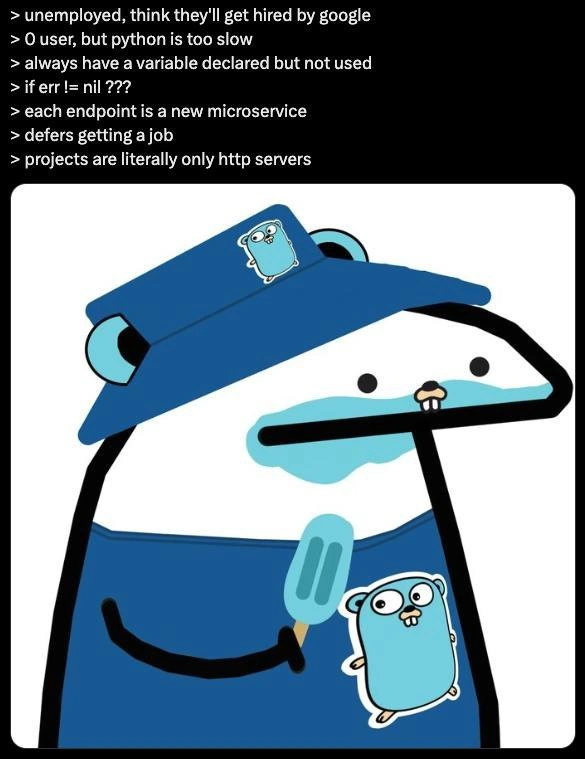
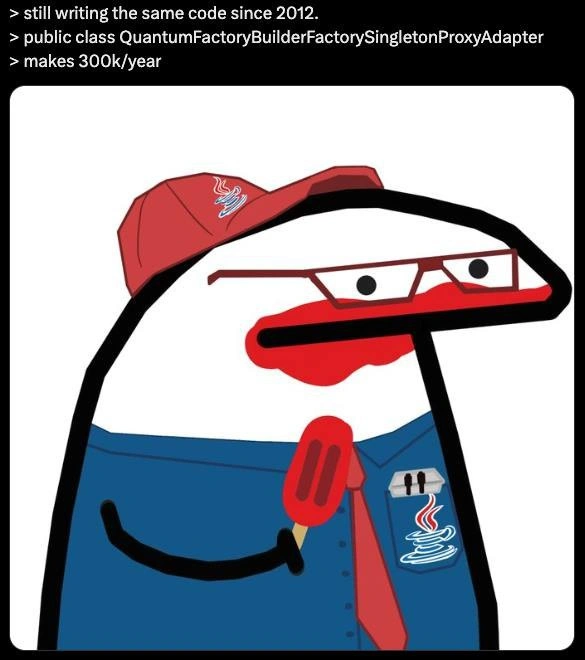
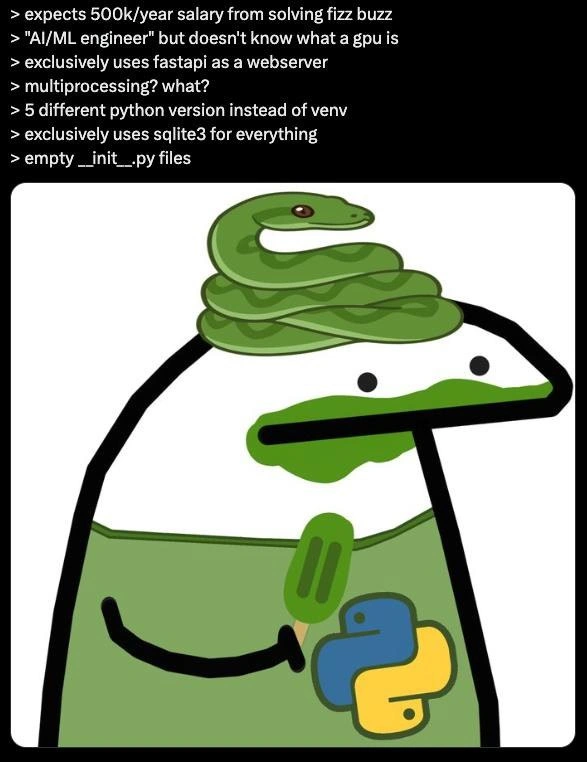
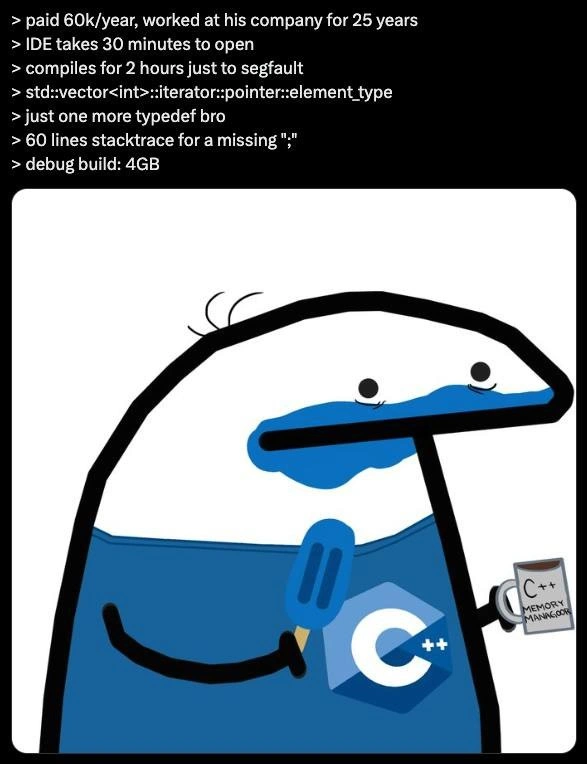
Why is this FunctionalProgramming meme funny?
Level 1: Know-It-All Chef
Imagine you have a friend who is a really quirky chef. He refuses to cook with normal ingredients or methods because he insists on doing everything in a super special, “pure” way. If you suggest a common shortcut like using ready-made sauce or a microwave, he gasps and says “How could you even suggest that?!” He’s always reading big fancy cookbooks and researching molecular gastronomy instead of actually making dinner. In fact, he’s spent ten years perfecting one secret recipe – and in all that time, only three people have ever even tasted it! He doesn’t run a restaurant or work as a chef anywhere (he’s basically jobless), but somehow he won a huge cash prize or inheritance, so he’s actually a millionaire who doesn’t need a job. And get this: when he writes down his recipes, he even uses little emoji faces as part of the instructions, like a smiley face to represent an ingredient. 😄
It’s pretty funny, right? Your friend is so proud of his unique approach that he acts a bit smug about it. He thinks everyone else is cooking “the wrong way” and brags about how much special knowledge he has (with words and symbols that most people don’t even understand). The whole situation is humorous because it’s an exaggerated cartoon of a perfectionist: someone who cares more about being technically perfect and different than about being practical or popular. We laugh because, while it’s over the top, we all know a person or two who’s a little bit like this – someone smart and talented who just can’t help showing off their knowledge, even if no one else really gets it. In simple terms, this meme is joking about a know-it-all in the programming world who’s extremely proud, a little bit eccentric, and living by his own rules. It’s funny and endearing at the same time, just like teasing that chef friend who puts a 😏 secret ingredient in every dish and believes he’s nailed the ultimate recipe that the rest of us simple cooks wouldn’t understand.
Level 2: Haskell Starter Pack
Let’s break down the concepts and jokes in this meme in simpler terms, especially for those new to functional programming or the whole “language wars” culture:
Haskell: Haskell is a programming language that falls under the category of Functional Programming. This means it’s built around using functions (like in math) as the primary way to compute things. Haskell is known for being purely functional, which implies that functions in Haskell don’t have side effects – they don’t change variables or do unpredictable stuff behind the scenes. This is very different from languages most beginners start with (like Python, Java, or JavaScript). Haskell’s community is a bit smaller and academically inclined compared to more popular languages, which is why there are many in-jokes about it.
Object-Oriented Programming (OOP): This is another style of programming, used in languages like Java, C++, or Python. OOP is all about “objects” – which you can think of as little machines or actors that hold data and have methods to do things. OOP often involves changing the state of these objects (for example, a
Counterobject might have an internal number that increases when you callincrement()). Haskell fans often avoid OOP because it involves those state changes (side effects), which pure functional folks try to minimize. So when the meme says “too pure to touch OOP”, it’s highlighting that this Haskell person refuses to do object-oriented programming at all, considering it an inferior or “impure” approach. It’s a bit like a chef refusing to use microwaves because it’s not the “pure” way of cooking – maybe admirable, maybe a tad extreme!Monad: Ah, the famous monad. In simple terms, a monad is a concept or pattern used a lot in Haskell to deal with things like input/output, or computations that might fail, in a structured way. If you’ve never heard of it, you’re not alone – many programmers write code for years without encountering monads. But in Haskell and functional programming circles, monads are everywhere. They’re considered an advanced topic and are notoriously hard to explain in plain English (leading to many jokes in developer humor). Think of a monad as a kind of wrapper or container for values that also carries some context with it. For example, an “IO monad” in Haskell wraps values that come from doing input/output (like reading a file or printing to the screen) – it’s Haskell’s way to keep these actions under control so they don’t break the pure functional nature. The meme’s phrase “imagine not knowing what a monad is” is basically portraying the Haskell expert as a bit arrogant – he finds it unthinkable that someone might not know this concept. It’s tongue-in-cheek because, realistically, monads are a pretty advanced idea, and many programmers don’t know them unless they’ve specifically learned Haskell or functional programming.
Spending more time reading books than working: This line emphasizes the academic vibe of Haskell enthusiasts. Because Haskell is influenced by a lot of computer science theory, learning it well often means reading tutorials, books, or even research papers about how it works. For instance, someone might study a book on functional programming concepts or read about category theory (a branch of mathematics) to fully grasp Haskell’s advanced features. The meme is joking that our Haskell guru is constantly reading or increasing his theoretical knowledge instead of writing actual code or building practical projects. It’s an exaggeration, of course – Haskell programmers do write code! – but it plays on the stereotype that they love deep knowledge and can sometimes get lost in it. If you’re newer to coding, think of it like a friend who reads all the strategy guides and theory about a game but doesn’t play the game as much; they might know everything, but you don’t see them scoring points in a match.
GitHub repo with 3 stars (after 10 years): GitHub is a website where developers share code. You can “star” a project on GitHub if you find it interesting or useful – it’s similar to liking or bookmarking something. Popular projects get thousands of stars because many people use or admire them. So if a project has only 3 stars, it means almost nobody has noticed it or cared enough to mark it. Now, the joke here is that this Haskell purist spent 10 years (which is a long time in software!) working on some code project, but it’s extremely niche or obscure, so only three people have given it a star. That suggests maybe only a couple of other Haskell aficionados or friends even know about it. This paints a funny picture: he’s been toiling away for a decade on something technically perfect or very specialized, but it’s not something that gained any popularity. It’s like someone writing a very exquisite, complex novel that only a few readers in the world have read or appreciated. In the context of dev communities, it hints that some communities (like Haskell’s) produce brilliant work that remains in a corner of GitHub where average developers don’t venture.
Unemployed, worth $10,000,000 USD: This part is comedic hyperbole combining two opposite ideas. “Unemployed” means he doesn’t have a job, which might imply he’s not actively earning money from work. But “worth $10,000,000” means he’s extremely wealthy. How can that be? The meme is exaggerating to be silly, but the implication is that maybe he made a lot of money in some unconventional way (maybe through a tech startup, investing early in something like cryptocurrency, or working at a company that gave him stock that became valuable) and then left the workforce. This detail is there to amp up the irony: here’s a guy who doesn’t work in a regular programming job like most people, yet he’s financially set for life. It frees him to be sort of an eccentric language evangelist – he can afford to be choosy and only do things his way (the Haskell way) because he’s not worried about a salary. It’s also poking fun at a real phenomenon: in tech, some people do strike it rich and then pursue hobbyist or niche projects. If you’re new to this, imagine someone who won a lottery and then spent all their time perfecting a hobby that no one else really cares about; it’s that vibe, applied to a coder.
Unicode emotes as valid syntax: Unicode is a standard that includes characters from virtually every writing system – and also symbols like emoji. Most programming languages historically stuck to plain ASCII letters and symbols (the basic English keyboard characters), but modern languages often allow Unicode characters in code. Haskell is one of those languages that doesn’t restrict you to just A-Z and 0-9 for naming things; you can use Greek letters, math symbols, or other Unicode symbols in your code. The meme specifically jokes that “(^-^)” – which looks like a little happy face – is valid syntax in Haskell. This is a playful exaggeration, but it’s grounded in truth: you could, for example, define a custom operator in Haskell using characters like
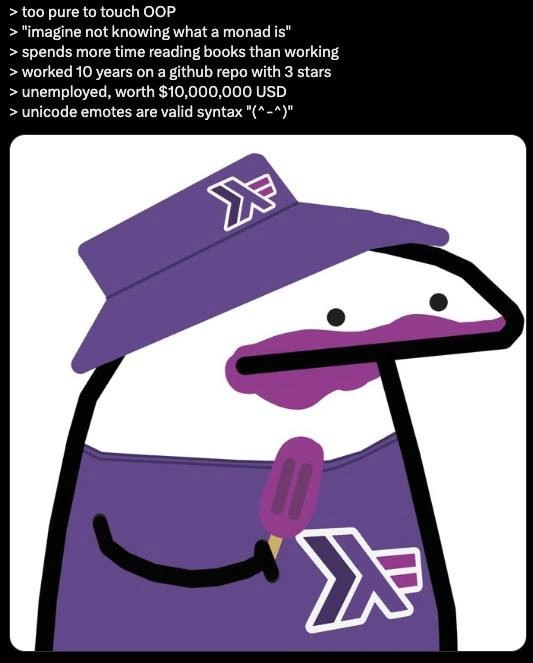
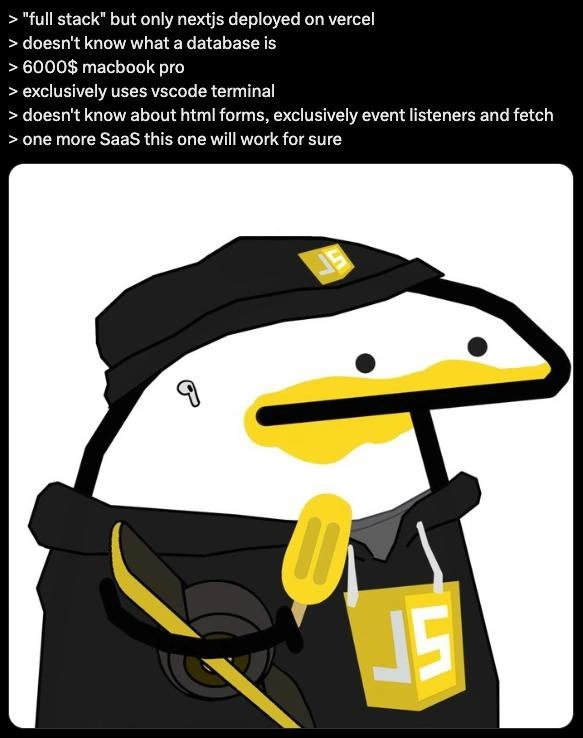
^and-in such a way that when you see it in code, it resembles an emoticon. Some Haskell developers enjoy using special Unicode symbols to make code look cleaner or more mathematical. For instance, they might useλ(the Greek letter lambda) instead of writing the word\\for an anonymous function, just because it looks cool and is conceptually fitting. Using an actual emoji like “(^-^)” is not common (and might need some tricks to work), but the meme is being silly on purpose to emphasize how quirky and proud this Haskell person is about their language. They’re basically saying, “Look, Haskell is so advanced, we can even use smiley faces in our code and it’ll compile!” It’s a tongue-in-cheek boast about the language quirks and flexibility of Haskell syntax.The cartoon character with Haskell gear: In the image, there’s a simple cartoon blob character wearing a purple bucket hat and apron, both sporting the Haskell logo (which is this kind of stylized “>>=” symbol, fittingly the monadic bind operator, in white on purple). He’s also holding a purple popsicle and has a smug facial expression. This visual is reinforcing everything the text says. Purple is the color often associated with Haskell (many Haskell websites or logos use purple), so the character is basically draped in Haskell pride. The smug look on his face matches the tone of those quotes like “imagine not knowing what a monad is” – he looks self-satisfied, as if he’s reveling in being more enlightened than everyone else. The popsicle might just be there as a quirky prop, possibly also colored purple to stay on theme. Overall, the cartoon is an art style often seen in developer memes to depict different programmer stereotypes. Here it clearly labels this character as the “Haskell purist,” visually and textually.
Putting it together, this meme’s “starter pack” of traits is describing an ultra-idealistic Haskell programmer. Each bullet point is a stereotype:
- Shuns common practices (like OOP) in favor of purity,
- Knows advanced concepts (like monads) and looks down on those who don’t,
- Is highly theoretical (reads a lot, very academic),
- Dedicates effort to perfect code over popular or practical code (hence the obscure GitHub repo),
- Lives outside the normal work-life because of a windfall (unemployed but rich),
- Even codes in an eccentric way (using unusual Unicode symbols).
For someone new to programming, the humor here comes from the exaggeration. It’s taking real things that people associate with Haskell programmers or hardcore functional programming fans and dialing them up to cartoonish levels. It’s a form of self-deprecating humor from the tech world: people in the Haskell community can laugh at this because there’s a kernel of truth (these tendencies do exist), but it’s obviously making fun of the extreme case. And even if you don’t know Haskell specifically, you might recognize the general type of person being parodied – the sort of brilliant nerd who’s a bit aloof and proud about their esoteric knowledge. All communities have their internal jokes and stereotypes; this meme is basically the Haskell/functional programming community poking fun at itself (and maybe taking a light-hearted jab at others during the eternal language wars about which style of programming is best).
Level 3: Functional Ivory Tower
For seasoned developers, this meme hits a collection of painfully familiar dev community tropes. It’s poking fun at the archetype of the Haskell purist – that one programmer who treats coding less like a job and more like a philosophical calling. Right away, the line “too pure to touch OOP” paints the picture of a developer who snubs Object-Oriented Programming entirely. In real projects, most teams blend paradigms pragmatically, but the Haskell guru prides himself on absolute functional purity. This is the kind of colleague who might roll their eyes in a meeting if someone suggests a design pattern involving mutable objects or class hierarchies. They’ll mutter about “side effects” and insist everything can (and should) be done with pure functions and types. It’s a satire of language wars in the office: the functional programming evangelist versus the OOP practitioners. The joke lands because many senior devs have seen these debates spiral – the Haskell devotee in the corner raising an eyebrow at your Python OO code, hinting that it’s “not mathematically elegant enough.” It’s a mix of truth and hyperbole: Haskell folks really do value immutability and functions above all, sometimes teasing that OOP is an impure hack. The meme exaggerates it to cult-like levels for effect, implying this character wouldn’t even touch OOP as if it’s something dirty.
Then we get the notorious monad reference: “imagine not knowing what a monad is”. This line perfectly encapsulates a well-known monad joke in programming culture. Monads in Haskell are conceptually challenging – countless blog posts and Stack Overflow threads attest to that – so bragging about monad knowledge is a geeky form of one-upmanship. The meme’s Haskell fanboy is basically saying, “I can’t even fathom being as ignorant as you plebs who don’t grok monads.” It’s absurd, and that’s why it’s funny. Every experienced dev knows someone who lords a bit of knowledge over others. In the Haskell world, monads are that ultimate litmus test – a mysterious concept that outsiders find intimidating but insiders treat as basic enlightenment. In reality, a monad is a design pattern (a way to structure computations) – not magic – but the community aura around it can feel elitist. Senior devs will chuckle here, recalling threads where Haskell experts casually drop terms like functor, monoid, and monad as if everyone learned them in kindergarten. Language evangelism at its finest: using fancy jargon as a flex. The humor comes from that shared experience – we’ve all seen the online arguments or conference talks where someone almost smugly says, “Well, if you understood monads, you’d do it this way…” It’s both a tease at Haskell folks and a self-own by them – many Haskellers are aware of their monad obsession and jokingly play it up.
The next part – “spends more time reading books than working” – highlights the academic programming culture around Haskell. Unlike more mainstream languages (where a lot of learning is hands-on or via StackOverflow debugging), Haskell’s community has a reputation for deep theoretical involvement. A senior engineer reading this can easily imagine the stereotype: that colleague who has TAOCP (Knuth’s The Art of Computer Programming) on their desk, or who quotes research papers about type systems during code review. Haskell in particular encourages understanding heavy concepts: its users often delve into books like “Learn You a Haskell for Great Good!”, “Real World Haskell”, or even category theory textbooks. The meme exaggerates it to the point where this person apparently hardly writes code at all – just reads and reads to attain ever more functional wisdom. It’s poking fun at the idea that Haskell purists might value theoretical perfection over shipping features. And truthfully, many experienced devs have seen “analysis paralysis” or over-engineering: situations where a developer spends ages researching the perfect solution (maybe exploring a fancy new type theory) instead of delivering something. The Haskell purist stereotype embodies that – a brilliant mind more comfortable in academic exploration than messy real-world coding. This resonates as a gentle jab, because being well-read is normally great, but here it’s turned into a comedic flaw: he’s so busy chasing pristine knowledge that actual coding takes a backseat.
Now, the “worked 10 years on a GitHub repo with 3 stars” line is a chef’s kiss for those of us familiar with open-source quirks. GitHub stars are essentially kudos or bookmarks – developer currency for how popular or useful a project is. Three stars is comically low, implying only a couple of people ever found this project interesting. The meme suggests our Haskell guru poured a decade into a labor-of-love project that almost nobody else cared about. This is a sly nod to how some functional programming projects go: a developer could create a brilliantly abstract library (say, a new purely functional GUI toolkit or a category-theory-based web framework), and it ends up largely unnoticed because it’s too complex, too niche, or just not marketed. It’s self-deprecating humor from the Haskell side too – Haskellers have long joked about their ecosystem’s tiny user base for many libraries. The phrase “functional purity flex” comes to mind: he flexed his pure skills in that repo, but only a handful of similarly-minded people appreciated it. For veteran developers, there’s also a ring of truth about long-running but obscure projects. We’ve all seen repositories that are technically beautiful, with maybe a PhD thesis behind them, but practically no one uses them in production. Often the maintainers of such projects keep at it out of passion or principle, not fame. So when the meme presents this scenario, it’s both poking at the Haskell purist’s priorities (he cares more about perfection than popularity) and evoking that bittersweet reality of open source – effort doesn’t always equal impact. It’s humor laced with a bit of empathy: you can’t help but admire the dedication even as you laugh at the outcome. (Also, one imagines those three GitHub stars might just be the author’s three alternate accounts – a joke many devs will get.)
Then comes the twist that really elevates the absurd character: “unemployed, worth $10,000,000 USD.” This is a hilarious contradiction on the surface – how does an unemployed programmer have ten million bucks? For seasoned folks, a few scenarios come to mind immediately: maybe our Haskell devotee struck it rich during a tech IPO, or hopped on the Bitcoin train early (perhaps because he was academically intrigued by the cryptographic algorithms and decided to mine some as a hobby?). The tech industry has these legends of eccentric geniuses who don’t hold a regular job but somehow hit a jackpot. The meme leverages that: it implies this guy is so brilliant or lucky that he doesn’t need a job, which only fuels his smugness. He can spend all day on theoretical pursuits because financial reality isn’t tethering him down to a 9-to-5. This touches on a subtle humor for senior devs: we often joke about “retiring early and coding only what I want.” A Haskell purist with millions in the bank is the ultimate embodiment of “I don’t care if you don’t like my code, I’ll code for myself.” It also jabs at the stereotype that some Haskell or functional programming experts went into fields like high-frequency trading or blockchain (where FP languages are valued for reliability) and made a fortune. So now they can remain uncompromising – they won’t write a single line of Java or JavaScript for a paycheck, because they literally don’t need to. It’s funny because it’s such an exaggerated scenario that has grains of truth. (In the back of our minds, we all know one or two folks who got a crazy exit or crypto gains; they might not turn into monad-preaching hermits, but the meme imagines if they did!)
Finally, that last line about “unicode emotes are valid syntax ‘(^-^)’” is the quirky cherry on top – a language quirk that seals the stereotype. Haskell is known for being highly expressive and even a bit eccentric in syntax. In fact, Haskellers sometimes use actual Greek letters or fancy symbols in their code to make it look cleaner or more mathematically sound (with compiler extensions, you can write λ instead of \ for lambda, or ∀ instead of forall, etc.). The meme takes this to the extreme by suggesting the guy uses a Unicode emoticon as part of his code. It’s a hyperbole, but it’s based on reality: you *could* name your Haskell functions or operators using many Unicode characters. Using something like (^-^) as an operator is not a common practice, but it’s syntactically feasible to define an operator composed of symbols including ^ and -. So for the in-joke, picture a snippet of Haskell where instead of a normal function name, you see (^-^) x = .... It looks like a happy face, but it might actually compile! Seasoned devs find that hilarious because it highlights how far removed this purist is from normal coding conventions – he’ll even code with smiley face symbols if it tickles his fancy. It’s a playful dig at how Haskell enthusiasts sometimes revel in doing things very differently from mainstream programmers. Other dev communities might poke fun at Haskellers for writing code that looks like line noise or algebra, and here the Haskell meme character proudly embraces that sentiment: “Yes, my code has emoticons and Greek letters – problem?” It’s absurd in a lovable way. This is developer humor gold because it’s both a parody and a celebration of the Haskell community’s uniqueness. They know they’re the outliers with their Unicode tricks and obsession with pristine code, and by joking about it, they make it easier for everyone to laugh along.
Overall, the meme is a self-deprecating language wars caricature. It exaggerates the Haskell purist to an extreme: intellectually elitist, impractically idealistic, but strangely admirable (and lucky!) all at once. Seasoned devs from any background can smirk at this because it reflects a real tension in tech culture: the impractical genius versus the practical coder. It’s funny because it’s true enough to recognize, yet exaggerated enough to be ridiculous. Whether you’ve sparred with a functional programming evangelist or you are one, this meme hits home in the best way – everyone’s in on the joke.
Level 4: Monadic Enlightenment
At the highest level, this meme riffs on deep functional programming theory. Haskell is a purely functional language rooted in mathematics like lambda calculus and category theory. When the meme brags about monads (in classic smug tone "imagine not knowing what a monad is"), it’s pointing to a concept so theoretical that it originated in academic math. In category theory terms, a monad is essentially a monoid in the category of endofunctors on a type system. That definition sounds arcane (and it is!), but Haskell programmers love it: it highlights Haskell’s tight connection to abstract math. Monads in Haskell provide a way to handle things like I/O or state in a purely functional way, by encapsulating side-effects into structured “contexts”. Formally, Haskell defines a Monad type class with operations return (to wrap a value in the monadic context) and bind (>>= to sequence computations within the context). This abstraction lets Haskell remain pure (no variable mutations or random side effects) even when doing real-world tasks. The meme’s character flaunts this purity as a badge of honor – too pure to touch OOP, indeed. In theoretical terms, Object-Oriented Programming is almost heretical to a Haskell purist: OOP relies on objects with mutable state and side-effect-laden methods, which is fundamentally opposed to Haskell’s referential transparency (the idea that a function call can be replaced by its output value without changing a program’s behavior).
This academic purity tends to require a ton of upfront learning. Haskell’s champions often dive into dense textbooks and papers. (It’s no coincidence the meme says he “spends more time reading books than working” – mastering concepts like monads, functors, and applicative functors can feel like studying graduate-level algebra.) The humor here is that Haskell invites an almost monastic approach to coding: you study ancient tomes (well, programming language theory papers and Category Theory for Programmers), unlocking enlightenment that mere mortal coders might never seek. The result is code that is mathematically elegant and functionally pure, but this quest for perfection sometimes overshadows practical results.
Even the syntax wink in the meme – “unicode emotes are valid syntax ‘(^-^)’” – has a basis in Haskell’s rich, expressive syntax. Haskell’s compiler and language spec are Unicode-friendly, meaning you can use a wide range of Unicode symbols (including Greek letters, math symbols, even some emoji) in your code. Hardcore Haskellers sometimes define custom operators that look like ∘ (composition) or ⇒ or even λ to mirror mathematics. Defining an operator that visually resembles an emoticon is an extreme (and comical) example of this expressiveness. It’s theoretically possible to make an operator named (^-^) or use (^_^)/ style glyphs in Haskell code, since ^ and other symbols can form custom operators. This showcases Haskell’s language quirks – it’s a language so flexible and abstract that even what looks like a smiley face could compile if done right. The meme exaggerates it for humor, implying our Haskell guru writes code that literally contains emoticons as part of the logic.
The line about “worked 10 years on a GitHub repo with 3 stars” is a nod to how esoteric and under-appreciated some functional programming projects can be. In theory, a decade of work on a brilliantly engineered Haskell library might yield a masterpiece of code – perhaps proving some theorem or creating a perfectly composable abstraction. But in practice, if it addresses a niche problem in the most theoretically pure way, hardly anyone else might use it. It’s an academic programming culture joke: a Haskell purist might craft a beautiful library that only a handful of other scholars appreciate (hence the pitiful 3 stars on GitHub). Those 3 stars might even just be close friends or the other co-authors – a humorous reminder that avoiding success at all costs has been a tongue-in-cheek motto in the Haskell community. This is an irony that resonates with seasoned devs: sometimes the most elegant, correct solution isn’t the most popular. The meme’s character doesn’t mind – popularity is a mutable, impure metric anyway!
And finally, “unemployed, worth $10,000,000 USD” lands as an absurd punchline grounded in the tech reality that great ideas (or lucky bets) can pay off. A Haskell savant might have gotten rich by, say, selling a startup or buying Bitcoin early (many Haskell enthusiasts were involved in early crypto and fintech projects, as those fields value strong correctness guarantees). The theoretical joke is that he’s so principled he won’t take an ordinary dev job (where he might have to write unpure code in Java or C++ – the horror!), yet thanks to some quirk of fate or intellect, he doesn’t need to work to be successful. This exaggeration plays on the trope of the ultra-smart but eccentric programmer who rails against industry norms, yet still reaps rewards (maybe by applying his mathematical genius in lucrative ways once). It’s a final bit of irony rounding out the Haskell purist stereotype: detached from the grind of nine-to-five coding, existing in a realm of pure thought – and perfectly happy (and wealthy) to stay there.
Description
The image displays a 'Flork of Cows' meme character, a simple sock puppet-like figure, dressed in a purple fast-food-style employee uniform. The uniform's cap and shirt feature a logo combining the Greek letter lambda (λ), a greater-than symbol, and an equals sign, symbols closely associated with functional programming languages like Haskell. The character is holding a purple popsicle. Above the character, a list of 'greentext' statements describes the stereotypical FP purist: '> too pure to touch OOP', '> "imagine not knowing what a monad is"', '> spends more time reading books than working', '> worked 10 years on a github repo with 3 stars', '> unemployed, worth $10,000,000 USD', and '> unicode emotes are valid syntax "(^-^)"'. The humor arises from the satirization of the FP evangelist as someone who is academically brilliant and theoretically pure but pragmatically unsuccessful and disconnected from mainstream software development. The juxtaposition of their condescending attitude about complex topics like monads with their implied low-status job and unpopular open-source project creates a sharp, ironic critique of this subculture
Comments
7Comment deleted
Their code is guaranteed to be free of side effects, including the one where it generates a paycheck
Monads compose elegantly, but revenue isn’t a functor - just ask the guy whose 10-year, 3-star repo made him $10 M in crypto while we’re still wrestling nulls in prod
The Haskell developer's code is so pure, even their side effects have to file environmental impact statements before executing
The Haskell developer's GitHub repo with 3 stars after 10 years isn't a failure - it's a perfectly pure, side-effect-free monument to mathematical elegance that the imperative masses simply aren't enlightened enough to appreciate. Meanwhile, they're worth $10M from that one Ethereum smart contract they wrote in a weekend, proving that sometimes the real monad is the friends (and crypto gains) we made along the way
We rewrote billing in Haskell for correctness; revenue is now a lazy IO action we never bound - mathematically flawless and financially silent
Monads compose flawlessly in theory; in practice, they just fmap wealth from crypto while pure-repo'ing 3 stars
Only in Haskell do you raise an eight-figure valuation after proving the '(^-^)' operator is a lawful Semigroup under -XUnicodeSyntax - still three GitHub stars