Which ski mask design do you wear for covert midnight hacking operations?
Why is this Security meme funny?
Level 1: No Costume Needed
Imagine someone putting on a robber costume just to use their computer – that sounds pretty silly, right? If you’re breaking into a house, a mask might hide who you are. But if you’re trying to break into a computer, nobody can see you through the screen, so a mask on your face does nothing. It would be like wearing a superhero cape to do your homework: it doesn’t help you solve any problems, it just looks funny. This meme is joking about that idea. It’s asking, “Which ski mask do you wear when hacking?” The answer is: none! Real hackers don’t need to dress up at all when they’re working on a computer. They stay hidden by using their technology and skills, not by wearing costumes.
Level 2: Hacker Dress Code 101
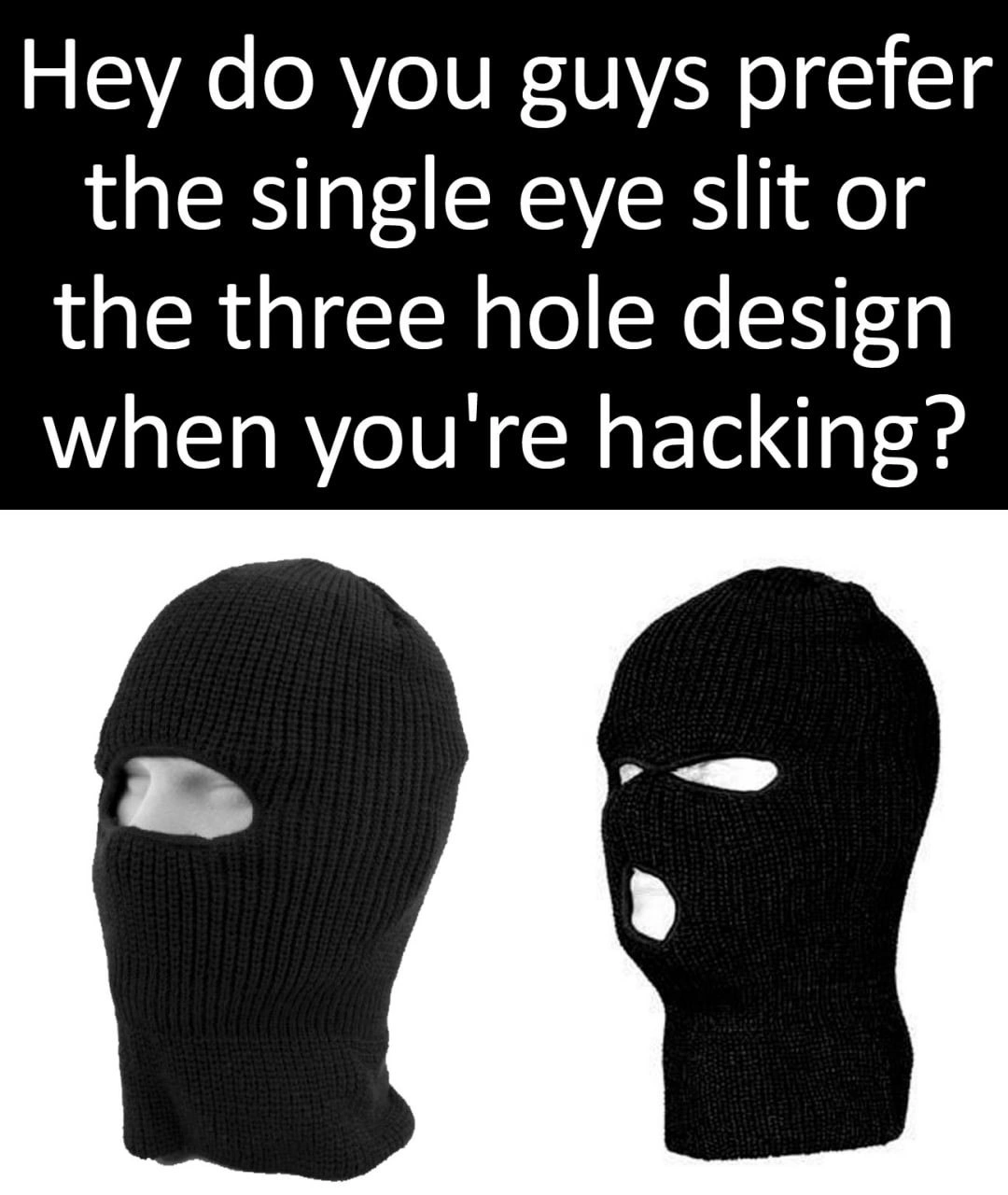
This meme is highlighting the silly idea that hackers have a special “uniform.” The image shows two black ski masks (also called balaclavas) side by side. One has a single wide opening for the eyes, and the other has three holes (two for the eyes and one for the mouth). The caption asks: “Do you guys prefer the single eye slit or the three-hole design when you're hacking?” The joke is that real hackers never actually wear ski masks when hacking on a computer, so debating mask styles is totally absurd. It's like asking a pilot what color cape they wear to fly a plane – pilots don’t wear capes, and hackers don’t wear ski masks to do their job.
Let's break down why this is funny. A ski mask or balaclava is a knit face covering that hides your identity. Burglars and robbers in movies (and in real life) wear them during physical break-ins so they won’t be recognized on cameras or by witnesses. It makes sense for a thief breaking into a house to cover their face. But hacking means breaking into computers or networks through software and the internet, not by physically entering buildings. When a hacker is typing away on a keyboard from their bedroom or office, nobody can see their face anyway! So wearing a ski mask while launching a cyber attack would be pointless – it doesn’t hide anything in the digital world. The only “mask” hackers might use is a digital one (using tools to hide their computer’s identity or IP address online), not a literal mask on their face.
There’s a big hacker stereotype in pop culture that this meme is mocking. In movies, TV shows, and even cybersecurity ads, hackers are almost always shown as mysterious figures in dark hoodies or masks, working in a dimly lit room with streams of green code on the screen. This look has become a visual cliché – it’s meant to instantly communicate “this is a hacker.” It’s true that many developers or hackers do wear hoodies (they're comfy and common casual wear), but they’re not doing it to hide their identity like a disguise; it’s just normal clothing. In reality, a hacker could be any person in front of a computer – no dramatic lighting or costume required. They might be wearing jeans and a t-shirt, and they could be working in broad daylight from a coffee shop or an office cubicle. Those spooky images in infosec marketing (infosec means information security) are used because a guy in a ski mask in a dark room looks menacing and exciting. But it’s just marketing imagery. Actual cyber attacks don’t look exciting from the outside – usually it’s just someone quietly typing at a computer.
Now, about the term black hat (since the tags mention it): in security lingo, a “black hat” hacker means a malicious hacker – basically the “bad guy” who breaks into systems without permission. It’s not an actual hat they wear; it’s a figure of speech that came from old cowboy movies (bad guys wore black hats, good guys wore white hats). By contrast, a white hat hacker is a good guy – an ethical hacker who uses their skills to help people or companies (for example, finding security bugs with permission so they can be fixed). There are even gray hat hackers who might break some rules but aren’t clearly good or evil. These terms are just labels; they don’t come with literal hats or costumes. So a "black hat" hacker isn’t literally putting on a black ski mask when they sit down at the keyboard. The meme takes that figurative idea and teases it as if it were literal – which is why it’s funny.
It’s also worth noting that some hackers (especially penetration testers – the good guys hired to test defenses) do sometimes try to break into buildings as part of a security test. But when they do, they still don’t wear obvious burglar gear! In a real-life security test, an ethical hacker might try to enter a company’s office to see if they can slip past physical security. They’ll dress like a regular employee or a repair person, not in a ski mask that would instantly raise suspicion. They might carry a fake ID badge and use social engineering (polite trickery, like asking someone to hold the door open) to get in. The idea is to blend in, not stand out. A ski mask is basically the most attention-grabbing thing you could wear – it screams “I’m a thief!” So even in actual covert missions, no one serious is having a debate about mask fashion. They’re focusing on tools and tricks, not knitwear.
To really drive home the difference between the Hollywood image of hacking and the reality, here’s a quick comparison:
| Movie Hacker Stereotype | Real-Life Hacker Reality |
|---|---|
| Wears a ski mask or dark hood while typing on a computer. | Wears whatever is comfortable (hoodie, t-shirt, pajamas) – no one sees them through the screen. |
| Sneaks into buildings at midnight to physically access a computer. | Launches attacks remotely over the internet, often from home or office, at any time of day. |
| Surrounded by dramatic green code on multiple screens in a secret lair. | Probably just using a normal laptop with some special software tools, sitting in a normal room. |
| Announces “I’m in!” or other cheesy lines for drama. | Stays quiet and runs scripts or checks logs. Real hacking involves patience and coding, not catchphrases. |
| Relies on masks, gloves, and spy movie gadgets. | Relies on coding skills and maybe anonymity software like VPNs or Tor – no dress-up needed to break into systems. |
Table: Pop culture portrayal vs. real-world hacking
As you can see, the visual hacking cliché is very different from actual hacker behavior. The meme humorously pretends that hackers treat a ski mask as standard equipment, which is far from the truth. In reality, there is no dress code for coding. Hackers succeed because of their techniques and knowledge, not because of any costume they're wearing. So the question about mask design is funny because it's the last thing a real hacker would worry about during a secret hacking operation. The bottom line: a hoodie or pajamas (and strong technical skills) are more "hacker gear" than any ski mask will ever be.
Level 3: Hollywood Hacker Chic
For seasoned security pros, this meme reads as pure satire. It's midnight, you're about to exploit a vulnerable server, and right before hitting Enter on your meticulously crafted script, you pause to debate: "Wait, am I wearing the correct ski mask for this hack?" The absurdity is immediately clear. No actual hacker does a wardrobe check at go-time; they're more worried about open ports and firewall misconfigurations than balaclava fashion. In real cybersecurity, the only mask that matters is your digital one – your IP address masked behind layers of VPNs, proxy servers, and maybe a Tor network – not a literal wool ski mask.
This meme pokes fun at the perennial gap between Hollywood's hacker stereotype and reality. Hollywood loves to portray hackers like they’re cat burglars: clad in black, faces concealed, sneaking into buildings at midnight to "hack the mainframe." It's a visual shorthand to make invisible cyber threats look dramatic. Of course, in real life, hacking is usually done remotely, often from the comfort of someone's desk or couch. Attackers hide behind screens and network anonymity, not behind ski masks. If anything, a hacker's "uniform" might be a comfy hoodie (more for warmth and habit than secrecy), not a bank-robber getup.
The question "single eye slit or three-hole design when you're hacking?" is deliberately ridiculous. It mixes up physical intrusion gear with a digital intrusion scenario. It's as if someone thinks hacking into a server is like robbing a bank vault where you'd literally need a disguise. In practice, when conducting covert midnight operations on networks, the last thing on a hacker's mind is fashion advice. A knit mask would only make it hard to see the keyboard and might earn you odd looks from your cat at 2 AM. Pro tip: A balaclava won't boost your packet-sniffing skills or help you bypass a firewall – it’ll just make you sweaty and half-blind at your keyboard.
Veteran infosec folks often roll their eyes at these clichés. We even have a term, "movie-plot threats," for scenarios like the ski-masked super-hacker abseiling into a data center – exciting in films, but vanishingly rare in real life. Most breaches aren't a James Bond break-in; they're more often an attacker quietly exploiting a weak password or an unpatched vulnerability from miles away. Why risk physical trespass (and triggering an alarm) when you can, say, phish an employee with a dodgy email and get in with far less effort? Real black hat hackers (the bad guys) don't bother with ski masks when they can be effectively invisible online. The term "black hat" itself comes from old Western movies (villains wore black hats, heroes wore white hats), but it's figurative – no actual hats required to deploy a SQL injection attack.
This meme also jabs at how infosec marketing and the media frequently depict hackers. Browse any cybersecurity article or vendor brochure, and you'll likely see the silhouette of a masked figure in a dark hoodie in front of green binary code. It's become the unofficial logo of "hacker" in pop culture. That imagery is visually striking, sure, but it's about as realistic as a bank's website showing burglars with striped shirts and swag bags to represent online theft. Security professionals have seen this trope so often it's a running joke. Social engineering experts (who trick people rather than prying windows open) will tell you that blending in is key. If an ethical hacker is doing a physical penetration test (say, trying to sneak into an office after hours), they're more likely to wear a company polo and carry a fake ID badge than to don a ski mask – the whole point is to not look like an intruder. The real stealth is digital, not dress-up.
So, the humor here comes from that stark contrast: hacking is a battle of wits and technology, not a literal costume party. The meme exaggerates the misconception to a laughable extreme – suggesting that serious hackers are out here discussing balaclava design options as if it’s mission-critical gear. It's poking fun at the Hollywood hacker chic that outsiders imagine. In truth, a ski mask won't help you crack passwords or evade detection in a network log. Hackers "mask" their identities with code and cunning, not knitwear. The only time a hacker cares about holes in something, it's in a firewall or a security policy – not in their ski mask.
Description
The image is split into two sections. The top third is a black banner with large white text that reads, “Hey do you guys prefer the single eye slit or the three hole design when you're hacking?” The lower portion shows two photos of black knitted balaclavas on mannequin heads: the left mask has one wide horizontal opening for both eyes while the right mask has three separate holes for each eye and the mouth. The joke lampoons the Hollywood cliché that every hacker dons a ski mask, contrasting physical burglary gear with the reality that most cybersecurity attacks happen from keyboards in hoodies, not break-ins. It plays on infosec marketing imagery and the cultural stereotype of the mysterious “black-hat” hacker
Comments
6Comment deleted
Single-eye slit or three-hole? Real senior pentesters run headless - zero holes, SSH only, minimal facial attack surface
The real question is whether you prefer your penetration testing with a three-factor authentication mask or just single sign-on visibility - though most of us just need eye holes big enough to see Stack Overflow through the tears of debugging production at 3 AM
The real question is whether your threat model requires the three-hole design for better peripheral vision during lateral movement, or if the single-slit provides adequate field of view for your typical privilege escalation scenarios. Either way, both designs fail basic OPSEC since neither supports multi-factor authentication for face recognition bypass
Single eye slit - smaller attack surface; the three-hole mask keeps failing pen tests: too many open ports and the mouth endpoint has no rate limiting
Neither - use ed25519 keys behind a YubiKey and a VPN; rotate keys, not balaclavas
Single slit for monolith focus; three holes for microservices - two eyes tracking pods, mouth invoking kubectl