Skip to content
DevMeme
6477 of 7435
Grok 4 Promoted as Vibe-Coding Tool That Replaces Cursor IDE
AI ML Post #7102, on Sep 5, 2025 in TG

Grok 4 Promoted as Vibe-Coding Tool That Replaces Cursor IDE

Why is this AI ML meme funny?

Level 1: Throw Everything at It

Imagine you have a big box of LEGO pieces – we’re talking every Lego piece from every set you own, all mixed together in one huge box. Now, you want to build a specific toy house from those pieces. Instead of picking out the few pieces you need for the house, you dump the entire box on your friend’s lap and say, “Here, you build the house. You’ve got all the pieces in there. Go ahead, you have a few minutes!”

Sounds a bit silly, right? Your friend would be overwhelmed by the pile of bricks. They’d have to dig through hundreds of unrelated pieces to even start finding what’s needed for that house. It’s not an easy or sensible way to get the result you want. It would be much better to give them just the pieces and instructions for the house.

This meme is joking about someone doing that kind of silly thing, but with computer code and an AI helper. The person gives all the code they ever wrote (imagine it like that big box of mixed LEGO bricks) to the AI in one go and asks it to add a new feature. It’s funny because it’s an over-the-top idea – almost like expecting a robot to understand a million things at once and solve your problem instantly. In real life (and in coding), it usually works better when you break things down into smaller parts. The joke here is showing what it would look like if someone ignored that and just threw everything at the AI hoping for a magical fix. It’s that exaggeration that makes it humorous and easy to see: you probably shouldn’t do that, but it’s fun to imagine if you could!

Level 2: All Code, One File

At its core, this meme is joking about using an AI tool in a very exaggerated way. Let’s break down what’s happening in simpler terms:

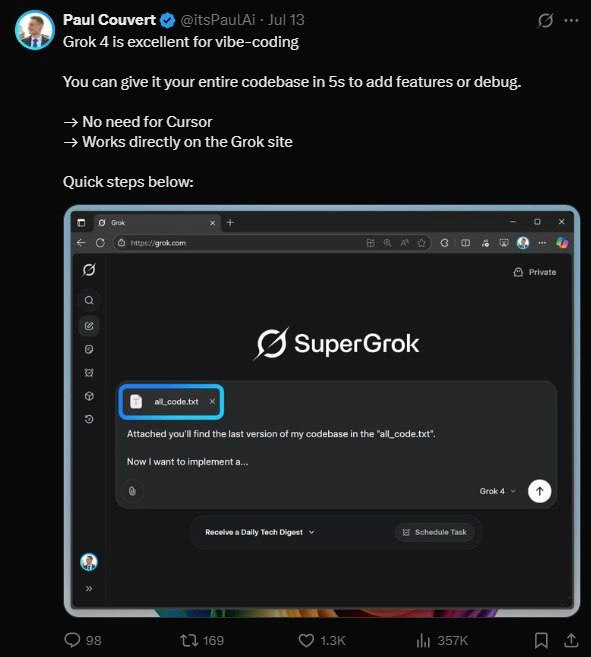
  • Grok 4 and the SuperGrok UI: Grok appears to be the name of an AI coding assistant (similar to ChatGPT or GitHub Copilot, but perhaps a specific platform’s version). The screenshot shows a chat interface called SuperGrok where you can talk to this AI. Think of it like having a super-smart chatbot that’s been trained on programming knowledge. When the tweet says “Works directly on the Grok site,” it means you use it through a web page chat, not through a separate app or coding editor.

  • “Vibe-coding” with AI: The tweet describes Grok 4 as “excellent for vibe-coding.” Vibe-coding isn’t a formal term; it’s a playful phrase. It suggests coding in a looser, more experimental way – going with the vibe (feeling) rather than following strict methodology. In practice, vibe-coding here means you throw an idea or request at the AI and just see what it comes up with, instead of carefully crafting the solution yourself. It’s like saying, “Alright AI, do your thing!” This is the style being hyped – very casual, almost magical. For a newcomer, it sounds exciting: you just describe what you want and the AI writes the code. The meme is poking fun at how idealistic that sounds.

  • Pasting the whole codebase (all_code.txt): A codebase is all the source code for a project – every file, every line of code that makes the application or website work. In any moderately sized project, the codebase is huge: maybe hundreds or thousands of files organized in folders. The normal way to use an AI assistant is to open a specific file or snippet, ask about a function, or maybe let it index your project in the background. Here, they joke that you just copy everything into one giant text file (all_code.txt) and send it to the AI in a single go. This is really unusual! Developers don’t actually combine all their code into one file – that would be chaotic. The meme exaggerates on purpose to make us laugh. It’s highlighting the idea of an “all or nothing” approach: “Here’s literally ALL my code, please fix or add to it.” It’s funny because it’s like using a sledgehammer for a task that usually needs a scalpel.

  • “No need for Cursor”: The tweet specifically says “→ No need for Cursor.” Cursor is likely referencing a tool (indeed there’s a popular AI-powered code editor called Cursor) that helps programmers by integrating AI into their coding workflow. With Cursor, you might navigate your code project and ask AI for help in context, file by file. By saying no need for it, the tweet implies Grok 4 can do the job without any special IDE or plugin – just through the chat website. Essentially, “skip that intermediate tool, just dump everything right here, it’s easier!” For a junior developer or someone new, this sounds convenient (one less thing to learn). But experienced folks suspect that’s oversimplifying. Those tools exist for a reason – they manage context and help you target specific parts of the code. Bypassing them might lead to confusion, as the AI could get lost in so much information.

  • Expectations vs Reality: The screenshot text, “Attached you’ll find the last version of my codebase in the all_code.txt. Now I want to implement a…”, showcases the user literally telling the AI “here’s everything, now do X for me.” The meme’s author is gently mocking how some people wish AI worked. Yes, AI models are very advanced and can write code, but giving it the entire codebase all at once is overkill and likely impractical. In reality, current AI coding assistants have limits. They might only accept a certain amount of text (maybe a few thousand lines) at a time. And they work better when you point them to the specific part of code or problem. If you feed in too much irrelevant information, the AI might get confused or give a very general answer. The meme exaggerates this scenario to make the hype obvious – it’s as if someone truly believes an AI can absorb a massive project in seconds and flawlessly act on it. It’s a little like pouring a whole bucket of ingredients on a chef and expecting a perfect cake to pop out immediately.

  • Why it’s humorous: For someone new to coding, imagine this: normally, to add a feature, you’d open the relevant part of the project, maybe two or three files, focus on those, and code the feature. It’s a bit of work and understanding. The meme shows someone basically saying, “Let me skip all that effort and understanding – I’ll just give the AI everything and tell it what I want. Done!” It’s funny because it feels like a schoolkid handing the teacher an entire backpack of notebooks and saying, “My answer is in there somewhere, can you find it and give me an A?” We know that’s not how things work, but it sure would be nice if it did! The developer humor here comes from recognizing that this “one-click fix” mentality is wishful thinking. It pokes fun at the current AI hype by showing an absurd use-case.

To sum up Level 2: this meme is a light-hearted critique of over-relying on AI in software development. It uses the absurd image of a single file with all code as a joke to highlight that while AI tools are powerful, you can’t just bypass all good practices and expect perfect results. It’s a reminder that new tools should complement developer workflow, not become a magical shortcut (especially not one that involves a 100MB text file copy-paste!).

Level 3: One File to Rule Them All

The meme shows a developer doing the unthinkable: attaching their entire codebase as a single file named all_code.txt into an AI chat. The tweet above gushes about Grok 4 (an advanced coding LLM, or Large Language Model) being “excellent for vibe-coding” – essentially coding by feel with AI’s help. It even boasts, “You can give it your entire codebase in 5s to add features or debug.” Seasoned engineers immediately smirk at this scenario. It’s both hilarious and horrifying, like watching someone pour a data lake worth of code into a chatbot and expecting magic. We’ve all seen hype cycles, and this one’s cranked to 11.

Let’s unpack why experienced devs are raising an eyebrow:

  • Monolithic Mayhem: Real-world projects are split into dozens or thousands of files for a reason – modularity, clarity, and maintainability. Stuffing millions of lines of code into one giant all_code.txt goes against every principle of source control and sane architecture. It’s the ultimate monolith: all eggs (or code) in one basket. A senior dev sees that file name and immediately imagines a nightmare merge conflict or a single typo bringing down the whole system. It’s a tongue-in-cheek reference to the mythical “big ball of mud” codebase – only now you’ve handed that mud ball to an AI and said “Here, you deal with it.”

  • Token Limit Overload: Today’s LLMs (like GPT-4, etc.) have a maximum context window – essentially the amount of text they can ingest at once. This tweet’s suggestion of handing over the entire repo would obliterate those limits. In practical terms, if your codebase is hundreds of thousands of lines, no current AI model can literally read all of that in one go without some fancy chunking or vector database tricks. The meme exaggerates this with the 5-second claim – as if poof!, the AI will absorb and understand your sprawling code instantly. Experienced devs know that even indexing and searching a large repo takes time (and good tools). So the idea of an instant one-file upload “Works directly on the Grok site” comes off as pure ✨ AI hype ✨. It’s like saying you can read an entire library in 5 seconds because you have a new pair of glasses. We’re not buying it without seeing the science.

  • Hype vs. Reality (No Silver Bullet): The meme pokes fun at our industry’s constant search for a silver bullet. Today’s hype is AI pair programming, with tools like GitHub Copilot, Cursor, and now Grok promising to revolutionize development. The tweet even jabs at Cursor (“→ No need for Cursor”) implying that Grok’s so powerful you can ditch specialized IDE helpers. A veteran dev chuckles here – it sounds just like the promises of yesteryear: “Forget unit tests, our new framework never fails!” or “Forget manuals, Clippy will handle it!” We’ve been promised “just push a button and the code writes itself” many times. 😏 In reality, each tool has its trade-offs and a tendency to be oversold. Today’s Grok 4 might be amazing, but claiming it renders all prior tools obsolete and can do all your coding by “vibe” smells like classic IndustryTrends_Hype. The meme beautifully satirizes that breathless optimism.

  • Shared Trauma of Debugging: There’s an undercurrent of dark humor every senior dev recognizes: when you’re absolutely stuck on a bug at 3 AM, you’ve probably tried desperate measures. Admit it – you’ve copy-pasted a huge error log or multiple source files into Stack Overflow or an AI hoping for insight. “Maybe if I just dump everything, it’ll figure it out,” says the panicked voice in our heads. This meme takes that to a ridiculous extreme: “Attached you’ll find the last version of my codebase… Now I want to implement a… (something).” It’s funny because we have felt that temptation, but we also know it’s a long shot. A veteran sees that and thinks, “Oh sure, I’ll just feed the omniscient AI my spaghetti code and get a perfect feature diff. And maybe it will also solve world hunger while it’s at it.” The reality is that debugging and feature implementation are complex, often iterative tasks. No AI (yet) can replace understanding the system’s architecture and context that only developers gain over time.

  • Practical Red Flags: Beyond humor, there’s a practical OMG moment: uploading your entire proprietary code to a third-party AI service. DeveloperExperience_DX isn’t just about convenience; it’s also about safety and policy. Many companies’ security teams would have an aneurysm if an engineer tried to paste the whole codebase into a web UI 😬. The meme’s scenario is so absurd that it sidesteps those concerns for the laugh, but a senior dev can’t help but think, “Good luck explaining to the boss where all your code went.” Even if the Grok UI says “Private” in the corner, we know that doesn’t magically grant you an NDA with the AI. So this adds another layer of chuckling – it’s not just technically far-fetched, it’s also something you’d never get approval for in a serious production environment.

In short, Level 3 humor lies in how over-the-top the scenario is. It combines the latest tech buzzwords with an almost naive faith that complex software engineering can be reduced to a single-step AI prompt. The experienced perspective appreciates the satire: it’s a send-up of our tendency to dream that maybe this new tool will do our jobs for us. Deep down, we know better – but it’s fun to imagine, and even funnier to see it memed so bluntly.

Description

A screenshot from X.com showing Paul Couvert (@itsPaulAi) posted on Jul 13: 'Grok 4 is excellent for vibe-coding. You can give it your entire codebase in 5s to add features or debug.' with bullet points: 'No need for Cursor', 'Works directly on the Grok site'. Below is a screenshot of the SuperGrok interface at grok.com showing a file 'all_code.txt' uploaded with the prompt 'Attached you'll find the last version of my codebase in the "all_code.txt". Now I want to implement a...' using Grok 4 model. The post has 98 comments, 169 retweets, 1.3K likes, and 357K views. This captures the AI coding tool landscape where every new model becomes the next 'IDE killer'

Comments

22
Anonymous ★ Top Pick Dumping your entire codebase into a text file and uploading it to an AI chatbot is what we call 'vibe-coding' now -- back in my day we called it 'giving up'
  1. Anonymous ★ Top Pick

    Dumping your entire codebase into a text file and uploading it to an AI chatbot is what we call 'vibe-coding' now -- back in my day we called it 'giving up'

  2. Anonymous

    Ah, 'all_code.txt'. The final evolution of version control, where 'git blame' is just you, staring at the two-million-line file, blaming yourself for ever thinking this was a good idea

  3. Anonymous

    Because nothing says "enterprise-ready" like zipping a 2-million-line monolith into all_code.txt and hoping the 16-k-token context window figures out your circular dependencies before the coffee gets cold

  4. Anonymous

    Ah yes, 'vibe-coding' - when you've given up on understanding your codebase so thoroughly that you're willing to upload the entire thing to Elon's AI and hope it vibes with your technical debt better than you do. Nothing says 'senior architect' quite like trusting critical business logic to an LLM that learned programming from Twitter threads

  5. Anonymous

    Ah yes, 'vibe-coding' - where you upload your entire legacy monolith as a single text file and an LLM magically refactors 15 years of technical debt in 5 seconds. I'm sure the context window won't hallucinate that critical payment processing logic into a recursive cat fact generator. But hey, at least we've finally automated the 'works on my machine' excuse into 'works in my prompt.'

  6. Anonymous

    Cursor: 'Gimme your whole monorepo.' Grok 4: 'Nah, just the file' - peak DX, zero context bloat

  7. Anonymous

    Pro tip: “No need for Cursor” usually implies “yes need for counsel” - monorepo-as-all_code.txt tends to exceed context windows and security budgets simultaneously

  8. Anonymous

    Strategy meeting: zip the monorepo into all_code.txt, upload to Grok, and let it “add features” - boom, instant onboarding, instant vendor lock-in, and a SOC2 finding that writes itself

  9. @Algoinde 10mo

    cat **/* >> codebase.txt

    1. dev_meme 10mo

      node_modules goes brrrrrr

    2. アレックス 10mo

      Wouldn’t preserve file names or hierarchy. You want find . -print -exec cat {} \; > codebase.txt

  10. @paranoidPhantom 10mo

    Its only Paul AI relax guys

  11. @CcxCZ 10mo

    Ultima Ratio Regum moment

  12. @n3oney 10mo

    Wait till you find https://repomix.com/

    1. @qtsmolcat 10mo

      Just sends you back a picture of spaghetti

  13. @TERASKULL 10mo

    he even texts the LLM like a corporate cuck, not surprised

  14. @AlexKart20129 10mo

    Actually, Grok can accept individual code files, up to 10 at a time. But Qwen only accepts TXT files, and for it I really need to use this trick with one big TXT file.

  15. @M4lenov 10mo

    I did put a whole library into a single txt file for gemini to read it

  16. @NaNmber 10mo

    I do this, works for me import { appendFileSync, readFileSync } from 'fs'; import { readdir } from 'fs/promises'; import { join } from 'path'; const ROOT = './'; const IGNORE = ['.git', 'node_modules', 'yarn.lock', 'package.json', 'pnpm-lock.yaml']; const OUT = 'out.txt'; const init = async () => { const entries = await readdir(ROOT, { recursive: true, withFileTypes: true, }); const files = entries.filter((e) => e.isFile()); for (const entry of files) { const fullPath = join(entry.parentPath, entry.name); console.debug('Checking:', fullPath); if (IGNORE.some((el) => fullPath.includes(el))) { console.debug('Ignoring:', fullPath); continue; } console.debug('Passing:', fullPath); const content = readFileSync(fullPath, 'utf-8'); const out = `/*start of file [${fullPath}]*/\n` + content; appendFileSync(OUT, out + `/*end of file [${fullPath}]*/\n\n`); } }; init();

  17. @n3oney 10mo

    One xml file for the entire repo lmao

  18. @n3oney 10mo

    And if you have enough of a context window it can work to explain something lol

  19. @Diotost 10mo

    I tried to upload a long log file to minimax ai, but it couldn't read it fully.

Use J and K for navigation