Skip to content
DevMeme
3044 of 7435
The Absurdist Critique of Productivity Culture
MentalHealth Post #3359, on Jul 1, 2021 in TG

The Absurdist Critique of Productivity Culture

Why is this MentalHealth meme funny?

Level 1: Never-Ending Chores

Imagine you have to clean your room, but no matter how often you clean it, it magically gets messy again by the next day. You pick up all your toys, put away your clothes, and feel good for a moment – but when you turn around, it’s like the mess just respawned. 😓 It feels like you could clean forever and never be done. Kinda unfair, right? That’s the basic joke of this meme. It’s saying a programmer’s work is like those chores that never stay finished. For example, every time you finish one homework assignment, there’s another one tomorrow. If you wash the dishes today, by dinner there are more dirty dishes. It can make you feel frustrated, like “Why do I even try to finish it all?” The meme plays with this feeling by pretending to be a serious work poster that instead says “STOP DOING” – as if the solution is to just quit trying so hard. It’s a silly, over-the-top way of expressing how tiring and endless work can feel. The final line, “They have played us for absolute fools,” is like when you find out a game you were playing has no winning point – you might laugh and say, “I can’t believe I fell for that!” So the meme is funny because it uses everyday stuff (like too many emails, to-do lists, and cleaning the house) to show how grown-up work often feels like a game you just can’t win. It makes us laugh at the feeling of “ugh, this never ends!” so we don’t feel so bad about it. After all, sometimes the only way to deal with never-ending chores (or work) is to joke about how crazy it is, then take a break and maybe play a real game for fun.

Level 2: Endless To-Do List

If you’re a newer developer or just starting your tech career, this meme might seem a bit over-the-top, but it’s riffing on something you’ll recognize soon: the endless to-do list that comes with professional programming (and, well, adult life in general). Let’s break down the key pieces. First, the term backlog in software refers to the collection of all outstanding tasks for a project or team. Think of it as the master to-do list of features to add, bugs to fix, improvements to make, you name it. In methodologies like Agile/Scrum, you continuously pull tasks from the backlog into sprints (short work cycles) to tackle them. The joke here is that no matter how many tasks you complete, the backlog never empties out. There’s always another Jira ticket or sticky note waiting, or new ones being added. This can be shocking for someone fresh out of school – unlike a homework assignment, you can’t just finish all the work and go “Done, time to relax for the rest of the year!” In a real development team, finishing 5 tasks often leads to discovering 10 new tasks. Fix one bug, and you might uncover two more. Ship version 1.0, immediately start planning 1.1. So it ends up feeling like you’re running on a treadmill: lots of effort, but the finish line keeps moving.

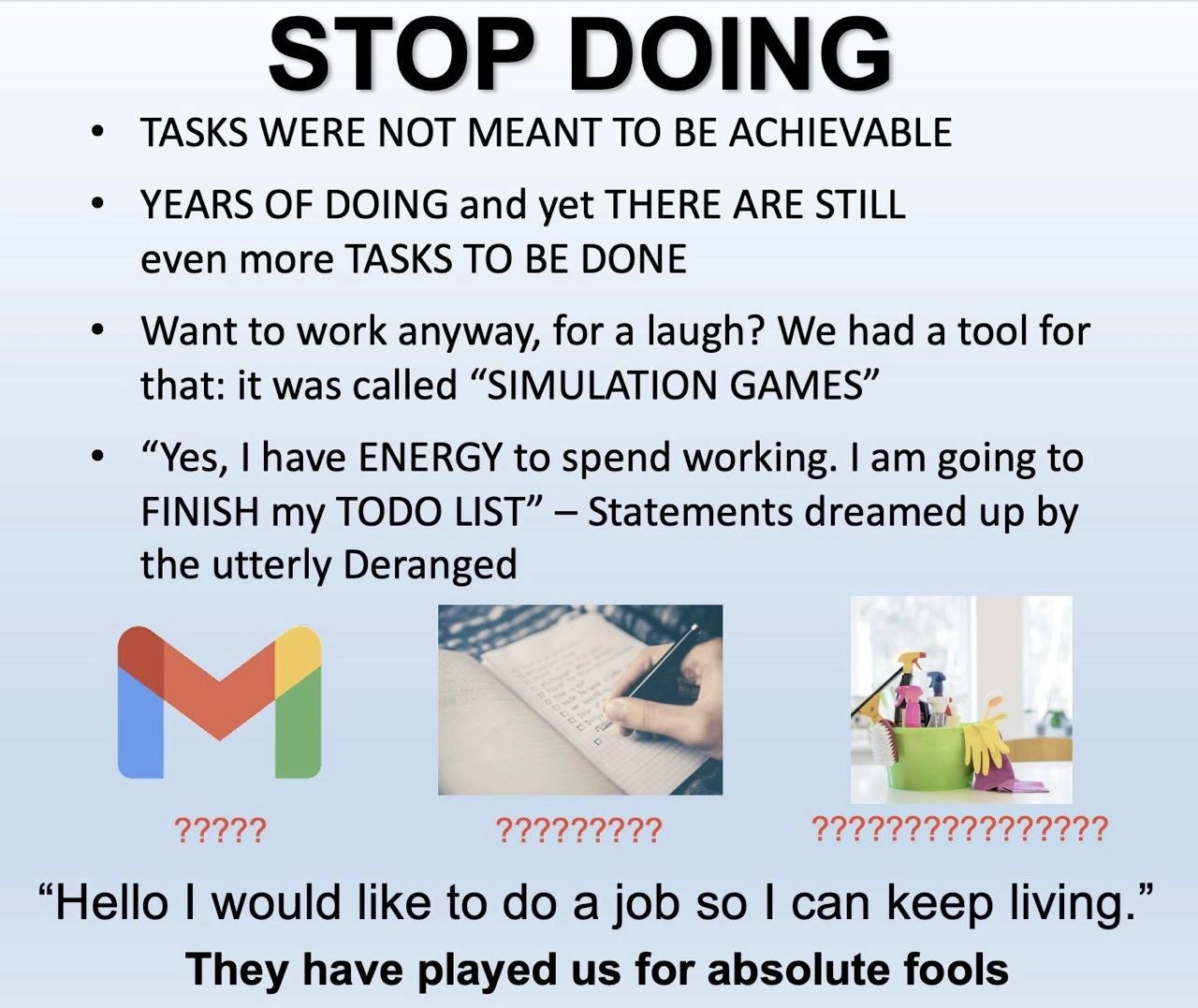
The slide in the meme exaggerates a truth to make a point. It’s styled like a company’s PowerPoint slide with a big bold heading “STOP DOING”. Normally companies encourage productivity and hustle, so seeing “STOP DOING” is immediately funny – it’s the opposite of corporate-speak. Each bullet item on that slide is dripping with sarcasm. For example, “TASKS WERE NOT MEANT TO BE ACHIEVABLE” is a dramatic way of saying “don’t expect to finish every task.” When they say “YEARS OF DOING and yet THERE ARE STILL even more TASKS TO BE DONE”, it’s reflecting a common developer frustration: you might spend years coding, yet every morning you still have a long list of things to do. It’s not that you didn’t work hard or smart; it’s that software is a moving target. Requirements change, users request new features, and technology evolves, so new work keeps appearing.

One bullet jokes about simulation games: “Want to work anyway, for a laugh? We had a tool for that: it was called ‘SIMULATION GAMES’.” This is referencing video games that simulate real-life activities or management, like SimCity, The Sims, or even those tycoon games where you run a virtual business. In those games, there’s always some task to manage – your Sims character’s house perpetually needs cleaning and upgrades, or your city always has another traffic jam to fix. The meme is wryly saying, “if you strangely enjoy doing never-ending tasks, go play one of those games for fun, instead of doing extra work in real life.” It’s poking fun at the idea that working more for no real finish is about as productive as playing a game. At least games are entertaining! The simulation_games_reference here helps developers laugh at themselves – sometimes we treat our work like a game we think we can beat if we just try harder, but in reality it’s more like an open-world game that doesn’t end.

Now look at the images beneath the bullet points. They’re not random – they each symbolize a different endless task domain. The first is the Gmail logo (the email icon) with “?????” under it. This points to the phenomenon of inbox overload. Many of us have seen an inbox count so high that it might as well be question marks. For instance, Gmail might show something like “99+” unread if you have over ninety-nine unread emails. It’s a playful way to say “the emails keep coming and I can’t keep up.” Developers often get tons of emails: automated build alerts, code review requests, support tickets, meeting invites – it piles up quickly. Chasing Inbox Zero (clearing all emails) starts feeling like chasing a mirage, especially when you’re busy coding or in back-to-back meetings. Seeing “?????” is an exaggeration, but any junior dev who’s returned from a week off knows the slight horror of opening their email to 300+ new messages.

The middle image shows a hand writing on a checklist, labeled “??????????”. This represents your personal to-do list or work task list. The question marks imply an unknowably large number of tasks – basically so many tasks that we can’t even count. As a new developer, you might maintain a list of things you need to do: fix bug #123, implement the login feature, review Alice’s code, update documentation, and so on. The joke is that this list will never be fully checked off. No matter how diligently you work, there will always be another line to add. It’s like when you’re new and think, “I’ll finish all my assigned tasks and then I’ll be free.” Seasoned coworkers might chuckle because they know as soon as you finish those, the team lead will hand you new ones. This isn’t because anyone is evil – it’s just the nature of working on a living product. So the meme is using a bit of hyperbole (lots of question marks) to convey that feeling of seeing your task list just keep growing.

The third image is a bucket of cleaning supplies, again with an exaggerated string of question marks beneath. This is an everyday cleaning_chore_metaphor. Chores like cleaning the house or doing laundry are a perfect analogy for endless tasks. Think about it: you take a day to clean your room spotless. Done! But a week later, dust has settled, clothes are on the floor again, the trash bin is full – time to clean again. It’s a loop that never ends because life keeps happening. The meme uses this to mirror software work: maintaining a codebase is like cleaning, you can’t just do it once. For instance, you might refactor (clean) a messy piece of code. A month later, new features made other parts messy, or a new bug messed up that old code again. This image makes the meme relatable even beyond coding – anyone who’s done housework knows the futility of the phrase “I finished all the cleaning” (it only stays “finished” for a very short time!). By including the cleaning supplies, the meme says “see, it’s not just you, everybody’s to-do list in life is unending.”

Finally, the bottom captions tie it all together with a hefty dose of sarcasm and reality. “Hello I would like to do a job so I can keep living.” is a deliberately plain, almost pathetic statement. It’s like someone politely raising their hand saying, “I’ll work because I need the paycheck.” It highlights the grim truth that many of us work out of necessity – we need to pay rent, buy food, survive. Then, in bold, “They have played us for absolute fools” delivers the punchline. “They” could mean the corporate bosses, society, or the whole system that convinces us to keep grinding. It suggests that by agreeing to this never-ending workload, we’ve been tricked or bamboozled. Of course, this is an exaggeration meant to be funny – it’s the meme’s way of venting developer frustration. When you’re a junior, you might still feel energized to tackle everything (you might even relate to the mocked quote about having energy to finish your to-do list – that optimism of “I got this, I’ll clear my list today!”). This meme lovingly calls that optimistic person “utterly deranged”. Don’t take it personally – we’ve all been that person at some point, thinking we could finish all our work if we just pulled an all-nighter or found the perfect system. Over time, though, you learn endless work is… well, endless. The humor here is a bit like a senior developer putting an arm around a newbie and saying with a chuckle, “Oh, you sweet summer child, you think the task list actually ends? Let me tell you, it doesn’t. So don’t drive yourself crazy.”

In simpler terms, the meme is both a joke and a tiny caution. It’s DeveloperHumor highlighting a mental health tip in disguise: work-life balance matters because work will always be there. There will always be more deadline pressure and more tasks. So pacing yourself is key. The meme’s dramatic “STOP DOING” isn’t literal advice (we can’t all just stop working!), but it’s a sarcastic reminder not to fall for the trap of overwork – thinking “I’ll just get everything done then I can rest” can lead straight to DeveloperBurnout when you discover “everything” never ends. Better to do your reasonable share, then log off and live your life too. You are not a fool for not finishing all tasks; the system is set up that way. By laughing at the absurdity of a never_ending_backlog, even junior devs and team members can bond over the shared challenge and maybe feel a little less stressed when their to-do list inevitably has a few carry-overs to tomorrow. After all, as this meme implies in a tongue-in-cheek way, procrastination humor aside, you’re not alone – everyone’s in the same infinite boat of tasks, so take a breath, do your best, and don’t forget to hit “Pause” (or go play a real simulation game for a break!).

Level 3: The Sisyphean Sprint

In the world of software development, finishing all your work is a bit like finding a unicorn – magical and impossible. This meme nails that truth with dark humor. It parodies a slick corporate motivational slide, except it’s telling us to “STOP DOING”. Why? Because our backlog of tasks behaves like a mythical Hydra: complete one task, and two more pop up to take its place. The first bullet point mocks us with “TASKS WERE NOT MEANT TO BE ACHIEVABLE” – a sarcastic twist on what every burned-out senior dev knows in their bones. In Agile terms, the backlog is essentially infinite, a queue that constantly refills. Every sprint planning, we slay a couple of Jira tickets, and by Friday, product managers have added a dozen more. It’s a perpetual cycle – a Sisyphean sprint where you roll the boulder of code up the hill, deploy to production, and whoops, here come more bug reports and feature requests rolling right back down.

This humor hits on a core DeveloperProductivity paradox: no matter how many all-nighters you pull, there’s always another task lurking. The slide’s format lampoons typical CorporateCulture presentations – but instead of droning on about efficiency and growth mindset, it bluntly admits the truth every frustrated developer jokes about after their 5th cup of coffee. It’s essentially saying, “the backlog will never die, so why are we killing ourselves trying to conquer it?” This resonates as shared pain in tech teams everywhere. We’ve all watched our todo list only grow over YEARS OF DOING, as the second bullet shouts in exasperation. New features, refactors, support tickets, tech debt cleanup – the buffet of work never closes. Senior engineers know that software is never truly “done”, it’s just in a state of “not broken at the moment.”

The meme also drags everyday tasks into the mix with biting sarcasm. The Gmail logo at the bottom left, labeled with “?????”, represents the inbox overload developers face. Ever seen your unread email count climb into the triple or quadruple digits until the app just shows 99+ (or in this case, question marks because even Gmail is like “I can’t count this high”)? Yeah, that’s the life – clearing your email is as futile as achieving Inbox Zero under deadline pressure. Next to it, a photo of a hand writing a checklist with “??????????” underscores todo list futility: you can write down all your tasks, but the list of checkboxes never ends – it just scrolls forever like an infinite simulation log. And then there’s the bucket of cleaning supplies with an absurd number of question marks: the cleaning_chore_metaphor. It equates writing code to cleaning your house; you scrub the kitchen clean (deploy a stable release), but a week later it’s messy again (critical bug or new user request!). Even outside of coding, life chores are endless – laundry today, laundry tomorrow, ad infinitum. By juxtaposing the Gmail icon, a to-do list, and cleaning supplies all labeled with “?????”, the meme drives home that every facet of adult life is an endless to-do list. They have played us for absolute fools, the caption declares in bold, as if revealing the grand conspiracy of modern work: whether it’s sprint tasks, email replies, or household chores, you’re trapped in an unwinnable simulation game.

There’s a sly reference here to the idea of work as an “infinite game.” In game theory or life philosophy, an infinite game has no finish line – the goal is just to keep playing. Sound familiar? Software projects and startup roadmaps are exactly that. There’s always a version 2.0, a new platform to support, another performance tweak. Your Deadline on Friday just turns into next Monday’s new sprint planning. The meme’s third bullet even jokes, “Want to work anyway, for a laugh? We had a tool for that: it was called ‘SIMULATION GAMES’.” This line suggests that working on endless tasks is as absurd as willingly playing a game that never ends. It’s referring to games like SimCity or Stardew Valley (or those addictive idle clicker games) where there’s always another crop to harvest or city block to build, but no final victory condition. The comparison is biting: if you really enjoy doing tasks with no finish, hey, play a video game! At least games are supposed to be fun – work burnout is not. This is classic DeveloperHumor mixed with existential dread. Seasoned devs often joke that tools like Jira or Trello feel like MMORPGs (Massively Multiplayer Online Games): you have quests (tickets), grinding (coding), and the fabled “Done” column is just a temporary resting place before the next expansion pack of work drops.

What makes this meme cathartic for experienced engineers is the raw sarcasm and truth bombs about DeadlinePressure and WorkLifeBalanceTips. The last line at the bottom, “Hello I would like to do a job so I can keep living.” perfectly encapsulates the bleak bargain: we work to survive, but the work itself might be gradually eroding our sanity. It’s an acknowledgment of the DeveloperBurnout cycle – you need a job to pay the bills, yet the job’s endless demands drain your life. That bold punchline “They have played us for absolute fools” sounds like the awakening of a burned-out programmer who just realized their never_ending_backlog isn’t a bug in the system; it is the system. It’s the same energy as discovering a cheat code that reveals the game was rigged from the start. Many senior devs relate to this moment of clarity (often at 3 AM after deploying “one last hotfix”) when you think, “All this overtime, and for what? There will just be another version, another list of tasks.” It’s a bitter laugh, a form of collective therapy through meme. We share this SharedPain not to despair, but to feel less alone in the absurdity. After all, realizing the backlog is infinite can paradoxically be freeing – you stop pretending you’ll reach a mythical state of “done” and maybe, just maybe, you take a freaking weekend off. As the meme bluntly says, “Statements like ‘I am going to FINISH my TODO list’ were dreamed up by the utterly deranged.” In other words, only a newbie or a madman believes you can completely finish all your tasks. Seasoned devs know better; instead, we prioritize ruthlessly, tackle what we can, then log off to fight another day. It’s a survival skill in tech.

To put it in pseudo-code for the truly tech-savvy, the workflow often looks like:

# Represent an endless backlog processing loop
backlog = ["Initial feature request"]  
while True:  
    task = backlog.pop(0)               # Take the first pending task  
    print(f"Working on: {task}")  
    complete(task)                      # Finish the task (in theory)  
    # Each completed task begets two new tasks (follow-up features, bug fixes, etc.)  
    new_tasks = [task + " - followup A", task + " - followup B"]  
    backlog.extend(new_tasks)           # Add the new tasks to the backlog  
    if backlog.is_overwhelming():  
        coffee += 1                     # Developer grabs another coffee when drowning in tasks  

This tongue-in-cheek snippet never terminates – just like your backlog. New tasks (followup A, followup B) keep spawning. It’s a lighthearted way to illustrate why doing more work often creates more work. For example, implement one new feature and suddenly you have to fix two unexpected bugs or write tests for it. ProductivityLoss creeps in because the finish line always moves further away. No matter how heroically you code today, tomorrow the backlog monster is hungry again. Recognizing this doesn’t mean we stop caring, but it sure gives context to that feeling of futility. CorporateCulture often glosses over this reality with pep talks, but this meme just lays it out: chasing the end of an infinite task list will drive you crazy. The senior perspective here is clear-eyed and a bit cynical: don’t fall for the “just push a little harder and you’ll be done” trap. There’s always “even more TASKS TO BE DONE.” Instead, work sustainably, take that joke of a backlog with a grain of salt, and remember you’re not alone in this absurd simulation game we call a career in software.

Description

This image is a surrealist, anti-work meme presented as a slide or a poster with the bold title 'STOP DOING'. It features a series of bullet points that satirize the nature of modern work, such as 'TASKS WERE NOT MEANT TO BE ACHIEVABLE' and '"Yes, I have ENERGY to spend working. I am going to FINISH my TODO LIST" - Statements dreamed up by the utterly Deranged'. Below the text are three images: the Gmail logo, a person checking off a to-do list, and a bucket of cleaning supplies, each with an increasing number of red question marks beneath them. The meme concludes with the statement: '"Hello I would like to do a job so I can keep living." They have played us for absolute fools'. This meme is an existential critique of the endless cycle of tasks and the societal pressure to be constantly productive. For senior engineers, it resonates with the feeling of burnout and the Sisyphean nature of infinite backlogs, inbox-zero goals, and the realization that the reward for work is often just more work, all while being a necessity for survival

Comments

9
Anonymous ★ Top Pick I've started treating my Jira backlog like a memory leak; I know it's growing, but I'm betting I'll get a new job before it causes a total system crash
  1. Anonymous ★ Top Pick

    I've started treating my Jira backlog like a memory leak; I know it's growing, but I'm betting I'll get a new job before it causes a total system crash

  2. Anonymous

    Our backlog is clearly procedural generation: every ticket you close triggers the PM’s noise function to spawn two refactors and a hotfix - yet they still want an exact ship date

  3. Anonymous

    After 20 years in tech, I've realized our sprint backlogs are just Conway's Game of Life - no matter how many tickets you close, they spontaneously generate new ones through some emergent property of organizational complexity. The only winning move is to redefine 'Done' until it becomes philosophically meaningless

  4. Anonymous

    After 15 years in the industry, I've realized that productivity tools are just distributed systems for procrastination - they promise eventual consistency with your goals, but in practice, you're just sharding your anxiety across multiple databases while your backlog scales horizontally into infinity. The real MVP is accepting that your sprint velocity will never match stakeholder expectations, no matter how many Kanban boards you instantiate

  5. Anonymous

    After 20 years I’ve learned our backlog isn’t a list - it’s an M/M/1 with λ > μ; “stop doing” is just enforcing WIP limits before Little’s Law converts us to burnout-as-a-service

  6. Anonymous

    Senior epiphany: Gmail, the TODO list, and “clean up tech debt” are just three UIs over the same infinite queue; anyone promising to finish it is proposing a stop-the-world GC in production

  7. Anonymous

    PMs dreaming up TODOs like untestable edge cases: theoretically finite, practically an infinite loop of deranged optimism

  8. @nuntikov 5y

    Anyway, stop doing scrum

  9. @mykolamor 5y

    Imagine doing tasks on your job. But you're a mobile developer. You're creating a TO-DO checklist app. That's the bottom of the barrel. You're a fool, an absolute buffoon! Just let that sink in and feel the misery...

Use J and K for navigation