Fixing Google's Outage by Inverting a Binary Tree
Why is this Interviews meme funny?
Level 1: Puzzles Don’t Fight Fires
Imagine all the lights go out in your entire city – a complete blackout. Electricians are rushing around to fix the power outage, which is a really complicated and urgent problem. Now picture someone joking, “Hey, have the electricians tried solving a Rubik’s Cube to get the power back on?” 😅 Obviously, solving a colorful cube puzzle won’t bring back electricity. It’s a totally unrelated solution, and that’s exactly why it’s funny to say – it’s silly.
In this meme, something like that happened in the tech world: Google (a giant company on the internet) had a huge problem where all its services went down at once – kind of like the lights going out on the internet for a lot of people. That’s the serious part. The funny part is someone made a joke: “Did they try to fix it by inverting a binary tree?” – which is basically saying “maybe they should try doing this little brain-teaser puzzle to fix the big outage.” It’s the same type of humor as the Rubik’s Cube joke. Inverting a binary tree is like a nerdy little puzzle that Google is famous for asking in job interviews (it’s like a test or riddle for programmers). But it has nothing to do with fixing real problems when a website or service is down.
So why do people laugh? Because the suggestion is so absurd and mismatched. It’s like telling a firefighter who’s putting out a big fire, “Hey, have you tried doing a crossword puzzle to solve it?” It makes us giggle because it’s obvious a puzzle won’t fix a real crisis, but it playfully teases Google (since Google loves that puzzle in interviews). In simple terms, the meme is funny because it mixes something very serious (all of Google being broken – oh no!) with something very trivial (a little coding puzzle – haha). Even if you don’t know the technical details, you can appreciate that they’re joking about using the wrong tool for the job, just to be cheeky. It’s a bit like laughing in a tense moment – it helps everyone feel a tiny bit better while the experts work on the real fix.
Level 2: Data Structures & Downtime
Let’s unpack the joke in a more straightforward way. First, some definitions for those who might not be familiar with the terms:
- Binary Tree: This is a basic data structure in computer science. Think of a family tree or an organization chart, but each person (node) can have at most two children (often called left child and right child). For example, in a binary tree that represents numbers, each node might have a left number and a right number branching off from it. If you invert a binary tree, you essentially swap the left and right branches of every node. Visually, it’s like taking the tree and flipping it like a mirror image. In coding, inverting a binary tree is a common exercise – you can do it with a simple recursive function. It’s a staple of coding interviews because it tests if you understand trees and recursion. Here’s a quick example of what that code might look like:
def invert_tree(node):
if node is None:
return None
# recursively invert the subtrees
left_subtree = invert_tree(node.left)
right_subtree = invert_tree(node.right)
# swap the left and right children
node.left = right_subtree
node.right = left_subtree
return node
# This function flips the binary tree.
# It's a classic interview question (especially at Google),
# but unfortunately it won't magically fix a broken server!
Google-wide outage: This means that all or most of Google’s major services went down (unavailable) at the same time. In December 2020, there was indeed a real incident where many Google services like Gmail, YouTube, Google Drive, etc., were unreachable for about an hour. Even the admin tools (like the Google Cloud Console, which is the website Google’s engineers and customers use to manage cloud resources) were down. In tech terms, we call this a production outage or downtime. Production is what we call the environment where the live software runs (the one users interact with). An outage means users can’t use the service as expected (kind of like a power outage but for an online service).
DevOps/SRE team: DevOps (Development Operations) or SRE (Site Reliability Engineering, a term Google itself popularized) are the engineers responsible for keeping services running smoothly. They build and maintain the infrastructure that runs the software. If something breaks, these are the folks who get alerts (often through a system like PagerDuty that literally pages them or sends a loud alarm) and jump into action to fix the issue. Being on-call means a specific engineer (or a few) must be available at any time (usually rotations of nights/weekends) to respond if an incident happens. It’s like being a firefighter for software systems – if there’s a fire (outage), the on-call engineer’s job is to put it out, or at least contain the damage.
“Feel the pain of their devops team”: This phrase from the meme means we should sympathize with how stressful and unpleasant that situation is for the engineers responsible. When something as important as Google goes down, those engineers are under huge pressure. Imagine millions of people not able to access Gmail – news spreads fast, managers are in panic mode, Twitter is blowing up with “Google is down?!” posts. The on-call team is likely scrambling to identify the problem and fix it ASAP. It can be a scary situation, and definitely a painful one in terms of stress (and perhaps career impact). So the original post is basically saying “let’s take a moment to appreciate that some folks at Google are having probably the worst day of their year right now trying to fix this.”
Now, the joke: “Did they try to fix them by inverting a binary tree?” To someone not familiar with Google or tech interviews, this sounds random. Why would you invert a data structure to fix Google? That’s the point – it is totally random as a solution, and that’s why it’s funny. Here’s the context to understand it:
Google (and other big tech companies) are known for asking tough coding interview questions. They often involve algorithms, data structures, and problem-solving on a whiteboard or shared doc. One very commonly cited example of such an interview question is “Invert a binary tree.” It’s almost become a joke on its own because of how often it’s reportedly used. Many coding practice sites and interview guides include the “invert a binary tree” problem, so it’s kind of a representation of all those leetcode-style interview questions.
However, when it comes to fixing real outages, the skills and actions required are totally different. Solving an interview puzzle like a binary tree inversion doesn’t actually help you fix a server or bring back a service that’s down. Real outages might be caused by things like a bug in the code, a misconfiguration, a hardware failure, a network issue, or some service running out of memory or quota. Fixing those could involve restarting servers, deploying a quick patch, rolling back a recent update, or reconfiguring something in the infrastructure. This is usually done via command-line tools, monitoring dashboards, and scripts – not by writing a new algorithm on the spot.
So the commenter is joking by suggesting a comically simplistic solution to an incredibly complex problem. It’s similar to the classic IT support joke, “Have you tried turning it off and on again?” – except tailored to Google’s stereotype. In other words, they’re saying: “Google asks every new engineer to solve this neat little binary tree trick. Maybe that’s the key to solving this giant mess – haha, just kidding.” It’s a form of irony.
For a junior developer or someone early in their tech career, the humor also serves as a gentle critique of tech interviews. It highlights how companies sometimes emphasize algorithmic trivia in hiring, even though day-to-day work, especially in roles like SRE, is more about systems, debugging, and dealing with ambiguity than implementing neat algorithms. If you’ve just started interviewing, you might be grinding through problems like binary tree inversions and thinking “Will I ever use this on the job?”. The answer is likely no for a crisis like this – you won’t fix a whole cloud outage with a binary tree function. But companies still value that problem-solving skill in interviews, arguing that it shows foundational knowledge. This meme takes a lighthearted jab at that disconnect.
To sum it up in simple terms:
- Big Google outage = everything is broken, very serious, needs real clever troubleshooting.
- Inverting a binary tree = a toy problem from interviews, very small scope and academic.
- The joke is saying “maybe the big serious problem could be fixed with this small academic exercise”. It’s funny because that’s a silly idea – like using a toy hammer to fix a real house.
Once you know these pieces, the meme makes sense: it’s developers finding humor in the contrast between what we practice for interviews and what we actually need in emergencies. And importantly, it’s also a way of saying “props to the Google SREs right now, they have a tough job” while also nudging Google like “hey, those interview questions aren’t saving you now, are they?”
Level 3: Whiteboard vs War Room
For seasoned developers and SREs, this meme hits on the absurd gap between interview questions and on-call realities. The setup is a real situation: a massive Google outage took down every single Google service – Gmail, YouTube, Google Calendar, you name it – even the Google Cloud Console that Google’s own engineers use to manage their cloud. This really happened (in late 2020), and it was a big deal. People all over the world suddenly couldn’t access Google’s products for a short while. In the dev community, whenever a huge outage like this occurs, there’s an immediate sense of empathy (and a little dread) for the on-call DevOps/SRE team at that company. We’ve been there on a much smaller scale – pagers blowing up, adrenaline kicking in, everyone scrambling to figure out what went wrong. It’s stressful. So the Reddit post by u/The_Grandmother saying “Let’s take a moment to feel the pain of their devops team” is basically saying, "Yikes, imagine being the poor engineer on-call for Google right now!" – a sentiment any on-call veteran understands in their soul.
Then you have the punchline comment by user lazic_: “Did they try to fix them by inverting a binary tree?” This is dev humor at its finest, combining two very different insider experiences:
The grueling on-call firefight: Picture a bunch of Google SREs in a war room (likely a virtual war room on Hangouts/Meets, given it’s Google) trying desperately to figure out why everything is down. Monitors are lit up with red alerts, error rates are off the charts, and a Vice President is probably asking for status updates every five minutes. It’s an all-hands-on-deck crisis. The folks on duty are likely executing runbooks, digging through logs, rolling back recent changes, maybe bypassing some faulty component – doing whatever it takes to restore services for millions of users. This is the reality of a production outage: intense, chaotic, and definitely not the time you’re writing new code from scratch. Actually, one painful detail here is that even Google’s internal tools (like the cloud console) were down, which is like trying to fix a car while your toolbox is locked in the trunk. The pain is very real.
The infamous Google interview question: Now switch scenes to a calm interview room or a Google Hangouts interview call. A candidate is nervously standing at a whiteboard (or sharing their screen), being asked to implement a function to invert a binary tree. This is a classic interview question at Google (and other big tech companies) meant to test understanding of binary trees and recursion. Inverting a binary tree means taking a tree data structure and swapping all left and right child nodes. It’s a harmless little puzzle; any senior developer knows it’s something you can solve in a few lines of code. But it’s also become a symbol of tech interviews. In fact, it’s almost a cliché – so much so that it turned into a meme after a famous tweet by a developer who complained that Google rejected him even though “90% of their engineers use his software, because he couldn’t invert a binary tree on a whiteboard.” That specific task – invert a binary tree – is often joked about as the quintessential example of interview trivia that has almost zero overlap with your day-to-day job.
So, lazic_’s quip basically mashes these two worlds together. It’s ridiculous because when you’re facing a global site reliability failure, the last thing you’d think about is writing a binary tree algorithm. But that’s exactly why it’s funny – it’s poking fun at the disconnect. Google hires engineers using brain-teaser algorithm questions, yet those brain teasers don’t help one bit when literally google.com is down. It’s a bit of schadenfreude and a bit of camaraderie rolled into one. Engineers who have been through interviews and on-calls laugh because they know how true it is: passing an interview by coding clever algorithms at a whiteboard doesn’t prepare you for the real chaos of being on-call.
There’s also an undercurrent of “We’ve all been there” humor. Granted, most of us haven’t been on-call for all of Google, but we’ve dealt with production issues where someone inevitably asks a totally off-base question or proposes an irrelevant solution. When things break, non-engineers might say, “did you try restarting it?” or “have you checked the firewall?” – here the comment is a tongue-in-cheek version of that, but tailored to Google’s stereotype. It’s essentially saying, “Hey Google SREs, maybe the secret fix to your nightmare is that fancy tree-inverting trick you love to ask in interviews!” with a big wink. Everyone knows it’s facetious. It’s like telling a firefighter, “Have you tried solving a math puzzle to put out that blaze?” The firefighter would roll their eyes – just as an SRE would upon hearing the binary tree suggestion – but they might still chuckle at the absurdity.
Another layer: by highlighting inverting a binary tree, the commenter is subtly roasting Google’s interview culture. Google is famous (or infamous) for its rigorous hiring process focusing on algorithms, sometimes perceived as disconnected from practical skills. So it’s a bit of a jab: all that elite interview hoop-jumping, and yet here we are. In a way, the community finds it ironically satisfying that a company filled with people who can invert binary trees in their sleep still encountered a massive failure. Not because anyone wishes Google harm, but it humanizes the situation – even the best engineers, armed with all that theoretical knowledge, have bad days where everything goes wrong.
To a senior dev, this joke lands because it references shared knowledge:
- Global outages – we know they happen even to the big players. (Heck, AWS, Facebook, everyone’s had big outages. It’s practically a rite of passage for internet giants.)
- On-call trauma – we remember the 3 AM incidents, the war stories, the post-incident blameless postmortems where you explain how a single misconfigured value cascaded into hours of downtime.
- Interview war stories – many of us have studied leetcode problems like invert a binary tree, sometimes to absurd lengths, just to get a job. We know the slight bitterness of that process, and we laugh at it when we can.
This meme combines those in one shot. It’s like two inside jokes for the price of one. No wonder it got 1.9k upvotes; it resonated with a huge swath of techies who have lived through interviews and outages (and have the scars to prove it).
Let’s break down the contrast in a more visual way. Here’s a tongue-in-cheek comparison between what Google focuses on in interviews vs. what their on-call engineers deal with in reality:
| What Google Interviews Emphasize | What On-Call SREs Experience |
|---|---|
| Data structure puzzles (e.g. invert a tree) | Distributed system failures (e.g. auth service down) |
| Isolated problems with neat solutions | Complex cascading problems with unclear causes |
| Algorithms on a whiteboard, in theory | Live systems on fire, in practice |
| Single-player brain teasers | Team firefighting and frantic collaboration |
| 20-30 minutes to solve and optimal answer | Minutes ticking while users worldwide are impacted |
| No real consequences for a wrong answer | Huge stakes: revenue, users, reputation on the line |
(Above: Whiteboard skills vs War Room skills – a stark difference.)
Seasoned devs appreciate this table because it highlights why the meme’s joke lands so well. It’s exaggerating that maybe Google’s interview trivia could solve a real-world outage, which is hilarious because we know how much more chaotic and complex production issues are.
Also, let’s not forget the classic tech joke: “It’s always DNS.” In ops circles, whenever there’s a mysterious outage, someone will dryly joke that the Domain Name System is at fault, because DNS misconfigurations do cause a lot of outages. Here, our Reddit commenter basically created a new joke on that template, but tailored to Google: “Did you try inverting a binary tree?” is the Google-specific absurd suggestion, much like “Did you try turning it off and on again?” is the generic helpdesk absurd suggestion. It’s the perfect blend of empathy (we feel your pain) and snark (here’s a useless suggestion based on your own quirks).
In summary, at the senior level we’re laughing at:
- The sheer irony (all those brilliant engineers and algo questions, yet a simple bug can bring down the world).
- The shared experience (we know the interview grind, and we know the on-call grind).
- The clever twist on a familiar meme format (“Have you tried X?” where X is a humorous non-sequitur solution).
This kind of humor keeps us sane. After all, if you can’t joke about the production database being accidentally deleted or the entire internet going dark for a few minutes, you’ll cry. And in those Google SRE war rooms, believe me, they crack dark jokes too even as they race to fix things. It’s how engineers cope with the absurd responsibility of keeping the world online. So this meme is a little nod of solidarity and a chuckle in the face of chaos.
Level 4: Big O to Oh No
At the highest level, this meme highlights a clash between algorithmic theory and systems reality. The joke about "inverting a binary tree" references a well-known algorithmic puzzle (often used in coding interviews) which is computationally trivial compared to the complexity of a Google-wide outage. In algorithmic terms, inverting a binary tree is a neat, self-contained operation with a clear solution. Formally, it's an $O(n)$ problem (linear in the number of nodes): you can solve it by recursively swapping left and right children of each node. There's no concurrency, no external dependencies – it's the kind of problem you can reason about with pure logic and maybe a few scribbles on a whiteboard.
By contrast, Google's entire platform going down is a staggeringly complex event that touches on the hairy edges of distributed systems theory. When "every single Google service is out", we're talking about countless interdependent systems failing in unison – a scenario that likely involves a cascading failure. In distributed computing, a cascading failure can happen when one critical component fails and triggers failures in systems that depend on it, propagating like dominos. This is often related to concepts like the CAP theorem (you can’t have consistency, availability, and partition tolerance all perfect at once) and the reality that large-scale systems always have single points of failure, no matter how much redundancy you build in. Google’s infrastructure is built to be highly redundant and reliable, but a global outage suggests a centralized dependency (perhaps an authentication service or configuration system) experienced a meltdown. In theoretical terms, that’s a global coherence problem – something at the core went wrong, and because everything relies on that core, everything broke.
Now, imagine trying to "debug" an outage of this magnitude. There is no single algorithm or binary decision tree that can pinpoint the issue instantly. Instead, engineers must rely on distributed tracing, telemetry, and years of design knowledge. They might be dealing with anything from a failed consensus in a Paxos-like system, to a network misconfiguration causing BGP routes to flap, or even a mundane thing like an expired certificate or a mis-set quota (which, as later reports indicated, was indeed the case in a December 2020 Google outage – an internal system hit a storage quota causing authentication to fail). These kinds of failures are addressed not by a neat sequence of code, but by coordinated emergency response across teams and data centers. In academic terms, it’s the difference between solving a well-defined algorithmic problem and handling an undecidable state in a massively complex state machine. There’s a hint of chaos theory here: tiny initial conditions (a small bug or oversight) can lead to a giant ripple effect in a system with billions of users. Inverting a binary tree, no matter how elegantly you do it, won’t appease the chaos gods of global distributed infrastructure.
The humor, from a high-level perspective, comes from this huge mismatch in complexity. It’s almost a form of sarcasm through computational complexity: "Oh, Google is down worldwide? Surely the fix is as simple as that textbook algorithm exercise!" It highlights a fundamental truth in computer science and engineering: the problems you face in the real world (like site reliability failures and global service disruption) often dwarf the neat problems we study in theory. This meme gets a knowing laugh from those who understand that contrast deeply. It’s a reminder that elegant code and algorithms are just one slice of tech – when the entire cloud is on fire, you’re dealing with messy realities that don’t fit on a whiteboard. Site Reliability Engineering isn’t about having a single trick or algorithm up your sleeve; it’s about architecting systems with fault tolerance, and when that fails, improvising under pressure. So the suggestion to "invert a binary tree" to fix Google is dripping with irony: it’s like bringing a pocket calculator to fight a wildfire.
Description
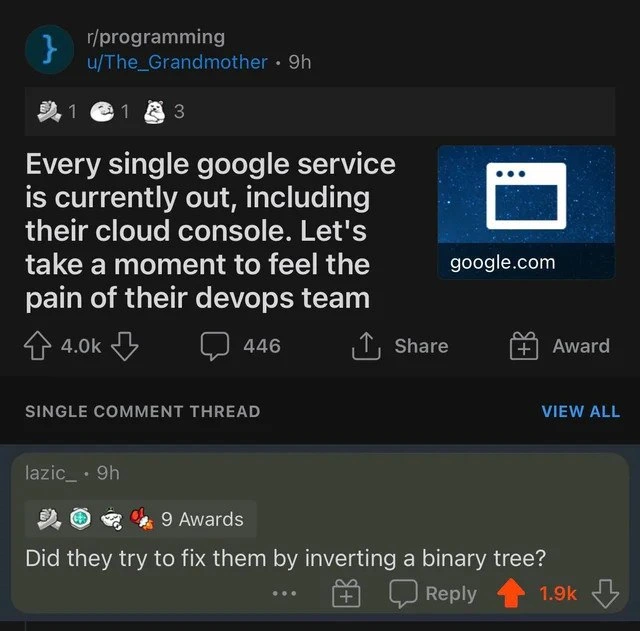
A screenshot of a Reddit thread from the 'r/programming' subreddit, viewed in dark mode. The main post, by user u/The_Grandmother, reports a massive outage: 'Every single google service is currently out, including their cloud console. Let's take a moment to feel the pain of their devops team'. This post has 4,000 upvotes. Below, a highly-awarded and upvoted (1,900 points) comment from user u/lazic_ sarcastically asks, 'Did they try to fix them by inverting a binary tree?'. The humor stems from mocking Google's famous and often-criticized reliance on esoteric, algorithm-heavy technical interview questions, like inverting a binary tree. The joke juxtaposes a theoretical computer science problem, which has little relevance to practical incident response, with a real-world, catastrophic system failure, highlighting the perceived disconnect between Google's hiring criteria and the skills needed to actually run their services

Comments
13Comment deleted
The problem wasn't inverting the binary tree; the problem was the global authentication service was the root node, and they had no pointers to it
Some SRE must’ve taken “invert a binary tree” literally - now the root of the global load-balancer points to /dev/null and the error budget is gone before the postmortem template loads
The real irony is that somewhere a Google SRE is desperately trying to access the runbook on Google Docs while the incident commander is attempting to join a Google Meet war room, both realizing they should have kept that 'legacy' on-prem wiki server running after all
When your entire cloud infrastructure goes down and someone asks if you tried inverting a binary tree to fix it - because apparently that's the skill that determines if you're qualified to keep Google's services running. Nothing says 'production-ready engineer' quite like being able to solve LeetCode mediums while your pager is melting and every SLA is burning. At least the DevOps team can take comfort knowing they aced their whiteboard interviews before this career-defining outage
Every Google service down, console included - turns out Auth is the last monolith; the runbook starts with “log in to roll back,” and without a break-glass path the rollback button just says 401
Google's outage: When the monolith's shared fate theorem strikes, no binary tree inversion saves the dependency DAG
When the global control plane faceplants, inverting a binary tree won’t flip IAM back on - this isn’t O(log n), it’s O(all regions) with retries DDoS’ing your own fleet
Ну конечно, а как же иначе. Все программисты знают, что умение развернуть бинарное дерево на листочке и объяснить принцип абстракции на пальцах решает проблемы на проде просто по волшебству. Comment deleted
i don't get it Comment deleted
It's referencing Google's love for tasks that are almost completely divorced from reality during their interviews Comment deleted
lol ok, thanks Comment deleted
Funny, but when you take a moment to think about it, programmers != devops, so probably programmer's won't fix this, and I'm not sure if they ask these kind of questions on devops interviews... 🙂 Comment deleted
"So, you want to be a DevOps, eh? Invert binary tree using Bash. And then find all palindrome paths in nginx" Comment deleted