When Google’s ranking algo becomes just another revenue stream
Why is this Google meme funny?
Level 1: Hide and Seek with Google
Imagine you have a favorite library that always helped you find the answers you need in a flash. It used to be that when you asked the librarian for a specific book or answer, they’d hand it to you right away. But now, something has changed. Now, when you ask for a book, the librarian first shows you a bunch of big shiny advertisements and random booklets that aren’t exactly what you wanted. You have to walk past all those stands of flyers and candy (things that make the library money) before you finally find the actual useful book tucked all the way in the back. It’s like playing a game of hide-and-seek for the information you need. You know the answer is in there somewhere, but you have to hunt for it, going past a bunch of distracting stuff that the library put in your way on purpose. And the reason they do that? Because the longer you stay wandering in the library, the more likely you are to grab one of those candy bars or brochures (in other words, the library makes more money from your visit). This meme is saying Google Search has become like that tricky librarian – making the good answers a bit harder to find so that you end up spending more time looking, during which Google can show you more ads. It’s funny in a “ugh, I recognize this” way: anyone who’s tried to find a simple answer online and had to wade through a bunch of nonsense first will get the joke. It feels a bit like asking a question and the response is, “Sure, I’ll help... but only after you look at these other things I want you to see.” The humor comes from calling out that sneaky behavior and confirming that no, it’s not just you – the game really has gotten harder, and it’s all by design to make more money, like a hide-and-seek where Google always wins.
Level 2: Ads vs Answers
Let's break down what’s going on in simpler terms. Google Search uses a ranking algorithm – basically a recipe of rules and machine learning – to decide which webpages to show you first when you search for something. Back in the day, Google’s algorithm was famous for usually putting the best, most helpful answers at the very top. If you searched a programming question like “How do I fix a NullPointerException in Java?”, you’d likely get a Stack Overflow page or a useful tutorial as the first result. That’s what we call an “organic” search result – it’s there because Google’s algorithm thought it was the most relevant answer, not because anyone paid for it.
Now Google also shows paid advertisements in search results. Those are the links that say “Ad” next to them. Companies bid money to have their site show up when you search certain keywords. In a healthy system, ads are clearly marked and the organic results (the real answers) are still easy to find. But what this meme highlights is a shift: it seems Google realized it could make more money by showing more ads and fewer immediately useful answers. The text in the meme references a study and even court documents suggesting Google tested giving people worse results on purpose. “Worse” here means maybe the results weren’t exactly what you needed, or the truly helpful page was buried under less helpful ones. The surprising (and kind of scary) finding: users didn’t leave Google when this happened. Most people just assumed they needed to tweak their search words and try again...which means more searches and thus more ads viewed. Essentially, if the answer to your question is not front and center, you’ll likely search again or scroll more, and each extra step is another chance for Google to show you an advertisement.
This ties into the idea of a monopoly. Google has such a dominant position in search (in many countries, well over 90% of all searches go through Google) that most users don’t think to go elsewhere when results are lacking. They’ll try different keywords on Google rather than switch to a different search engine. This lack of real competition (no strong alternative to defect to) is what the quote in the meme means by “immunity to quality concerns.” In plain language: Google can afford to let the quality of results slide a bit, because where else are you gonna go? They still win. It’s like being the only library in town – if they somewhat mess up the catalog, you’ll still come back because there’s nowhere better for information at that scale.
For a junior developer or just new folks in tech, this explains why you might have felt that recently your Google searches are less straightforward. Perhaps you search an error message and the first things you see are sponsored posts or SEO-optimized sites that aren’t very helpful. You might have to scroll past a bunch of noise, or even go to page 2 (gasp!) to find that Stack Overflow answer or official documentation you need. It’s not in your head; this meme is saying Google is potentially doing that on purpose. By making the “best information hard to find,” Google keeps you on their site longer and shows you more ads. Two big impacts are mentioned: (1) Ads become more valuable – because if the trust in organic results drops, an ad that guarantees a top spot looks more appealing to click (or for advertisers, more worth paying for). And (2) Users refine searches multiple times – which means you keep interacting with Google’s search (maybe clicking Google’s suggested related questions, or just rephrasing your query), and each time you do, you see new ads. It’s a bit like a vicious cycle: mediocre results lead you to search more, which in turn exposes you to more ads and makes Google more money.
In the context of CorporateCulture and TechIndustryHumor, this is a satirical way to say Google might be prioritizing profits over user experience. It’s a form of “ads over user experience” decision-making. For developers, who often rely on quick, relevant search results to do their jobs (solving errors, finding documentation, etc.), it’s particularly noticeable. We often joke that “the answer you seek is on page 2 of Google” now, which a few years ago was rarely the case. We’ve also developed coping mechanisms: for instance, using advanced search operators like site:stackoverflow.com or -inurl:experts-exchange (a throwback to an older notorious Q&A site) to filter results. Some devs even switch to alternative search engines like DuckDuckGo for cleaner results, or they’ve started using AI chatbots to get answers. The meme is basically validating that if you’ve felt frustrated with Google search lately, you’re not alone and it might be by design, not accident.
It’s important to understand that Google isn’t breaking their search algorithm in a blatant way – it’s more of a subtle re-tuning. The overall system is extremely complex (hundreds of factors, AI models like BERT for understanding language, etc.), but within that complexity, what they choose to prioritize can shift. This meme suggests they are prioritizing things that help the business side (like ad engagement metrics) even if it means the pure quality of results for the user takes a hit. In summary: Google Search quality degradation is the joke here, and it’s pinned on the idea that Google’s making a ton of money by doing so and faces little consequence because, well, they’re Google – the giant of search.
Level 3: From PageRank to PayRank
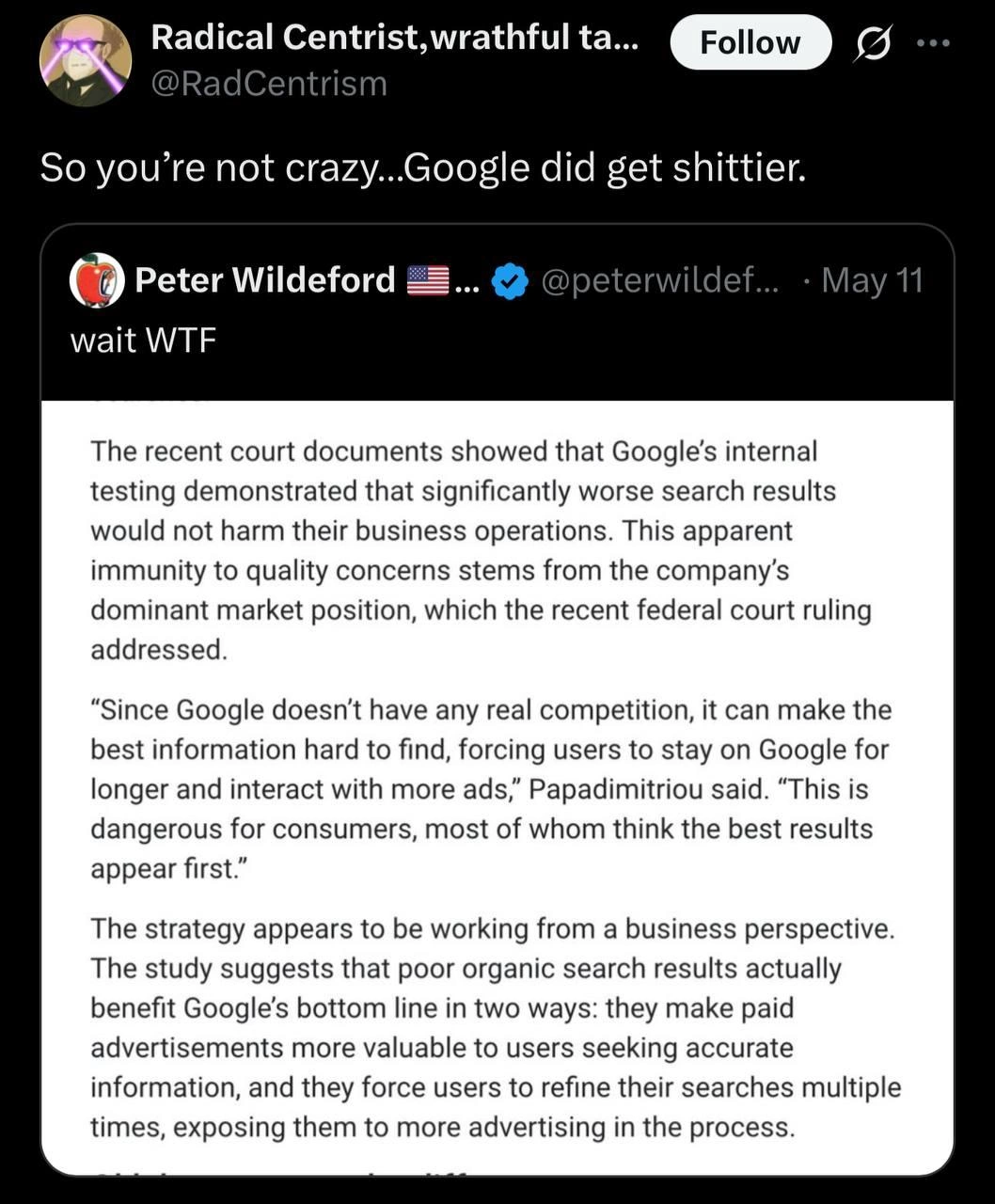
This punchy Twitter meme resonates with veteran developers and tech observers because it confirms a long-suspected shift: Google’s famed search engine — once celebrated for surfacing the most relevant information instantly — seems to have morphed into a money machine first, knowledge oracle second. The top tweet says “So you’re not crazy… Google did get shittier.” Seasoned engineers read this and nod knowingly. It validates the collective hunch that search results today feel less useful than a few years ago. Why? The quoted text spills the tea: internal testing at Google apparently showed that dialing down search result quality didn’t hurt usage. In plain terms, people kept googling even when the results were worse. For a Big Tech giant with virtually no real search competitor, that’s a green light to crank up the ad exposure. After all, if users aren’t leaving, why not squeeze a few more ad impressions out of each query? The meme highlights how Google’s Corporate Culture and business strategy might deliberately exploit this. What was once PageRank (Larry Page’s algorithm prioritizing authoritative sites) risks becoming “PayRank” – where the de facto top result is whoever paid for an ad spot, and truly authoritative answers are pushed further down, almost as an afterthought.
This phenomenon is painfully familiar to experienced devs. Think about those late-night debugging sessions: you paste a cryptic error message into Google, hoping the first hit is a Stack Overflow thread with the solution. But lately the first hits might be something like “Top 10 Ways to Fix [Your Error] - [Some content farm you’ve never heard of].” Often it’s an SEO-optimized blog that buries the actual fix under layers of fluff and affiliate links. The actual Stack Overflow answer might still be there – but a few scrolls down, or on page 2, just out of immediate sight. Google’s UI even blurs the line by making ads more blend-in, showing several “sponsored” results at the top that look almost organic except for a small label. The meme’s quoted expert, Papadimitriou, succinctly explains the tactic: no serious competition means Google can afford to make the best info harder to find, which keeps users on Google longer, increasing the chance they’ll click an ad or two. It’s a sly form of user retention: give you just enough of what you asked for to keep you searching, but not so fast that you leave.
For developers in particular, this feels like an architectural betrayal. We practically live in search tabs, using Google as an extension of memory and a gateway to documentation. Witnessing search quality degrade triggers equal parts frustration and dark humor. We joke about adding site:stackoverflow.com to every query or even switching to alternative search engines, but old habits die hard. Google’s dominance (over 90% market share in search) means it’s the default for billions, including us code jockeys. That dominant position creates a feedback loop that senior devs recognize: if users stay regardless, short-term revenue metrics win every argument. It’s the classic tale of tech industry satire: a company known for innovation slowly optimizes itself into a corner where ads over user experience become the norm. We’ve seen similar patterns with other big tech platforms (“enshittification” of content feeds, anyone?). This meme perfectly captures that too real blend of outrage and resignation. Even the tone — “Google did get shittier” — is something you’d hear from a battle-weary sysadmin during a late-night rant. It cuts through PR jargon and says what everyone feels.
To a seasoned eye, there’s also an implicit critique of CorporateCulture: Google’s internal slogan was famously “Don’t be evil.” Yet here we have court-confirmed evidence that someone inside effectively said “Turning up the evil dial doesn’t hurt metrics.” It’s like discovering that a beloved tool has a cynical backdoor: as long as quarterly earnings are up, who cares if that one truly relevant result is buried under a pile of sponsored content? The strategy “appears to be working from a business perspective,” the quote notes. Of course it does – when you control the gateway to the internet, you can shape the user journey to maximize profit. Senior devs will recall times when architecture decisions were made for profit or politics rather than engineering elegance; this feels similar, but at internet scale. It’s equal parts confirmation and condemnation of what Google has become. In meme form, it’s a rallying cry: We weren’t imagining it, the search-fu really is weaker now. And the cause isn’t a technical glitch or a hard problem (like caching or DNS); it’s deliberate product strategy. That’s a bitter pill masked in humor, and that’s why it hits home.
def google_search(query):
results = rank_by_relevance(query)
if Google.has_monopoly():
# With no competition, tilt toward profit
results = prioritize_ads_over_answers(results)
return results
# Experienced devs interpret the above:
# No competition means no urgency to give you the best result first try.
# The algorithm can afford to waste your time, as long as it earns Google more money.
Level 4: Relevance vs Revenue
At the theoretical apex, this meme spotlights an algorithmic trade-off between search result relevance and ad revenue optimization. Google's core ranking system — once grounded in elegant academic ideals like PageRank (an algorithm using the web's link graph as a proxy for trustworthiness) — now appears entangled with a monopoly-driven incentive structure. In information retrieval theory, search engines traditionally optimize for metrics like precision and recall (ensuring the top results are actually what you need). But what happens when a dominant player tweaks the objective function? When internal tests reveal that lowering result quality doesn’t reduce user retention, the optimization target shifts. It starts to resemble a grim game theory equilibrium, where Google’s dominant strategy isn’t delivering the best answer quickly, but rather maximizing the number of times you’ll need to ask. The result is a kind of algorithmic entropy, a deliberate noisiness injected into results. The meme references court documents that suggest Google found a stable equilibrium: even significantly worse search results didn’t drive users away (no competitor can exploit the opening), yet those worse results did drive users to engage with more ads and perform more queries. It’s as if someone solved a twisted form of the multi-armed bandit problem, where one arm is “show relevant info” and the other is “show profitable info,” and discovered that pulling the profit lever yields better payoffs with negligible penalty. This highlights a broader principle: in the absence of competition (a near-monopoly scenario), the utility function guiding an algorithm can drift away from user satisfaction without immediate negative feedback. Google’s ranking algorithm, once a guardian of web relevance, can be repurposed as an ad delivery engine while the theoretical underpinnings (like machine learning ranking models or neural search techniques) are subtly retuned to prioritize engagement over enlightenment. It’s a high-level socio-technical insight: systems optimize for what their masters reward. In Google’s case, if the reward is ad revenue and the system is robust against quality degradation (thanks to lack of alternatives and user habituation), the algorithm naturally evolves toward an ad-fueled attractor state. This meme wryly exposes that balance equation — revealing how search algorithms at scale might satisfy business constraints (keep users in the Google ecosystem longer) at the direct expense of the original information-retrieval mission.
Description
The image is a screenshot of a tweet thread displayed in Twitter’s dark mode. At the top, user “Radical Centrist, wrathful ta…” (@RadCentrism) writes: “So you’re not crazy…Google did get shittier.” Embedded beneath is a quoted tweet from “Peter Wildeford” (@peterwildef...) dated May 11 that simply says “wait WTF”. Peter’s tweet in turn shows a white text block (likely from a news article) that reads: “The recent court documents showed that Google’s internal testing demonstrated that significantly worse search results would not harm their business operations. This apparent immunity to quality concerns stems from the company’s dominant market position, which the recent federal court ruling addressed. “Since Google doesn’t have any real competition, it can make the best information hard to find, forcing users to stay on Google for longer and interact with more ads,” Papadimitriou said. “This is dangerous for consumers, most of whom think the best results appear first.” The strategy appears to be working from a business perspective. The study suggests that poor organic search results actually benefit Google’s bottom line in two ways: they make paid advertisements more valuable to users seeking accurate information, and they force users to refine their searches multiple times, exposing them to more advertising in the process.” Visually, the dark background contrasts with the white quote card, emphasizing the negative commentary. For developers who live in search tabs, the meme highlights the architectural trade-off between user experience and ad-driven revenue, and nods to the feeling that their debugging queries now require extra pagination just to reach Stack Overflow links
Comments
20Comment deleted
I always suspected Google’s new ranking heuristic was `ORDER BY ad_revenue DESC, relevance NULLS LAST` - turns out it shipped to prod
The real PageRank algorithm was the friends we lost along the way... to sponsored results, AI-generated slop, and SEO farms that somehow outrank the actual documentation you desperately need at 3 AM during a production incident
Turns out Google's search algorithm wasn't suffering from technical debt - it was accruing *intentional* debt. When your A/B tests prove that degrading the product increases revenue and your market position means users have nowhere else to go, you've achieved the ultimate product-market fit: a captive audience with Stockholm syndrome. It's the only engineering problem where the optimal solution is provably making things worse, and somehow the business metrics still go up and to the right. Peak enshittification isn't a bug in the system - it's the system working exactly as designed by people who confused 'user engagement' with 'user frustration loops.'
Optimize for queries-per-session and ad CTR, and gradient descent will happily find the local maximum of revenue by marching downhill on relevance - PageRank quietly becomes PayRank
When the OKRs say “increase queries per session” and “boost eCPM,” the optimal ranking function is literally worse search - aka SpendRank; Goodhart would be proud
Google's search loss function: minimize relevance, maximize ad clicks - monopoly lets you deploy without A/B regret
Actually, when I want to find some books or torrent trackers DDG is better. Proofed by years of use in this specific case Comment deleted
using Kagi for months and never went back to Google Comment deleted
paid one, to me even first one plan is too low 😅 Comment deleted
🔥 Burn it to the fuckin ground 🔥 Comment deleted
I've used DDG for a decade at least and I can't go back to Google. It's light years ahead Comment deleted
yeah no Comment deleted
🤣 You know that 99%+ of DDG results is Bing Search, right? 🌚 Comment deleted
Well then I guess Bing is eating Google's lunch 🤷 Comment deleted
the hell Comment deleted
Also try entering "amazing titties" in Google's and ddg's image search - ddg is much more amazing Comment deleted
https://www.wheresyoured.at/the-men-who-killed-google/ Comment deleted
Good thing I use AI to search stuff for me now😂 Comment deleted
ddg = bing (ddg uses bing api) = the result i actually want MIGHT be on page 3 if im lucky. if im not, the results arent even remotely related Comment deleted
It gets me the results I need Comment deleted