Good Lord, What Is Happening in There? ...Unit Testing
Why is this Testing meme funny?
Level 1: "It's Just Homework," Says the Kid as Smoke Pours Out
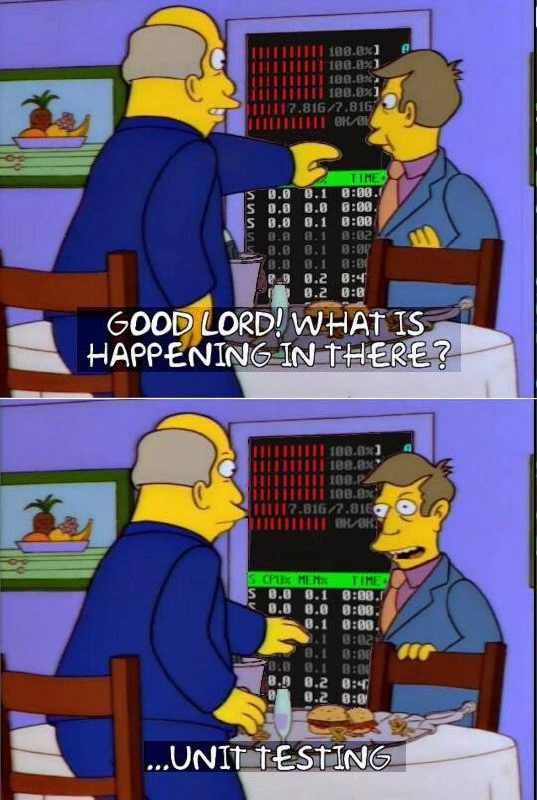
Imagine a kid's bedroom door with smoke curling out from underneath, strange grinding noises, and the lights in the whole house flickering. A parent yells, "What is going on in there?!" and the kid answers, totally calm, "...just doing my homework." That's this meme. The computer screen shows a machine working as hard as it possibly can — every gauge maxed out, nothing left — and the programmer explains it with the most innocent-sounding task in their job, the one that's supposed to be quick and tiny. The funny part is the calm, straight-faced answer when everything visible behind him says otherwise.
Level 2: Reading the Monitor Behind Skinner
The screen embedded in the doorway is htop, a terminal system monitor — the tool you open when your machine starts sounding like a jet:
- The red bars at
100.0%are CPU cores. One per row, all maxed, meaning every processor is fully busy. 7.81G/7.81Gis RAM usage — all memory consumed. Past this point the machine starts swapping to disk and everything turns to molasses.- The green table with
CPU%,MEM%, andTIMEcolumns lists running processes, sorted by who's eating the most.
A unit test checks one small piece of code in isolation — "does add(2, 2) return 4?" — and should run in milliseconds using mocks (fake stand-ins for databases, networks, and files). An integration test checks real pieces working together — actual database, actual HTTP calls — and is naturally heavier and slower. The joke is the gap between the label and the load: tests called unit tests producing the resource profile of a render farm.
You'll meet this early: you clone a repo, run npm test or pytest, and your laptop fans spin up like it's attempting liftoff. Check what the suite actually does — odds are it's launching containers or browsers. That's fine! It's just not "unit testing," no matter what the folder says.
Level 3: Aurora Borealis, Localized Entirely Within Your Test Suite
The "Steamed Hams" format is the perfect chassis for this joke because the original scene is about a man calmly asserting an obviously false explanation while his kitchen burns. Here, the kitchen doorway behind Chalmers and Skinner has been replaced with an htop readout: every CPU core bar pegged in red at 100.0%, memory reading 7.81G/7.81G — completely full — and a green process table grinding away. Chalmers demands:
GOOD LORD! WHAT IS HAPPENING IN THERE?
And Skinner, with the serenity of a man whose mocks have long since stopped mocking anything, replies:
...UNIT TESTING
The deflection works because everyone in the room knows what unit testing is supposed to mean: small, isolated, fast. A pure function in, an assertion out, milliseconds each, no I/O. A suite like that couldn't saturate eight cores and all available RAM if it tried. What's actually running behind that doorway is the industry's most common open secret: integration tests in disguise. The "unit" suite spins up Docker containers, seeds a real Postgres, boots a headless Chrome, hits a localhost API, and runs everything through a parallel test runner that forks one worker per core — because somewhere along the line, "isolated" quietly became "isolated from the staging environment, mostly."
The systemic pattern being satirized is taxonomy decay. Teams adopt the test pyramid with sincere intentions, then reality intervenes: mocking the database is tedious, the mocks drift from real behavior, someone gets burned by a bug the mocks hid, and the pragmatic fix is "just test against the real thing." Each individual decision is defensible. The aggregate is a 40-minute "unit" suite that turns laptops into space heaters and makes git push a fan-noise event. And like Skinner, nobody renames the suite — the directory is still called test/unit/, the CI stage is still labeled unit-tests, and the README still claims they run in under a minute. The lie is load-bearing now. Renaming it would mean admitting the pyramid inverted into an ice cream cone years ago, and that conversation requires a meeting nobody wants to schedule. Jest users get a bonus layer: the runner itself is famous for memory leaks across workers, so even honest unit tests can fill 7.81 of your 7.81 gigs given enough time and enough --maxWorkers.
Description
A two-panel meme from The Simpsons 'Steamed Hams' scene, edited for developers. Superintendent Chalmers and Principal Skinner sit at a dinner table, but the kitchen doorway behind them is replaced with a terminal monitor showing a system monitor (htop-style) with multiple CPU cores pegged in red at 100.0%, memory at 7.81G/7.81G, and a green process list with CPU%, MEM% and TIME columns. Top panel caption: 'GOOD LORD! WHAT IS HAPPENING IN THERE?'. Bottom panel, Skinner calmly replies: '...UNIT TESTING'. The joke maps Skinner's infamous 'Aurora Borealis' deflection onto test suites that inexplicably max out every core and all available RAM despite nominally testing small, isolated units
Comments
10Comment deleted
Unit tests? At this CPU load? Localized entirely within your laptop? ...May I see the mocks? ...No
Unit testing? At this stage of sprint, in this type of project, localized entirely within your prod VM!? Comment deleted
Y E S ! Comment deleted
Can I ps auxf it? Comment deleted
no. Comment deleted
SEYMOUR! THE PROD IS ON FIRE! Comment deleted
No, mother. It's just the unit testing. Comment deleted
Well, Seymour, you are an odd fellow, but I must say... you test a good unit. Comment deleted
meanwhile ps waux ... ./build/bin/llama-server -m ~/.my-agent/models/Qwen3.5-9B-UD-Q8_K_XL.gguf -ngl 99 --port 8080 ... Comment deleted
HELP! H E E E L P ! ! ! Comment deleted