Go Developers' Justice for Blocking I/O Sins
Why is this Languages meme funny?
Level 1: The Missing Off Switch
Imagine you have a toy or machine that’s running, and you suddenly need it to stop – maybe it’s a robot that’s about to knock over a vase. Normally, you’d press the off switch or a pause button, right? Now think about someone building a robot with no off switch at all. No matter what you do – even if you ask it nicely or yell “STOP” – it just keeps going and going. That would be a pretty scary (and annoying) design! In this meme, a programmer did the equivalent of that in code: they made something that can run and get stuck waiting, but they didn’t include any “stop button” (in coding terms, that’s the context for cancellation).
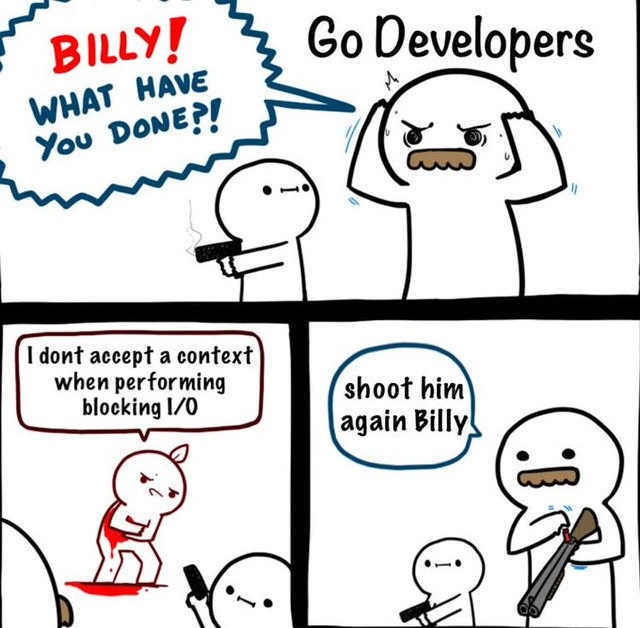
The cartoon shows one character, Billy, who has metaphorically “shot” someone – but the twist is the person he shot is confessing, “I wrote code with no stop button for long tasks.” This is such a bad move in the eyes of Go programmers that the other character (representing all the Go developers) humorously says, “Do it again, Billy.” In simple terms, the community is joking, “That’s such a big mistake that it deserves extra punishment!” Of course, they’re not serious about violence – it’s just an exaggerated way to say never ever do that.
So the funny part here is a mix of shock and an important lesson. It’s showing how important it is to have an off switch when you build things, whether it’s a toy or a piece of software. If you ignore the stop signal in a program, programmers get upset just like anyone would if a machine wouldn’t turn off. The meme makes us laugh because it turns this serious coding rule into a dramatic little story. Even if you don’t know Go programming, you can understand the feeling: someone broke a vital rule, and the “judge” is so appalled that he jokingly approves a very over-the-top consequence. In the end, it’s a memorable way to say always give your programs a way to stop gracefully!
Level 2: Context Matters
Let’s break down why Go developers reacted so strongly in this meme. First, some basics: Go (often called Golang) is a programming language that makes it easy to do many things at the same time using lightweight threads called goroutines. In Go’s model of concurrency, if you start an operation (like a network request or reading a file), you often hand along a special object called a context.Context. This context is like a hall pass that carries a “stop” or “timeout” signal. If the operation is taking too long or the user cancels the action, the context will be signaled, and well-written code will notice that and abort the operation. Blocking I/O means any Input/Output work that can make a goroutine wait – for example, waiting for data from a database, a web API, or a file on disk. “Blocking” just means the code can’t do anything else until that I/O is done. In Go, it’s considered good practice (practically mandatory) to accept a Context parameter for any function doing that kind of work, so the caller can say “Hey, cancel this if it’s taking too long or if the user is no longer waiting for the result.”
Now, the meme shows a classic four-panel comic format. In Panel 1, the character is yelling “BILLY! WHAT HAVE YOU DONE?!” at someone who apparently did something terrible. In Panel 2, we see the furious character is labeled “Go Developers”, and the smaller figure with the smoking gun is Billy. This sets the stage: the Go community (collectively) has caught someone (Billy) in the act of a “crime.” In Panel 3, the wounded victim on the floor delivers a shocking confession in a red speech bubble: “I don’t accept a context when performing blocking I/O.” In plain terms, this is the bad coding practice: writing a function that can get stuck waiting (maybe on a slow network or database) but not allowing a context to cancel it. That is the big no-no. By Panel 4, the Go Developers character, enraged by this confession, tells Billy: “shoot him again, Billy.” This is the punchline. It’s an exaggerated, dark joke showing just how unacceptable that practice is to Go programmers – so much that the normally upset questioner now sides with Billy’s drastic action.
For a newer developer, why is this such a big deal? Consider a simple example: you write a web server in Go that handles requests to fetch user data. Each request spawns a goroutine that calls a database or an external microservice. If that call is slow or the user disconnects, you don’t want your server goroutine waiting forever. Contexts solve this by letting you write code like:
// Pseudocode for handling a request in Go:
data, err := fetchUserData(ctx, userID)
if err == context.DeadlineExceeded {
log.Println("Request cancelled because it took too long")
return
}
Here, ctx might have a timeout or cancellation from the HTTP framework. If fetchUserData ignores the context and just does a blocking call, this code can’t break out early – it might hang indefinitely at fetchUserData. That’s why in real code, fetchUserData would be defined to accept a ctx and periodically check ctx.Done() or use I/O calls that honor context cancellation. When a function doesn’t do that, it means if something goes wrong (network outage, client gave up), your goroutine could be stuck like a telephone that never hangs up. Over time, many stuck goroutines can pile up and hurt your service.
So the meme is basically a dramatic way of teaching this lesson. The Go community cares a lot about this detail – it’s part of writing idiomatic, robust Go code. The phrase “shoot him again” is not literal, of course; it’s a grim joke. It translates to “that’s so bad, it merits an extreme response.” It’s like if a student said “I always do my homework by copying from Wikipedia” and the teacher facetiously asks another student to “give them another F.” Everyone in on the joke knows it’s hyperbole. In tech terms, the community is effectively saying “We absolutely do not tolerate ignoring context in blocking calls.”
In summary, the meme uses humor to convey a best practice: always pass context in Go when doing potentially slow operations. The tags and labels (Go, concurrency, code quality) all point to this being about coding etiquette in GoLang. Even if you’re relatively new to Go, it’s clear that context matters a lot – it’s the way Go programs stay responsive and controllable. The meme’s popularity among developers comes from that shared understanding: we’ve all seen code that doesn’t listen to a cancel signal, and we’ve learned that in Go, that’s practically a mortal sin.
Level 3: Zero Context Tolerance
For experienced Go developers, the punchline of this meme hits close to home. It satirizes the zero-tolerance attitude the Go community has toward functions that perform blocking operations without a context.Context parameter. In idiomatic Go (the conventions seasoned gophers live by), any function that might block or take a while must accept a context so the caller can cancel it if needed. The meme plays on a familiar scenario: a code review where someone finds a function that, say, makes a database query or HTTP call but doesn’t take a context. Cue the collective gasp – it’s practically a cardinal sin in Go land. The meme frames this as an over-the-top crime: the character proudly admits “I don’t accept a context when performing blocking I/O” and the Go developer responds with “Shoot him again, Billy.” It’s dark hyperbole, essentially saying “That’s so bad it deserves double punishment.” Go programmers love to joke that not using context for cancelation is one of the few acts worthy of such dramatic outrage.
Why such drama? Because veterans have been burned by this exact issue. Imagine a backend service handling client requests: each incoming request has a context (provided by Go’s HTTP framework) carrying a timeout or a cancellation signal (if the user clicks cancel or the connection drops). If your code ignores that context when doing a slow I/O operation – like calling an external API or reading from a file – then if the client goes away or the deadline passes, your goroutine keeps waiting indefinitely. It’s like someone in a group project not listening when you yell “stop, time’s up!” The result in real systems is often resource leaks or stuck routines. Experienced devs have seen servers hang because one function didn’t respect cancellations – maybe a database call that never returned because the network was partitioned, and the code had no timeout. When you have hundreds of such calls, those blocked goroutines accumulate like zombies. This can lead to memory bloat, exhausted file descriptors, or weird failures during shutdown (services refusing to exit because some goroutines are forever stuck). All of this is painfully familiar to seasoned backend engineers, hence the intense antipathy toward context-ignorant code.
The meme’s format (the classic “Billy, what have you done?” four-panel) is a perfect comedic vehicle here. In a typical scenario, the authoritative figure (labeled “Go Developers” with a furious face) catches Billy doing something awful. When the wounded victim reveals the awful deed (“I don’t accept a context on blocking I/O”), the Go dev – representing the Go community’s mindset – actually encourages more violence: “shoot him again, Billy.” It’s a tongue-in-cheek way to say “That’s so wrong that even a normally reasonable person would react harshly.” This resonates with experienced gophers because it’s exactly how it feels to read such code – you recoil instinctively. In code reviews or team discussions, the reactions, while not violent, are often vehement. You’ll hear seniors rant: “This function needs a context! What if the call hangs?!” The intensity is real, even if we don’t literally take up firearms in the office.
The humor also reflects code quality values. Go has a strong culture of doing things the “right way” (often phrased as “idiomatic Go”). Ignoring context isn’t just a minor oversight; it shows a lack of regard for well-known best practices. It’s akin to pushing to production with no error handling or running a database transaction without a commit/rollback – it makes seasoned engineers cringe universally. The community’s unified reaction (“Go Developers” as a whole character) implies just how unanimous this opinion is. In Go conferences or forums, bringing up a library that doesn’t support context will draw quick criticisms. They might say, “That library call is useless in modern Go; it doesn’t take a context so you can’t control timeouts.” And indeed, many core libraries were updated to include context-aware variants (http.Client.Do got a Do(req *http.Request) with context attached to the request, database/sql added QueryContext, etc.). These changes were driven by hard-earned lessons that cancellation propagation is vital.
So, the meme is funny to Go veterans because it’s an exaggerated reflection of their own knee-jerk reaction. The combination of concurrency model etiquette and dark humor lands well. We’ve all seen that one PR or stackoverflow answer where someone says “just leave it running, it’ll finish eventually” and the Go old-timers practically facepalm. They know that in production, “eventually” might mean never, and you’d have to restart the whole service (the software equivalent of “shoot him again”). The meme gives us license to laugh at how ferociously we enforce this rule: Never perform blocking calls without a way to cancel them. In short, it’s a community in-joke about Go’s zero context tolerance policy, wrapped in a macabre but funny meme format that every developer can meme-ify.
Level 4: Structured Concurrency or Chaos
In the world of Go concurrency, failing to propagate a cancellation context is like building a machine with no off-switch. This touches on a deep principle of concurrent systems: cooperative cancellation. Go’s designers intentionally avoided giving programmers a way to forcibly kill a goroutine from the outside (no direct equivalent of a kill -9 for goroutines). Instead, Go relies on a contract of cooperation – long-running or blocking I/O operations should periodically check if they should abort. The context.Context mechanism embodies this contract. It creates a tree of operations where a parent can signal children to cancel (a form of structured concurrency). When a function chooses not to accept a context, it’s basically reneging on that contract. It becomes an isolated task that can’t be politely stopped – a rogue goroutine that ignores the polite request to shut down.
From a theoretical standpoint, this is flirting with the fundamental challenge of concurrency: making sure every task can be managed and terminated safely. A function doing blocking I/O without context is akin to a thread that ignores interrupts or a child process that ignores SIGTERM. In operating systems theory, when gentle signals are ignored, the only remaining option is a brutal termination (think kill -9, the OS equivalent of “shoot him again”). The meme humorously amplifies this scenario. The Go Developers character represents an almost zealous enforcement of this cooperative cancellation principle. The extreme reaction – telling Billy to double tap the offender – parallels the idea that if a task won’t listen to cancel signals, you might have to take drastic action to stop it.
This fanaticism has roots in reliability and distributed systems theory. In large-scale backend services (where Go is popular), timeouts and cancellation aren’t just niceties – they’re essential for system health. A single blocked call that won’t cancel can hold up resources, threads, or memory, potentially causing cascades of issues (thread pools exhausted, requests piling up, etc.). Go’s contexts help implement timeouts, deadlines, and cancellation propagation in a structured way, preventing those cascades. By ignoring context, that code is essentially opting out of the whole structured concurrency model that keeps complex systems sane. It’s a bit like defying gravity in physics – you can try, but you’re going to get hurt (or in this case, your program or users will). The meme’s dark humor (“shoot him again”) underscores how unforgivable this breach is considered: it violates a core invariant of well-behaved concurrent code, leaving chaos as the only outcome.
Description
A four-panel comic strip meme depicting a scenario among 'Go Developers.' In the first panel, a character named Billy has just shot someone. A distressed character representing 'Go Developers' yells, 'BILLY! WHAT HAVE YOU DONE?!'. In the second panel, the wounded character, bleeding on the floor, confesses their coding sin: 'I dont accept a context when performing blocking I/O'. In the final panel, the 'Go Developers' character, now calm and holding a shotgun, instructs Billy, 'shoot him again Billy'. The humor is rooted in the Go programming language's best practices, where failing to pass a 'context' to blocking I/O operations is considered a major architectural flaw, as it prevents proper cancellation and timeout handling. The meme violently exaggerates the reaction of senior Go developers to this poor coding practice
Comments
7Comment deleted
That function doesn't take a context for its blocking I/O? That's not a function, it's a denial-of-service vulnerability waiting for a high-traffic Tuesday
Every time a blocking call ignores context, a goroutine becomes Schrödinger’s zombie - neither alive nor GC-able until your pager collapses the waveform at 3 AM
The real crime here isn't ignoring context.Context - it's the inevitable goroutine leak when your blocking I/O call hangs forever and your graceful shutdown becomes a kill -9 because someone thought 'contexts are just for tracing, right?'
This perfectly captures the Go community's relationship with context.Context - it's not just a parameter, it's a lifestyle choice. Refusing to accept context when doing blocking I/O is like writing Java without checked exceptions or Python without the GIL complaints - technically possible, but you'll face the wrath of every code reviewer who's ever had to debug a goroutine leak at 3 AM because someone's HTTP client hung indefinitely without respecting cancellation signals
Refusing context on blocking I/O turns SIGTERM into a 30-minute goroutine leak - so much for graceful shutdown
Go code review rule: any blocking I/O that doesn’t accept context gets two bullets - because cancellation won’t propagate and retries must be idempotent
Go devs skipping context on blocking I/O: the surefire way to turn a simple query into a cluster-wide DoS during peak traffic