Skip to content
DevMeme
4703 of 7435
Installer warns Emacs contains explicit content, daring devs to install anyway
IDEs Editors Post #5153, on Apr 27, 2023 in TG

Installer warns Emacs contains explicit content, daring devs to install anyway

Why is this IDEs Editors meme funny?

Level 1: For Big Kids Only

Imagine you see a big warning label on a jar of super spicy chili sauce. The label says, “Warning: Only adults should try this!” It’s not that the sauce is poisonous or bad – it’s just really spicy and might be too much for a little kid. This meme is doing a similar silly thing, but with a computer program called Emacs. Emacs is a tool programmers use to write text and code. It’s totally safe – there’s nothing bad like violence or naughty stuff in it – but it is very hard to use if you don’t know what you’re doing.

In the picture, the computer is jokingly saying “Hey, this app might have grown-up content. Are you sure you want to install it?” Of course, that’s not true for a text editor, and that’s why it’s funny. It’s like putting a “For Ages 18+” sticker on a picture book just as a prank. Programmers who see this will laugh because they know Emacs isn’t a scary movie or anything – it’s just a super complicated tool. The two buttons, “Don’t Install” and “Install Anyway,” make it extra playful. It’s as if the computer is daring them: “You might get confused or overwhelmed – still want to go ahead?” And most developers, being the curious big kids they are, will chuckle and click “Install Anyway”. In simple terms, the meme is funny because it pretends something very normal but complex is as shocking or inappropriate as an adult-only movie, which is a silly mix-up. Even if you’re not a programmer, you can picture how absurd it is to see a serious warning on something harmless. It’s just a goofy way to say, “This tool is only for the big kids (experienced folks) – do you dare try it?”

Level 2: Proceed at Your Own Risk

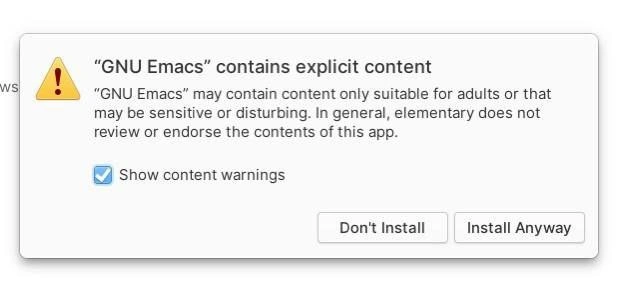
This meme shows what looks like a standard installation warning dialog on a computer, but with a hilarious twist. The dialog claims "GNU Emacs" contains explicit content, complete with a big yellow warning triangle icon. Normally, an explicit content warning is something you’d see when installing or opening media that might be inappropriate – like a violent video game, a movie with adult themes, or an app with strong language. Seeing it pop up for GNU Emacs, a programmer’s text editor, is immediately jarring and funny. It’s as if your computer is treating Emacs like some forbidden, R-rated material. The interface style (the flat gray alert with rounded corners and the specific button style) is modeled after elementary OS, a Linux operating system known for its polished, user-friendly interface. Elementary OS usually has an AppCenter (app store) that only shows vetted applications, and if you try to install something outside of that (or marked as potentially unsafe), it might warn you. The text “In general, elementary does not review or endorse the contents of this app.” is a fairly standard disclaimer for unreviewed apps. It’s basically the OS saying, “Hey, we didn’t check what’s inside this app. It could be anything.” That part is real enough. But the phrasing “may contain content only suitable for adults or that may be sensitive or disturbing” is deliberately over-the-top when applied to Emacs. It suggests there might be something shocking or inappropriate inside this software – which savvy developers know is not the case at all.

GNU Emacs is a famous text editor (part of the GNU project) that programmers use to write code or plain text. It’s not a video game or a movie; it doesn’t have pictures or story content. It’s essentially a tool – like Notepad on steroids (and then some!). Emacs has been around since the 1980s and has a ton of features. In fact, Emacs is sort of legendary for how much it can do: not just editing code, but also browsing the web in text, reading email, managing files, even playing simple games. It’s extremely customizable through a built-in programming language called Emacs Lisp. That means users can write little programs (or install community-made extensions) to make Emacs do almost anything. This power and flexibility come with a cost: Emacs is complex, especially for newcomers. The controls and shortcuts are very different from modern editors or IDEs (Integrated Development Environments) like VS Code or IntelliJ. For example, saving a file might require an odd key combination, and quitting Emacs famously involves pressing Ctrl + X followed by Ctrl + C. Many new users have to Google “how to exit Emacs” the first time—they joke that that’s an initiation ritual! Because of this steep learning curve, there’s an old joke that Emacs isn’t just a text editor; it’s an entire way of life. It even sparked a lighthearted “religious war” in programming communities: Emacs vs. Vim. Vim is another old-school text editor with a similarly devoted following and a steep learning curve (with its own bizarre quit sequence, :q!). For decades, programmers have poked fun at each other over which editor is the true path to enlightenment. These are the EditorWars: mostly humorous, sometimes passionate debates over which editor or IDE is better. In those jokes, fans of each side often exaggerate the other’s flaws. An Emacs fan might tease that Vim users are stuck in the past with arcane modes, while a Vim user might retort that Emacs is bloated or absurdly complicated. It’s all part of DeveloperHumor and tech culture lore.

Now, bringing it back to the meme: labeling Emacs as containing “explicit content” is a playful jab that fits right into that tradition. It’s implying that Emacs is so hardcore or esoteric that maybe only grown-ups (experienced devs) should dare use it. Of course, Emacs doesn’t literally have anything NSFW (Not Safe For Work) inside. The joke is in the mismatch. It’s like telling someone that a calculator app might have horror scenes – it’s unexpected and silly. The dialog even has two buttons: "Don't Install" and "Install Anyway". This mimics real warnings where the system gives you a chance to back out if you’re unsure. The meme is daring you, the developer, to click “Install Anyway” despite the ominous warning. Go on, be brave! For many devs who get the joke, the choice is obvious and funny: “Hah, as if a little editor scares me — of course I’ll install anyway!”

What makes this especially funny in a developer context is that it pokes at our everyday experiences. As developers or power users, we often install tools that our operating system might not recognize or that come from outside official app stores. We’re used to seeing generic security warnings like “This app is from an unidentified developer” or “Are you sure you trust this source?” Typically, we just sigh and click through because we know what we’re doing. In this meme, that mundane process is exaggerated into a content caution, as if Emacs were some creepy or naughty thing. It also winks at Emacs’s intimidating learning curve: a newbie might indeed find Emacs scary in the sense that it’s confusing or “disturbing” to use at first. Imagine a beginner opening Emacs expecting a simple text editor and instead entering a minimalistic interface where even basic actions require reading the manual — it can be a shock! The meme takes that feeling and blows it up into a dramatic content warning.

For context, elementary OS (mentioned implicitly through the dialog style and text) is known for caring about user experience. They usually show content ratings for apps (for example, indicating if an app has violence, language, etc., similar to how mobile app stores work). Most programming tools would just be rated as suitable for all ages because, well, they’re just tools. Emacs probably got a generic flag in some app repository indicating “no review,” which the OS interpreted in the funniest possible way here. The package_manager_warning aspect is real: package managers (like app stores or software centers) want to protect users by warning about unreviewed or potentially unsafe packages. It’s just rare (and humorous) to see wording that implies possible adult content in a developer tool. It’s that overstatement that makes developers chuckle and share this meme.

In summary, this meme is a fun mash-up of a tech inside joke and an everyday computing scenario. It assumes the viewer knows that Emacs is a powerful, somewhat intimidating text editor (part of those classic IDEs and Text Editors debates) and that content warnings are usually for edgy stuff. By combining these, it creates a ridiculous scenario: being “warned” off installing a coding tool as if it’s something scandalous. For any programmer who has ever chosen an editor, especially those aware of the Emacs vs Vim rivalry, the meme delivers a good laugh. It’s an exaggerated nod to the idea that using Emacs is an extreme sport in the programming world — not actually obscene, but so hardcore that you get a cheeky “viewer discretion advised” notice before diving in. And of course, true to form, we devs grin and hit “Install Anyway,” ready to embrace the complexity (or at least ready to screenshot the meme and share it with our team for a midday laugh).

Level 3: For Mature Devs Only

At first glance, seeing GNU Emacs slapped with a content warning is comically absurd to any seasoned developer. Here we have a venerable text editor — practically a piece of computing history — being treated like it’s some kind of risqué or dangerous media. The dialog on this elementary-OS style pop-up claims "'GNU Emacs' contains explicit content", as if installing Emacs might corrupt your morals rather than just your dotfiles. This tongue-in-cheek warning plays on Emacs’s hardcore reputation in developer culture. It’s as if the system is saying: "Careful, kiddo, this editor is not for the faint of heart. You sure you can handle all its power?"

The humor lands because Emacs is a legendary text editor known for its power and complexity, not anything actually NSFW. In the eternal editor wars of Emacs vs. Vim (and now vs. modern IDEs like VS Code), Emacs has long been both revered and ribbed. Devs joke that Emacs is not just an editor but almost an operating system – it does email, IRC, web browsing, even Tetris – all inside a single window. It’s an extensible Lisp machine for your text editing. With great power comes great... many keybindings. 😂 Emacs can be overwhelming to newcomers: endless customization, strange default key combos (Ctrl+X Ctrl+C to exit, of course), and modes for everything under the sun. It’s powerful, explicitly so – every little behavior can be tweaked via Emacs Lisp. To a veteran developer, the idea of labeling Emacs as containing “content only suitable for adults” wryly implies that only truly experienced “grown-up” programmers can handle its steep learning curve and sprawling feature set. It’s a nod to the shared understanding that mastering Emacs is almost a rite of passage (or a sign of masochism, depending on whom you ask!).

This meme also parodies how modern software distribution can be overzealous with warnings. On a platform like elementary OS (a Linux distro known for user-friendly, curated apps and a clean UI), you might see a dialog warning when installing something outside the approved channels. Typically, it might say the app isn’t reviewed or could be unsafe. But here the wording mimics an explicit content dialog – the kind you’d expect for violent games or adult media – not a programmer’s text editor! That mismatch is pure DeveloperHumor: Emacs is “dangerous” only in the sense that you might lose a weekend tweaking your config or that you’ll be sucked into a decades-old EditorWars debate. The checkbox “Show content warnings” being checked is another layer of satire: it implies the OS is dutifully doing content-policing, and Emacs of all things tripped the filter. Perhaps the package metadata wasn’t reviewed by elementary’s team, triggering a generic package_manager_warning about unvetted content. This hints at real Developer Experience friction: sometimes perfectly legit developer tools get flagged with scary warnings because they’re not in some app store’s whitelist. It’s a playful exaggeration of those moments where a dev goes “Ugh, of course I trust this tool, just let me install it!” and clicks that “Install Anyway” button with a mix of confidence and defiance.

The phrase “Install Anyway” in the dialog is practically daring the developer, which adds to the joke. It’s like the system saying, “Alright, you’ve been warned. Do you have the guts to proceed?” And any Emacs fan or curious hacker will smirk and hit Install Anyway without hesitation – wearing the warning almost as a badge of honor. After all, long-time Emacs users are proud of having tamed the beast; being told their trusty editor is edgy content is deliciously ironic. There’s also a meta-joke here referencing how some view Emacs users: “only those who like pain (or extreme customization) use Emacs.” Scenes of a newbie opening Emacs, encountering the blank scratch buffer with a blinking cursor, and having no idea how to quit could indeed be considered “disturbing content” to the unprepared! 😉 The warning could tongue-in-cheek refer to the frustration and confusion a beginner might experience — like a horror movie for someone expecting a simple Notepad. In reality, nothing illicit is lurking in Emacs, but to a developer the idea of an unexpected Alt+Ctrl+weird-key cord or the wall of parentheses in an Emacs Lisp configuration file might be as startling as a jump scare.

Ultimately, this meme operates on multiple levels of insider knowledge. It riffs on TextEditorChoice quirks and the culture of DeveloperExperience: Emacs is powerful but notoriously user-unfriendly at first blush, so treating it like a shocking, age-restricted thrill is a brilliant bit of satire. It also pokes fun at the modern trend of software needing disclaimers for everything. In a world where app stores might ask “Are you sure?” even for a command-line tool, the dialog’s formal language — “elementary does not review or endorse the contents of this app” — is perfectly over-the-top when applied to something as prosaic as a code editor. It’s a knowing wink to developers: yes, this is ridiculous, and that’s why it’s funny. The next time you see a warning pop up while installing a harmless dev tool, you’ll remember this meme and chuckle, then confidently press that Install Anyway button, just like the fearless Emacs aficionado this dialog dares you to be.

Description

A desktop dialog box styled like elementary-OS pops up with a yellow triangle warning icon. Bold headline reads “"GNU Emacs" contains explicit content”. The body text states: “"GNU Emacs" may contain content only suitable for adults or that may be sensitive or disturbing. In general, elementary does not review or endorse the contents of this app.” A checked checkbox says “Show content warnings”, and two buttons offer “Don't Install” or “Install Anyway”. The meme humorously treats the venerable GNU Emacs editor - famous for its power and complexity - as if it were NSFW software, poking fun at the eternal editor wars and how package managers sometimes over-zealously flag harmless developer tools

Comments

28
Anonymous ★ Top Pick Explicit content? Nah - the checkbox is just warning you that 40 years of embedded Lisp might make you realize your whole microservices fleet still can’t do what one Emacs buffer can
  1. Anonymous ★ Top Pick

    Explicit content? Nah - the checkbox is just warning you that 40 years of embedded Lisp might make you realize your whole microservices fleet still can’t do what one Emacs buffer can

  2. Anonymous

    After 40 years of elisp configurations, recursive acronyms, and org-mode addiction, the app store finally recognized Emacs for what it truly is: a gateway drug to spending your entire life customizing your development environment instead of shipping code

  3. Anonymous

    Ah yes, the infamous GNU Emacs content warning - because nothing says 'explicit content' quite like discovering M-x butterfly actually exists, or realizing you've accidentally launched Tetris, a psychotherapist chatbot, and a full email client when you just wanted to edit a config file. The real warning should read: 'May cause existential crisis when you realize Emacs is less of a text editor and more of a Lisp-powered operating system that occasionally edits text.' Elementary OS isn't wrong to warn users - once you go down the Emacs rabbit hole and start writing custom elisp to automate your automation, there's no coming back. The 'Install Anyway' button should really say 'Abandon All Hope, Ye Who Enter Here.'

  4. Anonymous

    “Emacs contains explicit content” - fair: enable org-babel and TRAMP and your notes start executing code and editing prod over SSH; Magit even rewrites history. Not suitable for auditors or change control

  5. Anonymous

    Explicit Emacs content? Clearly the macro expansions that warp reality - only for devs mature enough to debug them

  6. Anonymous

    The AppCenter bot saw a thousand occurrences of "sexp" and "kill" in elisp and slapped on an 18+ badge - governance by regex, brought to you by the editor that’s already an OS

  7. @sylfn 3y

    use vim instead

    1. @endisn16h 3y

      based

    2. @mpolovnev 3y

      Not vim! Once you enter, you may not leave!

      1. @sylfn 3y

        why would i

    3. @Araalith 3y

      It's 21+ and shoud have warnings for sensitive people.

      1. @sylfn 3y

        oh i am 17 (and have been using vim sometimes for about 2 years) and a sensitive person, but i dont think vim did something to me...

        1. @sylfn 3y

          i used vim from cygwin on windows xp, nothing happened to me i promise

  8. @callofvoid0 3y

    Howso

  9. @trainzman 3y

    Biggest sex you'd ever have

  10. @trainzman 3y

    Oh, wait, that's about installing Haskell

  11. @RichStallman 3y

    Slander

  12. @sylfn 3y

    what would you do if you have no "second" terminal?

    1. @infinitewanderer 3y

      install screen or tmux

      1. @sylfn 3y

        vim already opened

        1. @infinitewanderer 3y

          overwhelm it until the system kills vim due to OOM

        2. @batuto 3y

          Call a console command inside vim

          1. @sylfn 3y

            I don't think that an unexperienced user that can't exit vim can call console commands from it

            1. @batuto 3y

              😆 then turn off the computer

  13. @sashakity 3y

    its porbably cause emacs has a web browser

  14. Deleted Account 3y

    vim is the text editor to set ip address and dns in /etc/network/interfaces and to set set right repos in /etc/apt/sources.list Then you can install any editor you like and delete vim

    1. @Assarbad 3y

      You're confusing Vim with Nano 😜

      1. Deleted Account 3y

        You are confusing the real life and your fantasy

Use J and K for navigation