When your YouTube coding tutor is also your offshore competition
Why is this Career HR meme funny?
Level 1: Friend or Rival?
Imagine you have a friend who is really good at a game, and you want to get better at that game. Your friend is super nice and spends time teaching you all the best tricks to win. You feel happy because now you can play much better thanks to their help. But a little later, there’s a big school tournament for that game with a cool prize, and you enter it… and suddenly you see the same friend is also playing in the tournament! Now you have to compete against the very person who helped you. You feel nervous and a bit weird: you’re grateful to your friend for helping you improve, but you also really want to win and you worry they might beat you. It’s a funny mixed feeling, right? On one hand, “Yay, they helped me!” and on the other hand, “Uh-oh, they might take the prize I want.” That’s exactly the feeling this meme is joking about — someone who was your helper could also be your challenger, all in one. It’s like being happy and worried at the same time, which is a little silly and why it makes people smile.
Level 2: Global Mentor, Local Fears
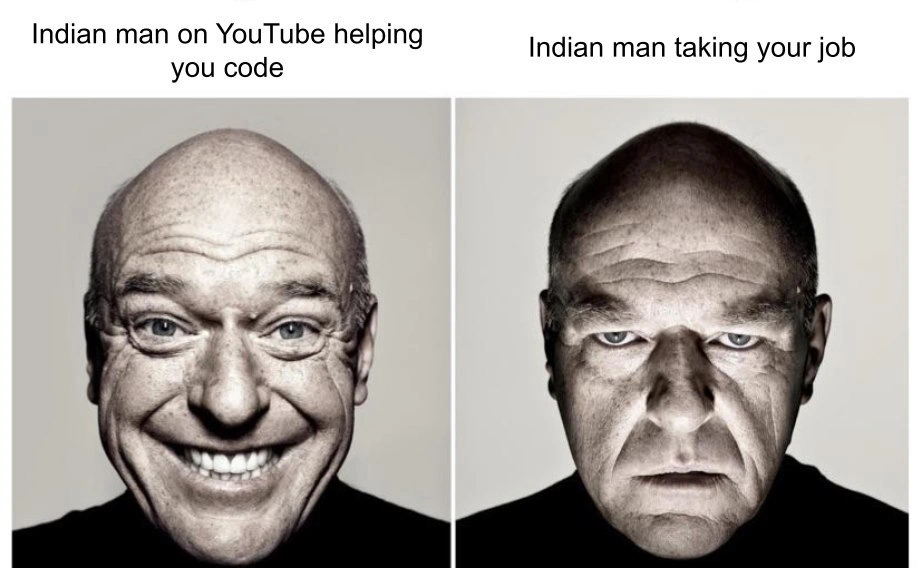
In this meme, the two panels show the same man’s face with two different captions. On the left it says “Indian man on YouTube helping you code,” and on the right it says “Indian man taking your job.” The joke is that the friendly tutor who helps you learn programming online could also turn out to be someone who might compete with you for a job. The images (a big smile on the left, an intense stare on the right) drive home how the attitude flips from gratitude to fear. It’s a playful way to point out a common situation in today’s tech world.
First, let’s break down the left side: YouTube coding tutorials are a hugely popular way for developers (especially newcomers) to learn. If you’ve ever searched “How to build a website in Python” or “JavaScript async tutorial,” you’ve probably clicked on a YouTube video made by a software engineer somewhere in the world. A large number of these tutorial creators happen to be from India, because India has a huge community of engineers and many are eager to share knowledge (plus, they speak English, reaching a global audience). So “Indian man helping you code on YouTube” is a nod to that very familiar experience – an expert from halfway around the world teaching you something on your screen for free. You feel thankful because that person is helping you solve problems and learn new skills. This is part of a global developer community: knowledge is shared openly, and it doesn’t matter where the helper lives. It’s a positive thing; many developers have a sort of virtual mentor or favorite YouTube teacher who might live in a different country.
Now, the right side introduces the fear. “Indian man taking your job” refers to the concept of outsourcing and global job competition. Outsourcing means a company hires people outside the company (often in another country) to do work, usually to save money. For example, a US company might hire developers in India or Eastern Europe to do the same work at a lower cost. This has been common in tech for decades. The phrase “offshore competition” or offshore team specifically means the team is in another country (offshore literally meaning “across the oceans”). So, why would an Indian developer potentially “take your job”? It’s not that he’s stealing it — it’s that your company might decide to employ him (or someone like him) instead of you if he can do the job just as well for less money. That possibility can make developers in high-cost countries nervous about job security. This feeling is what we call job_market_anxiety or just anxiety about your job prospects. It’s a mix of worry and insecurity that you could lose your position or find it harder to get a new one because the competition has expanded.
RemoteWorkCulture plays a big role here. Especially after the COVID-19 pandemic, working remotely (from home, not necessarily in an office) became a normal thing. Companies realized they don’t need all their employees to be in the same building — people can collaborate over the internet. Once that door is open, it also means companies can hire people from anywhere in the world, not just the local area. This is what we mean by the global_talent_market: imagine a giant worldwide pool of people who have the skills for a job. If you’re an employer, you can pick from that entire pool now. Great for the employer (they have more choices and maybe can find someone cheaper), but for an employee this means more competition. You used to be competing with, say, other developers in your city; now you might be competing with developers on the other side of the globe. The meme labels the right image as “taking your job” because it’s highlighting that fear that someone in another country (like India in this case) could fill your role if you’re not careful. It’s a bit exaggerated for humor — in reality, it’s not like the same person teaching you will immediately swoop in and replace you. But it taps into a genuine worry about outsourcing_fear: the concern that tech jobs will move overseas where labor is cheaper.
This contrast is funny to developers because it’s so ironic. We love the global help we get (free tutorials, open-source code, answers on Stack Overflow), but we also joke about being a little afraid of the global competition. It’s a form of CareerHumor or DeveloperHumor that mixes gratitude with insecurity. The meme is basically saying, “Haha, isn’t it funny (and a bit scary) that the guy who taught me to code might also want my coding job?” It’s a lighthearted way to deal with that DeveloperAnxiety. In day-to-day reality, developers handle this by continuously learning and improving — often using those same resources online — so they remain valuable. And many developers work remotely with international colleagues as teammates, not just competitors. But the meme isn’t a serious commentary, it’s more of a tongue-in-cheek joke. It exaggerates the situation to make us laugh and also think for a second. It’s TechIndustrySatire because it’s poking fun at the tech industry’s global nature and how it can create funny (and nerve-wracking) situations. In simple terms: the meme uses one person with two labels to show the double-edged feeling in tech today — “Thank you for teaching me... please don’t also take my job!”
Level 3: The Offshoring Irony
This meme hits on a painfully ironic truth in the tech world: the person saving your skin with a free coding tutorial might also be competing for your job the next day. In the left panel we have “Indian man on YouTube helping you code.” That represents the countless YouTube coding tutorials produced by skilled engineers (often from India) that help developers worldwide fix bugs or learn new frameworks at 2 AM. It’s the warm, smiling face of global knowledge sharing. DeveloperHumor frequently nods to this trope: every developer knows that when you’re stuck, there’s probably a low-view video by a kind expert with an accent patiently walking you through the solution step-by-step. Many coders jokingly say they got their degree from “YouTube University,” with those friendly tutors as the professors. We’re grateful for that global generosity.
Now the right panel flips the script: “Indian man taking your job.” The exact same smiling tutor is shown as a stern, ominous figure. This taps into a very real job_security_in_tech anxiety: the fear of offshore competition. The meme slyly suggests that the helpful guru who taught you could also be the guy who replaces you. It’s a sharp ironic_comparison poking at the global nature of the tech job market. Basically, “Thanks for the array sorting tutorial, by the way our company might hire you to do my job cheaper.” The humor here is dark and self-deprecating — a form of TechIndustrySatire where we laugh at the absurdity of benefiting from the same global talent pool that makes us feel replaceable. It’s a laugh-or-cry situation for many developers.
Why does this joke land so well with seasoned engineers? Because we’ve seen the pattern. In modern CorporateCulture, cost-cutting is king. If a company can pay someone elsewhere half the salary to do the same work remotely, often they will. The rise of RemoteWorkCulture means a developer in Bangalore or Mumbai can collaborate just as easily as one in Boston or Munich. So that friendly YouTube tutor from abroad isn’t just a theoretical helper — he’s also a very real potential job candidate in the global_talent_market. The meme exaggerates it as the same individual (with identical photos) to drive home the point: from the perspective of a nervous developer, every anonymous online helper from a lower-cost region transforms into a job_market_anxiety nightmare fuel when you remember your boss’s accounting mindset. We’re essentially looking at two sides of globalization: the knowledge sharing side (awesome for learning) and the outsourcing side (terrifying for job security).
There’s also an implicit critique here of corporate Career_HR practices. Seasoned devs have been through waves of outsourcing. The cynical veterans remember the early 2000s when entire teams were suddenly replaced by offshore contracts. This meme puts a 2020s twist on it: now you might literally learn React or Docker from an engineer in India on YouTube, then find yourself interviewing against that same engineer (or someone like him) for a remote job. It’s absurd, it’s satirical, but it’s also a little too real. The meme stings because it captures that uncomfortable loop: we import knowledge from the global community (for free!), and in return some companies export jobs to that community. No good deed goes unpunished, indeed. We’re happy to have a global mentor, but not so happy about the global rival that comes with it. The result is a wry, knowing chuckle — the kind of laugh you let out when a joke reveals an ugly truth you’ve grappled with yourself. In other words, this meme is the software developer equivalent of nervously laughing while saying, “We’re in danger, aren’t we?”
Description
The meme is a two-panel image with identical grayscale head-shots of a bald man on a pale gray background. Above the left photo, the text reads “Indian man on YouTube helping you code,” and above the right photo, it reads “Indian man taking your job.” Aside from a slight shift in lighting, the portraits are the same, humorously suggesting that the friendly tutorial creator and the person who might replace you at work are one and the same. The joke highlights developer reliance on free online lessons - often produced by engineers in India - while simultaneously fearing job displacement through global outsourcing and remote work. It satirizes career insecurity, remote-first hiring trends, and the irony of benefitting from the very talent pool that intensifies competition
Comments
6Comment deleted
I binged his YouTube series to finally grok Kubernetes; overnight he autoscaled himself into my role - turns out the real HPA is cheap bandwidth plus UTC+5:30
The same guy who taught you how to implement a distributed system in 2015 is now the principal architect reviewing your design docs and asking why you didn't consider eventual consistency
This perfectly captures the senior engineer's paradox: you've spent 15 years building expertise, yet that random YouTube tutorial with 47 views and broken English just solved your Kubernetes networking issue in 8 minutes - while simultaneously reminding you that someone equally talented will do your entire job for a third of your TC. It's the tech industry's version of 'the call is coming from inside the house,' except the house is global and the call is a Zoom interview at 2 AM your time
He optimized your fizzbuzz; now he's optimizing your headcount
Two-panel career path: watch a 10‑minute tutorial at 2x and skip the outbox; six months later the same author is hired to “take your job” by cleaning up your exactly‑once fantasy
Open education lowered your team’s ramp-up time; procurement noticed - the tutorial author now leads the vendor that underbid your burn rate with a follow-the-sun SLA; knowledge transfer, but for org charts