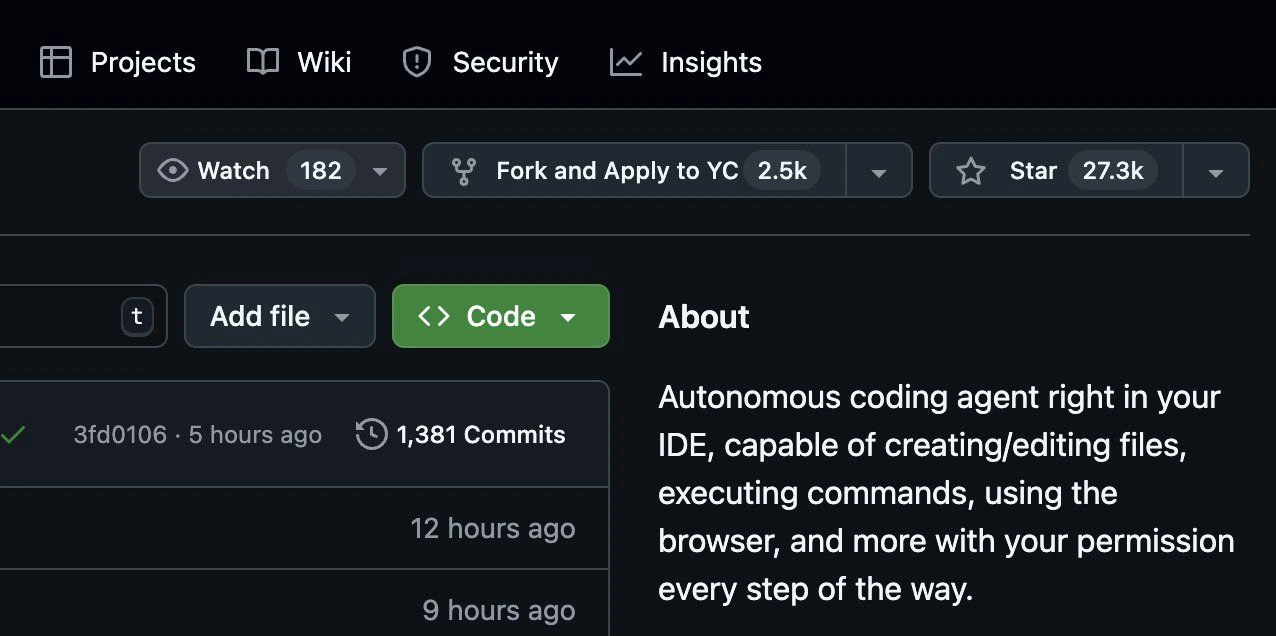
Autonomous coding agent repo earns a 'Fork and Apply to YC' button
Why is this AI ML meme funny?
Level 1: Copy to Company
Imagine a kid in your neighborhood comes up with an amazing cookie recipe and shares it freely with everyone. The cookies taste so good that hundreds of people start baking them at home. It’s so popular that the recipe website jokingly changes the “Save Recipe” button to say “Save and Open a Bakery.” Why is that funny? Because it’s exaggerating how excited everyone is. It’s like saying, “This recipe is such a hit that if you copy it, you might as well start your own cookie business!” Of course, normally a recipe site wouldn’t tell you to start a bakery just because you liked a recipe. The joke highlights how something really popular can make people suddenly dream big. In simple terms, when an idea (or a cookie recipe, or a piece of code) becomes a huge hit, folks start thinking, “Wow, I could take this and make it my thing, maybe even build a company around it!” The meme makes us laugh because it takes that thought and turns it into a silly one-step process – click a button and suddenly you have your own company. It’s a playful way to show how excitement can quickly leap from “I love this” to “I’m going to build a business from this,” all with one cheeky button.
Level 2: Fork, Stars & Startups
This image is a screenshot of a GitHub repository, which is basically an online home for an open-source coding project (open-source means the code is publicly available for anyone to view, use, or contribute to). GitHub’s interface has a few key buttons and stats at the top, and the meme plays with those:
Watch 182: This means 182 people are “watching” the project. On GitHub, clicking "Watch" lets you get notifications whenever something changes in the repo (like new updates or discussions). If you really care about a project, you watch it to stay in the loop. 182 watchers is already a lot – it means 182 developers want to know immediately when something happens in this project.
Fork and Apply to YC 2.5k: Normally, this button just says Fork, and the number (2.5k here) shows how many times people have forked the repository. Forking a repo means making your own copy of the project under your account. Think of it like clicking “Save a copy” on a Google Doc, but for code – you get your own duplicate of all the code and files. People fork projects to experiment with them, contribute changes, or use them as a starting point for their own idea. Here, someone has jokingly renamed the button to "Fork and Apply to YC." YC stands for Y Combinator, which is a famous startup accelerator program. “Apply to YC” means trying to get your project accepted as a startup that YC will fund and mentor. So the meme suggests that this project is so hot that if you fork it, your next obvious step is to turn it into a startup and pitch it to Y Combinator. Of course, on real GitHub the button wouldn’t say that; it’s edited text to be funny. But the number 2.5k is real and shows about 2,500 forks – an enormous number, indicating just how many people have copied this project (whether to tinker with it or with dreams of launching their own version).
Star 27.3k: A Star on GitHub is similar to a “like” or bookmark. When you star a project, it means you find it interesting or useful, and you want to sort of endorse it or easily find it later. Seeing 27.3k stars (that means 27,300 stars, since “k” stands for thousand) is jaw-dropping. For comparison, even many well-known open-source projects might have a few hundred or a few thousand stars. 27k means this project went viral in the developer community. It’s like tens of thousands of developers all went “Whoa, this is cool!” at roughly the same time. That number suggests this repository was trending on GitHub – possibly one of the top projects of the week or month.
These big numbers (watchers, forks, stars) tell us the project is extremely popular and gaining attention fast. Now, what is the project itself? The sidebar’s About section describes it: “Autonomous coding agent right in your IDE, capable of creating/editing files, executing commands, using the browser, and more with your permission every step of the way.” Let’s break that down in simpler terms:
IDE (Integrated Development Environment): This is the application or software that developers use to write code. For example, Visual Studio Code, IntelliJ, or PyCharm are popular IDEs. They are like smart text editors with a bunch of extra features to help you code (like highlighting code, showing errors, running the program, etc.). Saying the agent runs “in your IDE” means it works alongside you as you code, probably as an extension or plugin. It’s not a separate app; it’s integrated into the place where you already write and test code.
Autonomous coding agent: This refers to an AI-powered assistant that can do coding tasks largely on its own. “Autonomous” means it operates independently to some extent. It’s like a very advanced version of those autofill code suggestions you might have seen (for instance, GitHub Copilot suggests code as you type). But this agent goes further – it doesn’t just suggest one line of code; it can decide to create new files, modify your code, run commands, basically act like a mini developer that helps you.
Creating/editing files: It can make new files or change existing ones in your project. For example, if you ask it to “set up a basic website,” it might generate an
index.htmlfile and some CSS and JavaScript files for you, and if you ask it to add a new feature, it might go into your code files and edit them.Executing commands: This means it can run command-line instructions on your computer. Many development tasks involve commands, like running a build (
npm run buildfor a JavaScript project, orgccto compile C code, etc.), launching a development server, or installing packages. An agent that can execute commands could automate those steps. It’s powerful but also a bit risky – a wrong command can mess things up – which is why the description adds “with your permission”.Using the browser: This is pretty wild – it implies the agent can open webpages or interact with web content. Maybe the agent can search online for solutions/documentation, or log in to a web dashboard, or scrape information from the internet as part of its tasks. For instance, if it needed to find a code library or check API docs, it could automatically do a web search. This is not something typical coding tools do, so it really underlines how ambitious this AI tool is.
“With your permission every step of the way”: This means the tool isn’t going to run off and do things without asking. For every major action – like creating a file, running a command, or visiting a webpage – it will likely pop up a message saying “The AI wants to do X, do you allow it?” and you can click yes or no. This safeguard is there so you remain in control. You wouldn’t want an AI that just automatically runs code or installs software on your machine without you knowing. By asking permission, it ensures you can prevent anything you’re not comfortable with. It also helps you trust the tool more, because you see what it’s doing step by step.
So in plain language, this project is an AI helper that lives in your coding software, and it can do a lot of the coding work for you or with you – but it’s polite and asks before making any changes or doing anything potentially risky. That’s a pretty exciting idea! Imagine you’re coding and instead of just auto-completing a single line, the AI could handle an entire routine task for you (like set up a new project structure, or refactor some code) if you permit it.
Now, why is everyone joking about Y Combinator (YC) here? Well, Y Combinator is a place you go if you have a startup idea and want funding and support to turn it into a real company. It’s very prestigious in the tech world. If a project has 27k stars, it suggests there’s huge interest – possibly even commercial potential – in it. There’s a trend where if an open-source project becomes super popular, the creators or others might form a company around it. With AI developer tools being such a hot area right now (often tagged as AIHype or AIHumor in memes because there’s so much buzz and excitement, sometimes excessively so), the joke is that simply by copying this repository (forking it), you might be able to present it as your own product and get accepted into YC.
In reality, of course, starting a company is more involved than just copying someone’s code. But the meme exaggerates to make a point about the excitement: This project is so hyped that people feel like “whoever owns this or builds on it could be the next big tech startup.” It’s making light of the pattern where developers see a popular AI project and immediately think of startup possibilities. For a junior developer, it’s useful to know that stars and forks are a kind of currency in the open-source world – they indicate a project is worth paying attention to. And YC is one path people take when they think they’ve hit upon something big.
So, the screenshot basically screams: “This AI coding tool is blowing up in the community right now. Everyone’s trying it (forks), everyone’s talking about it (stars and watches), and some folks are even thinking of turning it into a business (hence the YC joke).” If you’re new to this, it’s a peek at how an idea can go from just code on GitHub to the center of a lot of excitement in both the developer and startup communities. It also shows the blend of version control humor (playing with GitHub buttons) and AI humor (joking about the AI startup craze). Even if you haven’t experienced it before, you can relate it to, say, a school project that suddenly every student wants to copy and take to the school science fair competition – except here the “competition” is Silicon Valley’s startup scene!
Level 3: Forking to Fortunes
To an experienced developer, this meme elicits a knowing grin because it captures the startup hype cycle in a nutshell. You’ve got an insanely popular open-source repo – thousands of people are watching it, tens of thousands have starred it as a favorite, and over 2.5k have forked it (made their own copy). In GitHub terms, those numbers scream “viral project.” The joke is that GitHub has replaced the normal “Fork” button label with “Fork and Apply to YC.” Why? Because in today’s tech climate, the moment something in AI blows up on GitHub, you can bet a dozen enterprising developers are thinking, “This is it! I’ll turn this into a startup and get funding.” The meme satirizes that gold rush mentality. Instead of just forking the code to contribute or play with it, people are figuratively forking it and immediately writing Y Combinator application essays about their new “AI-powered coding revolution” business. It’s poking fun at how every hot repo spawns a wave of wannabe founders.
Y Combinator (YC), for context, is the legendary startup accelerator in Silicon Valley that helped launch Airbnb, Dropbox, Stripe, and many others. Getting into YC is like receiving a golden ticket to venture capital land. So, the meme imagines GitHub streamlining the process: “Fork this repo, and go straight to YC.” It’s hilarious because it feels almost plausible in our hype-driven industry. In real life, when a project like this autonomous coding agent gets traction, you actually do see pitches flying around. VCs and angel investors start buzzing, Twitter fills up with threads about “AI agents are the new $BILLION opportunity,” and every hacker with a weekend to spare is cloning the project to add their twist. The meme exaggerates it just a bit: as if GitHub itself is acknowledging, “Yep, this repo is basically a startup now – might as well fast-track your Y Combinator application.”
The humor lands especially well with developers who’ve witnessed past tech crazes. There’s a strong sense of “here we go again”. Seasoned folks remember the blockchain frenzy a few years back: one minute a whitepaper’s on GitHub, the next minute there’s an ICO and everyone and their cat is a crypto founder. Or the web 2.0 era, when slapping “social” or “mobile” on any app idea could get you a meeting with investors. In the late ’90s dot-com bubble, it was enough to add “.com” to your company name to cause stock whiplash. Now we’re in the age of AI hype: if your project description contains “AI” or better yet “autonomous agent”, the swarm descends. This repository’s description – an AI agent that can write and edit code for you – reads like startup catnip. It checks all the boxes: cutting-edge AI, developer tool, automation of tedious work, even a safety nod (“with your permission”) which investors love to hear because it addresses risk. No wonder thousands of devs clicked “Star” in a heartbeat. It’s the perfect storm of FOMO (Fear Of Missing Out) meets open-source innovation.
From an industry perspective, the meme highlights a real tension: open source vs. startup potential. Traditionally, open-source projects are collaborative and freely available, while startups are proprietary and profit-driven. But in modern tech, the line blurs. A wildly successful open-source project can be the foundation of a startup (look at Docker, or MongoDB, or GitLab – all started as open source and built companies around the project). So when devs see a repo explode in popularity, it’s not crazy to think “maybe this could be a company.” The meme riffs on GitHub’s interface to say out loud what everyone’s thinking. It’s funny because it’s true: when an AI tool gets 27k stars practically overnight, you know venture capitalists have already bookmarked it and half the folks forking it are dreaming of being the CEO of “AwesomeAI Dev Agents Inc.” There’s an implicit commentary here on how hype can overtake pragmatism. Everyone’s forking the project not just to improve it or use it, but to stake a claim in the next big tech gold rush.
For those of us who’ve been around the block, there’s also a sardonic edge to it. We know that most of these forks won’t end up as successful businesses. Forking a repo is easy; building a company is hard. You can almost hear the cynical inner voice of a senior engineer reading that button: “Sure kid, fork the code and start a company – because that always ends well,” said with an eyeroll. It harkens back to countless “great idea, but can it be a business?” conversations. The meme condenses that whole saga into a single UI element. Instead of reading a think-piece about AI startup mania, we get a one-liner visual: If you like this code so much, why not marry it — or at least monetize it?
The specific numbers in the screenshot add to the hilarity. “Watch 182” – meaning 182 people are actively monitoring updates – is impressive, but then “Star 27.3k” and “Fork 2.5k” are astronomical for a project only hours or days old. Those are the sort of stats you see on a runaway hit repository. A senior dev knows that when a repo’s star count looks like a phone number, something big (or hyped) is going on. And combining that with the YC reference? It’s a perfect jab at how our industry can turn a few days of buzz into full-on startup fever. We joke that there’s a hidden button to monetize everything. Here the meme makes that explicit: Step 1: fork code, Step 2: ???, Step 3: profit (and the question marks aren’t even that many because everyone’s assuming the business model is obvious — “It’s AI!”).
In essence, this level of humor resonates with senior developers because it’s a mirror of tech culture absurdity. We all love a good open-source success story, but we also shake our heads at how quickly the narrative shifts from “cool hack” to “startup XYZ just raised $10 million on the promise that their fork of CoolProject will change the world.” The “Fork and Apply to YC” button is a snarky UX design for that phenomenon. It’s the kind of thing you laugh at on your second monitor while production code compiles on the first, nudging your coworker: “Take a look – someone finally made a UI for the startup bandwagon.”
Level 4: Ghost in the IDE
In the depths of this joke lies a genuinely cutting-edge concept: an autonomous coding agent embedded directly in your IDE. This is more than just a clever marketing line – it touches on advanced topics in AI and software engineering. Fundamentally, we’re talking about a program that uses a Large Language Model (LLM), a type of AI with billions of parameters trained on vast swaths of code and text, as a kind of brain to write and modify code. It’s the classic dream of program synthesis and AI-assisted development reborn with modern machine learning. In academic terms, such an agent combines natural language understanding with code generation and even elements of automated planning: the AI must interpret your high-level instructions, break them down into concrete coding tasks, and then execute those tasks step by step.
What makes this agent “autonomous” is its ability to carry out multi-step operations (like creating files, editing code, running commands, or browsing web documentation) with minimal human micromanagement. Under the hood, it likely implements an iterative reasoning loop – the LLM generates a plan or next action, executes it in the coding environment, observes the result, and then decides the following action. This kind of loop is reminiscent of AI planning algorithms and reinforcement learning, but here the policy (the decision-maker) is a giant pre-trained model doing something like “chain-of-thought” reasoning. The tricky bit is that code isn’t just free-form text – it has syntax, it runs, it can cause errors – so the agent must juggle code semantics and real-world side effects. When it “executes commands,” it’s essentially bridging from the abstract world of the LLM to the concrete world of the operating system and browser. In research, this is related to the concept of tool-using LLMs, where a language model is augmented with the ability to call external APIs or perform actions on a computer. It’s a hard problem: ensuring the AI’s text-generated plans actually work when grounded in a real environment is an ongoing challenge at the cutting edge of AI research.
Importantly, the project blurb emphasizes "with your permission every step of the way." This is a crucial nod to AI safety and alignment. Modern LLMs, as smart as they seem, have no true understanding of right or wrong – they’ll blithely suggest rm -rf / (the command to delete everything) if it fits their predicted solution, unless instructed otherwise. By requiring user confirmation for each action, the developers are effectively inserting a human-in-the-loop safeguard. It’s a pragmatic form of control to prevent the AI from going rogue or making destructive mistakes. In theoretical terms, it acknowledges the current limitations of AI autonomy: we don’t yet fully trust these models to operate unchecked in complex tasks, because they can “hallucinate” (generate misleading or incorrect actions) or misunderstand the goal. Each permission step is like a checkpoint to enforce that the AI’s actions align with the user’s intent – a simple form of what AI researchers might call an alignment strategy. This design reflects lessons from decades of AI: when an automated system can’t be formally verified or guaranteed safe, you keep a human overseer in the loop.
Interestingly, the incredible popularity hinted by the screenshot (thousands of forks and tens of thousands of stars in mere hours) underscores another phenomenon: the democratization of cutting-edge AI through open source. Not long ago, such advanced AI capabilities were confined to research labs and tech giants. But a public repo like this means anyone can inspect the code, contribute improvements, or create their own variant. It’s a case of collective experimentation at scale. In a way, the repository itself is an experiment in software collaboration with an AI at its heart. Every commit (over 1,381 so far) represents rapid iterations, possibly by multiple contributors worldwide, trying to improve how the agent writes code or secures itself. The repo’s explosive growth may even feed back into the AI field: developers will report issues, suggest enhancements, and maybe even formally research the emergent behaviors of letting an LLM loose on a coding environment.
From a computer science history perspective, this is the latest step in a long journey toward automating programming. We’ve gone from early attempts like genetic programming and expert systems that could spit out simple code, to today’s massive deep learning models that can complete functions or even generate entire programs in response to plain English. Each generation faced the challenge of complexity: writing correct software isn’t trivial. The humor of the meme belies the sophistication of what’s happening in that GitHub repo – it’s akin to having a junior developer who’s read every Stack Overflow post in existence, working 24/7 in your IDE, but still needing a senior’s approval for each git push. In theoretical parlance, it’s AI-assisted pair programming, except your partner is a probabilistic model. The fact that so many developers are forking it (making their own copy to tinker with) suggests that this approach – mixing human oversight with an autonomous AI agent – might be a compelling new paradigm. Today it’s a meme, but it hints at a future where AI agents could become commonplace tools in software development, raising fascinating questions about software engineering principles, developer workflows, and even the economics of coding when part of your workforce is synthetic.
# Hypothetical pseudocode for the agent's loop, blending AI planning with user oversight:
for goal in user_requests:
steps = llm.plan(goal) # The LLM proposes a series of actions (plan) to achieve the goal
for step in steps:
print(f"AI proposes: {step.description}")
if step.requires_permission:
user_ok = ask_user(f"Allow action: {step.description}?")
if not user_ok:
print("Action denied by user. Stopping plan.")
break
result = environment.execute(step) # Perform the action (like editing a file or running a command)
llm.observe(result) # The LLM gets feedback from the outcome to inform next steps
if goal.completed:
print("Goal accomplished!")
In the code above, which is a simplification, the AI agent generates a plan for a given task and then seeks the user’s approval at critical junctures. Each step might be something like "Create file Config.py with default settings" or "Run tests to verify the changes." By checking step.requires_permission, the agent makes sure nothing drastic happens without a green light. The loop of llm.plan -> execute -> llm.observe is essentially the feedback loop that allows the agent to handle multi-step tasks intelligently. This cocktail of techniques – natural language planning, code execution, and iterative refinement with a human watchdog – is why this project is exciting to seasoned engineers and researchers alike. It’s a convergence of ideas from AI research and practical software tooling, served up in a form that thousands are experimenting with in real time.
Description
Screenshot of a GitHub repository in dark mode. The top bar shows navigation tabs: "Projects", "Wiki", "Security", and "Insights". Immediately below are repository counters: a grey "Watch 182" dropdown, a humorous grey "Fork and Apply to YC 2.5k" dropdown, and a grey "Star 27.3k" dropdown. On the code tab, a green "Add file" button sits next to a larger green "Code" dropdown; the latest commit hash "3fd0106" is marked as 5 hours ago with "1,381 Commits" in small text, followed by relative timestamps "12 hours ago" and "9 hours ago" on subsequent rows. In the right-hand sidebar, the bold heading "About" precedes the description text: "Autonomous coding agent right in your IDE, capable of creating/editing files, executing commands, using the browser, and more with your permission every step of the way." The image pokes fun at the explosive popularity of AI-powered developer tools - so viral that GitHub’s usual "Fork" button jokingly suggests applicants head straight to Y Combinator
Comments
39Comment deleted
When the “Fork” button auto-generates a Delaware C-corp and a SAFE, the only DORA metric left to optimize is Time-to-Term-Sheet
When your AI coding assistant is so good it starts writing its own YC application while you're still debugging that race condition from 2019
An autonomous coding agent with 27k stars that can edit files, execute commands, and browse the web 'with your permission every step of the way' - because nothing says 'autonomous' quite like asking for permission before every action. It's like having a senior engineer who needs approval to rename a variable, but hey, at least it won't silently rm -rf your production database... probably
When the Fork button says “Apply to YC,” Unix permissions officially become r, w, x… and pitch - right before the agent asks for sudo in your IDE
1381 commits in 12 hours with permission prompts: finally, an intern that doesn't force-push to main
An “autonomous” coding agent that asks for permission every step is just a junior dev with sudo - the only thing it does without approval is click “Fork and Apply to YC.”
What could go wrong. Comment deleted
Can ai coding agents write new ai coding agents? Comment deleted
That’s literally the idea behind the singularity Comment deleted
If the AI agent can code a new AI, and then evaluate its offspring, and kill itself in favour of the new one because the new one is better… then you can get a feedback loop going Comment deleted
Now what happens when the AI has access to chip designs and a simulator? Can it make its own processor faster? Comment deleted
And when it’s running on the new processor, does it take less time to make the next generation of new one? Comment deleted
so long as people keep feeding it energy Comment deleted
What’s the repo url? Comment deleted
https://github.com/cline/cline Comment deleted
But where is the "Fork and Apply to YC" button? Comment deleted
it works on my machine Comment deleted
continue is better Comment deleted
The fun side of me using Continue with Mistral Comment deleted
can it finish my project works and write me a thesis? Comment deleted
Thank god it still needs data centre monkeys to go cable it up. If they make a robot that can run fibre optics we are fucking done, pack it up. Comment deleted
once there's robots that can lay fibre optic cables, I'll start calling them wife and make them wash my dishes Comment deleted
Broohooo that was good old photoshop Comment deleted
this is an english chat. I don't speak russian Comment deleted
me neither Comment deleted
oh I guess this is about "atomic heart" halfway in the paragraph? Comment deleted
…weren't the sisters actually humans converted to robots or something? Comment deleted
the twins are the protagonist's wife who was impossible to save surgically after almost dying in a mission, and she was a highly skilled FSB member so they decided to split her conciousness into two combat robots Comment deleted
https://makoto.sakamoto.pl/anime/000UNSORTED/video.mp4 Comment deleted
yeah Comment deleted
link? Comment deleted
Got this translation, but it doesnt make much sense Comment deleted
Seems like an article but the sisters in atomic heart like the lisa said Comment deleted
in the newest DLC she's back to one robot and you put a ring on her Comment deleted
major spoiler tho Comment deleted
here u go Comment deleted
I have finished it already Comment deleted
literally robot wife Comment deleted
like after the c compiler was programmed by assemble code, other c compilers were all made by c Comment deleted