Skip to content
DevMeme
211 of 7435
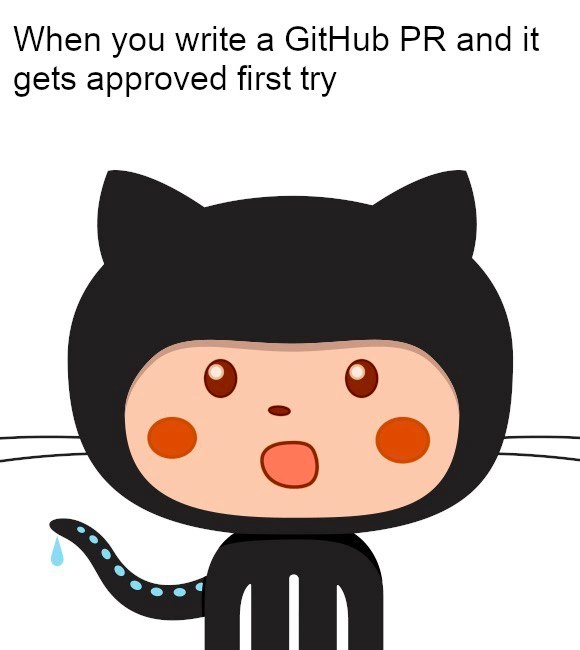
The Shock of a First-Try Pull Request Approval
CodeReviews Post #254, on Mar 22, 2019 in TG

The Shock of a First-Try Pull Request Approval

Why is this CodeReviews meme funny?

Level 1: When the Teacher Doesn't Find a Single Mistake

You hand in your homework fully expecting red pen all over it — there's always red pen. But this time the teacher just smiles and says "Perfect!" and hands it back untouched. Your first feeling isn't pride — it's panic. Did she actually read it? Did I hand in the right homework? Is this a trap? That's exactly the face the wide-eyed cat mascot is making, sweat drop and all: something you braced to be hard was suddenly easy, and easy feels more suspicious than hard ever did.

Level 2: What a PR Actually Goes Through

A quick decoder for the ritual being referenced:

  • PR (Pull Request): On GitHub, you don't push changes straight into the shared codebase. You open a PR — a proposal showing exactly what lines you changed — and teammates review it before it merges.
  • Code review: A teammate reads your diff and either approves it, or leaves change requests and comments: bugs, style issues, naming complaints, "why not do it this way?" Most PRs go through at least one round of feedback and fixes.
  • LGTM: "Looks Good To Me" — the traditional approval comment. Sometimes it means a thorough read; sometimes it means the reviewer had ninety seconds before standup.
  • First-try approval: Zero comments, zero requested changes, straight to merge. Rare enough that an entire mascot is sweating about it.

If you're early in your career: your first PRs will collect many comments — that's normal, not a verdict on you. Review feedback is how teams transfer their unwritten conventions. And when you eventually get that suspicious first-try approval, do what veterans do: re-read your own diff once more before merging. The reviewer is a safety net, not a guarantee — the approval doesn't ship the code, you do.

Level 3: Approval Is Not a Signal, It's a Sample

The caption — "When you write a GitHub PR and it gets approved first try" — pairs with an Octocat frozen mid-gasp, mouth a perfect shocked O, one sweat drop falling from a spotted tentacle. The sweat is the load-bearing detail. This isn't joy. This is the face of someone whose Bayesian prior just got violated, and who is now recalculating what the approval actually means.

Because here's the seniors-only secret the meme runs on: a first-try approval is an ambiguous signal with at least four wildly different interpretations, and only one of them is good. Either (a) your code was genuinely clean — possible, congratulations; (b) the reviewer rubber-stamped it — the drive-by LGTM between meetings, where "approved" means "I scrolled"; (c) the diff was so large the reviewer surrendered — the well-documented inverse law of code review, where a 10-line PR collects ten comments and a 1,000-line PR collects "looks good to me"; or (d) nobody on the team feels safe nitpicking you, which is its own organizational disease. The Octocat sweats because it cannot tell which universe it's in, and three of the four are bad news wearing a green checkmark.

The deeper satire targets what code review has actually become versus what it claims to be. Nominally it's a defect-catching gate; in practice it's equal parts knowledge transfer, style enforcement, and social ritual. Developers internalize the ritual so thoroughly that they pre-stage it — deliberately leaving a small imperfection for reviewers to find (the apocryphal "sacrificial duck"), padding estimates with a review-rework cycle, bracing for the second round before the first begins. When the expected friction simply… doesn't arrive, the trained response isn't relief, it's suspicion: did CI even run? Did I push the right branch? Is the reviewer on vacation and this was an auto-approve bot? The healthiest reaction — and the meme's implicit punchline — is that the author now becomes their own reviewer, re-reading the diff with fresh paranoia. Nothing motivates careful self-review like the terrifying absence of external review.

Description

A meme featuring a cartoon character resembling GitHub's Octocat mascot, with wide, surprised eyes and an open mouth. The character is wearing a black cat-like costume with an octopus tentacle for a tail, which has a drop of sweat or liquid dripping from the tip, emphasizing the shock. Above the image, the text reads, 'When you write a GitHub PR and it gets approved first try'. The humor stems from the common developer experience where pull requests (PRs) almost always require revisions based on feedback from code reviews. Getting a PR approved on the very first submission is such a rare and unexpected event that it can be genuinely shocking, leading to disbelief or even suspicion. For senior developers, this resonates as a humorous take on the rigorous, often lengthy, peer review process that is standard in mature engineering teams
Comments

8
Anonymous ★ Top Pick A PR approved on the first try is the developer equivalent of a unicorn sighting. You're happy, but you also immediately check if the reviewer accidentally hit 'Approve' instead of 'Comment'
  1. Anonymous ★ Top Pick

    A PR approved on the first try is the developer equivalent of a unicorn sighting. You're happy, but you also immediately check if the reviewer accidentally hit 'Approve' instead of 'Comment'

  2. Anonymous

    PR merged on the first review: either I finally mastered the 237-line contributor guide, or everyone’s busy chasing a distributed-trace fire and we just invented Schrödinger’s LGTM

  3. Anonymous

    Either the reviewer didn't actually read it, or you've finally internalized every passive-aggressive comment from the last 500 code reviews and preemptively addressed them all

  4. Anonymous

    First-try approval doesn't mean your code is perfect - it means nobody actually read it. Time to re-review it yourself

  5. Anonymous

    The real unicorn in software engineering isn't a billion-dollar startup - it's a PR that passes review without a single 'nit:', 'consider:', or 'why didn't you just...' comment. This developer just experienced what statisticians call a p-value of 0.001: technically possible, but you'll spend the rest of the day wondering if your reviewer actually looked at the code or if they're just having an unusually good day

  6. Anonymous

    First-try PR approval? Either it’s a pure deletion with green checks, or CODEOWNERS didn’t match and we’re about to practice postmortem-driven development

  7. Anonymous

    PR approved first try? Either I deleted a thousand lines or CODEOWNERS points at /dev/null - both oddly improve uptime

  8. Anonymous

    Rarer than a regex that works on first draft - either 10x wizardry or the reviewer skipped their morning Jira ritual

Use J and K for navigation