
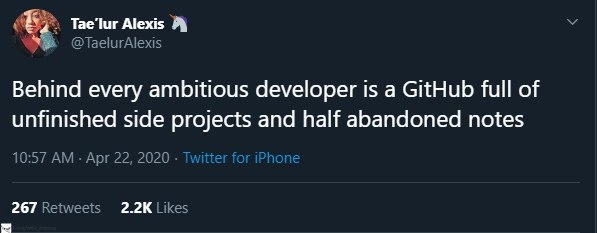
The Ambitious Developer's GitHub Graveyard
Description
A screenshot of a tweet from user Tae'lur Alexis (@TaelurAlexis). The tweet, posted on April 22, 2020, reads: 'Behind every ambitious developer is a GitHub full of unfinished side projects and half abandoned notes'. The post has garnered 267 retweets and 2.2K likes. This content resonates deeply within the developer community as it highlights a shared, often unspoken, reality. The humor and relatability come from the acknowledgment that the drive to learn and innovate often leads to starting many more projects than can ever be completed. For senior engineers, it's a knowing nod to the years of accumulated 'good ideas' that now serve as a digital graveyard of ambition, a testament to curiosity and the eternal struggle between creative impulse and finite time






Comments
7Comment deleted
My GitHub is a testament to my ambition. It's also a graveyard of ideas that looked great before I had to write the webpack config
My GitHub is basically a microservice cemetery: each repo was spun up by 2 AM inspiration, then kube-garbage-collected the moment I realised shipping it would require writing the Terraform - apparently my motivation has a tighter SLO than our P99 latency
My GitHub contribution graph is just a QR code that links to my therapist's booking page
Every senior engineer's GitHub is essentially a distributed system of abandoned microservices - each repo representing a different architectural pattern we were convinced would revolutionize our workflow, until we discovered the next shiny framework three commits later. The real technical debt isn't in production; it's in that 'awesome-project-ideas' private repo with 47 half-written README files and a single commit message: 'initial commit - this time for real'
Ambition looks like Raft on my GitHub - perpetual candidates, no leader, and a commit log that never gets applied
GitHub side projects: the only true event sourcing architecture, where every commit logs a saga of eternal 'in progress'
My side projects implement eventual consistency: ideas get committed instantly, code converges right after the next production incident