Skip to content
DevMeme
6284 of 7435
The Joy of Submitting a Terrible Pull Request
VersionControl Post #6888, on Jun 15, 2025 in TG

The Joy of Submitting a Terrible Pull Request

Why is this VersionControl meme funny?

Level 1: Everyone’s Laughing Now

Imagine you made a really messy project at home – say you baked a “cake” but it’s actually just mud and sticks. You’re happy and proud of it when you’re alone in your kitchen. It’s a bit like a secret that only you know, so it doesn’t bother you that it’s not a real cake. But then you decide to bring this muddy cake to school for show-and-tell, and you put it on the table for everyone to see. Suddenly, all your classmates gather around. Some start giggling, a few are holding their noses going “Ew, what is that?!”, and others are laughing so hard they have tears in their eyes. You stand there dressed like a chef, realizing uh-oh, this was a bad idea. You feel just like a clown who tried to show off but ended up being the joke. In this simple story, you thought your creation was okay when it was your little secret, but once everyone saw it, you got embarrassed. That’s exactly what’s happening in the meme: a programmer wrote some messy, silly code (the mud cake), and it was fine when it was only on their own computer. But when they shared it with everyone (like bringing it to class), all the other programmers saw how bad it was and started laughing and throwing jokes (represented by the poop and laughing emojis). The poor programmer went from feeling proud to feeling picked on in no time. The meme is funny because we can all picture that feeling of “oops, everyone can see my mistakes now and they think it’s funny.” In other words, something that was okay in private became a big public oopsie.

Level 2: Commit, Push, Panic

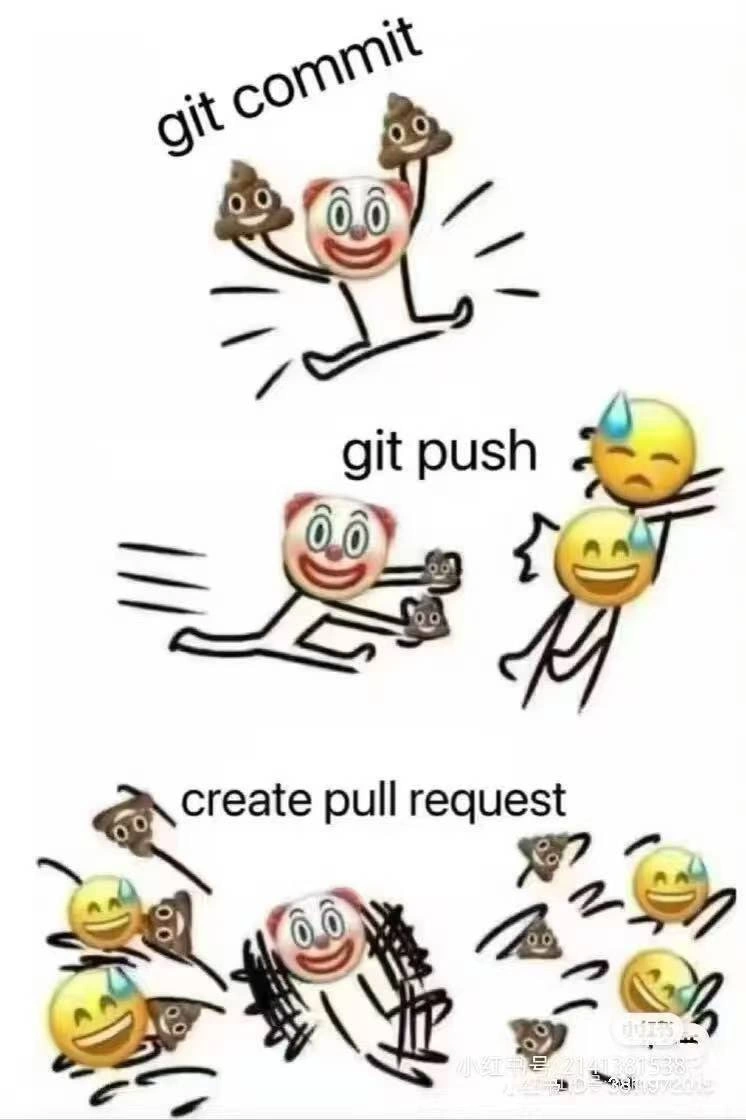
Let’s break down what’s happening for a junior developer or anyone new to Git and code reviews. This meme uses three key Git actions as captions – git commit, git push, and create pull request – to tell a story. Here’s what each of those means in real-life developer terms, and how they map to the images:

  1. git commit: This command saves your changes to the local Git repository on your computer. Think of it as taking a snapshot of your code at a point in time, along with a message describing the changes. In the first panel, the clown is happily running with two poop emojis while “git commit” is written above. This implies the developer just committed code that is low quality (hence the 💩 icons). It’s a private victory lap – the code might be messy, but it hasn’t left their machine yet. At this stage, no one else sees the changes, so the clown (developer) feels safe and even excited. In reality, developers sometimes commit code that is a bit embarrassing or hacky but tell themselves it’s okay because no one is looking yet. The clown face represents the developer kind of fooling themselves or being a bit silly—almost literally “clowning around” with the code.

  2. git push: This sends your committed changes from your local repository to a remote repository (for example, on GitHub or GitLab). The second panel, labeled “git push,” shows the clown rushing to the right, carrying the poop code and zooming past a shocked 😅 emoji. That emoji with the sweat drop represents someone (or something) on the remote side reacting. It could be a teammate who just saw the new code appear in the repository, or an automated build system noticing the changes. Essentially, by pushing, the developer has made their previously private code visible to others. The wide-eyed, sweating reaction conveys a sense of “Oh no, what is this that just got pushed?!” This is a moment many new devs find nerve-racking: you push your code and immediately worry if you did something wrong. Sometimes, if the code is really problematic, the push might even trigger failing tests or alerts, hence the look of panic on that emoji. So git push is the point where the code goes from just your computer to the shared project space, and any issues might come to light quickly. The clown in this panel is still grinning, possibly unaware of the trouble ahead – or just desperately hoping everything will be fine despite the messy code.

  3. create pull request: A pull request (PR) is a way to ask others to review your changes and eventually merge them into the main codebase. It usually involves opening a page where everyone can see the differences you introduced, comment on them, and suggest changes. In the third panel, captioned “create pull request,” the clown developer is now crouched down while multiple poop emojis and laughing-face emojis are flying at him from all directions. This is a dramatization of the code review process that happens with a PR. Once the PR is created, the team or community members will inspect the code. If the code quality is bad (like our poop 💩 code), reviewers will likely point out a lot of issues. Those flying poop emojis symbolize the negative feedback or critique coming in. The laughing 😂 emojis show that the reviewers find the code ridiculously bad – they’re literally laughing at the code (and by extension, at the poor developer who wrote it). In a real code review, feedback comes in the form of comments. For example, a reviewer might write, “This function is doing way too much – consider refactoring,” or “There’s a bug here, this won’t work for all cases.” If the code is particularly sloppy, teammates might even poke fun at it in chat with joking remarks (hence the laughter). The clown now realizes they’ve been a fool; the carefree attitude from the commit stage is gone, replaced by embarrassment or dread. Essentially, the developer’s bad code, which was once private, has been exposed to everyone, and the reaction is overwhelmingly critical (though in the meme it’s shown in a comically exaggerated way).

In simpler terms, this meme is describing the journey of a piece of bad code from a developer’s local environment to the moment it’s shared with others for review. At first, the developer is content because the code “works” for them (even if it’s a mess). After pushing, there’s a hint of worry as the code enters the shared space. And by the time it’s in a pull request, the problems are out in the open and the feedback comes crashing down. The VersionControl system (Git) allows this sequence: you can have isolated work (commits) and then integrate with the team (push and PR). But that also means you can’t hide poor quality once you try to merge your code. The phrase “local 💩 goes worldwide” in the title is playful: “local 💩” = bad stuff on your machine; “worldwide” = visible to the whole team or community after the PR.

For a newer developer, the lesson (hidden in the humor) is: code review is where your work gets scrutinized, so what felt “okay” in private might turn out not okay when others examine it. It’s very relatable because many of us have written code that we weren’t 100% proud of. Maybe you hardcoded a value, or wrote a confusing loop, or left a lot of TODOs in the code. You commit it late at night thinking, “I’ll fix it later” or “maybe nobody will notice.” But when you create a pull request the next day, your teammates notice everything. It can be a bit embarrassing, as if you were caught red-handed. This meme uses silly emojis to show that embarrassment in a lighthearted way. After all, a clown getting pelted with laughing faces and poop is a humorous exaggeration of how it feels to get heavy critique.

Also, notice the use of emojis: 🤡 (clown) often means someone acting foolish or not taking things seriously; 💩 (poop) is a common symbol for bad quality (people literally say “this code is poop” informally); 😂 (laughing/crying) means people find it really funny. The combination tells a mini story even without text: “Foolish person holding bad stuff -> shares it -> everyone laughs and throws it back at them.” In developer terms: a programmer wrote some garbage code, pushed it, and the team had a laugh while tearing it apart in the review. It might sound mean, but it’s presented in a joking way because every developer has been the clown at some point, and every team has had a laugh (hopefully kindly) over a wild pull request. This falls under DeveloperHumor and RelatableDeveloperExperience because it’s poking fun at a common experience in software development.

In summary, for a junior dev: Git is a powerful tool that tracks code changes. A commit is your personal save point. A push shares those changes with others. And a pull request is basically asking, “Hey team, can you check my work and maybe add it to the main project?” If your work is great, a pull request is routine. If your work is messy (like in this meme), a pull request can turn into a bit of an event where everyone comments. The meme just illustrates that in a comical, exaggerated fashion. The key takeaway is funny and clear: be careful, because the quick-and-dirty code you write locally could become an open spectacle once it’s up for review!

Level 3: Pull Request Pile-On

At the highest level, this meme hilariously captures a scenario every seasoned developer recognizes: pushing bad code and getting brutally called out in a code review. The three panels map to stages of the Git workflow and the ensuing developer humiliation spectacle. In the first panel labeled git commit, our intrepid developer (portrayed as a clown emoji 🤡) happily wields two piles of 💩 – a not-so-subtle representation of crappy code. The clown’s joyful sprint implies they’ve cobbled together a quick-and-dirty solution (perhaps full of code smells and questionable logic) and are gleefully saving it in their local repository. Why the optimism? At this commit stage, the code is still local, hidden in the developer’s silo. There’s a false sense of safety – as if VersionControl hasn’t yet exposed their hack to anyone else. The clown face says it all: “Hehe, it’s not great, but it works on my machine! No one will know…” We’ve all been there, making a Git commit of something we know isn’t our best work, but hoping it’ll fly under the radar.

Next comes git push, the second panel. Here the clown is racing full tilt to send his changes upstream. In Git terms, this means transferring those local 💩-laden commits to the remote repository (e.g. on GitHub or GitLab). The moment of truth begins. The clown still clutches the poop code, but now an onlooker – an emoji with wide eyes and a sweat drop 😅 – appears, recoiling as the clown dashes by. This onlooker represents the first other entity to witness the bad code. It could be a colleague seeing the new branch appear, or perhaps the continuous integration (CI) system detecting something off (imagine an automated test going “Wait, what is this?!”). That sweat-drop emoji perfectly embodies the panic of catching a whiff of trouble. At the push stage, the code is no longer private; it’s now visible on the remote and possibly triggering alerts or discussions. The developer might push hoping nothing bad happens, but as that emoji’s reaction shows, people (or systems) are already thinking, "Uh-oh, something smells funky in this commit." The humor here comes from how quickly the situation escalates: one moment the clown-dev is merrily coding alone, the next moment someone else has noticed the stench.

Finally, the third panel: “create pull request”. This is where it all blows up – the clown has opened a Pull Request (PR) to merge the changes, effectively inviting the entire team (or the open-source community) to review the code. Now the clown-developer crouches down as they’re bombarded from all sides by flying poop emojis 💩💩 and laughing-crying emojis 😂. This is a code review in full swing, and it’s not gentle. Each 💩 being flung represents a flaw or criticism being tossed back at the author: bad variable names, hacky logic, missing tests – you name it. The 😂 emojis signify the reviewers finding the code so bad it’s comical. In real life, of course, code reviewers (teammates, tech leads, or project maintainers) wouldn’t literally throw poop at you, but their code comments can feel just like that barrage. They might write long review comments on how the code is wrong or share the snippet in team chat with a joking "WTF is this?" meme. The DeveloperExperience_DX on display is the dev going from private smugness to public shaming in one PR. It’s a code review roast. The clown’s grin has basically turned into a cringe. Everyone is laughing (notice those 😭😂 faces) – not with the developer, but at the poor quality code. The phrase in the title, “your local 💩 goes worldwide,” nails it: code that was quietly sitting on your machine is now worldwide in the sense that it’s visible to all your collaborators (or the entire open-source world if it’s a public repo). And boy, are they reacting! This is a relatable humor moment because many of us have felt that dread when a hastily written change goes up for review and feedback starts pouring in.

What makes this particularly funny (and painful) for experienced devs is the accuracy of the depicted stages of Git and code review culture. It’s using a silly emoji comic to illustrate the very real CodeReviewPainPoints of modern software development:

  • Embarrassment of a sloppy commit: The clown with poop is basically saying the coder knowingly (or obliviously) committed something smelly (bad code). Perhaps they thought “it’s fine for now” or “I’ll clean it later” – a classic source of technical debt.
  • The false confidence before feedback: In their own bubble (local repo), a developer might feel like a genius for getting a quick fix to work. The clown’s carefree run pre-PR reflects that overconfidence. Nothing has broken yet, so maybe it’s okay…
  • Immediate consequences upon push: The sweating emoji character is a clever addition. It hints that sometimes even just pushing code (like deploying to a dev environment or running CI) will surface issues. It’s that moment of “Did I just crash the build server with my hack?”. Other devs or bots start noticing anomalies. The push is when your code goes from just yours to shared. The meme cleverly personifies the repository or a colleague as physically recoiling – a dramatization of getting an alert like “⚠️ Tests failed” or a teammate messaging “Did you just push? Something’s odd…”.
  • Public shaming in the PR: The last panel exaggerates the code review as an almost cartoon mob. In reality, code review comments might include a lot of nitpicks and questions. Sometimes teammates will use the 😅 or 💩 reaction on GitHub to jokingly signal “this code stinks” or they might tag a comment with 😂 if it’s a particularly silly mistake. It can feel like being pummeled. The clown curling up on the floor is every developer who’s opened a PR and then wanted to hide under their desk as notifications about review comments keep popping up. (Anyone who’s merged an unapproved **// TODO** comment or left debugging print() statements in code can relate to the horror when those lines are pointed out in review).

The comedy works on multiple levels. Visually, using emojis like 🤡 and 💩 is an emoji meme style that resonates with devs who communicate in Slack/Discord with those same symbols. Conceptually, it’s an exaggeration of an all-too-real workflow in software teams. A PullRequest is literally a request for others to pull (merge) your code, but it’s culturally also a moment for peers to scrutinize your work. This meme pokes fun at that dynamic: the reviewers’ reaction is so strong it’s like a barrage of flying objects – almost like a food fight, but with poop (ew!). It’s absurd, but also mirrors how a review can feel when lots of critiques come at once. There’s even a bit of schadenfreude: if you’re the reviewer (not the clown this time), it’s funny because you recall times you’ve left a ton of suggestions on someone’s terrible PR, essentially pelting them with “💩” feedback (hopefully constructive!).

To give a sense of how each step changes the situation, consider this tongue-in-cheek table of the evolving audience and reactions at each Git stage:

Stage Who Sees the Code Developer’s Feeling Others’ Reaction
Local Commit Only the dev (private) 😁 “It’s fine, nobody’ll know.” (no immediate reaction)
Push to Remote Teammates & CI (shared) 😅 “Hope this doesn’t break….” 😧 “Uh, what’s this?!”
Pull Request Reviewers/World (public) 🤡 “Uh-oh… here it comes.” 😂💩 “Hahaha, look at this code!”

In essence, the meme distills a relatable developer experience into one visual story: you can hide your poop_code_quality on your laptop, but the moment you try to integrate it with the team’s code via a PR, you’re inviting a reality check (and some ridicule). Notice the progression of the clown’s demeanor: from joyful (ignorance is bliss), to frantic (rushing the bad code out), to beleaguered (enduring the feedback storm). It’s a perfect illustration of the saying, “don’t ship your org’s 💩 code.” Everyone in software has witnessed or inadvertently caused these “poop-flinging” code review sessions. The meme uses humor to convey a gentle lesson: Think twice before you fling your local hacks into a public repo — you might become the clown of the day.

On a more serious note for the seasoned folks: this also touches on why good practices like incremental commits, writing tests, and self-review before pushing exist. It’s essentially showing a code review anti-pattern – dumping a whole pile of unchecked changes on your peers. The laughter in the meme is cathartic because we survive these moments and later joke about them. It’s funny because it’s true. A single bad Pull Request can indeed make your personal garbage a team-wide concern instantly. The meme exaggerates it to “worldwide” scale, hinting perhaps at open source contributions where a bad PR could get public ridicule on platforms like GitHub. (Ever seen those tweet threads where someone’s silly code comment in a popular repo goes viral? That’s literally local 💩 going worldwide!). So the next time you hit git commit on something sketchy, remember this clown and maybe clean it up before you hit git push. 😜

To sum up, the clown-and-poop emoji combo delivers a potent inside joke: bad code+Git = global comedy. It’s both a cringe and a laugh, reflecting the dual reality that messing up is human and inevitable, but in software development, our mistakes often get very publicly documented. The meme’s comedic warning resonates strongly with devs who’ve learned (the hard way) that a Pull Request can feel like a code review circus. Keep your commits clean – or prepare for the flying 💩!

# Local commit: a quick hack that "works" 😇
try:
    do_important_task()
except Exception:
    # Ugly workaround – just ignore ALL errors 😬
    pass

# Pushing this code and creating a PR means reviewers will see this 😱
# ...and that's when the comments start flying 💩💩💩

(Above: a lighthearted pseudo-code example of the kind of "💩 code" a clownish dev might commit. Reviewers would undoubtedly point out that catching a broad Exception and doing nothing is a terrible practice – a true code smell!)

Description

A three-panel, low-resolution meme comic that uses crudely drawn stick figures with emoji heads to illustrate a developer's workflow for submitting bad code. In the first panel, labeled 'git commit', a figure with a clown emoji head gleefully juggles two smiling poop emojis, representing the developer happily writing and committing low-quality code. In the second panel, 'git push', the clown figure runs and throws the poop emojis at two other figures with anxious, sweating smiley emoji heads, symbolizing the act of pushing the bad code to a shared repository for others to see. In the final panel, 'create pull request', the clown figure aggressively smears the poop emojis all over the panicked emoji figures, depicting the moment the developer assigns the messy code to their colleagues for review, making it their problem. The meme satirizes the irresponsible behavior of developers who knowingly submit messy or incomplete work, offloading the burden of quality control onto their teammates
Comments

7
Anonymous ★ Top Pick Some engineers follow the 'fire and forget' deployment model, but for pull requests. The CI pipeline isn't just running tests; it's a blast shield for the reviewers
  1. Anonymous ★ Top Pick

    Some engineers follow the 'fire and forget' deployment model, but for pull requests. The CI pipeline isn't just running tests; it's a blast shield for the reviewers

  2. Anonymous

    Bad code obeys the first law of thermodynamics: it can’t be destroyed - only pushed upstream so code reviewers become the garbage collector

  3. Anonymous

    The three stages of enlightenment: 'It works on my machine' (commit), 'Why are the CI tests failing?' (push), and 'I've addressed all 47 review comments and now nothing works' (PR). The poop emojis perfectly capture that sinking feeling when your elegant local solution meets the harsh reality of team standards, linting rules, and that one senior dev who comments on every single line

  4. Anonymous

    The meme perfectly captures the three stages of Git grief: the naive confidence of 'git commit' when your code is still safely local, the dawning realization during 'git push' that you've just made your mistakes permanent and distributed, and the existential dread of 'create pull request' when you realize senior engineers will now dissect every line while you frantically remember that one TODO comment you left in production code. It's the technical equivalent of going from 'I'm a genius' to 'Why do I even have commit access?' in three commands

  5. Anonymous

    This is why we enforce pre-commit hooks and branch protection: keep the clowning in your working tree - otherwise the PR becomes a distributed poop-to-comments pipeline run by CI bots and three Staff Engineers

  6. Anonymous

    Commits are your private spa day; pushes, the commute to judgment; PRs, the all-hands where every nitpick echoes eternally

  7. Anonymous

    A commit is reversible, a push is traceable, and a PR is where the team runs a distributed consensus protocol on your sins

Use J and K for navigation